
Pre-hiring assessments compliance with regulations: a 2026 guide for HR
The laws that govern hiring tests, how to check for adverse impact and the steps HR teams take to keep every assessment legally defensible.

Pre-hiring assessments compliance with regulations means every test you use in hiring is job-related, given to all candidates the same way, accessible to people with disabilities, checked for adverse impact, run with clear candidate notice and documented well enough to defend. The rules come from anti-discrimination law, data protection law and, more and more, laws written for AI in hiring.
Skills tests are one of the fairest ways to screen candidates when they are built and used properly. The legal risk rarely comes from testing itself. It comes from a test that measures the wrong thing, a cut score nobody can explain, a missing accommodation or an AI score that no person reviews.
TL;DR:
- Pre-employment tests are legal in the US, UK, EU and India when they measure skills the job needs and are applied the same way to every candidate.
- In the US, Title VII, the ADA and the ADEA set the core rules, and the Uniform Guidelines explain how to validate tests and spot adverse impact.
- Use the four-fifths rule as a first check: a group passing at under 80% of the top group's rate is a warning sign that needs a job-related reason.
- AI scoring adds duties: NYC requires a yearly bias audit and 10 business days' notice, and Illinois and California now apply civil rights law to AI hiring tools.
- In the EU, recruitment AI is high-risk under the AI Act, and emotion recognition at work has been banned since February 2025.
- Keep a compliance file for every assessment: job analysis, test choice, cut score logic, accommodations, pass rates by group and review dates.
- Ask vendors for bias audit results, security certifications and data retention terms before you sign.
 ChatGPT
 Gemini
 Claude
 Grok
 Perplexity
What does pre-hiring assessments compliance with regulations mean?
Pre-hiring assessments compliance with regulations is the practice of designing, running and reviewing hiring tests so they meet equal employment, disability, age, privacy and AI rules in every place you hire. A compliant test measures a real job requirement, treats every candidate the same, and leaves a paper trail that shows both.
In practice, pre-hire assessment compliance covers four questions a regulator or a rejected candidate's lawyer would ask:
- Job-relatedness: Does the test measure something the job actually needs?
- Fair treatment: Did every candidate for the role get the same test under the same conditions?
- Fair outcomes: Do pass rates differ sharply between groups, and if so, can you justify it?
- Candidate rights: Were candidates told about the test, offered accommodations and protected on data use?
These checks apply to every format, from a coding task to a one-way video interview to the pre-hiring assessments that cut time to hire at the top of the funnel.

Are pre-employment assessments legal?
Pre-employment assessments are legal in most countries, including the US, UK, the EU and India, as long as they are job-related and do not discriminate. US law explicitly allows professionally developed ability tests, provided they are not designed, intended or used to discriminate on race, color, religion, sex or national origin.
What makes a test unlawful is how it is used. Hiring teams get into trouble in three common ways:
- Disparate treatment: Testing some candidates for a role and not others, or giving some groups more time or easier versions.
- Disparate impact: Using a test that screens out a protected group at a higher rate without a solid job-related reason.
- Wrong timing or content: Asking disability or medical questions before a conditional offer, or including items about religion, family plans or health.
Key takeaway: The question is never "is this test legal?" but "can we show this test measures the job, and that we used it the same way for everyone?"
Which laws regulate pre-hire assessments?
The laws that regulate pre-hire assessments fall into three groups: anti-discrimination laws, data protection laws and AI-specific hiring laws. The table below shows what each one expects from your assessment process. The EEOC's guidance on employment tests is the best single starting point for US federal rules.
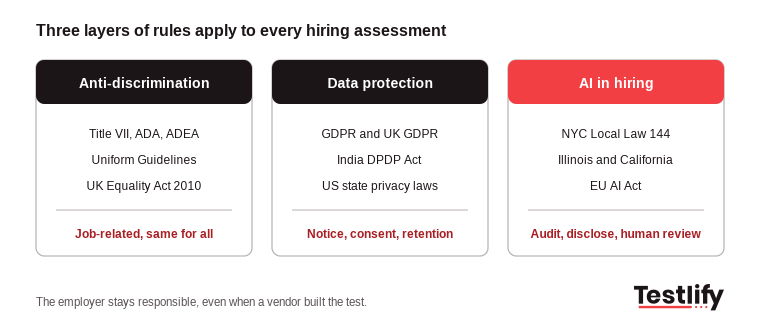
State and local rules keep changing, so check the places you hire at least twice a year. Colorado, for example, replaced its original AI Act in May 2026 with a narrower law that law firm summaries report starting on January 1, 2027.
How do you check assessments for adverse impact?
Adverse impact is checked by comparing pass rates between groups at each stage where a test filters candidates. The usual first test is the four-fifths rule in the Uniform Guidelines, 29 CFR 1607.4: if one group's selection rate is under 80% of the highest group's rate, regulators generally treat that as evidence of adverse impact.
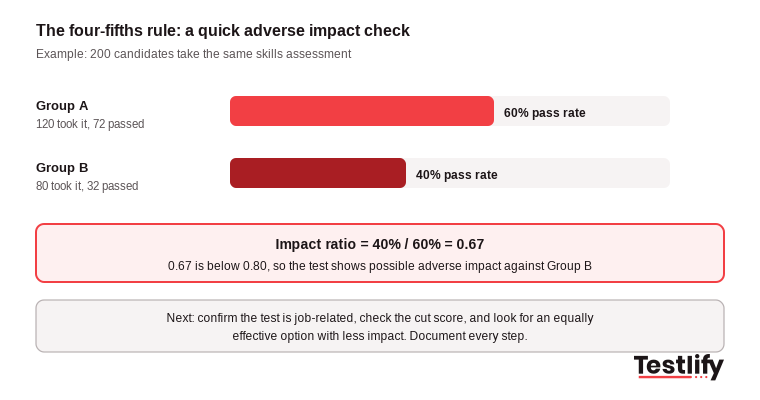
Here is how to run the check on one assessment stage:
- Count candidates by group: Use the voluntary self-identification data you already collect, kept separate from hiring decisions.
- Work out each group's pass rate: If 72 of 120 candidates in Group A pass, the rate is 60%. If 32 of 80 in Group B pass, the rate is 40%.
- Divide the lower rate by the highest: 40% divided by 60% gives 0.67, which is below 0.80.
- Investigate before you act: Check whether the test is tied to the job analysis, whether the cut score is higher than the job needs, and whether a different test of the same skill would have less impact.
- Record what you found and decided: Keep the numbers, the reasons and any change you made.
The four-fifths rule is a rule of thumb, not a safe harbor. Small samples can swing either way, and a large, statistically significant gap can still count even above 80%. The EEOC's own cases show the stakes: Ford agreed to pay $8.55 million and replace a cognitive test used for apprenticeships, and a strength test at Dial cut women's share of entry-level hires from 46% to 15%.
Pro tip: Set cut scores from what the job needs, not from how many candidates you want to keep. An arbitrary high cutoff is one of the fastest ways to create adverse impact you cannot defend.
How do AI hiring laws change assessment compliance?
AI hiring laws add transparency, audit and human review duties on top of the existing anti-discrimination rules. The employer stays responsible for the outcome even when a vendor built the tool, so "the software decided" is not a defense.
The rules that matter most for hiring assessment legal compliance in 2026:
- New York City: Under Local Law 144, an automated employment decision tool needs an independent bias audit within one year before use, a published summary of results and notice to candidates 10 business days before use. Penalties run from $500 to $1,500 per violation.
- Illinois: From January 1, 2026, using AI that has a discriminatory effect in hiring is a civil rights violation, and employers must tell candidates when AI is used. The older AI Video Interview Act already requires notice, an explanation and consent before AI analyzes a video interview.
- California: Rules under the Fair Employment and Housing Act, in force since October 1, 2025, make clear that automated decision systems are covered by civil rights law and that anti-bias testing helps an employer's defense.
- European Union: AI used to screen, rank or evaluate candidates is high-risk under the AI Act. The 2026 Digital Omnibus deal moved those high-risk duties from August 2026 to December 2027, but the ban on emotion recognition in the workplace has applied since February 2, 2025.
- United Kingdom: The ICO's audit of AI recruitment tools produced close to 300 recommendations, including collecting less data and setting clear retention periods.
Age is a live risk with automated filters. In 2023, iTutorGroup paid $365,000 to settle an EEOC lawsuit after its software automatically rejected older applicants.
How can HR maintain pre-hiring assessments compliance with regulations?
HR can maintain pre-hiring assessment compliance with regulations by following the same eight steps for every role, from job analysis to yearly review. The process below works for skills tests, cognitive tests, personality questionnaires and AI interviews.
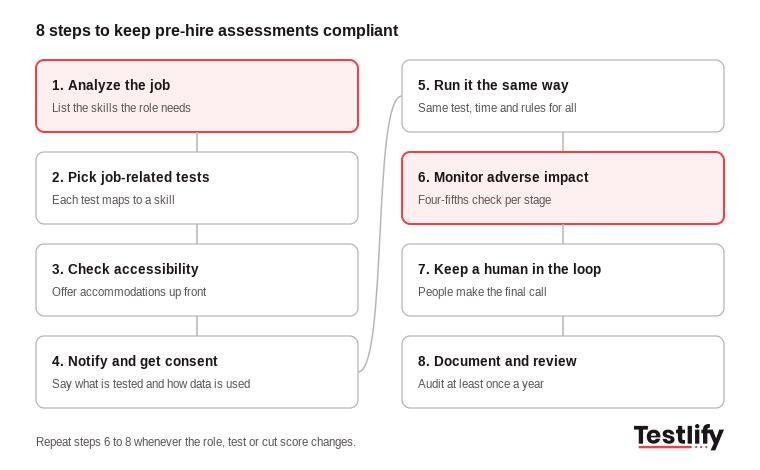
Using pre-employment assessments responsibly requires more than choosing tests that measure candidate skills. You also need to ensure the process is job-related, accessible, consistent and fair to every applicant. A well-documented assessment process can help reduce hiring bias, support compliance and make selection decisions easier to justify. Here are eight steps to follow:
- Analyze the job: List the tasks and skills the role needs before choosing any test. A documented job analysis is the foundation of every job-relatedness argument.
- Pick job-related tests: Map each test to a skill in the job analysis. Drop tests that feel useful but measure nothing on the list.
- Check accessibility up front: Tell candidates how to ask for accommodations, such as extra time, screen reader support or an alternative format, before the test starts. Decide in advance who approves requests and how fast, so no candidate waits past the deadline.
- Notify candidates and get consent: Explain what is tested, how long it takes, whether AI scores any part and how data is stored and deleted.
- Run it the same way for everyone: Same test, same time limit, same proctoring settings and same cut score for every candidate in the role.
- Monitor adverse impact: Run the four-fifths check for each stage at least once a quarter in volume hiring, and after any change to the test or cut score.
- Keep a human in the loop: Let people make final decisions and review automated rejections, especially near the cut score.
- Document and review: Audit each assessment at least once a year and whenever the role changes.
Training matters as much as the tools. Hiring managers who add their own questions or skip the test for a referred candidate undo the consistency the process depends on. Short refreshers on common types of hiring bias help keep everyone on the same page.
What should a compliance file for each assessment include?
A compliance file for each assessment should hold the evidence that the test is job-related, fairly run and monitored. If a candidate complains or a regulator asks, this file is your answer.
Record | What to keep | Why it matters |
|---|---|---|
Job analysis | Tasks, skills and how they were identified | Proves the test targets real job needs |
Test selection | Which tests, which skills each covers, vendor documentation | Links every test to the job analysis |
Cut score logic | How the passing score was set and by whom | Defends against "arbitrary cutoff" claims |
Candidate notices | Invite text, AI disclosure, privacy notice, consent | Shows transparency duties were met |
Accommodations log | Requests received and what was provided | Shows ADA and Equality Act compliance |
Adverse impact checks | Pass rates by group, dates, actions taken | Required analysis under the Uniform Guidelines |
Bias audit | Independent audit summary for any AI scoring tool | Required in NYC; strong evidence elsewhere |
Review history | Dates of reviews and changes made | Shows active monitoring, not a one-time setup |
Keep records for at least as long as the strictest law you hire under requires. In the US, private employers must keep hiring records for one year under EEOC rules, California asks for four years for automated-decision data, and GDPR expects you to delete candidate data once you no longer need it.
Which types of pre-employment tests carry the most legal risk?
The tests with the most legal risk are those that can look like medical exams, those that touch protected traits and those with known group score gaps. Work sample and skills tests usually carry the least risk because the link to the job is easy to show.
Test type | Risk level | What to watch |
|---|---|---|
Job-specific skills and work samples | Lower | Keep tasks close to real work; avoid irrelevant extras |
Cognitive ability | Medium to high | Known group score gaps; validate for the role and set cut scores carefully |
Personality | Medium | Use work-related traits only; never clinical tools that can count as medical exams |
Integrity | Medium | Avoid questions on religion, politics, credit or arrest history |
Physical ability | High | Must match actual job demands; a common source of sex-based adverse impact |
AI video or voice scoring | High | Notice, bias audits and human review; no emotion recognition in the EU |
Proctoring needs care too. Webcam, screen and audio monitoring should be disclosed up front, limited to what you need and covered by your retention policy.
What should you ask an assessment vendor about compliance?
Ask an assessment vendor for proof, not promises. The UK ICO's work on AI tools in recruitment found tools collecting more data than needed and keeping it indefinitely, so the questions below are worth asking every vendor:
- Bias audits: Has an independent auditor tested your AI scoring for bias, and can we see the summary?
- Test development: Who builds and reviews the tests, and how are questions tied to job skills?
- Accommodations: Can we give extra time or alternative formats to individual candidates?
- Security: Do you hold ISO 27001 and SOC 2 Type II, and will you sign a data processing agreement?
- Data residency and retention: Where is candidate data stored, and can we set deletion periods?
- Transparency: Can candidates and recruiters see how scores are produced?
- Human oversight: Can we review and override automated recommendations before any rejection?
How does Testlify support compliant pre-hire assessments?
Testlify supports compliant pre-hire assessments with job-related tests, consistent scoring and documented security controls. The aim is to give hiring teams the evidence they need, while people stay in charge of decisions.
- Job-related tests: 3,500+ tests across technical and non-technical roles, plus custom tests built by subject matter experts and reviewed before release.
- Independent bias audit: A third-party NYC Local Law 144 bias audit of the Matching Model, completed June 16, 2023.
- Security and privacy: ISO 27001, SOC 2 Type II, GDPR and CCPA compliance, a data processing agreement and regional data residency. Details are on the security and compliance page.
- Consistent conditions: 20+ proctoring checks applied the same way to every candidate, with timestamped activity logs.
- Access for global candidates: Tests in 15+ languages, with role-based access control for your team.
- Records you can export: Score reports, benchmarks and logs that export to CSV or PDF for your compliance file.
Ready to run compliant assessments?
Testlify gives hiring teams job-related tests, an independent bias audit and the security certifications legal and procurement teams ask for. Browse the Testlify test library to find tests mapped to your roles, or book a demo to see how scoring, proctoring and reporting fit your compliance process.
Frequently asked questions (FAQs)

Human Resources Lead
Snehi Parmar leads People at Testlify, owning hiring, culture, performance, and retention for a 90-person team. She writes on practical HR strategy and building people processes that scale.
Related resources
View all
HR & recruitment
Risks of skipping pre-hiring background checks and how to avoid them
HR & recruitment
Red flags in pre-hiring checks: what HR should look for
HR & recruitment
Are personality tests reliable for candidate evaluation?

HR & recruitment
Important components of a candidate assessment report
HR & recruitment
How to create an effective onboarding process for new hires
HR & recruitment
Talent acquisition best practices: 12 ways to hire better in 2027
Get started.
Hire on proof, not resumes.
Run your first skills-based assessment free — no credit card required.