
DISC Personality Test Results: How to Read Them in 2026
A practical guide to reading DISC test results: scores, graphs, blends and unusual patterns, and how hiring teams can use them fairly.
DISC personality test results show how strongly a person leans toward four behavioral styles: Dominance (D), Influence (I), Steadiness (S) and Conscientiousness (C). Most reports give each style a score, mark the one or two that stand out, and plot them on a graph or circle. Read well, DISC personality test results tell you how someone prefers to work and communicate. They do not tell you whether that person can do the job.
TL;DR:
- Find the highest score, judge its intensity, name the blend, compare natural and adapted graphs, and check for unusual patterns.
- Dominance, Influence, Steadiness and Conscientiousness. No style is better than another.
- Read the top two styles together, not just the primary letter.
- Use results to plan interviews and onboarding, not to accept or reject candidates.
- Ask every candidate the same core questions, then add one or two probes based on their profile.
- AI tools can answer personality tests, so use harder-to-game formats, proctoring and follow-up interviews.
 ChatGPT
 Gemini
 Claude
 Grok
 Perplexity
What do DISC personality test results show?
DISC personality test results show a person's preferred behavior at work, not their ability, intelligence or values. A typical report includes a score for each of the four styles, a primary style (the highest score), a blend of the top two styles, and often two graphs: one for natural behavior and one for adapted behavior.
DISC is based on the model William Marston described in the 1920s. Modern tests ask people to rate or rank statements about themselves, then turn the answers into style scores. Because every answer is self-reported, the results describe how a person sees their own behavior. That makes DISC useful for starting conversations, and weak as evidence on its own.
DISC results usually answer four questions:
- Pace: Does this person prefer to move fast and speak up, or to work at a steady, considered pace?
- Focus: Is their attention drawn more to tasks and results, or to people and relationships?
- Pressure: How do they tend to react under stress or when the job asks them to adapt?
- Communication: What kind of message lands best with them, short and direct or detailed and warm?

What do the four DISC styles mean?
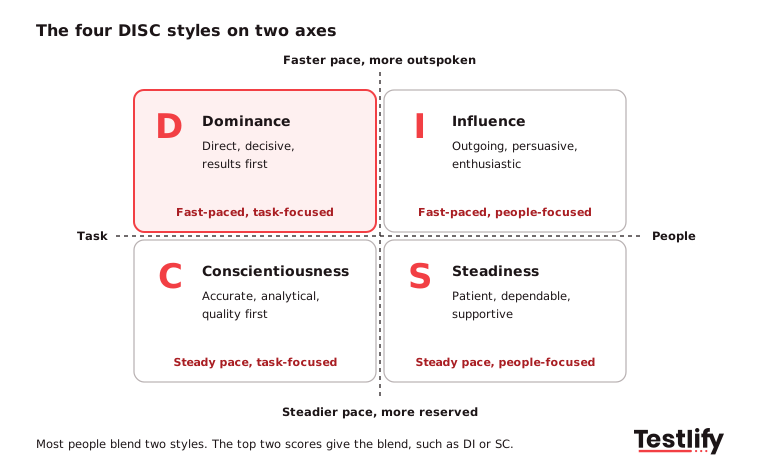
The four DISC styles sit on two simple axes: pace (fast and outspoken vs steady and reserved) and focus (task vs people). D and I are faster-paced. S and C are steadier. D and C lean toward tasks, while I and S lean toward people.
Style | Typical strengths at work | Watch-outs | How to communicate |
|---|---|---|---|
D: Dominance | Decisive, direct, drives results, comfortable with risk | Can seem blunt, may skip input from others | Be brief, lead with the outcome |
I: Influence | Persuasive, energetic, builds rapport fast | May overpromise or lose track of detail | Be warm, leave room for discussion |
S: Steadiness | Patient, reliable, good listener, team-first | Can resist sudden change, avoids conflict | Give context and time to adjust |
C: Conscientiousness | Accurate, analytical, high standards | Can be slow to decide, critical of rushed work | Bring data, be precise |
No style is better than another. A high D is not a born leader and a high S is not a weak one. Each style describes a preference, and good performers exist in every style.
How do you read DISC personality test results step by step?
Reading DISC personality test results works best in a fixed order: the highest score first, then intensity, then the blend, then the gap between natural and adapted graphs, and finally any unusual pattern. Following the same order for every report keeps reviewers consistent and stops one striking number from driving the whole reading.
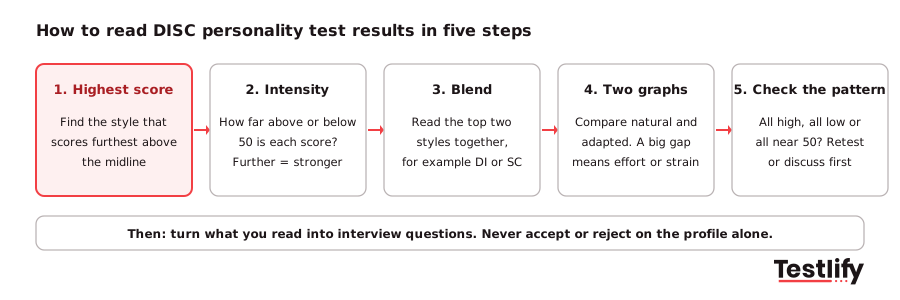
- Find the highest score: Most reports score each style from 0 to 100, with 50 as the midline. The style that sits furthest above the midline is the primary style. It shows the behavior the person falls back on most often.
- Judge the intensity: A score of 90 says much more than a score of 58. The further a score sits from 50, the more visible that behavior is likely to be. A low score matters too: a very low D usually means the person avoids confrontation and prefers to build agreement.
- Name the blend: Read the top two styles together. Someone with D at 82 and C at 71 (a DC blend) behaves very differently from someone with D at 82 and I at 71 (a DI blend). The blend is more useful than the single letter.
- Compare natural and adapted graphs: The natural graph shows how a person prefers to behave. The adapted graph shows how they adjust to their current role or setting. A small gap means the role fits their natural style. A large gap means they are spending energy to fit in, which can signal stress over time.
- Check for unusual patterns: If all four scores sit close to 50, or all sit high or low, treat the report with care. Ask the person about it or retest before reading anything into it.
Pro tip: Write down your reading of each report in two or three sentences before you meet the candidate. Then test each sentence in the interview. That turns DISC from a label into a list of things to verify.
How do you read DISC charts and graphs?
DISC charts come in two common formats: bar or line graphs that show a score for each style, and a circle that places the person as a dot among the four styles. Both show the same thing, so read whichever your provider uses, and always check the key before comparing two people's reports.
Bar and line graphs: Each of the four styles gets a bar or a point, with a horizontal line at the midline. Points above the line are styles the person uses often; points below are styles they use less. Many reports show two graphs side by side.
- Natural graph (sometimes called basic or core): How the person prefers to behave when they are not adjusting for anyone. TTI Success Insights describes it as how a person "prefers to do what they do."
- Adapted graph (sometimes called work or mask): How the person believes they need to behave in their current setting. Comparing the two, says TTI, "reveals stress, role misalignment, and development opportunities."
The circle or 12-style map: Some reports, such as those based on the Everything DiSC model, place a dot inside a circle split into four quadrants, often divided further into 12 slices (D, Di, iD, i, iS, Si, S, SC, CS, C, CD, Dc). The closer the dot sits to the edge, the stronger the preference. A dot near the center means the person uses all four styles fairly evenly.
Report element | What it tells you | How to use it |
|---|---|---|
Score for each style (0 to 100) | How strongly each style shows up | Start with the highest, note any very low score |
Midline (50) | The line between used often and used less | Read intensity as distance from 50 |
Natural graph | Preferred behavior | Use as the baseline for the person |
Adapted graph | Behavior adjusted for the current role | Compare with natural to spot strain |
Circle dot and distance from center | Primary style and its strength | Name the blend from the slice it sits in |
What are the most common DISC blends?
DISC blends combine a person's two highest styles, and most people have one. A pure single-style profile is less common than a blend, which is why reading the top two styles together gives a far better picture than the primary letter alone.
Blend | How it often shows up at work | Roles where it can be a natural fit (not a requirement) |
|---|---|---|
DI | Fast, persuasive, likes to lead and win people over | New business sales, team lead roles |
DC | Results-driven and exacting, challenges weak ideas | Operations, engineering leads, audit |
ID | Energetic, influential, quick to act | Account management, partnerships |
IS | Warm, encouraging, good at keeping people engaged | Customer success, recruiting, training |
SI | Patient, supportive, builds trust over time | Support, HR, care roles |
SC | Steady, careful, follows process well | Back office, quality, compliance |
CS | Precise, calm, prefers clear standards | Finance, data, QA |
CD | Analytical and firm, sets high bars | Analysis, risk, technical specialists |
Treat the right-hand column as a talking point, not a rule. Strong salespeople with an SC blend exist, and so do great analysts with an I blend. Skills and experience decide who can do the job.
What do unusual DISC patterns mean?
Unusual DISC patterns are profiles where the scores do not form a clear shape, and they usually point to how the person answered rather than who they are. Three are worth knowing before you read anything else into a report.
- Over-shift (all four styles high): The person may have tried to look strong on everything, perhaps because they were applying for a job. Read it as "this person wants to be seen as capable at everything" and ask about it.
- Under-shift (all four styles low): The person may have been unsure how to answer, answered for several situations at once, or been stressed when taking the test.
- Tight profile (all scores near 50): The person may adapt easily across styles, or may have answered in a neutral way. A conversation tells you which.
In each case, the safe move is the same: do not draw conclusions. Discuss the result with the person, or ask them to retake the test in a calmer setting.
How should hiring teams use DISC personality test results?
Hiring teams should use DISC personality test results to plan interviews, onboarding and team conversations, not to accept or reject candidates. The publisher of Everything DiSC states on its comparison page that the assessment "is designed for learning and development, not employment decisions" and "shouldn't be used for selection decisions."
There is also a legal reason for care. The EEOC guidance on employment tests says any test or selection procedure "must be job-related," and that tests which disproportionately exclude a protected group are only allowed when they are job-related and consistent with business necessity. A style preference is hard to defend as a job requirement.
DISC results can help you | DISC results cannot tell you |
|---|---|
Plan structured interview questions for each candidate | Whether the person has the skills for the role |
Spot how someone prefers to communicate and decide | How well they will perform |
Shape onboarding and the first 90 days | Their intelligence, values or integrity |
Start honest conversations about team dynamics | Whether they will "fit the culture" |
Help managers adapt their style to new hires | Which candidate to hire when used alone |
Personality and soft skills testing is now mainstream. Fortune reported in July 2025 that about 76% of employers use some kind of skills test, 69% use soft skills tests and 35% use self-report exams. That makes it more important, not less, to use each result for what it can actually show.
For a deeper look at the debate, read should the DISC personality test be used in hiring?.
Key takeaway: DISC personality test results are best used to decide what to ask a candidate, not whether to hire them. Pair them with skills tests and structured interviews, and keep a person accountable for every decision.
What interview questions should follow DISC results?
Interview questions after DISC results should test the behavior the report suggests, using real past examples. Ask every candidate for the same role the same core questions, then add one or two probes based on their profile. That keeps the interview fair while still using what the report tells you.
If the report shows | What to check | Example question |
|---|---|---|
High D | How they decide and take input | "Tell me about a decision you made quickly. Who did you consult, and what would you change?" |
High I | Follow-through on detail | "Describe a commitment you made to a client. How did you track it to completion?" |
High S | Response to change | "Tell me about a time a process you relied on changed suddenly. What did you do in the first week?" |
High C | Speed vs accuracy | "Describe a time you had to deliver before you had all the data. How did you decide it was good enough?" |
Large natural vs adapted gap | Strain in the current role | "Which parts of your current job take the most energy, and which come easily?" |
Score the answers against the skills the role needs, not against the DISC style. A high S who handled sudden change well has shown the skill, whatever the profile predicted. For a full method, see how to run a structured interview.
How do you keep DISC results honest when AI can answer the test?
Keeping DISC results honest now takes test design and proctoring, because AI chatbots can produce convincing answers to personality questionnaires. Test publisher Hogrefe warns that AI tools can generate "highly plausible" answers tailored to a job, and that traditional faking checks may not catch them.
Hogrefe's practical advice for employers is to focus on prevention rather than detection:
- Use formats that are harder to game: Forced-choice items, where candidates pick between equally positive statements, are harder to fake than simple agree or disagree scales.
- Control the test session: Proctoring, copy and paste blocking, and tab switching checks make it harder to paste questions into a chatbot.
- Do not treat a flag as proof: If a result looks implausible, follow up with a structured interview or a retest rather than rejecting the candidate.
- Tell candidates the truth: Explain how the results will be used. Honest framing reduces faking and improves the candidate experience.
How does the Testlify DISC test report results?
The Testlify DISC personality test reports a candidate's results across four dimensions that map to the classic DISC styles, with 12 sub-skills underneath, so reviewers see more than a single letter. The test takes about 25 minutes and is based on William Marston's model.
The four dimensions on the Testlify DISC personality assessment are labeled as follows:
- Decisiveness (D): assertiveness, determination, results orientation.
- Impact (I): social, outgoing, persuasiveness.
- Support (S): cooperativeness, patience, team orientation.
- Certainty (C): analytical, detail-oriented, systematic.
DISC works best next to tests that measure ability. In Testlify you can combine it with role-specific skills tests from a library of 3,500+ tests, add structured AI interview questions, and protect results with 20+ proctoring checks, including copy and paste blocking and tab proctoring. Scores, AI candidate insights and reports sit in one place, so reviewers can read the DISC profile next to the skills evidence. See anti-cheating and proctoring for the full list of checks.
Frequently asked questions
Ready to read DISC results next to real skills evidence?
DISC tells you how a candidate likes to work. Skills tests tell you whether they can do the job. Browse the Testlify test library to pair the DISC test with role-specific skills tests, then start a 7-day free trial, no credit card required.

Content Writer
Yashika Khandelwal is a Content Writer with 3+ years of experience creating research-backed content on hiring, talent assessment, and HR technology. She is a registered Organizational Psychologist and subject matter expert who combines behavioral science with practical recruitment insights to produce accurate, evidence-based content.
LinkedInRelated resources
View all
HR & recruitment
How can the DISC personality test help you identify training and development needs?

HR & recruitment
Why DISC personality test is more important than ever
HR & recruitment
How to hire a machinery mechanic?

HR & recruitment
Does the DISC personality test belong in the workplace?
HR & recruitment
Pros and cons of the DISC personality test in hiring process

HR & recruitment
Should the DISC personality test be used in hiring?
Get started.
Hire on proof, not resumes.
Run your first skills-based assessment free — no credit card required.