
How to use AI and ATS for efficient lateral hiring in 2026
Explore how AI and ATS transform lateral hiring, enhancing speed, precision, and fairness in recruiting top talent. Discover best practices, challenges, and future trends.

Lateral hiring in 2026 is no longer driven by speed alone and is now defined by confident hiring decisions. Organizations must be sure that experienced hires can perform from day one and continue to add value as roles evolve.
Yet many teams still depend on manual screening, disconnected systems, and resume-led evaluations that increase the risk of costly mis-hires. As skill shortages and role complexity grow, this approach no longer scales.
Leading organizations are responding by combining modern Applicant Tracking Systems with Artificial Intelligence. This article shows how organizations can make effective use of ATS platforms, AI-powered assessments, and interviews to identify, evaluate, and hire strong lateral talent with confidence.
According to a recent study by SHRM, organizations leveraging AI and ATS in lateral hiring experience a 40% reduction in time-to-hire, highlighting the significant impact of these technologies in streamlining the recruitment process for top-tier talent.
 ChatGPT
 Gemini
 Claude
 Grok
Grok Perplexity
How ATS platforms improve lateral hiring
An Applicant Tracking System is no longer just a system of record. In high-performing hiring organizations, it operates as a system of intelligence that enables consistent, scalable, and low-risk lateral hiring. A modern ATS strengthens lateral hiring by enabling the following capabilities:
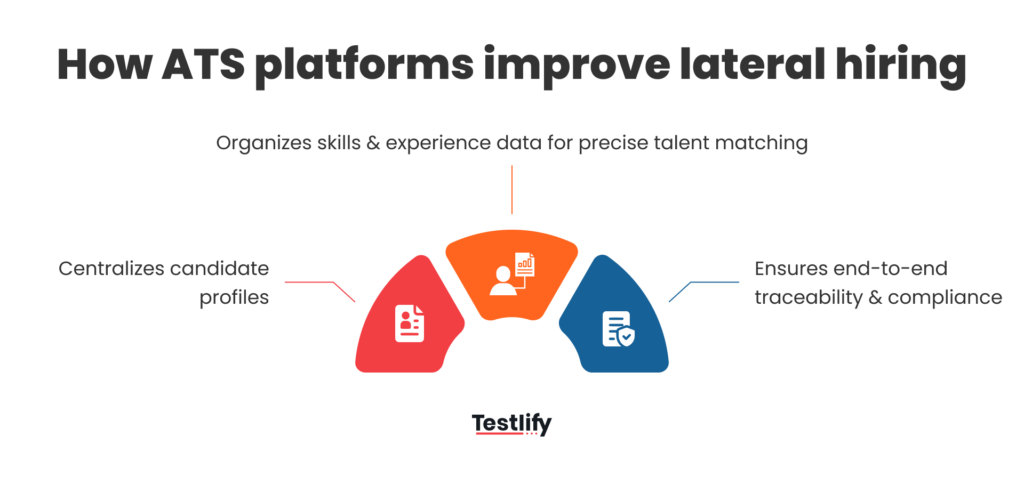
Centralizes candidate profiles
A well-configured ATS creates a unified and continuously updated source of truth for every experienced candidate the organization has engaged with over time, including:
- Former applicants and silver medalists who narrowly missed prior roles
- Employee referrals and internal mobility candidates with contextual endorsements
- Alumni, contractors, and previous consultants familiar with the organization
- Passive candidates who were engaged earlier but are not actively seeking a role
Each centralized profile consolidates critical hiring intelligence such as:
- Complete application history across multiple roles and hiring cycles
- Interview feedback captured from recruiters and hiring managers
- Assessment results and skill validation outcomes
- Hiring decisions, rejection reasons, and progression notes
- Communication history that preserves candidate context and intent
This allows hiring teams to:
- Avoid duplicating sourcing efforts for recurring or similar lateral roles
- Rapidly re-engage candidates who already understand the business and culture
- Shorten hiring cycles by starting with informed, pre-qualified talent
- Reduce hiring risk by leveraging historical assessment data
- Deliver personalized candidate experiences
For lateral hiring, where experience and prior context significantly influence success, centralized candidate intelligence becomes a strategic advantage rather than an administrative convenience.
Organizes skills and experience data for precise talent matching
Advanced ATS platforms enable recruiters to move beyond unstructured resumes by capturing standardized, searchable data across key dimensions, including:
- Verified technical, functional, and behavioral skills
- Certifications, licenses, and formal qualifications
- Industry and domain-specific experience
- Role level, leadership exposure, and scope of responsibility
- Geographic preferences, availability, and compensation expectations
This structured data framework enables recruiters to:
- Perform highly targeted searches across large talent pools
- Identify candidates who meet exact role requirements rather than approximate matches
- Reduce screening time by eliminating resume interpretation bias
- Create shortlists that align directly with hiring manager expectations
- Support consistent hiring criteria across teams and locations
For experienced hires whose career paths are often complex and non-linear, structured skill data ensures that true capability is surfaced rather than lost in resume formatting or keyword gaps.
Ensures end-to-end traceability and compliance
A modern ATS ensures full visibility and accountability across the lateral hiring process by providing:
- Standardized interview frameworks and evaluation criteria
- Consistent documentation of interview feedback and assessment outcomes
- Clear tracking of candidate movement across hiring stages
- Recorded decision rationale for selection and rejection
- Audit-ready hiring records that support regulatory and internal reviews
This level of traceability enables organizations to:
- Make fair, defensible, and evidence-based hiring decisions
- Reduce exposure to compliance and discrimination risk
- Identify bottlenecks and inefficiencies in the hiring workflow
- Analyze long-term hiring outcomes to improve future hiring decisions
According to the Society for Human Resource Management, organizations that use structured and traceable hiring workflows see greater consistency in hiring decisions and stronger compliance outcomes across roles and regions.
For HR leaders, traceability is not just about compliance. It is about building hiring systems that can scale without compromising fairness, quality, or trust.

How AI improves lateral hiring efforts
Artificial Intelligence is redefining lateral hiring by changing what organizations measure and how they measure it. Instead of relying on resumes, past titles, or interview performance alone, AI enables hiring decisions to be grounded in verified skills, real-world problem-solving, and job-relevant behavior.
AI-powered skills assessments to validate candidate skills
AI assessments are designed to simulate real job scenarios and evaluate how candidates apply their experience in practice. This approach enables organizations to:
- Measure role-specific skills using standardized and objective criteria
- Validate experience claims made by candidates on their resumes
- Evaluate candidates consistently regardless of background or career path
- Reduce the hiring bias of interviewers
- Identify candidates who can perform from day one in experienced roles
For lateral hires, where organizations expect immediate contribution, AI-powered assessments provide clarity that resumes and interviews alone cannot. They reveal how candidates think, prioritize, and execute in conditions that closely resemble the actual role.
In 2026, HR teams are increasingly using these assessments not as filters, but as decision enablers that bring rigor and credibility into lateral hiring conversations.
Conversational AI interviews for evaluating job readiness
According to insights referenced by Forbes, organizations adopting AI-driven interview tools reported stronger alignment between interview performance and early job success, especially in mid and senior-level roles.
Conversational AI interviews move beyond fixed questions and leverage AI interviewers to adapt the conversation to understand how candidates think, make decisions, and apply their experience to the role. Conversational AI interviews allow organizations to:
- Ask consistent yet dynamic questions aligned to role requirements
- Capture structured insights from open-ended candidate responses
- Reduce interviewer variability and unconscious bias
- Provide a fair and engaging experience for experienced candidates
For lateral hiring, conversational AI interviews are compelling because they go beyond surface-level responses. They reveal how candidates approach complex problems, deal with ambiguity, and apply leadership judgment in day-to-day work situations.
How to combine ATS platforms and AI for effective lateral hiring
According to a recent study by SHRM, organizations leveraging AI and ATS in lateral hiring experience a 40% reduction in time-to-hire, highlighting the significant impact of these technologies in streamlining the recruitment process for top-tier talent.
The real value of combining ATS platforms and AI does not come from automation alone. It comes from clarity. Clarity about what the organization needs, how experienced talent should be evaluated, and how decisions are made consistently over time.
When ATS platforms and AI are treated as a single hiring system rather than separate tools, lateral hiring becomes more disciplined and far less reactive.
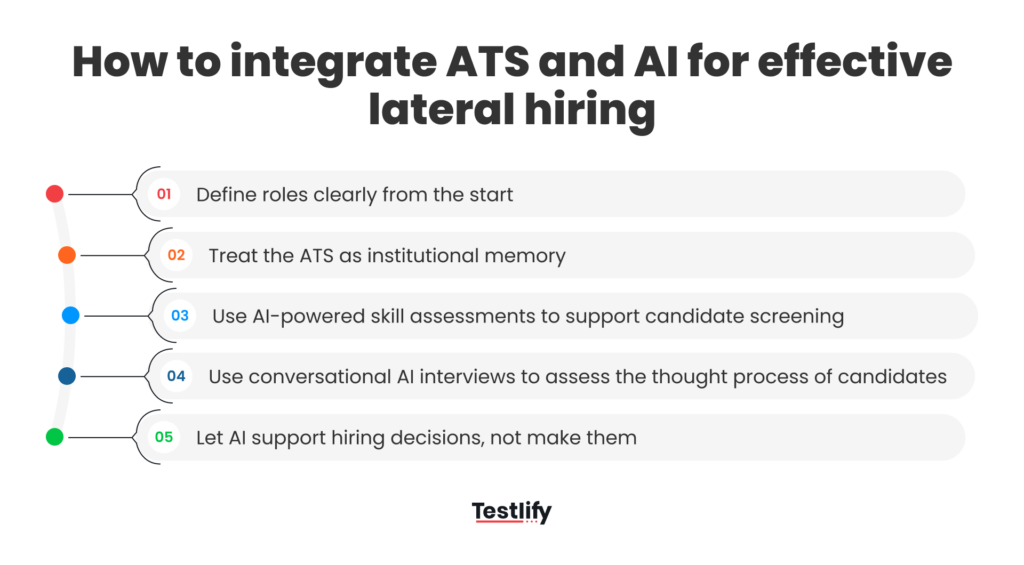
Define roles clearly from the start
Lateral hiring breaks down when roles are defined too loosely or too late. Before AI enters the picture, organizations need to be clear about what success looks like in the role.
This means using the ATS to document:
- The skills that matter most for performance
- The level of decision-making and ownership expected from candidates
- The experience required to be effective from day one
When this groundwork is done well, AI becomes a way to test assumptions rather than reinforce them.
Treat the ATS as institutional memory
Most organizations underestimate the value of the candidates they have already evaluated. An ATS should function as the organization’s hiring memory, not just its workflow tool. Strong lateral hiring teams use the ATS to:
- Retain context from past interviews and assessments
- Keep track of silver medalist candidates
- Preserve insights that would otherwise be lost between hiring cycles
This allows recruiters to return to known talent with confidence instead of starting from zero every time a role opens.
Use AI-powered skill assessments to support candidate screening
For experienced hires, resumes rarely tell the full story. AI-powered skills assessments introduce a level of evidence that early-stage screening often lacks. Used well, these assessments help organizations:
- Validate whether experience translates into on-the-job performance
- See how candidates approach real work problems
- Benchmark candidates on defined industry standards
The goal is not to replace judgment, but to anchor it in something more reliable than first impressions.
Use conversational AI interviews to assess the thought process of candidates
Once baseline capability is established, conversational AI interviews help explore how experience shows up in practice. These interviews are most effective when they are used to:
- Understand how candidates think through complex situations
- Explore judgment in ambiguous or high-pressure scenarios
- Bring consistency to early interviews without flattening nuance
Because AI interviewers assess candidates in the same way each time, they create a fairer and more comparable starting point for deeper human conversations later in the process.
Let AI support hiring decisions, not make them
The strongest hiring teams use AI to sharpen decisions, not outsource them. Assessment results and interview insights should inform conversations, not replace them. When integrated into the ATS, AI insights help teams:
- Focus discussion on strengths and risks that actually matter
- Understand which skills predict success
- Refine assessment criteria
- Align hiring managers around evidence rather than opinion
- Make faster hiring decisions without lowering the bar
Lateral hiring improves when organizations pay attention to what happens after the hire. ATS platforms make it possible to connect hiring decisions with real outcomes.
The bigger shift
The real shift is not technical. It is philosophical. Organizations that combine ATS platforms and AI effectively stop treating lateral hiring as a series of one-off decisions. For HR leaders, this approach creates something far more valuable than efficiency. It creates trust in the hiring system itself.
If you are ready to build that kind of trust into your lateral hiring process, it starts with adopting the right assessment tool into your hiring workflows.
Testlify enables skills-based hiring by integrating AI-powered assessments and conversational AI interviews directly into your ATS workflows, ensuring hiring decisions are grounded in evidence rather than instinct.
Book a demo to see how Testlify can help you evaluate experienced talent more accurately, reduce hiring risk, and turn lateral hiring into a repeatable strength rather than a recurring challenge.
Frequently asked questions (FAQs)

Content Writer
Yashika Khandelwal is a Content Writer with 3+ years of experience creating research-backed content on hiring, talent assessment, and HR technology. She is a registered Organizational Psychologist and subject matter expert who combines behavioral science with practical recruitment insights to produce accurate, evidence-based content.
LinkedInRelated resources
View all
HR & recruitment
How lateral hiring can enhance your teams’ inclusivity

HR & recruitment
Talent planning essentials for modern businesses

HR & recruitment
Navigating talent planning in the digital era

HR & recruitment
Balancing theory and practice: Effective essay strategies for aspiring HR professionals

HR & recruitment
Key functions of HR you learn in college

HR & recruitment
The ROI of Cognitive Ability Tests: What the Data Shows
Get started.
Hire on proof, not resumes.
Run your first skills-based assessment free — no credit card required.