
How to hire a packer: steps, skills, tests and interview questions
A practical guide to hiring packers: define the shift, test accuracy and safety, run a short work sample and keep new hires past 90 days.

To hire a packer, define the shift and physical demands first, then screen every applicant on the same short test of accuracy, reliability and safety before you interview. A packer prepares products for shipment or storage: picking the right items, checking them for damage, packing them securely, labeling and weighing each order. Packing errors turn straight into returns and reships, so the real question is simple: can this person pack the right items, safely, at your pace, for a whole shift?
TL;DR / Key takeaways
- To hire a packer, write down the shift, pace and lifting needs, test accuracy and safety first, then interview only the people who pass.
- The median packer earned $36,280 a year in May 2025, about $17.44 an hour, according to BLS and O*NET data.
- Accuracy matters more than speed: a short timed work sample of picking, checking and packing five orders shows both.
- Test four things: attention to detail, basic counting and weights, safety awareness and work reliability.
- Packer jobs are projected to shrink 5% from 2025 to 2035, yet O*NET still lists about 61,800 openings a year, so expect steady competition for reliable people.
- Keep new packers past 90 days with an honest job preview, a set first-week plan, a buddy and predictable shifts.
 ChatGPT
 Gemini
 Claude
 Grok
 Perplexity
What does a packer do?
A packer prepares goods for shipment or storage. The role covers checking items against an order, inspecting them for damage, choosing the right box and filling, sealing and labeling the package, weighing it and recording the order. In many warehouses the same person also picks items from shelves, which is why job ads often say "picker packer".
O*NET's profile for packers and packagers, hand lists the abilities the job leans on most: near vision, problem sensitivity, trunk strength and manual dexterity. More than half of packers say they use their hands, make repetitive motions and stand "continually or almost continually" through the shift.
Typical packer tasks include:
- Checking products and quantities against the packing slip or scanner
- Inspecting items and rejecting damaged or wrong stock
- Assembling, lining and padding cartons and crates
- Sealing, labeling and weighing packages for shipping
- Recording order and packaging details in the warehouse system
- Keeping the packing station clean, stocked and safe
Packer roles vary by setting. An e-commerce fulfilment center values order accuracy and speed, a food or pharmaceutical plant values hygiene and batch records, and a 3PL values flexibility across clients. Decide which version you are hiring before you write the ad.

How to hire a packer in seven steps
Hiring a packer takes seven steps: define the role and shift, write a clear job ad, source where hourly workers look, screen everyone with a short skills test, run a work sample, hold a structured interview and onboard with a set first-week plan. Each step filters on evidence, so a good candidate is not lost to a skimmed resume.
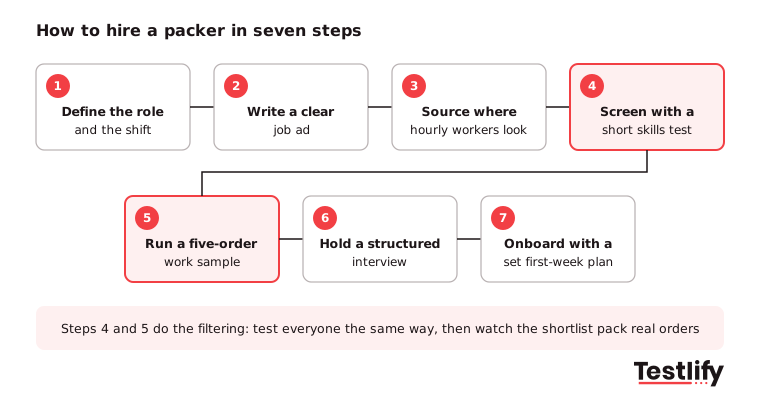
- Define the role and shift: Write down the products, daily order volume, shift pattern, weight limits and any equipment such as scanners, tape guns or pallet jacks. Decide whether the role is full-time, part-time, seasonal or temp-to-hire.
- Write a clear job ad: Put pay, shift times, location and the real physical demands in the first lines. Hourly applicants decide fast, and vague ads draw people who drop out later.
- Source where hourly workers look: Combine job boards, employee referrals, local community groups and staffing partners. For peak season, start sourcing six to eight weeks before you need people on the floor.
- Screen with a short skills test: Replace the resume pass with a 15 to 20 minute test of attention to detail, basic counting and safety knowledge that works on any device.
- Run a work sample: Ask shortlisted candidates to pick, check and pack a few sample orders. Score accuracy first and time second.
- Hold a structured interview: Ask every candidate the same questions about reliability, safety and accuracy, and score answers against a simple rubric.
- Onboard with a set plan: Pair new packers with a trained buddy, explain the quality checks and review progress at day 7, day 30 and day 90.
For roles you fill in bulk, these high-volume hiring strategies show how to run the same steps for dozens of hires at once.
What skills should you look for in a packer?
The skills that matter most in a packer are attention to detail, reliability, safe lifting and handling, basic counting and weights, and the stamina to keep quality up across a full shift. Experience with scanners or a warehouse management system helps, but most of it can be taught on the job in days.
Skill | Why it matters | How to check it |
|---|---|---|
Attention to detail | Wrong or missing items cause returns and reships | Spot-the-difference and order-matching questions |
Reliability | No-shows leave a line short-staffed | Reliability test plus past attendance questions |
Safety awareness | Lifting and handling injuries are the most common in warehouses | Safety knowledge questions and work-sample observation |
Basic numeracy | Counts, weights and box sizes must be right | Short counting, unit and weight questions |
Spatial sense | Choosing the right box cuts damage and shipping cost | Box-fit questions in the work sample |
Following instructions | Each client or product has its own packing rules | A packing slip with two special instructions |
Stamina and pace | Quality has to hold for eight or more hours | Timed work sample and shift-history questions |
Scanner or WMS use | Speeds up checking and recording | Ask about systems used; train the rest |
Soft skills matter too. Packers work in teams around a shared line, so look for people who flag a problem early instead of packing a damaged item to keep up.
How do you test a packer's skills before hiring?
The best way to test a packer's skills is a short online assessment followed by a hands-on work sample. The assessment filters a large applicant pool on the same questions in minutes; the work sample then shows how the shortlisted few actually pack. Together they show far more about day-one performance than a resume can.
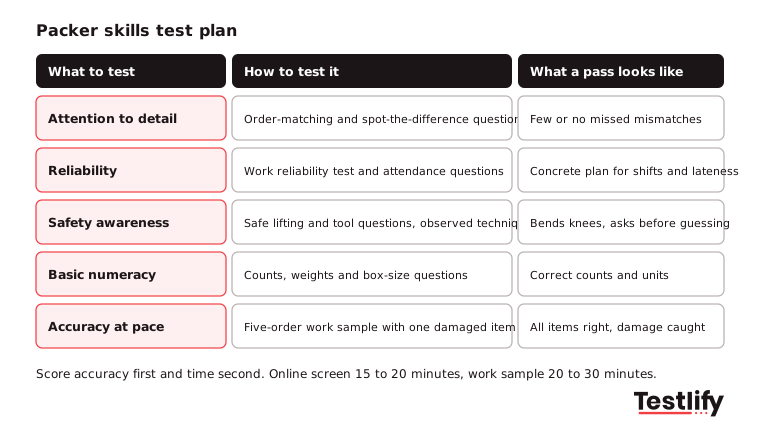
A practical test plan for a packer role:
- Online screen (15 to 20 minutes): A role test such as the packer test, plus short tests for visual attention to detail and safety awareness.
- Reliability check: A work reliability test gives a consistent read on dependability across every applicant.
- Numbers and space: Add a few numerical reasoning or spatial reasoning questions if your packers choose box sizes or calculate weights.
- Work sample (20 to 30 minutes, on site): Give five sample orders with a packing slip, one damaged item and one special instruction. Score correct items, damage caught, instruction followed, secure packing and time.
If your role is closer to hand packaging on a production line, the manual packer test covers that version of the job.
Pro tip: Weight accuracy over speed when you score the work sample. A candidate who is fast but ships one wrong item in five will cost you more than one who is careful and gets quicker in the first two weeks.
Where can you find packer candidates?
Packer candidates are easiest to find through hourly job boards, employee referrals, local community channels and staffing partners. Most applicants search on a phone close to home, so local reach and a quick application matter more than a big brand.
- Hourly job boards: Post with pay and shift in the title, and keep the application short.
- Employee referrals: Current packers know who is reliable. Pay the referral bonus after the new hire passes 30 or 90 days.
- Local channels: Community groups, workforce centers, colleges and local job fairs reach people who live near the site.
- Staffing partners: Useful for peak season and temp-to-hire, as long as their candidates take the same skills test as your direct applicants.
- Past seasonal workers: Keep a list of people who did well last peak and invite them back first.
More channel ideas are in this guide to finding blue-collar workers, and the seasonal hiring guide covers peak-season planning.
How much does it cost to hire a packer in 2026?
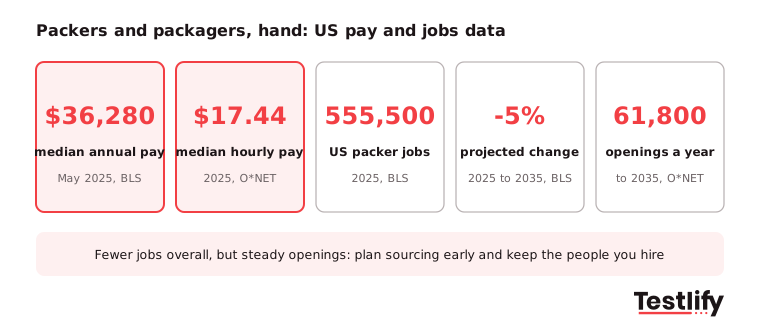
The median pay for packers and packagers, hand, was $36,280 a year in May 2025, according to the US Bureau of Labor Statistics Occupational Outlook Handbook. O*NET puts the median at about $17.44 an hour for the same year. Pay varies with region, shift premiums, industry and whether the role includes picking or equipment.
The labor market detail matters for planning:
- Jobs: There were about 555,500 hand packer and packager jobs in the US in 2025.
- Outlook: BLS projects a 5% decline from 2025 to 2035, a loss of about 27,500 jobs.
- Openings: O*NET still projects about 61,800 openings a year, because many people move on from the role.
Beyond wages, budget for job ads, referral bonuses, the time supervisors spend interviewing and training, and the cost of a bad hire: wrong orders, damage and a vacancy that opens again within weeks. A short pre-hire test and a work sample are cheap next to one early leaver.
What should a packer job description include?
A packer job description should state the shift, pay, location, physical demands and the three or four tasks that fill most of the day. Keep it short and specific so people can tell in seconds whether the job fits them.
Job title: Packer (Day shift, full-time)
About the role: You will pick, check, pack and label customer orders in our [location] warehouse so every order leaves complete, undamaged and on time.
Responsibilities:
- Check items and quantities against each packing slip or scan
- Inspect products and set aside damaged or wrong stock
- Choose the right box and filling, then seal, label and weigh each package
- Record orders in the warehouse system and keep your station stocked and clean
- Follow all safety and quality rules
Requirements:
- Able to stand for the full shift and lift up to [weight] lb, with or without reasonable accommodation
- Good attention to detail and basic counting
- Reliable attendance on [shift pattern]
- Warehouse or packing experience is a plus, not required
What we offer: [Hourly pay], [shift premium], [benefits], paid training and a clear path to lead or equipment roles.
For a ready-made version, adapt the warehouse associate job description template.
What interview questions should you ask a packer?
Interview questions for a packer should test accuracy, reliability, safety and how the candidate handles pace. Ask every candidate the same questions in a structured interview and score each answer from 1 to 5, so the decision rests on the same evidence for everyone.
Accuracy and quality:
- You notice an item on the slip does not match what is on the shelf. What do you do?
- How do you make sure an order is complete before you seal the box?
- Tell me about a time you caught a mistake before it reached a customer.
Reliability:
- What shift pattern works for you, and what could stop you from making a shift?
- In your last job, what did you do when you were running late or could not come in?
Safety:
- How do you lift a heavy or awkward box safely?
- What would you do if you saw a coworker using a box cutter unsafely?
Pace and teamwork:
- The line is behind and your supervisor asks you to speed up. How do you keep quality up?
- How do you handle doing the same task for a whole shift?
- Tell me about a time you helped a teammate catch up.
Strong answers name a concrete action: stop, check, ask and report. Weak answers skip checks to keep up or blame others.
Key takeaway: When you hire a packer, the same test, the same work sample and the same scored questions for every candidate give you a fair, fast decision you can explain.
How do you keep safety and compliance in the hiring process?
Safety in packer hiring starts with an honest description of the job's physical demands and a check that candidates know basic safe handling. The OSHA warehousing overview names musculoskeletal disorders from overexertion in lifting and lowering as the most common warehouse injuries, and being struck by forklifts and other material-handling equipment as another.
- State real physical requirements: List the actual weights, standing time and repetitive work, tied to the job as it is done.
- Offer accommodations: Say in the ad how candidates can ask for an accommodation in the test or the work sample.
- Test safety knowledge: Include safe lifting and knife-handling questions in the screen, and watch technique in the work sample.
- Keep the same steps for everyone: Every applicant takes the same test and the same interview questions, which keeps decisions consistent and easy to explain.
- Train before the floor: No new packer should start without a safety briefing on lifting, cutting tools and moving equipment.
How do you onboard and keep new packers?
New packers stay longer when the first week is planned, the job matches what the ad promised and shifts are predictable. A common reason new hourly workers quit in the first weeks is a gap between the job they expected and the job they got.
- Show the job before the offer: A floor tour or short video of a real shift prevents week-one surprises.
- Use a buddy system: Pair each new packer with an experienced one for the first shifts.
- Set clear quality targets: Explain the accuracy and speed you expect at day 7, day 30 and day 90.
- Keep shifts predictable: Publish schedules early and offer a premium for the least popular shifts.
- Show a path up: Lead packer, quality checker and equipment roles give good packers a reason to stay.
The guide on onboarding and training blue-collar workers has a full first-90-days plan.
How to hire a packer at volume with Testlify
Testlify helps hiring teams screen packer applicants on the same skills test in minutes, so supervisors only interview and run work samples for people who already showed the basics. The platform suits warehouse, e-commerce and logistics teams that hire in batches or for peak season.
- Ready-made tests: The Testlify test library has 3,500+ tests, including role tests for packers and warehouse pickers and blue-collar tests for attention to detail, safety and reliability.
- Build from a job description: The AI test builder turns your packer job description into a custom assessment in under a minute.
- Shortlist automatically: Score thresholds move candidates who pass straight to the next stage.
- Reach applicants where they are: WhatsApp invites and notifications, and tests in 15+ languages for multilingual teams.
- Keep results honest: 20+ proctoring checks, such as tab tracking and webcam snapshots, help confirm the candidate did the work.
- Fit your stack: Connects to 100+ ATS and HRIS tools through Testlify integrations.
Hiring for the rest of the floor too? See how to hire a warehouse picker and how to hire a warehouse worker.
Ready to hire your next packer?
Start with one skills test for every applicant and a five-order work sample for the shortlist. Try the packer test or browse the test library, and start a 7-day free trial with no credit card needed.
Frequently asked questions
Related resources
View all
Hiring Guide
How to Hire Manicurists and Pedicurists: A 2026 Guide

Hiring Guide
How to hire a maintenance worker?

Hiring Guide
How to Hire Maids and Housekeeping Cleaners in 2026

Hiring Guide
How to hire a machinist: skills, tests, questions and pay

Hiring Guide
How to hire food processing workers?

Hiring Guide
How to build efficient schools without traditional interviews?
Get started.
Hire on proof, not resumes.
Run your first skills-based assessment free — no credit card required.