
40 change management interview questions to ask in 2026
Interview questions for change management roles, grouped by skill and level, with sample answers, a scorecard, a work sample and red flags.
The best change management interview questions ask a candidate to walk through a real change they led: how they judged readiness, which model they used, how they handled resistance and what result they measured. This list gives you 40 questions grouped by those skills, from specialist to head of change, plus six sample answers, a scorecard and a short work sample, so every interviewer judges candidates on the same evidence.
TL;DR:
- Strong change management interview questions ask for one real change from start to finish: the readiness check, the model, the resistance and the measured adoption.
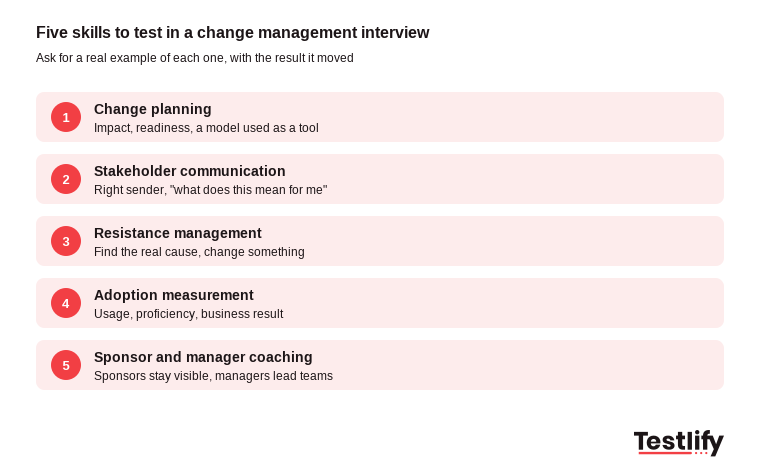
- Test five skills: planning with a change model, stakeholder communication, handling resistance, measuring adoption and working with sponsors and managers.
- Good answers name a model (ADKAR, Kotter or their own steps), a specific group that resisted and a number that moved. Weak answers stop at "we communicated a lot".
- Change fatigue is the problem senior hires must solve: in Gartner's 2025 HR priorities survey, 73% of HR leaders said employees are fatigued from change and 74% said managers are not equipped to drive it.
- Ask every candidate how they would roll out an AI tool. It is now the change most teams are managing.
- Use a 45-minute work sample (a one-page change plan for a real scenario) and a weighted scorecard, and run a skills test before the first interview to shorten the list.
 ChatGPT
 Gemini
 Claude
 Grok
 Perplexity
What does a change management professional do?
A change management professional plans and leads the people side of a change, such as a new HRIS, a restructure or an AI rollout, so employees adopt it and the business gets the result it paid for. The work covers readiness checks, stakeholder maps, communication and training plans, resistance management and adoption tracking.
The title varies by level. According to Prosci, the firm behind the ADKAR model, change roles usually split into specialist, manager and deployment lead levels. A change management specialist or analyst builds the plans and materials. A change manager owns the change on one or more projects and coaches sponsors and people managers. A head of change or change management strategist sets the approach across many projects and builds change capability in the organization. For a short definition of the discipline, see the Testlify HR glossary entry on change management.
Many change roles sit inside the broader management analyst occupation. The US Bureau of Labor Statistics counts 1,077,100 management analyst jobs in 2025, a median pay of $101,860 and 10% projected growth from 2025 to 2035, with about 94,100 openings a year. Demand is steady, so strong candidates often have more than one offer.

What are the best change management interview questions?
The best change management interview questions ask for a real example with a method and a result. If you only have time for ten, use this shortlist. It condenses the themes in the numbered list of 40 that follows:
- Walk me through the last change you led from the first readiness check to the final adoption numbers.
- How do you decide whether an organization is ready for a change?
- Which change model do you use most, and where do you adapt it?
- Tell me about a group that resisted a change. What did you do?
- How do you get a senior sponsor to stay visible after the launch?
- How do you measure whether people actually adopted the change?
- Describe a change that did not go to plan. What did you change?
- How do you prepare people managers to lead their teams through a change?
- How would you roll out an AI tool to a team that fears it will replace them?
- What do you do when a team is already dealing with three other changes?
The numbered sections below go deeper on each skill, with 40 questions in total. Pick two or three questions per skill so the interview stays under an hour.
What general and experience questions should you ask a change manager?
General and experience questions open the interview and show the scale and type of change a candidate has handled: technology rollouts, restructures, mergers, process changes or culture work.
- What kinds of change have you led, and in which industries?
- What is the largest change you owned, in number of people affected and length of the program?
- Were you inside the project team, in HR, or working as a consultant, and how did that change your role?
- Which part of change work do you enjoy most, and which part do you find hardest?
- What certifications or training have shaped how you work, such as Prosci or another change method?
- What would you want to learn in your first 30 days with us before you plan anything?
What questions test change models and planning?
Planning questions separate candidates who run communication tasks from candidates who design a change. Listen for how they gather evidence before building a plan, and whether they use a model as a thinking tool or a script. If you need a refresher on the terms, read the glossary entry on organizational change.
- Which change models do you know well, such as ADKAR, Kotter's 8 steps or Lewin, and when would you pick each one?
- How do you run a change impact assessment? Give a recent example.
- How do you assess whether a group is ready for a change, and what do you do when it is not?
- What goes into your change management plan, and which part do you build first?
- How do you fit change activities into a project plan without slowing the project down?
- How do you plan training for a change when people learn at different speeds?
- How do you plan for the change sticking after the project team moves on?
What questions test stakeholder communication and resistance?
Stakeholder and resistance questions test the skill that decides most changes: getting people to move from hearing about a change to using it. Ask for named groups, specific messages and what changed afterwards. For more on this side of the role, see our guide to HR communication during organizational change.
- How do you build a stakeholder map, and how often do you update it?
- How do you explain a change to frontline employees in a way that answers "what does this mean for me"?
- Who should deliver which messages during a change, and why?
- Why do people resist change, and how do you find the real reason in a specific team?
- How do you respond when someone says "this is how we have always done it"?
- How do you handle a respected team lead who openly opposes the change?
- How do you collect feedback during a change, and what have you changed because of it?
Which behavioral change management interview questions work best?
Behavioral change management interview questions ask for past examples, not opinions. Ask the candidate to answer with the situation, the action they took and the result, and push for numbers. Our guide to structured interviews explains why the same questions for every candidate give you fairer comparisons.
- Tell me about a change initiative that did not go as planned. What did you do, and what would you do differently?
- Describe a time you had to speed up a change because of outside pressure.
- Tell me about a time two changes competed for the same people. How did you decide what came first?
- Describe a time you had to win over a senior leader who did not support the change.
- Tell me about a time you changed your plan halfway through because of feedback.
- Describe a time employees were anxious about job security during a change. How did you support them?
- Tell me about a change that improved a measurable result. How did you prove the link?
What should you ask about AI and digital change?
AI and digital change questions matter more each year, because rolling out new tools is now the change most HR and operations teams are managing. A good candidate treats an AI rollout as a people change, not a software install, and plans for fear, skills and new ways of working.
Skills are the usual gap. The LinkedIn 2025 Workplace Learning Report found that 49% of L&D and talent professionals say their executives worry employees do not have the skills to execute the business strategy, and 71% of L&D professionals are already exploring or using AI in their work. A change manager who plans training around new tasks, not just new screens, closes that gap faster.
- How would you roll out an AI tool to a team that fears it will replace them?
- How do you decide which roles need training first when a new system goes live?
- How do you measure adoption of a new tool beyond the number of logins?
- What do you do when the technology is ready but the process around it is not?
- How do you work with IT or the vendor so the change plan and the go-live plan match?
What should you ask senior change managers and change leads?
For senior hires, the job is less about running one change and more about building change capability and protecting people from overload. In Gartner's 2025 HR priorities survey of 1,403 HR leaders, 73% said employees are fatigued from change and 74% said their managers are not equipped to drive change. A senior hire should have a plan for both.
Gartner's 2025 HR priorities survey also put change management among HR leaders' top five priorities for the year.
- How do you spot change saturation, and what have you done when a group reached it?
- How do you build a change portfolio view across many projects?
- How do you coach sponsors so they stay active after launch day?
- How do you prepare people managers to lead their own teams through change?
- How have you built change capability in an organization that had none?
- How do you show executives the return on change management?
- How do you decide which change requests to push back on or delay?
- What would your 30-60-90 day plan look like in this role?
What do good answers to change management interview questions sound like?
Good answers to change management interview questions name a model, a specific group, a decision and a result. The sample answers below show what a strong response sounds like for the six questions that matter most. Use the "look for" notes to score answers, not to expect the exact words.
1. Walk me through the last change you led from start to finish.
Look for: a clear sequence (impact assessment, readiness, plan, launch, reinforcement), the business reason for the change and an adoption number.
Sample answer: "We moved 1,200 people in finance and HR to a new expense system. I ran an impact assessment by role and found approvers were the most affected group, not claimants. I built the plan around them: manager briefings two weeks before launch, a two-page guide and drop-in sessions. Six weeks after go-live, 91% of claims went through the new system and late approvals fell by a third."
2. How do you decide whether an organization is ready for a change?
Look for: more than one source of evidence (a short survey, sponsor interviews, past change history, current workload) and a decision about what to do with the result.
Sample answer: "I look at four things: whether leaders agree on why the change matters, how the last two changes went, how many other changes the group is dealing with, and whether managers have time to support it. I use a short survey and talk to a few managers. When readiness is low, I do not just push harder. Once we moved a launch by a month because the same team was closing a year-end audit."
3. Tell me about a group that resisted a change. What did you do?
Look for: curiosity before pressure. Strong candidates find the real reason for resistance and change something because of it.
Sample answer: "Field technicians pushed back on a new scheduling app. I rode along with two crews and found the app needed signal in places that had none. We added an offline mode before rollout and asked two respected technicians to test it. Their feedback went into the training, and usage in that region reached the same level as the rest of the company within a month."
4. How do you measure whether people actually adopted the change?
Look for: measures beyond training attendance and logins, agreed with the sponsor before launch.
Sample answer: "I agree three measures with the sponsor at the start: usage, proficiency and the business result. For a CRM rollout that meant the share of deals updated in the system each week, a short skills check after training, and forecast accuracy. I report all three monthly and plan reinforcement for the teams that lag."
5. Describe a change that did not go to plan.
Look for: honesty, a clear cause and a concrete change in how they work now. Be careful with a candidate who cannot name one failure.
Sample answer: "We launched a new performance review process with good communication but no manager training. Managers did not know how to run the new conversations, and completion was 40% by the deadline. I ran short manager clinics, extended the window by two weeks, and we reached 88%. Now manager readiness is a gate in every plan I build."
6. How would you roll out an AI tool to a team that fears it will replace them?
Look for: honesty about what will change, involvement of the team early and a plan for new skills, not only a launch message.
Sample answer: "I would start with the leader being clear about what the tool will and will not do to roles, because people fill silence with the worst case. Then I would pick a few team members to test it on real work and share what they found. Training would cover the new tasks people will own, and I would track both usage and how people feel about it at 30 and 60 days."
How do you score a change management interview?
A change management interview is scored best with a short scorecard: five skills, a weight for each and a 1 to 5 scale with examples of what a 1, 3 and 5 look like. Every interviewer scores alone before the debrief, so the loudest opinion does not decide the hire. Our guide to the interview scorecard shows how to build one.
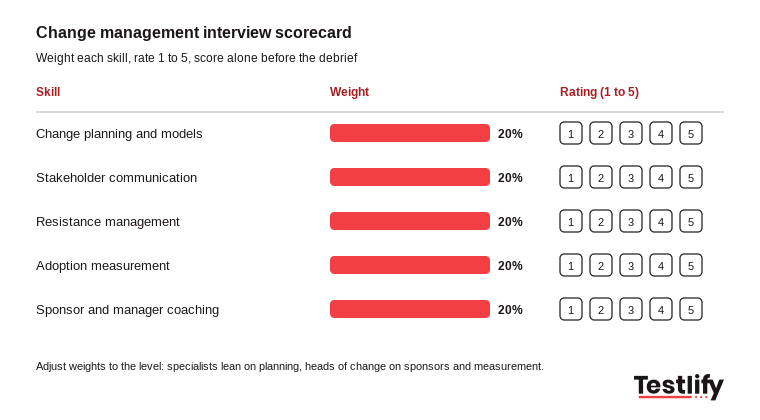
Skill | Weight | Questions to use | A strong answer shows |
|---|---|---|---|
Change planning and models | 20% | 7 to 13 | Uses a model as a tool, starts from impact and readiness |
Stakeholder communication | 20% | 14 to 16, 20 | The right sender for each message, answers "what does this mean for me" |
Resistance management | 20% | 17 to 19, 26 | Finds the real cause and changes something because of it |
Adoption measurement | 20% | 27, 30, 38 | Usage, proficiency and business result agreed before launch |
Sponsor and manager coaching | 20% | 24, 35, 36 | Keeps sponsors visible and gets managers ready to lead their teams |
Adjust the weights to the role. A specialist who builds plans and materials needs more weight on planning and communication. A head of change needs more weight on sponsors, measurement and change saturation.
Pro tip: Write down the score and one piece of evidence for each skill straight after the interview. Across the teams we work with, scores written the next day drift toward the overall impression and lose the detail that separates two good candidates.
What work sample should you use for a change management role?
A change management work sample asks the candidate to build a short change plan for a scenario from your own business, and it is the closest preview you will get of how they think. Most interview guides suggest a role play, but few say how to run or score one. Keep it to four steps.
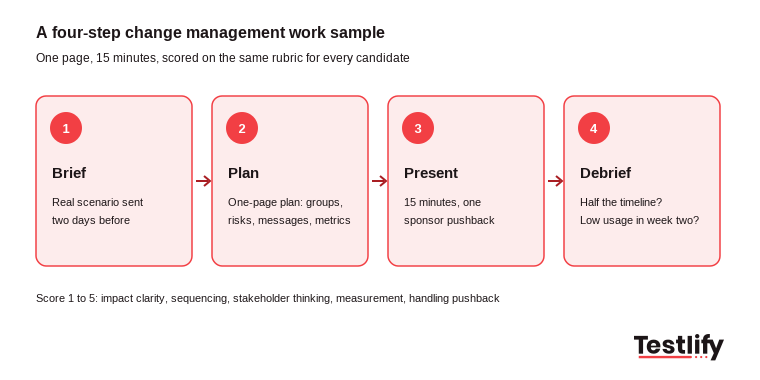
- Brief: send a one-page scenario two days before, for example a new HR system going live in eight weeks for 600 people across three sites.
- Plan: ask for a one-page change plan covering the most affected groups, the main risks, key messages and how adoption will be measured.
- Present: the candidate has 15 minutes to walk the panel through it. One panelist plays a skeptical sponsor and pushes back once.
- Debrief: ask what they would cut if the timeline halved, and what they would do in week two if usage was low.
Score the plan on clarity of impact, realistic sequencing, stakeholder thinking, measurement and how the candidate handled the pushback, each from 1 to 5.
What are the red flags in change management interview answers?
The biggest red flags in change management interview answers are vague results, a one-size-fits-all plan and treating resistance as a people problem to overcome. Watch for these patterns:
- Communication is the whole plan: every answer is emails, town halls and newsletters, with no training, coaching or reinforcement.
- Results stop at launch: the story ends on go-live day, with no adoption or business numbers.
- Model recital: the candidate lists the steps of ADKAR or Kotter perfectly but cannot say how they used them on a real project.
- Resisters are the problem: resistance is always the employees' fault, never the design, the timing or the message.
- No failures: an experienced candidate who cannot describe a change that went wrong is either not reflecting or not being honest.
- No sponsor story: the candidate has never had to manage a senior leader, which matters for any manager-level role.
Key takeaway: A strong change manager talks about specific groups, real reasons for resistance and adoption numbers. A weak one talks about messages sent.
How do skills tests help you hire a change manager?
Skills tests help you hire a change manager by checking judgment, communication and stakeholder skills before you spend panel time on live interviews. A short test stage means the people who reach the work sample can already handle realistic change scenarios and explain ideas clearly.
A typical test stage for this role combines three or four of these:
- The change management test for change planning, resistance and adoption knowledge.
- The stakeholder management test for mapping and influencing stakeholders.
- The communication skills test for clear written and verbal messages.
- The emotional intelligence test for reading reactions and handling anxious teams.
- Situational judgment questions built around change scenarios, such as a sponsor who wants to skip manager briefings.
Testlify's library has 3,500+ tests and 25+ question types, including video, audio and file upload, so you can ask candidates to record a two-minute change message or upload a sample plan. Results come back scored, with a per-skill breakdown, and sync to 100+ ATS and HRIS tools such as Workday, Greenhouse and SAP SuccessFactors. We have seen hiring teams use this stage to cut a long applicant list to a shortlist of five or six, then spend live interview time only on the questions and work sample above. For more ideas on what to measure, read our tips to evaluate change management skills.
Ready to hire your next change manager?
Build a test stage for your change management role from the Testlify test library, add a one-way video question, and share a ranked shortlist with your hiring manager before the first interview. Start a 7-day free trial with no credit card, or book a demo to see it set up for a change or transformation role.
Frequently asked questions about change management interviews

Wordpress Developer
Yash Patel is a Wordpress and SEO Specialist at Testlify with 3+ years of experience in technical SEO, on-page optimization, and content strategy. He works on improving Testlify's organic presence and produces content focused on hiring, talent assessment, and HR technology.
LinkedInRelated resources
View all
HR & recruitment
45 sustainability interview questions to ask candidates in 2026

HR & recruitment
60 Customer Experience Strategist interview questions to ask job applicants

HR & recruitment
60 Social Media Strategist interview questions to ask job applicants

HR & recruitment
60 Growth Hacker interview questions to ask job applicants

HR & recruitment
60 Marketing Operations Manager interview questions to ask job applicants

HR & recruitment
60 Influencer Marketing Coordinator interview questions to ask job applicants
Get started.
Hire on proof, not resumes.
Run your first skills-based assessment free — no credit card required.