
How to hire a machinist: skills, tests, questions and pay
A practical guide to hiring machinists: role levels, skills to test, a 3-stage skills check, interview questions, pay and a job post.

Knowing how to hire a machinist comes down to one thing: proving a candidate can turn a drawing and raw stock into a part that holds tolerance on your machines. A resume and a friendly interview cannot show that. A short sequence of skills checks can, and it also speeds up hiring in a market where good machinists get several offers.
TL;DR:
- Define the machinist level first, from CNC operator to journeyman, and tailor requirements to the machines, materials and work involved.
- Assess technical skills such as blueprint reading, GD&T, shop math, machine setup and precision measurement, rather than relying on experience or resumes alone.
- Use a three-stage evaluation: an online skills test, a blueprint review and a short hands-on shop trial.
- Ask structured interview questions about troubleshooting, safety, quality control and teamwork, using the same scorecard for every candidate.
- US machinists earned a median annual wage of $58,750 in May 2025, according to the BLS. Adjust offers for experience, location, specialization and shift.
- Source candidates through job boards, employee referrals, technical schools and apprenticeships to reach a wider talent pool.
- Avoid vague job posts, unnecessary requirements, long unpaid trials and slow hiring decisions.
- Use skills assessments to screen candidates consistently and reserve shop trials for those who demonstrate the required knowledge.
 ChatGPT
 Gemini
 Claude
 Grok
 Perplexity
What does a machinist do?
A machinist sets up and runs manual and CNC machine tools such as lathes, mills, grinders and drill presses to cut metal, plastic and other materials into precise parts. Machinists read blueprints and CAD/CAM files, plan the order of operations, choose tools and speeds, and measure finished parts against the drawing.
Day to day, a machinist usually:
- Reads engineering drawings, including dimensions, tolerances and GD&T callouts.
- Plans setups: workholding, tool selection, work and tool offsets, and the order of operations.
- Runs the machine, watches for tool wear, chatter and heat, and adjusts feeds and speeds.
- Inspects parts with calipers, micrometers, height gauges and, in some shops, a CMM.
- Keeps machines clean and maintained and follows lockout and guarding rules.
- Logs production and flags problems to engineering or quality.
According to the US Bureau of Labor Statistics, there were about 288,300 machinist jobs in the US in 2025. The largest employers were fabricated metal product manufacturing (35%), machinery manufacturing (21%) and transportation equipment manufacturing (13%). Some parts need accuracy to within .0001 of an inch, which is why precision is the first thing to test.

What types of machinists can you hire?
Machinist roles fall into four common levels, and each needs a different hiring bar. Decide the level before you write the job post, because a CNC operator who loads proven programs and a machinist who programs and proves out new jobs are different hires with different pay.
Level | What the person does | Typical experience | What to test |
|---|---|---|---|
CNC operator | Loads parts, runs proven programs, checks parts, changes inserts | 0 to 2 years | Measurement, shop math, attention to detail, safety |
Setup machinist | Sets up jobs, touches off tools, sets offsets, runs first article | 2 to 5 years | Print reading, setups, offsets, inspection |
CNC machinist / programmer | Plans the part, writes or edits G-code, proves out programs, often uses CAM | 4+ years | Programming, process planning, GD&T, troubleshooting |
Journeyman or tool and die maker | Builds tools, dies, fixtures and one-off parts on manual and CNC machines | Completed apprenticeship or 6+ years | Complex prints, tight tolerances, manual skills, mentoring |
If you are hiring a CNC operator, the CNC operator job description is a closer fit than a machinist post. For welding and fit-up roles, start from the fabricator job description.
What skills should a machinist have?
A machinist needs a mix of technical skills, which decide whether parts come out right, and working habits, which decide whether they come out right every shift. Test the technical side with real tasks and the habits with structured questions.
Technical skills
- Blueprint and GD&T reading: turning a drawing into a plan, including datums, tolerances and surface finish.
- Machine setup and operation: lathes, mills and grinders, manual and CNC, plus the controls your shop runs.
- Shop math: fractions, decimals, metric and imperial conversion, basic trigonometry for angles and bolt circles.
- Measurement and inspection: calipers, micrometers, indicators, gauges and reading a CMM report.
- Materials and tooling: how steel, stainless, aluminum and plastics cut, and how to pick tools, feeds and speeds.
- CNC programming (for higher levels): reading and editing G-code and M-code, and working with CAM output.
Working habits
- Attention to detail: catching a wrong offset or a worn insert before it scraps a batch.
- Problem solving: finding the root cause of chatter, poor finish or parts drifting out of tolerance.
- Safety discipline: guarding, lockout, chip handling and personal protective equipment, every time.
- Communication: clear shift handovers and clear questions to engineering about a drawing.
- Willingness to learn: new machines, new controls and new materials come up often.
Pro tip: List only the skills you would reject a strong candidate for missing on day one. Every extra must-have, such as a specific control brand that a good machinist could learn in a week, shrinks a pool that is already small.
How to hire a machinist, step by step?
Hiring a machinist works best in seven steps: defining the level, writing a specific post, sourcing in several channels, screening skills online, reviewing a real print with the candidate, running a short shop trial and making a fast, competitive offer. The skills checks in steps 4 to 6 are where most hiring teams save time.
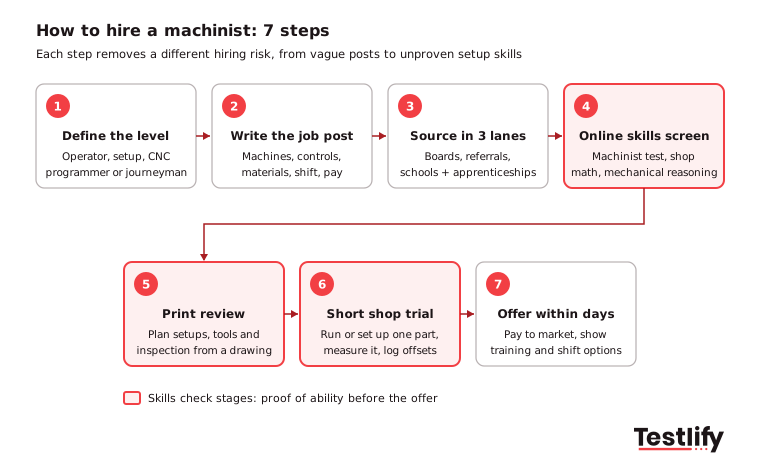
- Define the level: Pick operator, setup machinist, CNC machinist or journeyman, and list the machines, controls and materials the person will use.
- Write a specific job post: Name the equipment, the type of parts, the shift, the pay range and the training you offer. Machinists judge a shop by its equipment and its respect for the trade.
- Source in three lanes: Use job boards for active seekers, employee referrals for passive ones, and schools and apprenticeships for the long-term pipeline.
- Screen skills online: Send every applicant a short machinist test with shop math and mechanical reasoning, so you interview people who already know the basics.
- Review a print together: Give shortlisted candidates one of your drawings and ask how they would set up, tool and inspect the part.
- Run a short shop trial: Ask the final two or three candidates to set up or run one simple part and measure it.
- Offer within days: Good machinists rarely stay on the market long. Make the offer quickly and explain pay, shift options and the training path.
The need for speed is real. The Manufacturing Institute and Deloitte estimate that US manufacturers may need as many as 3.8 million new workers between 2024 and 2033, and that 1.9 million of those jobs could go unfilled if nothing changes.
Where can you find machinist candidates?
Machinist candidates come from four main places: job boards, referrals from your own machinists, technical schools and apprenticeship programs, and local trade networks. The best shops use all four, because each reaches a different group of people.
- Job boards and LinkedIn: good for active job seekers. Put the machines and controls in the title or first line, for example "CNC setup machinist, Haas and Mazak, day shift".
- Employee referrals: machinists know other machinists from school, past shops and local groups. A clear referral bonus paid after a set number of days usually works better than a vague one.
- Technical colleges and vocational schools: offer to host shop tours, sit on advisory boards or sponsor tools for a student. Graduates often join shops they already know.
- Registered apprenticeships: an apprenticeship program lets you train people on your own machines. The US Department of Labor says 90% of apprentices stay employed after they finish.
- Local trade groups and online communities: regional manufacturing associations, machinist forums and social media groups where people share job leads.
- Recruiters and staffing firms: useful for urgent or senior roles, at a higher cost per hire.
For more ideas that work across plant roles, see this guide on blue-collar hiring.
How do you test a machinist's skills?
Test a machinist's skills in three stages that get deeper as the pool gets smaller: an online screen for every applicant, a print review for the shortlist and a short shop trial for the final candidates. Each stage checks something the one before it cannot, and none of them takes a whole day.
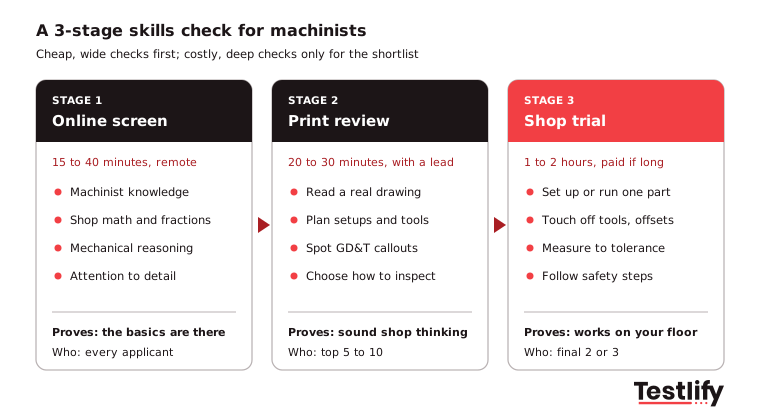
Stage 1: Online screen: Send a short test to every applicant before any interview. The Testlify machinist test is a 15-minute, 15-question intermediate test covering technical knowledge, problem solving, attention to detail, communication, and safety awareness.
Pair it with basic mathematics, mechanical reasoning and visual attention to detail for a fuller picture. For setup and programming roles, add spatial reasoning, since reading a 3D part from 2D views is central to the job.
Stage 2: Print review: Sit with the candidate for 20 to 30 minutes with one of your real drawings. Ask how they would hold the part, which tools they would use, in what order they would cut it, and how they would check the critical features. Strong candidates ask about material, quantity, and the critical tolerances before they answer.
Stage 3: Shop trial: Ask the final two or three candidates to set up or run one simple part on a machine they will use. Keep it to one or two hours and pay for the time if it runs long. Watch how they touch-off tools, set offsets, check the first part, and handle safety, not only whether the part passes.
Use the same scorecard for every candidate so the decision rests on evidence, not on who interviewed best.
What you score | Strong (3) | Acceptable (2) | Weak (1) |
|---|---|---|---|
Print reading | Finds datums, critical tolerances and GD&T callouts unprompted | Reads dimensions, needs help with GD&T | Misreads views or tolerances |
Setup plan | Clear workholding, tool list and order of operations | Workable plan with gaps | No clear plan |
Measurement | Picks the right instrument and checks the first part fully | Measures correctly, misses a feature | Wrong instrument or reading |
Troubleshooting | Explains causes and fixes for chatter, finish or drift | Knows common fixes | Guesses |
Safety | Guards, PPE and lockout without reminders | Needs one reminder | Ignores safety steps |
Key takeaway: The online screen tells you who knows the basics, the print review tells you who thinks like a machinist, and the shop trial tells you who can make parts on your floor. Skipping any of the three leaves a gap.
For more ways to check hands-on skills in plant roles, read how to assess blue-collar skills and experience.
What interview questions should you ask a machinist?
Machinist interview questions should cover machines and setups, print reading, measurement, troubleshooting, safety and teamwork. Ask every candidate the same questions in the same order and score the answers against a shared guide, as a structured interview does.
Technical questions
- Which machines and controls have you run, and which ones could you set up without help? Listen for specific machines, controls and part types, not a long list with no depth.
- Walk me through setting up a new job on a CNC mill, from drawing to first good part. A strong answer covers reading the print, workholding, touching off tools, work offsets, a dry run or single block, and first article inspection.
- A part is drifting out of tolerance halfway through a run. What do you check? Look for tool wear, thermal growth, workholding, offsets and material, checked in a logical order.
- How would you machine a thin-walled part without distortion? Good answers mention light cuts, sharp tools, supporting the part and the order of operations.
- Which measuring tools do you use for a bore with a tight tolerance, and why? Expect bore gauges, micrometers or a CMM, and an explanation of when calipers are not enough.
- How comfortable are you editing G-code at the machine? Give an example. For programmer roles, ask for a real change they made and why.
Behavioural questions
- Tell me about a time you caught a problem before it turned into scrap. Listen for the habit that caught it.
- Describe a time you disagreed with an engineer about a drawing. What happened? Strong answers show they raised it clearly and respectfully.
- Tell me about a time you had to learn a new machine or control quickly. Look for how they learned, not just that they did.
- What safety rule do you never break, and have you ever had to stop a job for safety? Look for specific examples.
- Have you trained a newer machinist? How did you go about it? Useful for senior and lead roles.
How much does it cost to hire a machinist?
The cost to hire a machinist is mostly salary. According to the BLS Occupational Outlook Handbook, the median annual wage for machinists was $58,750 in May 2025, with the lowest 10% earning under $39,200 and the highest 10% over $80,010.
Role | Median annual wage (May 2025) | Notes |
|---|---|---|
Machinists | $58,750 | Lowest 10% under $39,200, highest 10% over $80,010 |
Tool and die makers | $64,050 | Often need more training and postsecondary courses |
Machinists and tool and die makers combined | $59,620 ($28.66 an hour) | About 30,400 openings a year, nearly all to replace retirees and leavers |
Pay moves with the level, the region, the industry (aerospace and medical work often pay more), shift premiums and overtime. On top of salary, budget for job ads, referral bonuses, recruiter fees if you use one, assessment costs, the time your lead machinist spends on print reviews and trials, and tools or training in the first months. The cost of not hiring is real too: an empty machine is lost capacity, overtime for the rest of the team and late orders.
For how to build a competitive offer, see how to make blue-collar salary and benefits offers.
Machinist job description template
Use this machinist job description template as a starting point, then replace the brackets with your machines, parts and pay. Keep responsibilities to six or seven lines and must-haves to the few you would reject a candidate for missing.
Job title: [CNC / Setup / Manual] Machinist, [shift]
About us: [Two or three sentences on what you make, who you make it for and what your shop is like to work in.]
What you will do
- Set up and run [lathes, mills, grinders / CNC machines with Fanuc, Haas or Mazak controls] to make parts from drawings.
- Read blueprints and GD&T to plan setups, select tools and set work and tool offsets.
- Inspect first articles and in-process parts with calipers, micrometers, gauges and [CMM].
- Adjust feeds, speeds and offsets to hold tolerance and finish.
- Keep machines and the work area clean, maintained and safe.
- Record production and quality data and hand over clearly between shifts.
- Work with engineering and quality to fix problems and improve processes.
What you need
- High school diploma or equivalent; a technical program, apprenticeship or [NIMS] credential is a plus.
- [X]+ years of hands-on machining on [manual / CNC] equipment.
- Confident blueprint reading and shop math.
- Accurate use of precision measuring tools.
- A safe, careful working style.
Nice to have: G-code editing, CAM experience, [specific materials such as titanium or Inconel], [industry experience such as aerospace or medical].
Pay and benefits: [Pay range per hour or year], [shift premium], overtime, health, dental and vision cover, retirement plan with match, paid time off, tool allowance, paid training.
How we hire: a short online skills test, a 30-minute print review with our lead machinist, a short paid shop trial and an offer within [X] days.
Location and schedule: [City, site], [shift times], [weekend or overtime expectations].
Industry credentials can help you compare candidates from different shops. The National Institute for Metalworking Skills builds credentials that pair a written exam with a performance check, such as an inspected part.
What mistakes should you avoid when hiring a machinist?
The most common mistakes when hiring a machinist are vague job posts, hiring on years of experience alone, skipping a practical check and moving too slowly. Each one either shrinks the pool or lets a weak hire through.
- Writing a vague post. "Machinist wanted" with no machines, controls or pay gets few serious applicants.
- Filtering on years alone. Ten years of running the same proven program is not the same as five years of setups. Test the skill, not the tenure.
- Skipping the print review. Many people interview well but cannot plan a setup from a drawing.
- Running a long unpaid trial. A full unpaid day puts off the experienced machinists you want most.
- Taking weeks to decide. Strong candidates often accept another offer while you schedule a second round.
- Ignoring growth. Machinists leave shops where there is nothing new to learn. Show the training path and the machines they can move up to.
How can Testlify help you hire machinists?
Testlify helps hiring teams screen machinist applicants on real skills before the first interview, so lead machinists spend their time on print reviews and trials with people who already know the basics. You can send the machinist test on its own or combine it with shop math, mechanical reasoning and attention to detail tests from a library of 3,500+ tests.
- Role-based tests: machinist, mechanical reasoning, basic mathematics, spatial reasoning, safety awareness and problem solving, plus custom questions such as a photo of your own drawing with questions about it.
- Fair, comparable results: every candidate takes the same test and gets an automatic score you can compare side by side.
- Cheating controls: 20+ proctoring checks for remote screening.
- Fits your stack: 100+ ATS and HRIS integrations, and tests in 15+ languages for multilingual plant teams.
Try the machinist test with a 7-day free trial, no credit card needed, or book a demo to see how it fits your plant hiring.
Frequently asked question (FAQs)

Related resources
View all
Hiring Guide
How to hire food processing workers?

Hiring Guide
How to build efficient schools without traditional interviews?

Hiring Guide
How to hire event planners without on-site trials?

Hiring Guide
How to hire game Devs without coding challenges?

Hiring Guide
How to conduct managerial hiring with situational judgment tests?

Hiring Guide
How to find qualified candidates: 8 sourcing methods
Get started.
Hire on proof, not resumes.
Run your first skills-based assessment free — no credit card required.