
How to evaluate candidates skills with a Ruby assessment
What to test, which formats to use and how to score a Ruby assessment, with a skills matrix by level and a 7-step process for hiring teams.

A Ruby assessment is a timed skills test that shows whether a developer can read, write, test and debug Ruby code at the level the role needs. If you are working out how to evaluate candidates skills with a Ruby assessment, the short answer is: test the skills the job really uses, mix short questions with a real coding and debugging task, score each skill against an agreed rubric, and let engineers review only the shortlist.
TL;DR:
- Evaluate Ruby candidates with a 30 to 60 minute assessment sent right after the resume screen: a few concept questions, one coding task and one debugging task.
- Match the depth to the level. Juniors need syntax, collections and methods; mid-level adds blocks, modules and specs; seniors add Rails, performance and security.
- Score per skill with a rubric agreed before the first invite. Correctness counts most, but code quality, idiomatic Ruby, testing and debugging decide close calls.
- Treat the pass mark as a filter, not a hiring decision. A live code review of the candidate's own answer is the best next step.
- Ruby is a niche skill: 6.9% of professional developers used it in 2025, so a fair, fast test matters more than a long one that makes good people drop out.
- Proctoring, code playback and copy-paste tracking keep scores honest now that AI help is one tab away.
 ChatGPT
 Gemini
 Claude
 Grok
 Perplexity
What is a Ruby assessment?
A Ruby assessment is a pre-employment test that measures a candidate's practical Ruby skills: core syntax, object-oriented design, working with collections, error handling, writing tests and fixing bugs in existing code. Most combine short knowledge questions with at least one hands-on coding task scored automatically.
The goal is simple. A resume says "5 years of Ruby"; an assessment shows what those years produced. Hiring teams use it to screen Ruby developers, Ruby on Rails developers, back-end engineers and full-stack engineers before anyone spends an hour in an interview.
A good Ruby assessment usually has two parts:
- A knowledge part: Multiple-choice or short written questions on syntax, data structures, object-oriented programming and the standard library. Fast to score, good for filtering.
- A practical part: A coding task, a debugging task or a small work sample completed in a browser-based editor within a set time. Slower to build, but much closer to the job.
Some teams add a short written or video answer where the candidate explains a design choice, which helps when the role involves mentoring or code review. For background on the framework most Ruby jobs use, see the Ruby on Rails glossary entry.

Why evaluate candidates with Ruby tests before interviews?
Hiring teams evaluate candidates with Ruby tests before interviews because Ruby talent is scarce and engineer time is expensive. A short, scored test filters the pool on proof of skill, so senior engineers only interview people who can already write working Ruby code.
Three numbers explain the pressure:
- Ruby is a niche skill: According to the Stack Overflow Developer Survey 2025, only 6.9% of professional developers used Ruby. The pool is small, so you cannot afford to lose strong people to a slow process.
- Demand keeps growing: The US Bureau of Labor Statistics projects 10% growth for software developers, QA analysts and testers from 2025 to 2035, with about 106,100 openings a year.
- Skills widen the pool: LinkedIn's Economic Graph research from March 2025 found that hiring on skills instead of past job titles expands talent pools a median 6.1x worldwide and 15.9x in the United States.
A skills test also makes screening fairer. Every candidate gets the same questions, the same time and the same scoring rules, so a self-taught developer with a strong GitHub profile is compared on the same footing as someone from a well-known employer.
What Ruby skills should the assessment cover?
A Ruby assessment should cover the skills the role uses every week, scaled to the level you are hiring. For most roles that means syntax and collections, object-oriented design, blocks and modules, error handling, testing and debugging, then Rails, databases and security for senior back-end work.
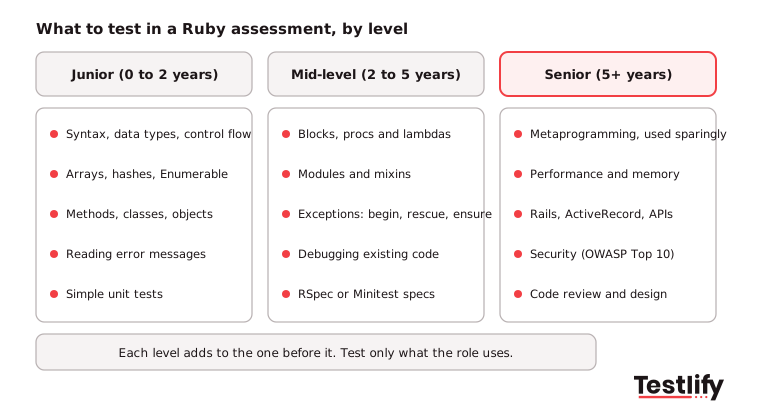
Skill area | What to test | Junior | Mid-level | Senior |
|---|---|---|---|---|
Syntax and control flow | Variables, data types, conditionals, loops, iterators | Yes | Yes | Yes |
Collections | Arrays, hashes, Enumerable methods such as map, select, reduce, group_by | Yes | Yes | Yes |
Object-oriented design | Classes, objects, inheritance, encapsulation, attr_accessor | Basic | Yes | Yes |
Blocks, procs and lambdas | yield, closures, passing behavior to methods | No | Yes | Yes |
Modules and mixins | include vs extend, namespacing, method lookup | No | Yes | Yes |
Error handling | begin, rescue, ensure, custom exceptions | Basic | Yes | Yes |
Testing | Writing or fixing RSpec or Minitest specs | Read | Write | Design |
Debugging | Finding and fixing a bug in someone else's code | Simple | Yes | Legacy code |
Frameworks | Rails conventions, ActiveRecord, REST APIs, Sinatra | No | If used | Yes |
Performance and security | N+1 queries, memory use, injection and access control | No | Basic | Yes |
Two choices shape the test more than any other:
- Pure Ruby or Rails: In the Stack Overflow Developer Survey 2025, 6.9% of professional developers used Ruby and 6.2% used Ruby on Rails, so most Ruby jobs are Rails jobs. If the job is mostly Rails, a pure Ruby test misses half of it. Pair it with a Ruby on Rails test or a Ruby full-stack developer test. If the job is scripting, tooling or a non-Rails service, Ruby on its own is enough.
- Depth over breadth: Five to seven skills tested well beat fifteen tested with one question each. Drop anything the role never touches, such as metaprogramming for a junior hire.
Beyond code, look at how candidates communicate. A developer who can explain a fix to a product manager saves the team hours. A short written answer or a review conversation covers this better than extra coding questions.
Which Ruby assessment formats work best?
The best Ruby assessment formats are a coding task and a debugging task, backed by a few quick concept questions. Multiple-choice questions filter fast but cannot show how someone writes code; take-home projects show a lot but cost candidates hours and are harder to keep honest.
Format | What it shows | Time | Best for | Watch out for |
|---|---|---|---|---|
Multiple choice (predict the output, pick the right snippet) | Language knowledge | 1 to 2 min each | First filter at volume | Rewards memory, not skill |
Coding task in a browser editor | Problem solving, idiomatic Ruby | 15 to 30 min | Every level | Needs hidden test cases |
Debugging task on existing code | Reading code, fixing bugs | 10 to 20 min | Mid and senior | Make the bug realistic, not a trick |
Written or descriptive answer | Reasoning, communication | 5 to 10 min | Senior and lead roles | Needs manual review |
Take-home project | Design, structure, tests | 2 to 4 hours | Final stage only | Drop-off, outside help |
Live pair programming | Collaboration, thinking aloud | 45 to 60 min | Shortlist | Interviewer bias, scheduling |
For an early-career role, an entry-level Ruby coding test plus a handful of concept questions is plenty. For senior roles, add a descriptive Ruby test so candidates can explain trade-offs in writing.
Pro tip: Make the debugging task look like your own codebase: a small service object with a failing spec, not a puzzle. Candidates who fix it quickly usually ramp up quickly too.
How to evaluate candidates skills with a Ruby assessment: what are the steps?
Evaluating candidates with a Ruby assessment takes seven steps: define the role, pick skills and formats, set time and pass rules, invite candidates after the resume screen, review per-skill scores, run a live code review with the shortlist, and decide on the combined evidence.
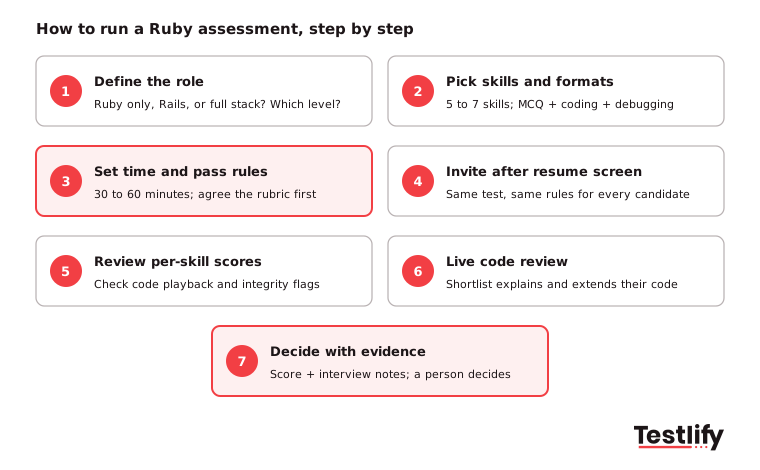
- Define the role: Agree with the hiring manager whether the job is pure Ruby, Rails or full stack, and which level. Use the Ruby on Rails developer job description template as a checklist of the duties the test must cover.
- Pick skills and formats: Choose five to seven skills from the matrix above. Combine 8 to 12 concept questions with one coding task, and add a debugging task from mid-level up.
- Set time and pass rules: Keep the whole test between 30 and 60 minutes. Agree the scoring rubric and the pass mark before the first candidate starts, not after you see the results.
- Invite after the resume screen: Send the same test to every candidate who passes the basic requirements. Tell them how long it takes, what tools they may use and when they will hear back.
- Review per-skill scores: Read the breakdown, not just the total. Check code playback and integrity flags for anyone near the cut-off.
- Run a live code review: Ask shortlisted candidates to walk through their own answer and extend it. Our guide to Ruby on Rails developer interview questions has follow-ups that work well here.
- Decide with evidence: Combine the test score, the review notes and the culture and team interviews. A person makes the final call; the score is evidence, not the decision.
Timing matters. Send the test within a day of the application and close the loop within a week; strong Ruby developers rarely stay on the market long. For more screening ideas, see how to screen candidates for Ruby on Rails developer roles.
How should you score Ruby assessment results?
Ruby assessment results are best scored with a weighted rubric: correctness first, then code quality, idiomatic Ruby, testing and debugging. Read the score per skill, use the pass mark only to filter, and compare candidates on the skills that matter most for the role.
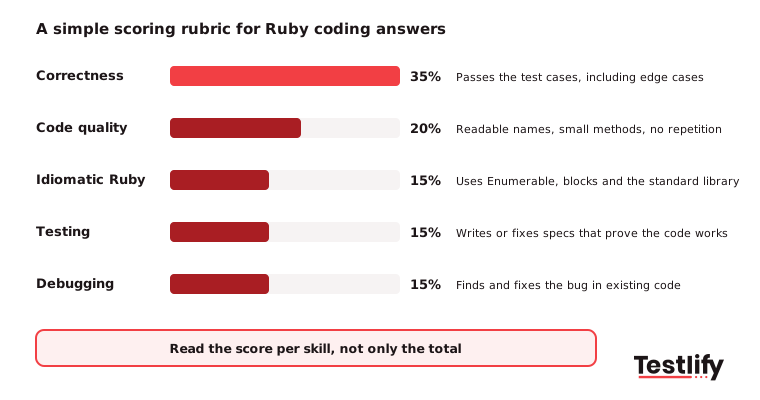
Criterion | Weight | Strong answer | Weak answer |
|---|---|---|---|
Correctness | 35% | Passes all test cases, including empty input and edge cases | Works only for the example given |
Code quality | 20% | Clear names, short methods, no repeated logic | One long method, unclear variables |
Idiomatic Ruby | 15% | Uses Enumerable, blocks and the standard library | Rewrites what Ruby already offers with manual loops |
Testing | 15% | Adds or fixes a spec that proves the change works | No tests, or tests that always pass |
Debugging | 15% | Finds the root cause and explains it | Patches the symptom |
A few rules keep scoring useful:
- Use the pass mark as a filter: A cut-off of around 60% to 70% on the automated part removes clear mismatches. It should never rank the finalists on its own.
- Read per-skill scores: A candidate at 65% overall with full marks on debugging may suit a maintenance-heavy team better than one at 80% who could not fix the bug.
- Benchmark against your own team: Ask two or three of your Ruby developers to take the test first. Their scores tell you what "good" looks like for your codebase.
- Score blind where you can: Review code answers without names or resumes in view to reduce bias.
What does a strong Ruby answer look like?
A strong Ruby answer is correct, short and easy to read, and it uses the language instead of fighting it. A classic task: given a hash of file names and owners, return a hash of owners with the files each one owns.
Here is how two candidates might answer:
- Weak answer: Creates an empty hash, loops over the files with
each, checksif result[owner] == nil, setsresult[owner] = []and pushes each file name. About 9 lines of manual bookkeeping. - Strong answer: One expression with Enumerable:
files.group_by { |_file, owner| owner }.transform_values { |pairs| pairs.map(&:first) }. Two lines once formatted, nothing to maintain by hand.
Both pass the basic test case. The second one shows that the candidate knows the standard library, writes less code to maintain and thinks in collections, which is how experienced Ruby developers work. In the live review, ask the candidate to handle an empty hash and to add a spec; how they respond tells you more than the first answer did.
Key takeaway: When you evaluate candidates with Ruby tasks, give credit for idiomatic, readable code, not only for passing tests. Two answers with the same score can be very different hires.
What are the pros and cons of using a Ruby assessment?
A Ruby assessment brings speed, consistency and evidence to technical hiring, but a badly designed one can mislead you or put strong people off. The table below sets out the main outcomes and how to handle each drawback.
Pros | Cons | How to handle the con |
|---|---|---|
Filters unqualified applicants before engineers spend time on them | Scores can misrepresent skill if a task is overly complex or tricky | Pilot the test on your own developers first |
Same questions and rules for every candidate | Coding answers need technical knowledge to review | Use automated test cases plus a rubric for the manual part |
Covers areas a conversation misses, such as debugging | Long tests cause drop-off | Keep it under 60 minutes; save projects for the final stage |
Runs remotely, any time zone | Candidates may look for outside help | Use proctoring, code playback and a live follow-up |
Gives data to compare hires with later performance | Results age as the stack changes | Review the test every 6 to 12 months |
In short, the value of the test depends on how well the team builds and manages it. A well-built assessment saves interview hours; a careless one simply moves the guesswork earlier.
How do you keep a Ruby assessment fair and hard to cheat?
A Ruby assessment stays fair and hard to cheat when every candidate gets the same conditions, integrity checks run in the background, and a person reviews anything flagged. Fairness also means realistic tasks, clear time limits and accommodations for candidates who need them.
- Integrity checks: Copy-paste tracking, tab and window monitoring, webcam snapshots and full-screen mode catch most shortcuts. Code playback shows whether an answer was typed or pasted in one go.
- AI assistance: Assume candidates can reach an AI assistant. Tasks tied to a specific scenario, plus a live follow-up where the candidate extends their own code, show who really wrote it.
- Realistic content: Avoid trick questions and obscure syntax. Test what the job uses so the score predicts the work.
- Security for senior roles: Ask senior Rails candidates to spot a vulnerability from the OWASP Top 10, such as SQL injection or broken access control, in a short code sample.
- Accommodations and notice: Offer extra time where it is needed and tell candidates in advance what is monitored and why.
Testlify's anti-cheating and proctoring features include 20+ proctoring checks, from copy-paste blocking to AI assistance detection.
How does Testlify help you evaluate candidates with Ruby?
Testlify helps hiring teams evaluate candidates with Ruby by combining a ready-made Ruby test, Rails and full-stack tests, and live coding in one assessment, with automatic scoring and proctoring. Recruiters can send it without writing questions, and engineers only review the shortlist.
- Ready-made Ruby tests: Start with the Ruby assessment and add Rails, full-stack or algorithm tests from a library of 3,500+ tests. Many teams know it as the Ruby online test.
- Live coding: Coding tests run in a browser IDE that supports 45+ programming languages, with automatic grading against test cases.
- Your own questions: Mix in 25+ custom question types, from multiple choice to file upload and video answers, or let the AI test builder draft an assessment from your job description.
- Scoring and reports: Each candidate gets a per-skill breakdown, AI-written strengths and gaps, and suggested follow-up questions for the code review.
- ATS sync: Results flow back to 100+ ATS and HRIS tools, including Greenhouse, Lever, Workday and SmartRecruiters, through Testlify integrations.
Ready to hire your next Ruby developer?
Build a Ruby assessment from your own job description, send it to your next applicants and see per-skill results the same day. Start a 7-day free trial of Testlify, no credit card required, or book a demo to see it with your hiring team.
Frequently asked questions

Senior SEO Specialist
Soham is a senior SEO specialist specializing in B2B HR tech. He covers search, answer, and generative engine optimization (SEO/AEO/GEO) for talent acquisition, skills-based hiring, and assessment-driven recruiting audiences.
LinkedInRelated resources
View all
Skill assessment
How to evaluate insurance agent candidates: a 2026 guide

Skill assessment
Mechanical reasoning assessment: how to evaluate candidates in 2026

Skill assessment
How to measure empathy in candidates: methods, questions and a scoring rubric

Skill assessment
How to evaluate candidates’ skills with a SpringBoot assessment

Skill assessment
How to evaluate candidates’ skills with a C++ assessment

Skill assessment
How to evaluate candidates’ skills with a PHP assessment
Get started.
Hire on proof, not resumes.
Run your first skills-based assessment free — no credit card required.