
5 ways to simplify campus hiring with recruitment tech
Recruitment tech simplifies campus hiring with EEOC-compliant testing, boosting fairness, efficiency, and diversity while enhancing candidate experience and legal compliance.

Campus hiring initiatives play an important role in building a strong, future-ready workforce. But sourcing, screening, and engaging early-career talent at scale is rarely simple.
Recruiters often juggle thousands of applications, tight academic timelines, and pressure to make fair and meaningful hiring decisions quickly. Manual screening and manual resume-based filtering often slow the process and increase the risk of bias.
This is where modern recruitment platforms make a real difference. By automating resume screening and early-stage evaluations through skills assessments and AI-powered interviews, hiring teams can identify qualified candidates faster.
In this article, we break down five practical ways recruitment technology simplifies campus hiring and helps teams hire faster and smarter.
 ChatGPT
 Gemini
 Claude
 Grok
Grok Perplexity
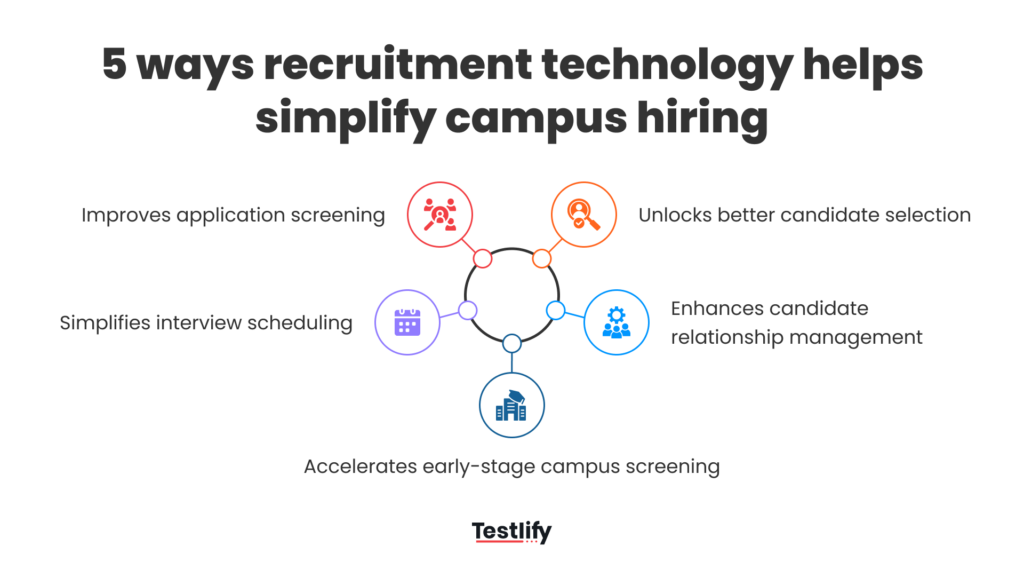
1. Improves application screening
One of the biggest hurdles in campus hiring is sifting through hundreds, sometimes thousands, of resumes and applications. Traditionally, this is done manually, which is both time-consuming and prone to human error.
Application screening tools can automate this process by screening resumes based on specific criteria such as degrees, skills, GPA, or experience. These systems quickly parse applications, ensuring that no strong candidate is overlooked.
How does it help campus hiring initiatives?
- Systems can assess applications based on predefined criteria such as qualifications, skills, and GPA.
- Reduces manual review and removes bias in screening.
- Customizable filtering options let recruiters tailor criteria for each job role.
- Fast processing allows for quick turnaround times during campus drives.

2. Unlocks better candidate selection
Another challenge faced in campus recruitment is evaluating a candidate’s true capabilities. While resumes may list qualifications, they don’t always provide an accurate reflection of a candidate’s skills or their ability to perform in a real-world job setting.
Campus recruiters can utilize AI-powered skills assessment platforms to evaluate critical skills, including coding, problem-solving, and situational judgment.
Platforms such as Testlify allow employers to send role-specific tests as part of the application process. These ensure that only the most capable candidates move forward in the recruitment process.
How do skills assessments help campus hiring initiatives?
- Assessments are customized for specific job roles, ensuring a tailored evaluation of candidates’ skills.
- Tests are administered remotely, giving candidates flexibility while enabling recruiters to evaluate candidates’ responses in a standardized manner.
- Automated grading provides instant results, reducing manual effort and delays.
- Provides deeper insights into candidates’ problem-solving and cognitive abilities, beyond their academic performance.
- Improves quality-of-hire, ensuring the selected candidates are truly capable of succeeding in the role.
3. Simplifies interview scheduling
Coordinating interviews with a large number of campus candidates can be a logistical nightmare. Manual scheduling often results in delays, missed opportunities, and poor candidate experiences.
Recruitment tech simplifies this process by automating interview scheduling, allowing candidates to book, reschedule, or cancel interviews with ease. This also improves coordination among hiring managers, ensuring smooth and timely interview processes.
How interview scheduling tool help campus hiring initiatives?
- Automated scheduling tools allow candidates to book their interview slots online and reschedule if need be.
- Calendar integration ensures no scheduling conflicts between recruiters and candidates.
- Automated reminders and alerts help reduce no-shows and keep the process on track.
- Increases reach, enabling recruitment teams to manage larger volumes of applicants.
4. Enhances candidate relationship management
Candidate engagement doesn’t end after the application or interview process. Maintaining strong relationships with candidates throughout the recruitment journey is important for meeting hiring goals.
Using a recruiter CRM system, recruiters can track students from campus events, segment talent pools, send personalized emails, and manage feedback all in one place. This centralized approach not only keeps the hiring process organized but also ensures candidates feel valued throughout their journey.
How recruitment CRMs help campus hiring initiatives
- Recruitment CRMs track and manage candidate relationships from events to interviews.
- Automated email campaigns ensure consistent communication with candidates.
- Prevents drop-offs by maintaining communication and ensuring a positive candidate experience.
- Improves conversion rates, as engaged candidates are more likely to accept offers.
5. Accelerates early-stage campus screening
Traditional campus hiring often involves time-consuming in-person or phone interviews, which may lead to scheduling conflicts or even biases in the selection process. AI-powered interview tools are transforming this aspect by automating the interview process, enabling companies to have AI conduct the initial round of screening interviews.
These tools assess candidates’ responses in real-time, evaluating factors like tone, language, and even facial expressions to provide unbiased insights into their capabilities.
Using AI interviews not only saves time but also helps standardize evaluations, ensuring every candidate is assessed based on the same criteria.
How AI interviews help campus hiring initiatives
- Natural Language Processing (NLP) algorithms analyze candidate responses, assessing communication skills, clarity, and emotional tone.
- Automated scoring of answers helps identify high-potential candidates based on their performance, removing subjective bias.
- Customizable question banks let recruiters tailor the interview questions to specific job roles or skills.
- Real-time feedback is provided to both recruiters and candidates, making the process more transparent and interactive.
- Integration with ATS systems helps streamline the recruitment process by automatically syncing candidate data and results.
In conclusion, recruiters can drastically reduce time-to-hire, improve candidate quality, and enhance the overall hiring experience for both candidates and employers using recruitment technology.
As campus hiring continues to evolve, adopting these technologies not only gives recruiters a competitive edge but also helps them build a talent pipeline that is ready to meet the demands of the modern workforce.
Top 10 campus hiring tools in 2026
To aid you in your campus hiring initiatives, here’s a curated list of 10 top tools for campus hiring, each addressing different aspects of the process:
Tool | Category | How it helps in campus hiring |
|---|---|---|
Testlify | Skills Assessments & AI interviews | Features role-specific assessments and conversational AI–powered interviews to help identify top academic talent. |
Handshake | Campus Career Network | Connects employers with universities, manages job postings, virtual fairs, and campus interview schedules. |
LinkedIn Recruiter | Talent Sourcing | Helps source students/new grads using filters, improves outreach, and reduces time-to-hire through targeted search. |
Yello | Event & Interview Management | Digitizes check-ins at fairs, captures student info, and automates interview scheduling and reminders. |
Rakuna | Mobile Recruiting CRM | Captures candidate data via QR codes, manages follow-ups, sends bulk emails, and keeps all event leads organized. |
HireVue | Video Interviews | Conducts one-way or live video interviews to replace early screening calls and speed up evaluation. |
InterviewStream | Video scheduling | Allows students to record intro videos and answer preset questions for early screening beyond resumes. |
Paradox (Olivia) | Handles Q&A, pre-screens candidates, and automatically schedules interviews through AI-driven chat. | |
Eightfold.ai | Talent Intelligence | Uses AI to match students to the right roles, reduce bias, and repurpose talent across departments. |
ATS (iCIMS, Greenhouse, Workday) | Applicant Tracking | Manages campus events, centralizes candidate data, tracks metrics, and integrates with other recruitment tools. |
Each of these tools addresses different parts of the campus hiring lifecycle. The best approach might be a combination: for example, use Handshake to source and advertise, Testlify to assess candidate skills, and Yello/Rakuna to manage events.
The right mix depends on your recruitment volume and budget. But importantly, all these tools share a common goal: to make campus recruiting more efficient, data-driven, and engaging for both recruiters and candidates.
For further reading, explore How To Simplify Candidate Screening With Electrician Test, How To Simplify Candidate Screening With Millwright Test, How To Simplify Candidate Screening With Sql Test & Simplify Candidate Screening With Javascript Test.
Final thoughts
Campus hiring initiatives don’t have to be overwhelming. With the right recruitment technology in place, teams can move away from manual screening, inconsistent evaluations, and scheduling chaos.
Tools for automated screening, skills assessments, CRMs, and AI interviews help recruiters focus on what truly matters: identifying potential, ensuring fairness, and delivering a strong candidate experience at scale.
If you want to run campus hiring initiatives that are faster, fairer, and easier to manage, Testlify can help. Its role-specific skills assessments and conversational AI interviews are designed to handle campus hiring at scale. Book a demo with Testlify to see how you can simplify your campus hiring process end-to-end.
Frequently asked questions (FAQs)
Related resources
View all
HR & recruitment
Overcoming campus hiring recruitment challenges

HR & recruitment
Campus hiring guide to hire new grads at scale

HR & recruitment
Maximizing recruitment ROI using right recruitment software

HR & recruitment
How poor candidate experience affects a business

HR & recruitment
How to enhance team productivity via cognitive reasoning

HR & recruitment
How cognitive reasoning can predict top performers
Get started.
Hire on proof, not resumes.
Run your first skills-based assessment free — no credit card required.