
Marketing test: what to assess and 10 questions to ask
How to use a marketing test in hiring: skills to check, formats that work, 10 questions with strong-answer cues and a scoring rubric.
A marketing test is a pre-employment assessment that checks whether a candidate can do the marketing work a role needs: read campaign data, plan a launch, write for a channel and make sound calls under time pressure. Hiring teams use it before or alongside interviews so every candidate is judged on the same tasks, not on how polished the resume looks.
TL;DR / Key Takeaways
- A marketing test is a pre-employment assessment of real marketing work. It checks whether a candidate can read campaign data, plan a launch and write for a channel.
- Measure the four to six skills the role uses most: fundamentals, analytics, channel skills, strategy, communication and creative judgment, weighted by level.
- Use knowledge and data questions as a first screen. Save work samples, case studies and video answers for the shortlist.
- Match the test to the role. A coordinator needs fundamentals and writing; a head of marketing needs strategy, budget and positioning questions.
- Keep the first screen under 30 to 40 minutes and any take-home to about two hours. Pay for longer tasks.
- Score open answers on a 1 to 4 rubric agreed before invites go out. Weight it to the role, such as 40% analytics for an analyst.
- Skills screening is mainstream: NACE reports 70% of employers use skills-based hiring. Treat the score as a filter, not the final decision.
 ChatGPT
 Gemini
 Claude
 Grok
 Perplexity
What is a marketing test?
A marketing test is a structured set of questions and tasks that shows how well a candidate applies marketing knowledge to real work. Most combine short knowledge questions with practical items such as a campaign data task, a scenario choice or a short writing sample, scored the same way for every candidate.
Marketing tests go further than a conventional interview. Interviews show how well someone talks about marketing; a test shows whether they can analyse a funnel, choose a channel or rescue a weak campaign when given the same brief as everyone else. The marketing test in the Testlify library covers fundamentals, analytics, general marketing, strategic marketing and communication in one screen.
Two other meanings share the search term. Students search "marketing test" for practice quizzes before a course exam. "Test marketing" is a product launch method, where a company sells a new product in a small market before a full rollout. This guide is about the hiring kind.

Why use a marketing test in your hiring process?
A marketing test gives you evidence of skill before you spend interview hours. Marketing covers a wide range of work, from data analysis and paid media to content and brand strategy, and a resume rarely shows which of those a candidate can actually do. A well-designed test confirms the skills a candidate claims and makes candidates comparable.
The main reasons hiring teams add one:
- Validating skills and knowledge: Real-world tasks, such as planning a social campaign or reading a traffic report, show whether claimed expertise holds up in practice.
- Real-world simulation: Candidates face the kind of problem the job brings in week one, so you see how they approach it, not only what they know.
- Quantifiable, fair comparison: Every candidate gets the same questions, time limit and scoring rules, which replaces gut feel with scores you can rank and explain.
- Less bias in decisions: Scoring the work, not the school or previous employer, keeps attention on ability and supports a more diverse shortlist.
- Time management under pressure: A timed test shows how a candidate prioritises when several tasks compete, a daily reality in marketing teams.
- Specialised skills and brand fit: Questions built around your brand, audience and channels show who can write in your voice and who already knows your stack.
- A better signal to candidates: A fair, relevant test tells strong marketers that you take skill seriously, which helps you attract the people you want.
Employers are moving this way. SHRM's skills-first research found that 34% of organizations often or almost always use skills-first hiring, and 29% of HR professionals name a lack of tools for assessing skills as a top barrier (SHRM skills-first study). About 85% said they would more readily consider a candidate without a degree if a reliable skills assessment existed.
What you learn | Resume | Interview | Marketing test |
|---|---|---|---|
Can the candidate read campaign data? | Rarely | Partly, by description | Yes, with a data task |
Can they write for your channel? | Links to past work, often edited by others | No | Yes, with a timed work sample |
How do they prioritise under pressure? | No | Partly, by story | Yes, with a time limit |
Is every candidate judged the same way? | No | Only if the interview is structured | Yes, same tasks and rubric |
Hours of hiring team time per candidate | Low | High | Low, scored before interviews |
For the interview stage that follows, a structured interview keeps the same consistency.
What skills should a marketing test measure?
A marketing test should measure the four to six skills the role uses most, not everything marketing could include. For most roles that means marketing fundamentals, analytics, channel skills, strategy, communication and creative judgment, weighted by level. The US Bureau of Labor Statistics lists analytical skills, communication, creativity, decision-making, interpersonal and organizational skills as the important qualities for marketing managers (BLS Occupational Outlook Handbook).
Skill area | What it shows | Example test item |
|---|---|---|
Marketing fundamentals | Knows the marketing mix, segmentation, targeting and positioning | Pick the right segment for a new product from four options |
Analytics | Reads data and acts on it | Given open, click and purchase rates, choose which to fix first |
Digital channels | Knows how SEO, paid search, social and email work | Explain why organic traffic dropped after a site move |
Strategy and planning | Turns goals into a plan and a budget | Outline a launch plan with a fixed budget and 90 days |
Communication and writing | Explains ideas clearly for a given audience | Write a 100-word product email for a named segment |
Creativity and judgment | Produces ideas that fit the brand and the data | Suggest two campaign angles and say which to test first |
Tools and automation | Uses CRM, analytics and automation platforms | Describe how you would set up a lead nurture flow |
BLS puts median pay for advertising, promotions and marketing managers at $165,780 in 2025, with about 36,300 openings a year projected over the decade. At that salary, a short test that prevents one wrong hire pays for itself many times over.
What types of marketing tests can you use?
Marketing tests come in six common formats, and most hiring teams mix two or three. Short knowledge and data questions work best as a first screen for many applicants. Work samples, case studies and video answers suit a shortlist, where you want to see deeper thinking from fewer people.
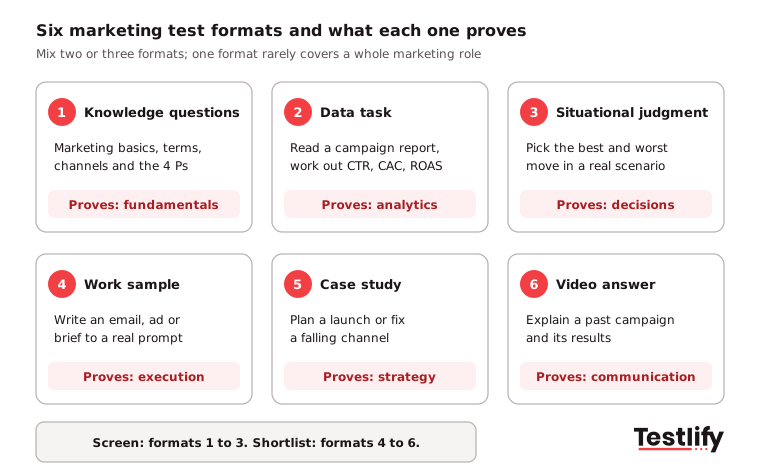
- Knowledge questions: multiple-choice items on marketing basics, channels and terms. Fast to score; good for screening volume.
- Data task: a campaign report or dashboard with questions on CTR, conversion rate, CAC or ROAS. The best single check for analytical roles.
- Situational judgment: a realistic scenario with options to rank, such as a launch slipping two weeks before an event. A situational judgment test shows decision-making without a long task.
- Work sample: write an ad, email, social post or creative brief to a set prompt. Keep it short and timed.
- Case study: plan a launch, fix a falling channel or reposition a brand. Best for managers, often followed by a short presentation.
- Video or audio answer: the candidate explains a past campaign and its results on camera, which shows communication and ownership.
Cognitive and personality tests can sit alongside these for high-volume or graduate hiring, but they do not replace a marketing-specific task.
Which marketing test fits each role?
The right marketing test depends on the level and the channel. Entry-level roles need fundamentals and execution; specialists need deep channel skills; managers need strategy, analytics and judgment. Testing a coordinator on budget allocation, or a head of marketing on email subject lines, wastes both sides' time.
Role | Focus skills | Suggested Testlify test |
|---|---|---|
Marketing coordinator or assistant | Fundamentals, organisation, writing | |
Digital marketing specialist | Channels, analytics, tools | |
SEO specialist | Technical and on-page SEO, content | |
Email or lifecycle marketer | Segmentation, automation, metrics | |
Performance marketing manager | Paid media, budgets, ROAS | |
Marketing analyst | Data, reporting, experiments | |
Content writer or copywriter | Writing, SEO basics, brand voice | |
Marketing manager | Strategy, analytics, team leadership | |
Head of marketing | Strategy, budget, positioning, leadership |
Pro tip: Pair one role test with one short practical task you write yourself from a real problem your team solved last quarter. The role test screens fairly at volume; the task shows who can do your actual work.
What are the top 10 marketing test questions?
The best marketing test questions ask candidates to apply knowledge to a realistic situation, not recite definitions. The 10 below work as open-ended test items or as structured interview questions after a screen. Each includes what to look for, so reviewers score the same way.
- Can you outline a strategic marketing plan for a new product launch? What it assesses: strategic thinking. A strong answer covers target audience, market research, competitor view, positioning, channels, budget and how success will be measured. Red flag: jumping to tactics with no audience or goal.
- How would you build a digital marketing strategy for a B2B software company? What it assesses: digital channel knowledge. Look for SEO, paid search, social, email and content tied to a long sales cycle and named buyer roles, not a list of every channel.
- How do you measure the effectiveness of a marketing campaign? What it assesses: analytics. A strong answer sets KPIs before launch, names tools such as an analytics platform, CRM and marketing automation, and links metrics to revenue or pipeline, not only clicks.
- Describe a creative campaign you developed. What were the results? What it assesses: creativity with accountability. Look for a clear idea, why it suited the audience, and numbers on what it achieved. Red flag: a great idea with no measured result.
- How would you rebrand a company that has lost market share? What it assesses: brand strategy. A strong answer starts with research into why share fell, then covers positioning, messaging and a rollout plan before any logo change.
- How would you build a content marketing strategy to attract and engage your target audience? What it assesses: content strategy. Look for audience segments, topics mapped to buying stages, distribution channels and how content performance will be measured.
- How would you improve the customer experience across touchpoints, from first awareness to post-purchase support? What it assesses: customer journey thinking. A strong answer maps the journey, finds the biggest drop-off and proposes a fix with a way to test it.
- How would you use social media platforms to increase brand visibility and engagement? What it assesses: social media skills. Look for platform choice based on audience, a content mix, community management and a realistic view of measuring social ROI.
- Which marketing automation tools have you used, and how did they improve your processes? What it assesses: tool fluency. A strong answer names platforms, describes one workflow they built, such as lead scoring or a nurture sequence, and the time or results it changed.
- How do you stay current with marketing trends and technologies, and how do you use them in your work? What it assesses: learning habits and adaptability. Look for specific sources, one recent change they applied, such as a new AI tool or a platform policy update, and what happened next.
For role-specific question sets, see the marketing manager interview questions guide.
How do you build and run a marketing test?
A marketing test works best when you build it backwards from the job. Start with the skills the role needs in its first 90 days, match each skill to a format, agree the scoring before anyone takes the test, then send one consistent screen and review results before interviews.
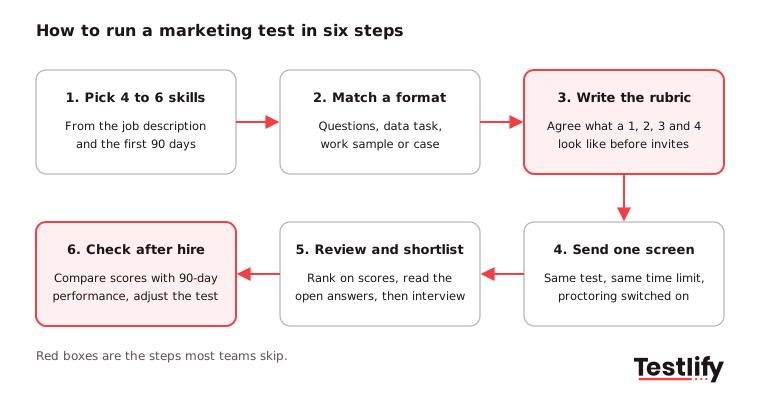
- Pick four to six skills: Read the job description and ask the hiring manager what the new hire must deliver in 90 days.
- Match a format to each skill: Use knowledge or data questions for screening and a short work sample or case for the shortlist.
- Write the rubric first: Define what a 1, 2, 3 and 4 look like for every open-ended item before invites go out.
- Send one screen to every applicant: Same test, same time limit, same instructions, with proctoring on for remote candidates.
- Review and shortlist: Rank by score, read the open answers of the top group, then use the results to plan interview follow-up questions.
- Check after the hire: Compare test scores with 90-day performance and adjust the test each hiring cycle.
Keep the first screen under 30 to 40 minutes, and keep any take-home task to about two hours. Skills-based screening is now mainstream: NACE reports that 70% of employers use skills-based hiring, up from 65% a year earlier, and 65% apply it at the screening stage (NACE Job Outlook 2026).
How should you score a marketing test?
A marketing test should be scored with automatic scoring for closed questions and a shared rubric for open answers. Agree the rubric before candidates start, have two reviewers score a sample independently, and only compare candidates who took the same test under the same conditions.
Score | Strategy or case answer | Data task answer | Writing sample |
|---|---|---|---|
4, strong | Clear goal, audience, plan and success metric, with trade-offs explained | Right metric, right fix, reasoning shown | On brief, on voice, clear call to action, no edits needed |
3, good | Sound plan with one gap, such as no budget or metric | Right answer, thin reasoning | On brief with minor edits |
2, weak | Tactics without a goal or audience | Picks a vanity metric over the real problem | Off voice or unclear ask |
1, poor | Generic or off-topic | Wrong reading of the data | Misses the brief |
Scoring this way also helps you measure quality of hire later. LinkedIn's Future of Recruiting 2025 report found that 93% of talent acquisition professionals say accurately assessing skills is crucial to quality of hire, while only 25% feel highly confident they can measure quality of hire well (LinkedIn Future of Recruiting 2025).
Key takeaway: Weight the scores to the role. For an analyst, analytics might carry 40% of the total; for a content marketer, the writing sample might.
What mistakes should you avoid with a marketing test?
Most marketing test problems come from asking too much or measuring the wrong thing. The common ones are easy to fix once you know them.
- Long unpaid take-homes: A multi-day project asks for free work and drives strong candidates away. Keep tasks short, or pay for anything longer.
- Trivia instead of tasks: Questions about definitions show memory, not ability. Use scenarios and real data.
- One test for every level: A coordinator and a head of marketing need different tests. Match difficulty and focus to the role.
- No rubric: Without agreed scoring, open answers get judged on writing style and reviewer mood.
- Ignoring the candidate experience: Explain why you test, how long it takes and when they will hear back. Candidates judge your company by the process.
- Treating the score as the decision: A test narrows the field. Interviews, references and the hiring team still make the call.
How does Testlify help you run a marketing test?
Testlify gives hiring teams ready-made marketing tests and the tools to run them at scale. The test library has 3,500+ tests, including the general marketing test and role tests for SEO, email, performance marketing, analytics and copywriting. If none fits, the AI test builder creates a custom assessment from your job description.
- 25+ question types, including video, audio, file upload and writing tasks, so you can add work samples and video answers.
- 20+ proctoring checks, such as tab tracking, webcam snapshots and copy-paste blocking, through anti-cheating and proctoring.
- AI candidate insights with a per-skill breakdown, pros and cons and suggested follow-up questions for the interview.
- 15+ languages for global marketing hiring.
- 100+ ATS and HRIS integrations, including Greenhouse, Lever and Workday, with two-way sync.
You can try any marketing test on a 7-day free trial with no credit card, and pay only when a candidate starts an assessment. Browse the marketing test to see what it covers, or read why skills-based hiring is replacing resume screens.
Frequently asked questions (FAQs)

Content Writer
Yashika Khandelwal is a Content Writer with 3+ years of experience creating research-backed content on hiring, talent assessment, and HR technology. She is a registered Organizational Psychologist and subject matter expert who combines behavioral science with practical recruitment insights to produce accurate, evidence-based content.
LinkedInRelated resources
View all
HR & recruitment
Why do you need Microsoft Office test in your hiring process

HR & recruitment
How to simplify candidate screening with Microsoft Office test

HR & recruitment
Salesforce skills assessment: how to test admins, developers and consultants

HR & recruitment
How salesforce test help you screen candidates

HR & recruitment
How to hire top talent using Salesforce test

HR & recruitment
How Ruby test helps you screen candidates
Get started.
Hire on proof, not resumes.
Run your first skills-based assessment free — no credit card required.