
How to evaluate Java programming skills: a 2026 hiring guide
The Java skills to check, tests matched to seniority, a weighted scoring rubric, live interview checks and the red flags to watch for.

Two candidates can both list five years of Java on their resumes and still write very different code.
Knowing how to evaluate Java programming skills means looking past the resume. A resume shows which Java versions and frameworks a candidate has seen, but only a test and a conversation show what they can build.
Four moves fix this: define the role's skills, give everyone the same timed test, score on a rubric, then confirm top scorers live. The sections below show each move with tables, prompts and red flags.
TL;DR:
- Evaluate Java programming skills with a role-based coding test first, then a live coding or code review round for the shortlist. Resumes and certificates alone are weak proof.
- Test six areas: core syntax, object-oriented design, collections and data structures, problem solving, exception handling and debugging, and the tools and frameworks the team uses.
- Match the test to seniority. Juniors get 30 to 45 minutes of fundamentals; senior hires get 60 to 90 minutes of design, concurrency and code review.
- Score on a written rubric: correctness 35%, efficiency 20%, code quality 20%, testing and edge cases 15%, explanation 10%.
- In 2026, 84% of developers use or plan to use AI tools, so add proctoring and an explain-your-code follow-up to every Java test.
- Skills-based screening widens the pool: LinkedIn found a median 6.1x larger talent pool when employers hire on skills rather than job titles.
 ChatGPT
 Gemini
 Claude
 Grok
 Perplexity
Why should you evaluate Java programming skills before you hire?
Evaluating Java programming skills before an offer is the only reliable way to know whether a candidate can write working, maintainable Java for your codebase. Java is a large, mature language, so two developers with "5 years of Java" on their resumes can have very different depth in object-oriented design, concurrency or the Spring ecosystem.
Java is still everywhere in enterprise software. In the Stack Overflow Developer Survey 2025, 29.4% of all respondents said they had used Java in the past year, which puts it among the most used languages for back-end systems, banking platforms and Android apps. That popularity means many applicants list Java, and resumes alone cannot separate the strong ones from the rest.
A structured evaluation does three things for a hiring team:
- Objective comparison: Every candidate solves the same problems under the same conditions, so you compare skill, not interview confidence.
- Faster shortlists: A timed test filters a large applicant pool before engineers spend hours in interviews.
- Wider talent pool: Testing skills lets you consider people with unusual backgrounds. A March 2025 report from the LinkedIn Economic Graph found that a skills-based approach expands talent pools by a median 6.1x globally.

Which Java skills should you evaluate?
Java skills worth evaluating fall into six groups: language fundamentals, object-oriented programming, collections and data structures, problem solving and algorithms, exception handling and debugging, and the tools and frameworks the role uses. Weight each group by the job: a back-end API role leans on frameworks and concurrency, while a junior role leans on fundamentals.
Skill area | What to check | How to check it |
|---|---|---|
Syntax and fundamentals | Variables and data types, control flow (if-else, switch, loops), methods and parameters, input and output, strings | Multiple-choice and short coding tasks |
Object-oriented programming | Classes and objects, encapsulation, inheritance, polymorphism (overriding and overloading), abstraction with interfaces and abstract classes | Design a small class model; read and critique code |
Collections and data structures | ArrayList vs LinkedList, HashMap and HashSet, stacks, queues, trees, generics | Coding task that needs the right structure |
Problem solving and algorithms | Breaking a problem down, sorting and searching, recursion, divide and conquer, dynamic programming, time and space complexity | Timed algorithm problem with hidden test cases |
Exception handling and debugging | try-catch-finally, checked vs unchecked exceptions, reading stack traces, breakpoints, logging with Log4j or SLF4J | Fix a partially working program |
Tools and frameworks | IDEs (IntelliJ IDEA, Eclipse), Maven or Gradle, Git, JUnit or TestNG, Spring and Spring Boot, Hibernate or JDBC | Real-world task plus interview questions |
For roles on newer codebases, also check modern Java features: lambdas, the Streams API, Optional, records and CompletableFuture. Ask which recent long-term support release the candidate has used, such as Java 17 or Java 21, since experience on very old versions does not always transfer.
For framework depth, pair the core test with a framework test such as the Java Spring test or the Hibernate test.
How do you match the evaluation to seniority?
Matching the evaluation to seniority means changing both the content and the format of the test. Junior candidates should prove fundamentals and clean code on small problems.
Mid-level candidates should solve realistic tasks with the right data structures and tests. Senior candidates should show design judgment, concurrency skill and the ability to review other people's code.
Level | Focus | Best format | Time |
|---|---|---|---|
Junior (0 to 2 years) | Syntax, OOP basics, collections, simple algorithms, exceptions | Multiple choice plus 1 or 2 short coding tasks | 30 to 45 minutes |
Mid-level (2 to 5 years) | Data structures, streams and lambdas, JUnit tests, debugging, REST with Spring Boot | Coding tasks plus a debugging task | 45 to 60 minutes |
Senior (5+ years) | Design patterns, concurrency and thread safety, performance, JVM memory and garbage collection, architecture trade-offs | Multi-file project or code review, then a design discussion | 60 to 90 minutes |
Asking a senior candidate only basic questions wastes their time and tells you nothing about their ceiling. Asking a junior candidate about JVM tuning tells you nothing either.
Testlify's junior Java developer test and senior Java developer test are built for each end of that range.
How to evaluate Java programming skills: what are the 5 steps?
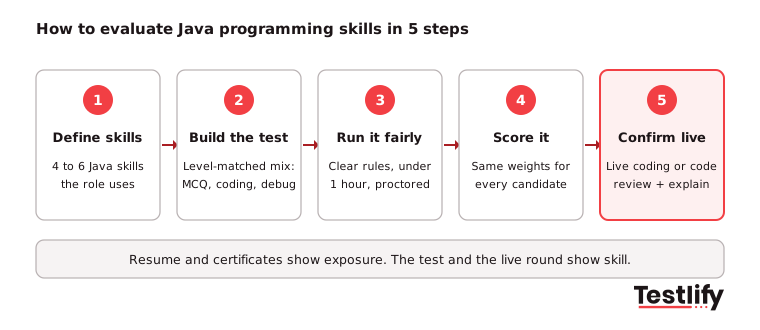
How to evaluate Java programming skills in practice follows five steps: define the role's skills, build a test for that level, run it under fair and monitored conditions, score it on a rubric, and confirm the shortlist in a live round. Each step removes a different kind of guesswork.
### Step 1: Define the skills for the role
List the 4 to 6 Java skills the job uses every week, using the table above. Agree with the hiring manager on which ones are must-haves.
### Step 2: Build the test for the level
Mix question types: multiple choice for concepts, coding tasks for problem solving, and a debugging task for real-world maintenance. A ready-made Java skills assessment can cover the core, with a custom task added for your stack.
### Step 3: Set clear rules and run it
Tell candidates the time limit, which resources they may use (for example the official Java SE documentation) and the coding standards you expect. Keep the first-stage test under an hour.
### Step 4: Score on a written rubric
Score correctness, efficiency, code quality, testing and explanation the same way for everyone. Automated test cases handle correctness, and a reviewer handles the rest.
### Step 5: Confirm in a live round
Invite the top scorers to a live coding, pair programming or code review interview. Ask them to explain the choices in their test answers.
Pro tip: Tell applicants in the job ad that a Java coding test is the first step. Candidates who know what is coming drop out less and perform closer to their real level.
What should a Java coding test include?
A Java coding test should include three kinds of questions: short concept questions on the language, coding tasks scored by automated test cases, and at least one real-world task that looks like the job. Questions must be clear, have one agreed definition of a correct answer, and map directly to a skill in your role profile.
Question types to mix:
- Basic: Loops, conditionals, string handling and simple collections. Good for junior roles and as a warm-up.
- Intermediate: Recursion, sorting, searching, string manipulation and choosing the right data structure.
- Advanced: Concurrency, trees and graphs, design patterns and framework code.
Real-world tasks that work well:
- Build a REST API endpoint with Spring Boot that validates input and returns the right status codes.
- Parse and aggregate data from a CSV file with Java I/O and streams.
- Fix a slow database query layer written with JDBC or Hibernate.
- Find and fix the bugs in a partially working class, as in the Java coding debugging test.
Platform features to insist on:
- A real compile-and-run environment with syntax highlighting, so candidates write Java the way they do at work.
- Automated test cases, including hidden edge cases, so correctness is scored the same for everyone.
- Plagiarism checks and proctoring, so the score reflects the candidate's own work.
- Reports a non-technical recruiter can read, with a score per skill.
Most vendor Java tests in the search results run between 20 and 60 minutes. Keep yours in that range for the first stage and save longer projects for the shortlist.
How do you score a Java coding test fairly?
Scoring a Java coding test fairly means agreeing on a weighted rubric before anyone sees an answer, then applying it to every candidate. A practical default gives correctness 35%, efficiency 20%, code quality 20%, testing and edge cases 15%, and explanation of the approach 10%.
Adjust the weights by role, not by candidate.
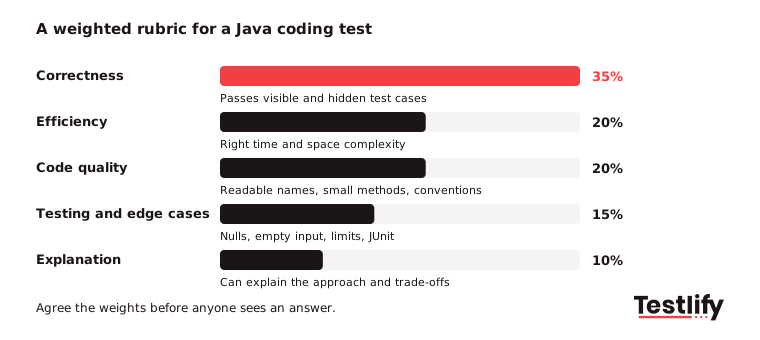
Two habits keep scores consistent. First, have two reviewers score a sample of submissions and compare: a large gap means the rubric wording needs work.
Second, compare each candidate against the benchmark for the role, not only against each other, so a weak applicant pool does not lower the bar.
Key takeaway: A score is only as fair as the rubric behind it. Write the rubric first, score every candidate on it, and keep a person reviewing every rejection.
How to evaluate Java programming skills in a live interview?
The live interview should confirm what the test showed, not repeat it. Spend 45 to 60 minutes on one of three formats: a live coding task in a shared editor, a pair programming session on a small feature, or a code review where the candidate critiques a Java class with planted problems.
Finish by asking the candidate to walk through their own test answers.
Good live-round prompts:
- "Walk me through your solution to question 3. What would you change if the input were 10 times larger?"
- "This method throws a NullPointerException in production. How would you find the cause?"
- "When would you pick a HashMap over a TreeMap here?"
- "How would you make this class safe to use from several threads?"
- "How would you test this with JUnit, and which cases matter most?"
Listen for how candidates reason, not only for the final answer. Strong Java developers ask clarifying questions, name trade-offs and explain their design in plain words, which also tells you how they will work in code reviews with the team.
For more question ideas, see these Java developer interview questions.
How do you stop AI-assisted answers from skewing results?
AI-assisted answers are now the biggest threat to an unproctored Java test. The Stack Overflow Developer Survey 2025 found that 84% of respondents use or plan to use AI tools in development, and 50.6% of professional developers use them daily.
A generated answer can pass test cases without the candidate understanding it.
Three counters work together:
- Proctor the test: Use full-screen mode, tab and copy-paste tracking, webcam snapshots and AI assistance detection, so you can see when an answer did not come from the candidate. Testlify includes 20+ proctoring checks with every assessment.
- Ask them to explain: An explain-your-code question, written or spoken, is hard to fake. A candidate who wrote the code can explain it in a minute.
- Decide your AI policy: If your developers use AI assistants at work, you can allow them in one task and score how well the candidate checks and fixes the output. The same survey found 66% of developers say AI answers are often "almost right, but not quite", so spotting those errors is a real skill.
What are the red flags when evaluating Java developers?
Red flags in a Java evaluation are habits that will cost the team time after the hire. Watch for these across the test and the interview:
- Code that only works for the example: Passes the visible case but fails hidden edge cases such as empty lists, nulls or very large inputs.
- Swallowed exceptions: Empty catch blocks or catching Exception everywhere instead of handling specific errors.
- No sense of complexity: Nested loops over large collections with no awareness of the cost.
- Everything in one class: No use of objects, interfaces or small methods, even when the task calls for them.
- No tests: Cannot describe how they would test their own code.
- Cannot explain their answer: Strong test score, weak explanation. Check the proctoring report before you move on.
Across the teams we work with, the last flag has become the most common one since AI coding assistants became mainstream.
Which mistakes make Java evaluations unreliable?
Java evaluations become unreliable when the test does not match the job, when scoring is left to gut feel, or when the test is treated as the whole decision. A Java test is strong evidence of coding skill, but it says little about communication and teamwork, so it should sit alongside structured interviews.
- Testing trivia: Questions about rarely used syntax reward memory, not skill. Test what the role does every week.
- One test for every level: A single generic test is too hard for juniors and too easy for seniors.
- Tests that are too long: A three-hour take-home at the first stage drives strong candidates away. Keep the screen under an hour.
- No written rubric: Without one, two reviewers will score the same code differently.
- Skipping feedback: Give every candidate a short result or note. It protects your employer brand with a small community of Java developers.
For a wider process view, see Testlify's Java developer hiring guide and the guide to screening candidates for Java developer roles.
How does Testlify help you evaluate Java programming skills?
Testlify helps hiring teams evaluate Java programming skills by combining ready-made Java tests, a live coding environment, automated scoring and proctoring in one platform. Recruiters can run the first stage without reading Java, and engineers only review the shortlist.
- Java tests for every level: The test library has 3,500+ tests, including Java tests for junior, senior, Spring, data structures and debugging. Combine several in one assessment or add your own coding question.
- Real coding environment: Coding questions run in a live coding IDE that supports 45+ programming languages, and live coding and pair-programming interviews cover the second round.
- Automated scoring and insights: Every answer is scored automatically, with a per-skill breakdown, AI-written strengths and gaps, and suggested follow-up questions for the interview.
- Integrity built in: 20+ proctoring checks, including AI assistance detection and copy-paste tracking.
- Fits your stack: Results sync with 100+ ATS and HRIS tools, including Greenhouse, Lever and Workday.
See all coding tests in the Testlify library.
Ready to evaluate your next Java developer?
Pick a Java test from the Testlify test library, add one real-world task from your own codebase, and send it to your next applicants. Book a demo to see a Java assessment built for your role, or start a 7-day free trial, no credit card required.
Frequently asked questions (FAQs)

Content Writer
Yashika Khandelwal is a Content Writer with 3+ years of experience creating research-backed content on hiring, talent assessment, and HR technology. She is a registered Organizational Psychologist and subject matter expert who combines behavioral science with practical recruitment insights to produce accurate, evidence-based content.
LinkedInRelated resources
View all
Skill assessment
5 tips to evaluate digital marketing skills

Skill assessment
5 tips to evaluate data visualization skills

Skill assessment
5 tips to evaluate project management skills

Skill assessment
5 tips to evaluate financial analysis skills

Skill assessment
5 tips to evaluate Python programming skills

Skill assessment
Trustworthiness in the workplace: How to assess it in hiring
Get started.
Hire on proof, not resumes.
Run your first skills-based assessment free — no credit card required.