
Top language assessment tools for hiring in 2026
Nine top language assessment tools for hiring compared: what each one tests, how it scores, the languages it covers and the need it fits.

The top language assessment tools for hiring in 2026 are Testlify, Versant by Pearson, TOEIC, Linguaskill Business, Pipplet, goFLUENT, Emmersion, TestGorilla and iMocha AI-EnglishPro. Each one checks how well a candidate reads, writes, listens or speaks a language at work, but they differ in what they test, how they score and how they fit into a hiring process.
TL;DR / Key takeaways
- The top language assessment tools for hiring in 2026 are Testlify, Versant by Pearson, TOEIC, Linguaskill Business, Pipplet, goFLUENT, Emmersion, TestGorilla and iMocha AI-EnglishPro.
- The ETS TOEIC Global English Skills Report found recruitment is the top reason employers run English assessments (78%).
- Pick by hiring need: Testlify for language plus job skills, Versant or Emmersion for fast spoken English, TOEIC or Linguaskill for a recognised score.
- For many languages, including rare ones, look at Pipplet (40+ languages) or goFLUENT (20+). TestGorilla's tests are multiple choice and do not test speaking.
- Set a CEFR level per skill and per role. B1 covers routine internal work, B2 suits most customer-facing roles and C1 fits daily writing or negotiating.
- Test language right after the application and before interviews, and sync scores to the ATS.
- The EEOC allows an English fluency requirement only if the job needs it. Score language, not accent, and keep a record of each level chosen.
Language screening is now a standard hiring step, not a nice extra. According to the TOEIC Global English Skills Report from ETS, a survey of more than 1,300 HR decision-makers in 17 countries published in March 2026, recruitment is the most common reason employers run English assessments (78%), and 83% say hiring people with weak English skills creates real costs in productivity and retention.
 ChatGPT
 Gemini
 Claude
 Grok
 Perplexity
What are the top language assessment tools for hiring in 2026?
The top language assessment tools for hiring in 2026 fall into three groups: hiring platforms that include language tests, dedicated language test publishers, and certificated English exams. Here are the nine worth shortlisting, with the job each one does best.
- Testlify: language tests, job skills tests and AI interviews in one hiring workflow.
- Versant by Pearson: fast, automated English tests scored by AI, built for volume.
- TOEIC (ETS): a widely recognised English score for workplace listening, reading, speaking and writing.
- Linguaskill Business (Cambridge): a modular, online business English test with CEFR results.
- Pipplet (ETS): written and spoken tests in more than forty languages.
- goFLUENT Language Assessment: proficiency and speaking tests with results sent to the ATS.
- Emmersion: short, AI-scored speaking, writing and grammar assessments.
- TestGorilla: quick multiple-choice language tests inside a general skills-test library.
- iMocha AI-EnglishPro: a business English test inside a broader skills platform.

How do the top language assessment tools compare?
The top language assessment tools compare most clearly on four points: how many languages they cover, whether they test speaking, how they score answers and which hiring need they fit. Facts below come from each vendor's own pages, checked in October 2026; confirm details with the vendor before you buy.
Tool | Type | Languages | Speaking tested | Scoring | Best for |
|---|---|---|---|---|---|
Testlify | Hiring platform | CEFR tests; platform in 15+ | Yes (audio, video, Voice AI answers) | Automated, CEFR levels A1 to C2 | Language plus job skills in one assessment |
Versant by Pearson | Language test publisher | English, plus spoken Spanish, French, Arabic, Dutch | Yes | AI, results in minutes, GSE and CEFR | High-volume English screening |
TOEIC (ETS) | Certificated exam | English | Yes (Speaking and Writing test) | ETS score scales | A recognised English score |
Linguaskill Business | Certificated exam | English | Yes | Hybrid human and AI marking, CEFR B1 to C2 | Business English with a certificate |
Pipplet | Language test specialist | 40+ | Yes | CEFR, AI scoring option | Hiring in many languages |
goFLUENT | Language test specialist | 20+ | Yes (Speaking Assessment) | Adaptive AI plus human scoring, CEFR | Global hiring with ATS sync |
Emmersion | Language test publisher | Several; check the list | Yes | AI, CEFR level | Short speaking screens |
TestGorilla | Skills-test library | 16 | No (multiple choice) | Automated, mostly B1 and C1 levels | Quick written checks |
iMocha AI-EnglishPro | Skills platform | English | Yes | CEFR-based report | Business English for tech-heavy teams |
Which language assessment tools are worth a closer look?
Language assessment tools worth a closer look are the nine below, each reviewed on what it tests, how results come back, where it is strong and what to check before buying. The order follows the list above, not a score.
1. Testlify
Testlify is an AI-native skills assessment and interviewing platform, so language testing sits next to role skills, cognitive tests and interviews rather than in a separate tool. The test library includes CEFR-aligned language tests from A1 to C2, and a 30-minute CEFR English test that candidates take from an email link, with no account, and that produces a downloadable certificate.
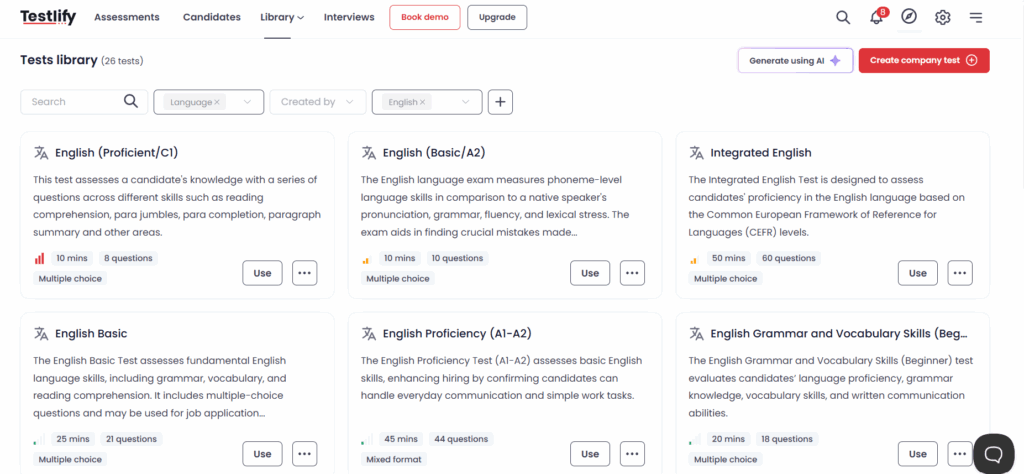
- What it tests: reading, writing, listening and speaking, using 25+ question types including audio, video and Voice AI answers for spoken English.
- How it scores: automated scoring with per-skill results, so recruiters see a CEFR level next to job skills scores.
- Strengths: 3,500+ tests in one library, 20+ proctoring checks, a platform available in 15+ languages and 100+ ATS and HRIS integrations. Testlify language tests
- Check before buying: Testlify results are for your own hiring decision, not a certificate candidates reuse elsewhere like TOEIC. White label and some integrations are add-ons on lower plans.
- Best for: teams that want one assessment covering language level and the actual job, such as support, sales and operations roles.
2. Versant by Pearson
Versant by Pearson is an automated English test for HR teams that scores speaking, writing or all four skills with AI. Pearson says it delivers about 3 million tests a year, with results in minutes on the Global Scale of English (GSE) and the CEFR, and it also offers spoken tests in Spanish, French, Arabic and Dutch.
- Strengths: speed at volume, flexible proctoring options and a ScoreKeeper admin with remote monitoring.
- Check before buying: Versant is a language test only, so job skills need a second tool.
- Best for: high-volume English screening for customer-facing roles.
3. TOEIC (ETS)
TOEIC from ETS is a family of workplace English tests: Listening and Reading, Speaking and Writing for intermediate to advanced levels, and TOEIC Bridge for beginners. ETS says organizations in more than 160 countries use TOEIC scores, and tests are ordered through local ETS partners.
- Strengths: a score many employers already recognise, useful for promotion, relocation and benchmarking as well as hiring.
- Check before buying: ordering through a regional partner adds a step, and scheduling a formal exam slows early-stage screening.
- Best for: roles where a recognised English score matters to clients or regulators.
4. Linguaskill Business (Cambridge)
Linguaskill Business is Cambridge's online, modular English test for employers. Teams choose any mix of reading, listening, writing and speaking; the test adapts to each candidate, uses hybrid human and AI marking, and reports results on the CEFR from B1 to C2 and the Cambridge English Scale. Topics include the office, business travel and human resources.
- Strengths: Cambridge recognition and a certificate, with an approved agent reporting acceptance by more than 1,400 organisations.
- Check before buying: results take days rather than minutes, according to Cambridge's approved test agent, and the test is delivered through agents.
- Best for: graduate, office and client-facing roles where a certificated business English level helps.
5. Pipplet
Pipplet, now part of ETS, tests written and oral skills on the CEFR in more than forty languages, using 30-minute online tests. ETS says more than 1,600 organizations use it, especially multinational recruiters, outsourcing companies and customer service providers.
- Strengths: wide language coverage, custom industry tests, an AI scoring option and white labeling.
- Check before buying: decide between AI scoring and examiner review per role, since turnaround and cost differ.
- Best for: BPO and support teams hiring for less common languages.
6. goFLUENT Language Assessment
goFLUENT offers a Proficiency Test and a Speaking Assessment for talent acquisition, built on adaptive AI with CEFR scoring. The company says candidates can be tested in more than twenty languages, with AI-generated questions plus human scoring, anti-cheating features and results sent straight to the applicant tracking system.
- Strengths: integrations with recruiting systems such as Workday, SAP SuccessFactors, SmartRecruiters and Teamtailor, and a language training product for after the hire.
- Check before buying: goFLUENT is mainly a language training company, so ask how hiring and training data are kept apart.
- Best for: global teams that want language screening and later language training from one vendor.
7. Emmersion
Emmersion runs AI-scored speaking, writing and grammar assessments that take under 15 minutes and report a CEFR level. The company offers an enterprise API and direct integrations with hiring platforms for pre-employment language screening.
- Strengths: short tests with instant results, which suit volume hiring.
- Check before buying: the site does not list how many languages are covered, so confirm your languages first.
- Best for: fast speaking screens before a recruiter call.
8. TestGorilla
TestGorilla is a general skills-test library with 37 language tests across sixteen languages, checked in October 2026. Every language test is multiple choice and takes 10 to 12 minutes, and most sit at B1 or C1, with a few at A2, B2 and C2.
- Strengths: easy to add a language check to other screening tests in one invite.
- Check before buying: multiple-choice tests do not measure speaking or written production, so pair them with a spoken step for customer-facing roles.
- Best for: a quick written language check for roles where speaking is secondary.
9. iMocha AI-EnglishPro
iMocha AI-EnglishPro is a business English test covering reading, writing, listening and speaking, with a CEFR-based report and AI proctoring that flags suspected cheating. iMocha sells it alongside a wider skills platform used mostly for technical hiring.
- Strengths: four skills in one business English test, inside a tech-focused skills platform.
- Check before buying: AI-EnglishPro covers English only, so other languages need another tool.
- Best for: IT services and tech teams hiring for English-speaking client work.
Which language assessment tool fits your hiring need?
The language assessment tool that fits your hiring need depends on three things: which languages you hire in, whether the role needs speaking, and whether you also need to test job skills. Start from the job, then pick the tool type.
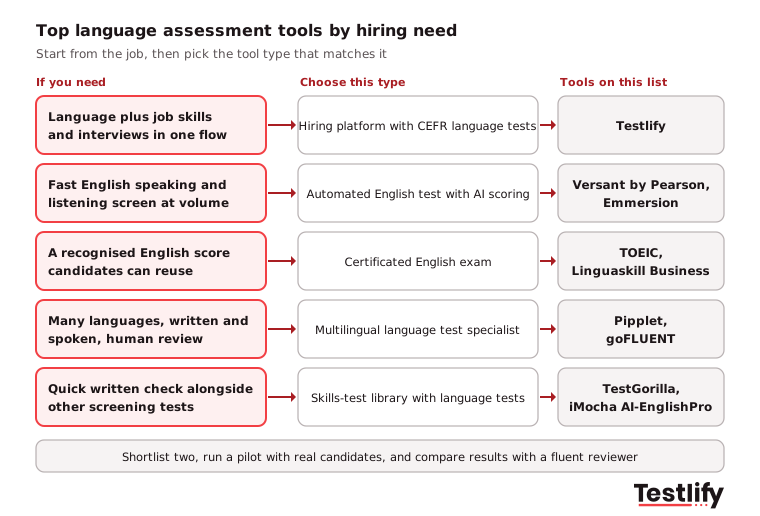
- Language and job skills together: a hiring platform such as Testlify keeps one invite, one report and one candidate experience.
- English at volume, spoken: Versant or Emmersion return AI scores within minutes.
- A reusable, recognised score: TOEIC or Linguaskill Business.
- Many languages, including rare ones: Pipplet or goFLUENT.
- A light written check: TestGorilla or iMocha AI-EnglishPro next to other tests.
For a deeper buying checklist, including how to test voice answers in a trial, see our guide to choosing a language assessment platform.
Pro tip: Run a two-week pilot with your top two tools on real applicants, and have a fluent colleague rate a sample of the same candidates. If the tool and the reviewer disagree on more than a few people, the test does not suit that role.
What should a language assessment measure?
A language assessment should measure the skills the job uses, at the level the job needs, on a shared scale. For most hiring that means the four skills (reading, writing, listening and speaking) reported on the CEFR, which describes six levels from A1 (basic) to C2 (mastery).
The CEFR helps because hiring managers, candidates and vendors read the same level the same way. The Europass CEFR self-assessment grid describes each level in plain "I can" statements for understanding, speaking and writing.
- Speaking and listening: essential for support, sales and any phone or video role. Only tools that record and score spoken answers measure this.
- Reading and writing: central for email support, documentation, compliance and back-office roles.
- Role context: questions built on real work tasks, such as handling a complaint, show how a candidate will cope at work better than grammar drills.
- Integrity: proctoring and identity checks matter more as remote tests grow. anti-cheating and proctoring
Which roles need a language test?
Roles that need a language test are the ones where the language is part of the work itself: customer support, sales, client services, healthcare and public-facing jobs, plus any role working across countries. Internal technical roles often need a lower bar for spoken English than the job ad suggests.
Some sectors have legal duties too. In the UK, Part 7 of the Immigration Act 2016 requires public authorities to make sure people in customer-facing roles speak fluent English, which makes a documented language check part of compliance, not only good practice.
Across the teams we work with, the most common gap is volume hiring for support roles in several languages at once. A tool that covers your second and third languages saves more time than one that is slightly faster in English. volume hiring with Testlify
Where does a language test fit in the hiring process?
A language test fits best early in the hiring process, right after the application and before interviews, so recruiters only spend time on people who meet the level the role needs. Results should flow back to the ATS next to the application.
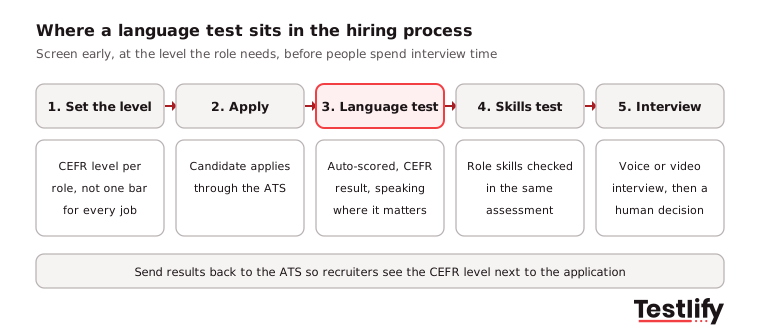
- Set the level per role: Agree the CEFR level for each skill with the hiring manager before the role opens.
- Test right after applying: An email invite with no account keeps completion high.
- Combine with job skills: Testing language and role skills in the same session saves candidates a second invite. Testlify CEFR English test
- Interview with the level in hand: Use the interview to confirm spoken fluency in a real conversation, not to repeat the test.
- Sync to the ATS: Scores should land in the system recruiters already use. Testlify integrations
How do you keep language screening fair and legal?
Language screening stays fair and legal when the level you test is the level the job needs, applied the same way to every candidate. In the US, the EEOC guidance on national origin discrimination says an English fluency requirement is allowed only if it is needed for effective performance of the position, and advises setting the level case by case.
- One level per role, not one level for all: We have seen teams set C1 for every job and turn away strong warehouse and engineering applicants for no business reason.
- Score language, not accent: A clear speaker with an accent is fluent; train reviewers and check AI scores on accented samples during the pilot.
- Offer the test in the same format to everyone: Same questions, same time limit, same accommodations process.
- Keep records: Store the level chosen for each role and the reason, in case a decision is challenged.
For more on this, read how to ensure language fairness in assessments.
Key takeaway: The best language assessment tool is the one that tests the skills your role uses, in the languages you hire in, at a level you can justify. Pick by hiring need first, then compare speed, scoring and integrations.
Want to see how a language test runs next to job skills tests? Try the Testlify CEFR English test with a 7-day free trial, no credit card needed, or book a demo to plan language screening for volume hiring.
FAQs

Wordpress Developer
Yash Patel is a Wordpress and SEO Specialist at Testlify with 3+ years of experience in technical SEO, on-page optimization, and content strategy. He works on improving Testlify's organic presence and produces content focused on hiring, talent assessment, and HR technology.
LinkedInRelated resources
View all
Skill assessment
Why is a product manager assessment essential for recruiting?

Skill assessment
Why an accounting manager test is essential for recruiting

Skill assessment
Why is a performance marketing test essential for recruiting?

Skill assessment
Why is a customer success manager test essential for recruiting?

Skill assessment
Business judgment test: what it measures and how to use it

Skill assessment
Why is an attention to detail visual test essential for recruiting?
Get started.
Hire on proof, not resumes.
Run your first skills-based assessment free — no credit card required.