
How to simplify candidate screening with Microsoft Office test
A practical guide to screening applicants with a Microsoft Office test: skills per role, test formats, cut-off scores, fairness and setup.

The fastest way to simplify candidate screening with Microsoft Office test results is to send every applicant the same short, job-related test before the first interview, then interview only the people who clear a cut-off. A Microsoft Office test checks how well someone actually uses Word, Excel, PowerPoint and Outlook, instead of trusting the "proficient in MS Office" line on almost every resume.
TL;DR:
- Send a Microsoft Office test to every applicant before the first interview, then interview only those above your cut-off.
- Test only the apps and the level the job uses every week: advanced Excel for finance, Word and Outlook for assistants, PowerPoint for sales and marketing.
- Use simulation or file-upload tasks for any skill the person will use daily; keep multiple choice for quick knowledge checks.
- Keep the whole test under 30 minutes and set the pass mark from the scores of your current top performers.
- Only 6.9% of HR leaders assess skills before the first interview, so testing early is a real edge in speed and quality.
- Offer accommodations, keep every task tied to the job and use the score as one input next to interviews, as EEOC guidance expects.
 ChatGPT
 Gemini
 Claude
 Grok
 Perplexity
What is a Microsoft Office test for hiring?
A Microsoft Office test for hiring is a short, timed assessment that measures how well a candidate uses Microsoft 365 apps such as Word, Excel, PowerPoint and Outlook on tasks the job really involves. Hiring teams use it early in the process to check skills that resumes only claim.
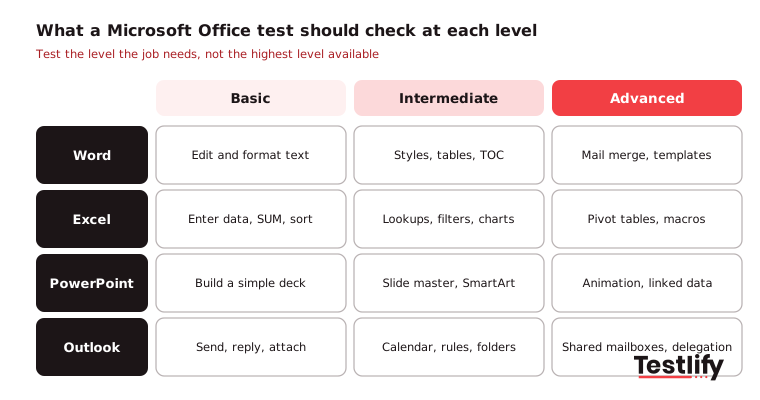
Most tests cover four apps, sometimes with OneDrive, SharePoint or Teams added:
- Word: formatting, styles, tables, a table of contents, track changes and mail merge.
- Excel: data entry, formulas such as SUM and lookups, sorting and filtering, charts, pivot tables and, at the top end, macros.
- PowerPoint: building a clean deck, slide masters, SmartArt, transitions and presenting data.
- Outlook: email etiquette, calendar and meeting management, rules and folders.
A test can cover the whole suite in one go, like the Microsoft Office software test, which checks Word, Excel, PowerPoint, Outlook and OneDrive or SharePoint use in 20 minutes. Or it can go deep on one app, such as a Microsoft Word test for assistants and editors.

Why should you screen candidates with a Microsoft Office test?
Screening with a Microsoft Office test is worth it because Office skills are hard to judge from a resume or an interview, and weak skills show up only after the hire. A short test gives every applicant the same tasks and the same scoring, so the shortlist rests on evidence instead of keywords.
The volume makes manual screening expensive. The US Bureau of Labor Statistics projects about 314,400 openings a year for secretaries and administrative assistants alone, and notes that entry-level hires usually qualify when they are comfortable with word processing and spreadsheet programs. Each of those openings draws applicants who all list Microsoft Office.
The main benefits, from both the screening and the hiring side:
- Objective evaluation: Every candidate does the same tasks and is scored the same way, which removes much of the gut feel from early screening.
- Time saved: Recruiters stop reading resumes for software claims and stop booking calls with people who cannot build a basic formula.
- Lower cost per hire: Fewer interview rounds are spent on candidates who were never a fit, so the hiring manager's time goes to the strongest few.
- Job relevance: A financial analyst is judged on Excel, an executive assistant on Word and Outlook, so the test reflects the actual work.
- Remote-ready: Candidates take the test online at a time that suits them, which widens the pool and removes scheduling.
Which Microsoft Office skills should you test for each role?
The Microsoft Office skills you test should match the tasks the role does every week, at the level it does them. A receptionist needs solid Outlook and basic Word; a financial analyst needs advanced Excel and little else. Testing every app at the top level only makes the test longer and pushes good applicants away.
Role | Apps to test | Level | Suggested test mix |
|---|---|---|---|
Administrative or office assistant | Word, Outlook, basic Excel | Basic to intermediate | Full-suite Office test plus a typing test |
Executive assistant | Word, Outlook, PowerPoint | Intermediate to advanced | Word test, Outlook test, a short PowerPoint task |
Data entry clerk | Excel, typing speed | Basic | Excel simulation (basic) plus a 10-key typing test |
Financial or business analyst | Excel | Advanced | Excel simulation (advanced) plus a role test |
Sales or marketing coordinator | PowerPoint, Excel, Outlook | Intermediate | Full-suite Office test plus a PowerPoint test |
Customer support or BPO agent | Outlook, Word, typing | Basic | Full-suite Office test plus typing and English tests |
HR or recruiting coordinator | Word, Excel, Outlook | Intermediate | Full-suite Office test plus a role test |
For Excel-heavy roles, a spreadsheet task beats any number of theory questions. The Excel simulation (advanced) test covers pivot tables, data cleaning, advanced formulas and macros in 30 minutes. Our guide to advanced Excel assessments goes deeper on that role group.
Pro tip: Ask the hiring manager to name three Office tasks a new hire must do in week one, such as "turn the weekly export into a pivot report". Build or pick the test around those three tasks, not around the app's feature list.
How do you simplify candidate screening with Microsoft Office test results?
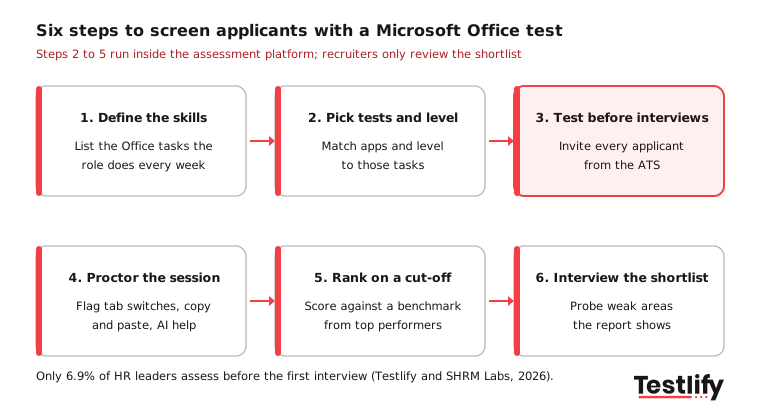
You simplify candidate screening with Microsoft Office test results by making the test the first filter, not the last. Define the skills, pick a short test, send it to every applicant from the ATS, proctor it, rank on a cut-off and interview only the shortlist.
1. Define job-specific skills
Identify the Microsoft Office applications and tasks employees use regularly. List the required skills for each task and exclude applications that are not relevant to the role.
2. Select the right tests and difficulty level
Choose a full-suite assessment for generalist roles or one or two application-specific tests for specialist positions. Match the difficulty level to the role's requirements, ranging from basic to advanced.
3. Assess candidates before the first interview
Introduce skills assessments immediately after application submission, before scheduling the first interview. According to the Testlify and SHRM labs skills-first talent report, only 6.9% of HR leaders assess candidates before the first interview, while 47.4% take more than a week to create their first shortlist.
4. Automate test invitations through your ATS
Configure automated test invitations based on candidate application stages. Integrate assessment scores with candidate profiles so recruiters can review results without switching between platforms.
5. Enable proctoring to maintain assessment integrity
Activate proctoring measures such as tab-switch tracking, copy-and-paste restrictions, and webcam snapshots. These checks help verify candidate authenticity and ensure assessment results accurately reflect individual skills.
6. Rank candidates and create your shortlist
Rank candidates based on their assessment scores and apply predefined cut-off criteria to identify qualified applicants. Share the shortlisted candidates with interviewers, along with their per-skill assessment reports, to support more informed hiring decisions.
Employers are moving the same way. According to the NACE Job Outlook 2025 survey, 64.8% of employers said they use skills-based hiring for entry-level roles, and about two-thirds of those apply it at the screening stage.
Tell candidates up front what the test covers, how long it takes and which apps they will use. Clear expectations improve completion rates and the candidate experience, and they cut the support emails your team has to answer.
Which test format should you use: multiple choice or simulation?
The right Microsoft Office test format depends on how much the job relies on the skill. Multiple choice checks knowledge fast; simulations and file-upload tasks show whether the person can do the work. For any app used every day, use a hands-on task.
Format | What the candidate does | Best for | Watch out for |
|---|---|---|---|
Multiple choice | Picks the right menu, function or shortcut | Quick knowledge checks, basic levels, high volume | Candidates can know the answer without being able to do it |
Simulation | Works in an Excel-like sheet or app view to finish tasks | Daily Excel use, data entry, analyst roles | Takes longer, so keep it to the core tasks |
File upload (work sample) | Downloads a file, completes it in Word, Excel or PowerPoint, uploads it | Formatting, reports and decks you want to see | Needs clear instructions and a scoring guide |
Mixed | Short knowledge section plus one or two tasks | Most roles | Total time creeping above 30 minutes |
A sensible default for most roles is a short multiple-choice section followed by one or two real tasks. Keep the total time under 30 minutes for volume roles; longer tests make strong applicants with other offers drop out.
How do you set a fair cut-off score?
A fair cut-off score comes from how your current good performers do on the same test, not from a round number like 70%. Ask a handful of people who already do the job well to take the test, then set the pass mark a little below their typical score.
- Benchmark first: Run the test with three to five strong current employees in the role. Their scores show what "good enough for the job" looks like.
- Set two lines, not one: Use a cut-off for "advance automatically" and a lower line for "review by a recruiter", so borderline candidates get a human look.
- Weight what matters: In a mixed test, give the Excel task more weight than the Outlook questions if the role is analysis-heavy.
- Read the per-skill breakdown: A candidate who scores 60% overall but perfect on the one task the job needs may beat a 75% all-rounder.
- Review after a hiring cycle: Compare test scores with how new hires do in their first three months and adjust the pass mark.
The Testlify and SHRM Labs study found that 44.5% of HR leaders say no one formally checks how well their assessments work. Revisiting the cut-off after each hiring cycle is the simplest way not to be in that group.
Key takeaway: A cut-off set from your own top performers is fairer and easier to defend than a borrowed pass mark.
How do you keep Microsoft Office tests fair and accessible?
Keeping Microsoft Office tests fair means testing only skills the job needs, giving everyone the same conditions and offering accommodations to candidates who ask. The EEOC guidance on employment tests says a test that screens people out must be job-related and consistent with business necessity, and that employers must provide reasonable accommodations in how a test is given.
- Accessibility: Choose a platform that works with screen readers and keyboard navigation, and allow extra time when a candidate asks for it.
- Job relevance: Do not test PowerPoint animation for a data entry role. Every task should map to a duty in the job description.
- Same conditions for all: Same test, same time limit, same scoring rules for every applicant in a role.
- Diversity and inclusion: Avoid tasks that rely on cultural references or local business jargon, and check pass rates across groups for gaps.
- Training resources: Point candidates to free practice material, so the test measures skill rather than familiarity with tests.
- Continuous updates: Microsoft 365 changes often. Review the test at least once a year so it reflects the current version, including tools such as XLOOKUP and Copilot.
AI use is the newer fairness question. The Microsoft and LinkedIn 2024 Work Trend Index found that 75% of knowledge workers already use generative AI at work, and two-thirds of leaders would not hire someone without AI skills. Decide whether AI help is allowed in the test; if it is not, say so and turn on AI assistance detection.
Do Microsoft Office certifications replace a screening test?
Microsoft Office certifications do not replace a screening test, but they are a useful signal. A Microsoft Office Specialist certificate shows that a candidate passed a proctored exam on one app at a point in time; a screening test shows how they handle your tasks today.
Microsoft Learn describes the Excel Associate (Microsoft 365 Apps) certification as a 50-minute proctored exam for people with about 150 hours of instruction and hands-on use, renewed every 60 months. That is a solid bar, but few applicants for admin or support roles hold it, and it does not cover your templates, reports or workflows.
Use certification as a tiebreaker or a reason to fast-track a candidate to the skills test, not as a substitute for it.
What mistakes make Microsoft Office screening harder?
The mistakes that make Microsoft Office screening harder are mostly about scope and placement: testing too much, testing too late and trusting the score alone.
- Overreliance on one score: The test checks software skills. Pair it with interviews, a role test and reference checks before you decide.
- Testing every app at an advanced level: Long, hard tests drive away good applicants and add nothing for roles that use two apps.
- Testing after the interviews: By then the time is already spent. Put the test first.
- Outdated questions: Tests written for older Office versions miss what people use now, such as shared files, XLOOKUP and Microsoft Teams.
- No feedback to candidates: A short score summary improves the candidate experience and your employer brand.
- Ignoring the data: Track average scores, pass rates and completion times per role to spot a test that is too hard, too easy or too long.
Many teams also use the same tests on current employees. The results show who needs Excel or Outlook training, and a retest after the course shows whether it worked.
How does Testlify simplify candidate screening with Microsoft Office test workflows?
Testlify lets you simplify candidate screening with Microsoft Office test workflows by combining ready-made Office tests, hands-on question types, proctoring and ATS sync in one place. You build the assessment, send it from your ATS and get a ranked shortlist back.
- Ready-made Office tests: The Testlify test library has 3,500+ tests, including full-suite Microsoft Office, Word, PowerPoint, Outlook and basic and advanced Excel simulations.
- Hands-on question types: 25+ question types, including MS Excel, Word and PowerPoint file uploads, so candidates can show real work.
- AI test builder: Generate a custom assessment from your job description, then add Office tests next to role, typing or English tests.
- Proctoring: 20+ proctoring checks are included, such as tab tracking, copy and paste blocking, webcam snapshots and AI assistance detection. See anti-cheating and proctoring.
- ATS sync: 100+ ATS and HRIS integrations with two-way sync, including Workday, Greenhouse, Lever and SmartRecruiters.
- Reports: Automated scoring, per-skill breakdowns, weighted scoring and benchmarking, so you can compare candidates side by side.
- Global hiring: Tests and candidate experience in 15+ languages for teams that hire across regions.
For admin roles in particular, the administrative assistant hiring guide shows where an Office test fits in the full process.
Ready to screen your next applicants with a Microsoft Office test?
Pick the Office tests that match your open role, set a cut-off from your best people and send the assessment before the first interview. Start a 7-day free trial with no credit card or book a demo to see the full workflow with your ATS.
Frequently asked questions (FAQs)

Head of Assessments
Usha brings a rare depth of expertise to Testlify’s assessment function, over 40 years of multidisciplinary experience spanning banking, insurance, healthcare, automotive, IT services, manufacturing, pharmaceuticals, and enterprise software. At Testlify, she ensures that every assessment, scoring methodology, and competency structure meets the highest standards of enterprise-grade transparency, fairness, and consistency, the kind that holds up under audit and earns the trust of the world’s most rigorous hiring teams.
LinkedInRelated resources
View all
HR & recruitment
Salesforce skills assessment: how to test admins, developers and consultants

HR & recruitment
How salesforce test help you screen candidates

HR & recruitment
How to hire top talent using Salesforce test

HR & recruitment
How Ruby test helps you screen candidates

HR & recruitment
How to hire top talent using Ruby test

HR & recruitment
Top 5 AI recruiting tools and apps for improved hiring process and work optimization
Get started.
Hire on proof, not resumes.
Run your first skills-based assessment free — no credit card required.