
How to reduce hiring bias: 10 steps that work in 2026
Ten practical steps to cut bias from screening, interviews and offers, plus how to measure progress and use AI hiring tools safely.

Two identical resumes can get different answers because of the name at the top. In a 2024 study of 97 large US employers, applicants with white-sounding names got about 9% more callbacks than identical applicants with Black-sounding names.
How to reduce hiring bias comes down to one idea: define good before you meet anyone, then judge everyone the same way. The 10 steps below follow the hiring process in order, and end with how to check results by group.
Good intentions are not enough, and the gap reached about 24% at the worst firms. The firms with the smallest gaps shared one thing: a more central, standard hiring process.
TL;DR:
- To reduce hiring bias, set job-related criteria first, test skills, run structured interviews with scorecards and audit pass rates at every stage.
- Bias enters at every stage: the job ad, sourcing, resume screening, interviews, the debrief and the offer.
- Structure beats awareness. Bias training on its own fades fast; scorecards, skills tests and independent scoring change outcomes.
- Measure it with the four-fifths rule: if one group passes a stage at under 80% of the top group's rate, review that stage.
- Skills-based hiring widens the pool. LinkedIn found talent pools grow 6.1x on average when employers hire on skills instead of past job titles.
- AI tools can cut or copy bias. Ask for a recent bias audit, explainable scores and human review of every decision.
- A TA team can put the core steps in place in about 30 days, starting with one high-volume role.
 ChatGPT
 Gemini
 Claude
 Grok
 Perplexity
What is hiring bias and why is it hard to remove?
Hiring bias is any judgment about a candidate that is driven by something other than their ability to do the job, such as their name, age, accent, school, looks or how much they remind the interviewer of themselves. Most of it is not deliberate, which is why it survives good intentions.
Much of the problem is unconscious bias: fast, automatic shortcuts the brain uses when it has little information and little time. Hiring is full of both conditions.
A recruiter scanning 200 resumes for one role, or an interviewer forming a view in the first five minutes, is running on shortcuts.
The 2024 "A Discrimination Report Card" study by economists at UC Berkeley and the University of Chicago shows the scale. The team sent 83,000 fake applications to 11,000 entry-level jobs at 97 Fortune 500 companies.
Firms with more centralized HR and standard workflows showed less bias, which points to the fix: change the process, not only the people.
Some firms showed almost no racial gap in callbacks. Others showed large ones.
Common types include affinity bias, confirmation bias, the halo and horn effects, name bias, age bias and racial or ethnic bias. For a full list with examples, see common types of hiring bias.

Where does bias enter the hiring process?
Bias enters the hiring process at six points: the job description, sourcing, resume screening, interviews, the debrief and the offer. Each stage has its own typical bias and its own fix, so a team that only trains interviewers still leaves four or five doors open.
Stage | Typical bias | What it looks like | Fix |
|---|---|---|---|
Job description | Gendered or coded wording, inflated requirements | "Rockstar", "digital native", a degree for a role that does not need one | Inclusive wording, must-have skills only |
Sourcing | Affinity bias | Most hires come from referrals and the same few schools | Add new channels, track source by group |
Resume screening | Name, school and age bias, halo effect | A known university or company outweighs actual skills | Blind first pass, skills test before resumes |
Interviews | Confirmation bias, first impression bias | Different questions for different people, a view formed in minutes | Structured interviews and scorecards |
Debrief | Conformity bias | The most senior voice sets the outcome | Independent scores submitted before discussion |
Offer | Anchoring, negotiation bias | Pay set from past salary or confidence in negotiating | Fixed pay bands per level |
How to reduce hiring bias: 10 steps
The 10 steps below follow the order of a real hiring process. Steps 1 to 4 stop bias getting in, steps 5 to 8 keep every candidate on the same scale, and steps 9 and 10 prove whether it worked.
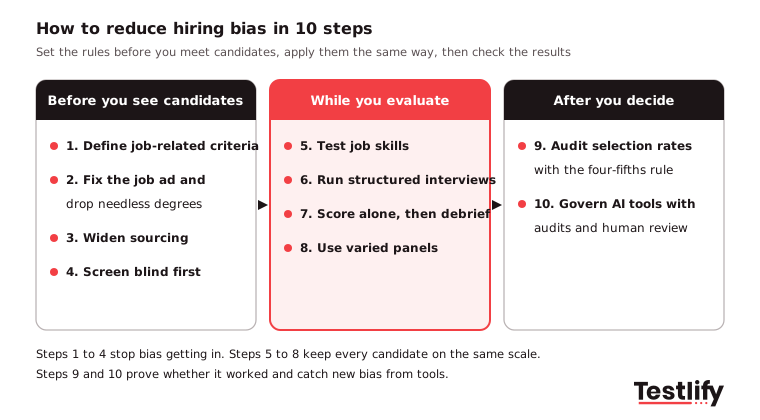
1. Define job-related criteria before you see a candidate
Write down the five to eight skills and behaviors the role needs, how you will test each one, and what a strong, average and weak answer looks like. Agree on this with the hiring manager in a short kickoff.
Every later step depends on it: without fixed criteria, people fill the gap with gut feel.
2. Rewrite the job ad and drop requirements you do not need
Cut coded words ("aggressive", "young and dynamic", "native speaker" when fluency is enough) and list only real must-haves. Degree and years-of-experience rules often screen out capable people without predicting performance.
Replace them with the skills you will actually test. A job description template for the role is a good starting point.
3. Widen sourcing beyond referrals
Referrals are fast but tend to bring in people who look like the current team. Add at least one new channel per role, such as community job boards, returnship programs or schools you have not recruited from before.
Then track where hires come from so you can see whether the mix changes.
4. Screen blind for the first pass
Hide names, photos, addresses, ages and graduation years during the first screen, so reviewers see skills and experience only. Blind hiring works best when it is short and early.
It cannot stay blind through interviews, so pair it with the next steps.
5. Test job skills before you weigh the resume
A skills test puts every candidate through the same job-related tasks and scores them the same way. Placing it before the resume review means people are judged on what they can do before pedigree has a chance to shape the view.
Use tests that match the criteria from step 1 and keep them short enough that candidates finish them.
Hiring on skills also widens the field. The LinkedIn Economic Graph's 2025 skills-based hiring report found that hiring on skills rather than past job titles grows talent pools by 6.1x globally, and could raise the share of women in AI-role talent pools by up to 24%. For more on how tests cut bias, see how to use skills assessments to reduce bias in hiring.
6. Run structured interviews with a scorecard
Ask every candidate for a role the same questions in the same order, and score each answer against a rating scale written in advance. Behavioral and situational questions tied to the criteria work best.
A structured interview limits small talk and follow-ups that drift into "culture fit", which is where affinity bias hides.
Pro tip: Use an interview scorecard with a short note field next to every score. Asking interviewers to write the evidence behind a number makes weak or biased scores easy to spot.
7. Score alone, then debrief
Each interviewer submits scores and notes before the panel meets. Discussion starts from the written scores, and the most senior person speaks last.
That one change stops a single confident voice from setting the outcome and makes disagreements visible.
8. Use varied interview panels
A panel with different backgrounds, functions and levels spreads out individual blind spots. Train every panel member on the criteria and the scorecard, not only on bias in general.
Rotate panel members so the same two people do not decide every hire.
9. Audit selection rates at every stage
Track how many candidates from each group pass each stage: application, screen, test, interview and offer. A drop at one stage tells you exactly where to look.
The next section shows how to run the check with the four-fifths rule.
10. Govern every AI tool you use in hiring
AI screening and scoring tools can apply the same criteria to every candidate, but they can also learn bias from past hiring data. Before you switch one on, ask for its latest bias audit, how scores are explained and how a person reviews decisions.
Recheck pass rates by group after launch.
Does bias training reduce hiring bias on its own?
Bias training on its own rarely reduces hiring bias for long. Awareness sessions help people name the problem, but the effect fades within weeks if nothing about the process changes.
Training works when it teaches people to use the new structure: the criteria, the scorecard and the independent scoring rule.
A better approach is short, practical training tied to each step:
- For recruiters: How to run a blind screen and read skills test results.
- For interviewers: How to ask structured questions, take evidence notes and score against the rating scale.
- For hiring managers: How to set criteria at kickoff and lead a debrief that starts from written scores.
Self-tests that reveal personal bias can start a useful conversation. They do not change who gets hired, but process changes do.
How do you measure whether hiring bias is going down?
Hiring bias is measured by comparing pass rates between groups at each stage of the process. The standard check in the US is the four-fifths rule from the federal Uniform Guidelines: if one group's selection rate is below 80% of the highest group's rate, the stage may have adverse impact and needs a closer look.
The rule is set out in 29 CFR 1607.4(D). Here is how it works with real numbers:
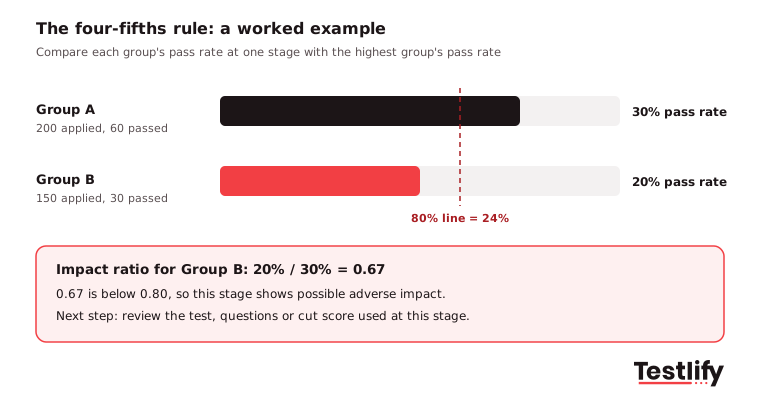
- Count each group at the stage: Group A has 200 applicants and 60 pass the skills test. Group B has 150 applicants and 30 pass.
- Work out each pass rate: Group A passes at 30% and Group B at 20%.
- Divide the lower rate by the higher rate: 20% divided by 30% gives an impact ratio of 0.67.
- Compare with 0.80: 0.67 is below 0.80, so this stage shows possible adverse impact.
- Review the stage: Check whether the test, questions or cut score are truly job-related, and whether a different cut score keeps quality while closing the gap.
Run the check every quarter for high-volume roles. Small numbers swing a lot, so treat results from fewer than about 30 candidates per group as a prompt to watch, not proof.
Other measures worth tracking:
Metric | What it tells you |
|---|---|
Pass rate by group at each stage | Where in the funnel bias appears |
Interviewer score spread | Which interviewers score far above or below peers |
Source of hire by group | Whether sourcing changes are working |
Offer acceptance and starting pay by group | Whether bias moves to the offer stage |
90-day retention and performance | Whether the new process still picks people who succeed |
How do you use AI in hiring without adding new bias?
AI in hiring reduces bias only when it applies clear, job-related criteria and people check its results. AI that learns from past hiring decisions can copy the bias in those decisions at scale, so the questions to ask a vendor matter as much as the features.
Rules are catching up. In New York City, Local Law 144 lets employers use an automated employment decision tool only if it has had a bias audit within the last year, a summary of the audit is public, and candidates get notice.
Enforcement began on July 5, 2023. In the EU, Annex III of the AI Act lists AI used to recruit or select people, filter applications and evaluate candidates as high-risk, which brings duties on risk management, human oversight and records.
Buyers want this too. In Testlify's State of AI-ready talent 2026 research, 34.4% of respondents named bias or fairness detection among the AI features they want in an interview process.
Ask every AI hiring vendor five questions:
- Audit: When was the last independent bias audit, and can we see the summary?
- Inputs: What data does the model score, and does it use anything not tied to the job?
- Explainability: Can a recruiter see why a candidate got a score?
- Human review: Can a person override every automated decision?
- Monitoring: Can we export pass rates by stage to run our own four-fifths check?
What does a 30-day plan to reduce hiring bias look like?
A 30-day plan to reduce hiring bias starts with one high-volume role, fixes the process for it, and measures the result before rolling out to other roles. Starting small gives you clean data and a working example for hiring managers who are unsure.
Week | Focus | Actions |
|---|---|---|
1 | Baseline | Pull pass rates by stage for the pilot role, run the four-fifths check, pick the worst stage |
2 | Criteria and ad | Hold the kickoff, write the criteria and rating scale, rewrite the job ad, drop needless requirements |
3 | Screen and interview | Turn on a blind first pass and a skills test, build the structured interview kit and scorecard, brief the panel |
4 | Debrief and review | Run independent scoring, collect interviewer feedback, plan the next quarterly audit |
After the pilot, compare time to hire, pass rates by group and hiring manager satisfaction with the baseline. Those three numbers make the case for rolling the process out.
How does Testlify help teams reduce hiring bias?
Testlify helps teams reduce hiring bias by putting skills evidence in front of the hiring decision and keeping the same criteria for every candidate. It covers several of the steps above in one platform:
- Skills tests first: A library of 3,500+ tests across tech and non-tech roles, so candidates are judged on job tasks before resumes. Browse the test library.
- Built from the job description: The AI test builder turns a job description into a role-specific assessment and suggests competencies and scoring criteria, which supports step 1.
- Structured AI interviews: Video, voice and chat AI interviews ask every candidate the same questions and score each answer against the same criteria, with human review.
- Explainable screening: The AI resume screener gives an explainable match score with High, Medium and Low fit labels, and syncs results back to 100+ ATS and HRIS tools.
- Audited model: Testlify's matching model completed a third-party bias audit under NYC Local Law 144 on June 16, 2023. See the NYC bias audit.
- Fair conditions: 20+ proctoring checks and 15+ languages keep test conditions the same for every candidate, wherever they are.
Start building a fairer hiring process
Pick one role, write its criteria, and put a skills test in front of the resume review. Book a demo to see how Testlify supports each step.
Prefer to try it yourself? Start a 7-day free trial, no credit card needed.
Frequently asked questions (FAQs)

Human Resources Lead
Snehi Parmar leads People at Testlify, owning hiring, culture, performance, and retention for a 90-person team. She writes on practical HR strategy and building people processes that scale.
Related resources
View all
HR & recruitment
8 ways to improve quality of hire to build a high-performing team

HR & recruitment
How to recruit for small businesses: 9 steps

HR & recruitment
6 workplace inclusion strategies to build a better work environment

HR & recruitment
Top 7 strategies to create a great recruitment experience
HR & recruitment
How to hire the best DevOps engineer?
HR & recruitment
Cognitive bias in hiring: 10 biases and how to stop them
Get started.
Hire on proof, not resumes.
Run your first skills-based assessment free — no credit card required.