
Red flags in pre-hiring checks: what HR should look for
The pre-hiring red flags that matter, the ones that are false alarms, and a fair, legal way to act when a background check finds a problem.

Red flags in pre-hiring checks are findings that contradict what a candidate told you or that point to a real, job-related risk: an identity that does not match, a job or degree that cannot be verified, a relevant conviction, evasive references, or a refusal to consent to screening. A red flag is a reason to verify and ask, not an automatic rejection.
TL;DR: This guide covers the checks that surface red flags, the ten red flags HR teams see most, and the findings that look bad but usually are not. It gives a five-question way to weigh any flag, the legal steps to follow before you act on a background report, and how identity fraud and AI-written applications have changed what screening has to catch in 2026.
 ChatGPT
 Gemini
 Claude
 Grok
 Perplexity
What are red flags in pre-hiring checks?
Red flags in pre-hiring checks are pieces of information, found during screening, that do not line up with the application or that suggest a candidate could create a safety, legal or performance risk in the specific role. Most fall into three groups: dishonesty (false claims), risk (relevant history) and process problems (missing consent, inconsistent forms).
A pre-hiring check is any step that verifies a candidate before an offer becomes final: identity verification, employment and education checks, reference calls, criminal record searches, licence checks and, for some roles, credit or driving records. Skills tests and structured interviews belong here too, because they confirm whether a candidate can actually do what the resume says.
The goal is not to find a reason to say no. The goal is to make a fair, documented decision with the full picture, and to avoid negligent hiring claims when a known risk was ignored.

Which pre-hiring checks can surface red flags?
Pre-hiring checks surface different red flags at different stages. Identity and skills problems show up early, in applications and assessments. Criminal, credit and licence findings usually appear in the background check after a conditional offer.
Check | What it confirms | Typical red flag | Usually used for |
|---|---|---|---|
Identity verification | The candidate is who they say they are | Name, ID or photo mismatch; a different person on camera | All roles, especially remote |
Employment verification | Employers, titles and dates | Dates or titles that do not match the resume | All roles |
Education and licence checks | Degrees, certifications, active licences | Unverifiable degree, lapsed or suspended licence | Regulated and professional roles |
Reference checks | How the candidate worked with others | Vague, evasive or rehearsed answers; no reachable manager | Mid-level and senior roles |
Criminal record search | Convictions relevant to the job | A recent conviction tied to the role's duties | Roles with safety, money or data access |
Credit history | Financial responsibility | Recent fraud-related judgments | Finance roles, where state law allows |
Motor vehicle record | Driving history | Suspended licence, serious violations | Driving roles |
Skills assessment | The candidate can do the work | Scores far below claimed experience; proctoring violations | All roles |
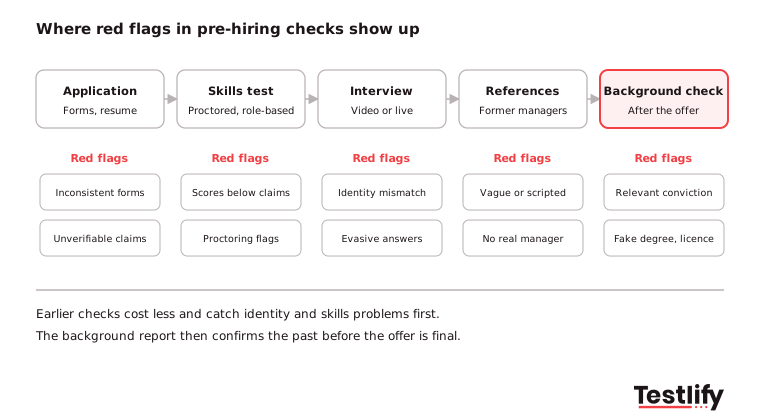
Pro tip: Run the checks that cost the least and catch the most first. A short skills test and an identity check at the start stop a fake or unqualified applicant long before you pay for a background report.
What are the most common red flags in pre-hiring checks?
The most common red flags in pre-hiring checks are identity mismatches, resume claims that cannot be verified, unexplained gaps, false credentials, job-related convictions, weak or evasive references and a refusal to consent. Most employment background check red flags fall into one of these groups, and each one deserves a follow-up question before a decision.
1. Identity that does not match
A name, ID, photo or voice that does not match across the application, the video interview and the ID check is now the most urgent red flag in remote hiring. Checkr's 2026 survey of 3,000 US managers found that 40% have interviewed a candidate later found to be using a fake identity, up from 31% in 2025.
2. Employment history that does not check out
Titles, dates or employers that differ from what a former employer confirms are the classic discrepancy. A small date slip is common. A job that never existed, or a "senior manager" who was an intern, is not.
3. Long gaps with no explanation
A gap on its own is not a red flag. A long gap the candidate hides, or explains differently each time you ask, is. Ask directly and record the answer.
4. Degrees, certifications or licences that cannot be verified
A degree from an unaccredited school, a certification the issuer has no record of, or a licence that has lapsed or been suspended matters most in regulated roles like healthcare, finance and engineering.
5. A criminal record that relates to the job
A conviction is a red flag only when it relates to the duties of the role, for example a recent fraud conviction for an accounts payable job or a serious driving offence for a delivery driver. The age of the offence and evidence of rehabilitation count too.
6. Weak, evasive or fake references
References who cannot describe the candidate's work, who all sound scripted, or who turn out to be friends or the candidate themselves are a warning sign. Ask for a former direct manager and use the reference check to test specific claims from the resume.
7. Refusing to consent to a background check
A candidate who will not sign the authorization after you explain what the check covers is telling you something. Make sure the request is clear and standard for the role before you read too much into it.
8. Incomplete or inconsistent forms
Different addresses, dates or names across the application, tax forms and ID can be innocent, but they can also hide a past the candidate does not want found. Ask for clarification in writing.
9. Skills that do not match the resume
A candidate who claims five years of Python but cannot pass a basic coding task, or who scores well only when the webcam is off, is a red flag no background report will catch. Checkr found that 65% of managers have uncovered a candidate who misrepresented their skills or experience.
10. Conduct problems in public posts
Threats, harassment or hate speech posted publicly can matter for customer-facing and leadership roles. Review only public, job-relevant content, use the same process for everyone, and keep protected traits (religion, health, politics in many places) out of the decision. More on this in the role of social media in pre-hiring assessments.
Which findings look like red flags but usually are not?
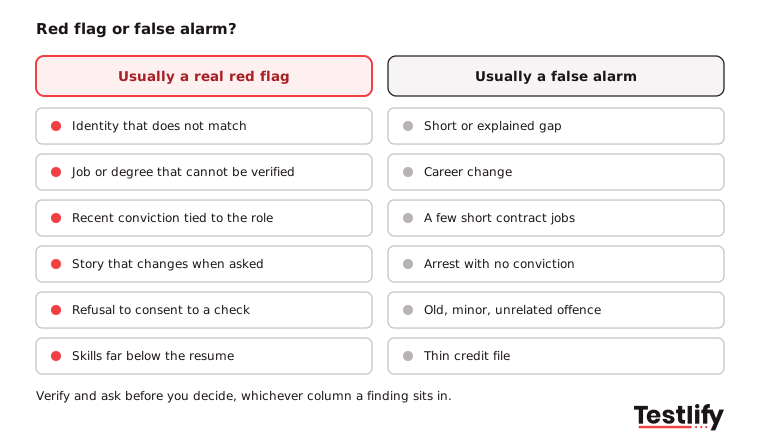
Findings that often look like red flags but usually are not include short employment gaps, a career change, a few short jobs, missing references from companies that closed, and arrests that never led to a conviction. Treating these as disqualifiers shrinks your pool and can create legal risk.
- Short or explained gaps: Caregiving, study, health, layoffs and job searches all take time.
- Non-linear careers: Moving from teaching to customer success or from sales to product is common and often a strength.
- A few short stints: Contract work and layoffs explain most of them. A pattern of very short jobs with no explanation is different.
- Arrests without a conviction: An arrest is not proof of anything, and some jurisdictions, including New York City, bar employers from asking about or acting on non-conviction records.
- Old, minor or unrelated offences: A decade-old minor offence that has nothing to do with the job rarely predicts anything.
- Thin credit files: Young candidates and new immigrants often have little credit history. Several US states and cities limit credit checks to specific roles.
How should HR weigh a red flag?
HR should weigh a red flag by asking five questions: is it relevant to this job, how serious is it, how recent is it, is it part of a pattern, and has the candidate explained it? A flag that is relevant, serious, recent and unexplained carries real weight. One that fails most of these tests usually does not.
Question | Carries weight | Carries little weight |
|---|---|---|
Relevant to the role? | Fraud conviction for a finance role | Old traffic fine for an office role |
How serious? | Fake degree for a licensed role | Wrong month on a start date |
How recent? | Within the last few years | A decade or more ago |
Part of a pattern? | Several unverifiable jobs | One unreachable reference |
Explained? | Story changes when asked | Clear, documented explanation |
Write the criteria down before you see any reports and apply them the same way to every candidate. The EEOC's guidance on background checks warns that using different standards for different groups breaks federal law, and that excluding people over criminal records must be "job related and consistent with business necessity".
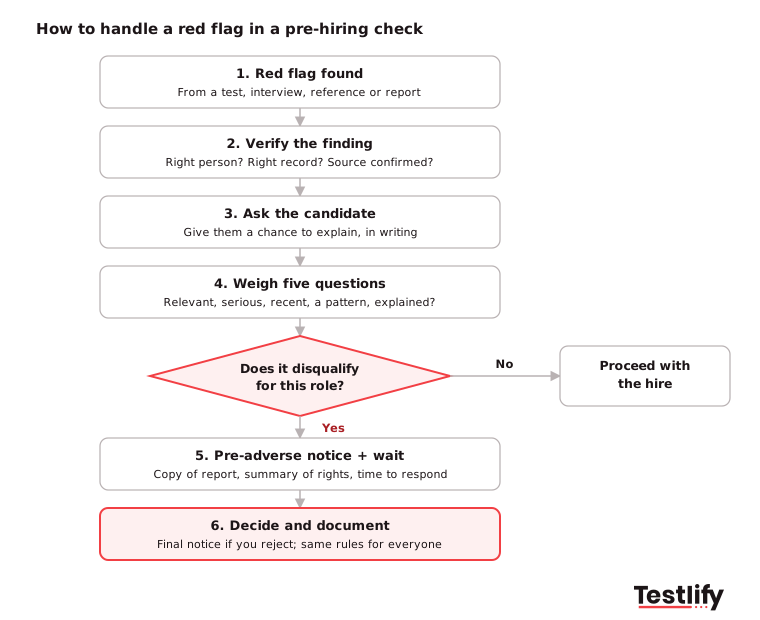
Key takeaway: A red flag starts a conversation. Verify the finding, let the candidate explain, weigh it against the job, and write down why you decided what you decided.
What does the law require before you act on a red flag?
The law requires, in the US, that employers get written consent before ordering a background report and give the candidate notice and a chance to respond before rejecting them because of it. State and city fair chance laws can add timing rules on top of that. Outside the US, data protection rules usually limit checks to what the role needs.
Under the Fair Credit Reporting Act, as the FTC's guide for employers explains, the steps are:
- Disclose and get authorization. Give a written disclosure in a stand-alone document, not buried in the job application, and get written permission.
- Send a pre-adverse action notice. Before you reject someone because of the report, send them a copy of it and "A Summary of Your Rights Under the Fair Credit Reporting Act".
- Wait and listen. Give the candidate time to point out errors. Background reports do get people mixed up, especially with common names.
- Send the adverse action notice. Include the screening company's name and contact details, a note that the company did not make the decision, and the candidate's right to dispute the report and get a free copy within 60 days.
Fair chance laws go further. In New York City, the Fair Chance Act lets employers ask about convictions only after a conditional offer, and before withdrawing that offer they must share the inquiry and their written analysis and give the candidate at least five business days to respond. Many other states and cities have their own versions, so check every location you hire in, and talk to employment counsel when a decision is close.
How are AI and fake candidates changing pre-hiring checks?
AI and fake candidates are moving the biggest red flag from the background report to the start of the process. AI tools make it easy to write a resume that matches any job description, and remote interviews make it easier for someone else to sit the interview or for a candidate to read answers off a second screen.
The numbers have grown fast. According to HR Dive's report on Gartner research, Gartner expects that by 2028, 1 in 4 candidate profiles worldwide could be fake, and 6% of the 3,000 candidates it surveyed admitted to interview fraud. Checkr's 2026 survey adds that 86% of organizations faced at least one type of hiring fraud in the past year, while only 23% of managers are extremely confident their process would catch a fraudulent candidate.
What this means for pre-hiring checks:
- Verify identity early, not only at the background check stage. Match the ID to the person in the video interview.
- Test skills under watch, with proctoring that flags tab switching, a second face on camera or pasted answers.
- Compare signals across stages. A strong written test followed by a weak live conversation is worth a follow-up.
- Keep checking after the offer. Confirm on day one that the person who starts is the person you interviewed.
For tactics on live calls, see how to spot red flags in interviews.
How do skills assessments catch red flags a background check misses?
Skills assessments catch the red flag a background check cannot: a candidate whose real ability does not match the resume. A background report confirms that a job existed. A proctored, role-specific test shows whether the person can do the work today.
Testlify supports this part of pre-employment screening in a few ways:
- Role-based tests. The test library has 3,500+ tests across technical, cognitive, language and role skills, so claimed experience gets checked against real tasks.
- Integrity and behaviour. An integrity test adds a structured look at honesty and reliability, alongside personality tests for spotting red flags.
- Proctoring. 20+ anti-cheating and proctoring checks, including webcam snapshots, face detection, tab and copy-paste tracking and AI assistance detection, flag the behaviour behind fake results.
- A person decides. Scores and flags inform the decision; a recruiter still reviews before anyone is rejected.
Background checks and skills assessments work best together: one confirms the past, the other confirms the present. If you want to see how the two fit, you can try Testlify free for 7 days, no credit card needed.
Frequently asked questions

Related resources
View all
HR & recruitment
Are personality tests reliable for candidate evaluation?

HR & recruitment
Important components of a candidate assessment report

HR & recruitment
How to create an effective onboarding process for new hires

HR & recruitment
What is talent acquisition and best practices for HR professionals

HR & recruitment
How to foster a positive company culture in your organization

HR & recruitment
How to implement flexible work policies for employee satisfaction
Get started.
Hire on proof, not resumes.
Run your first skills-based assessment free — no credit card required.