
How to simplify candidate screening with PostgreSQL test
Screen PostgreSQL candidates faster with one short test: skills by role, a 6-step workflow, sample tasks, cut-offs and cheating controls.

How to simplify candidate screening with PostgreSQL test results comes down to one change: test the skill before you spend time on the person. Send a short, role-specific PostgreSQL test right after the application, score every candidate on the same tasks, and invite only the people above your cut-off to interviews.
TL;DR / Key Takeaways
- A PostgreSQL test simplifies screening because every applicant writes real queries on the same tasks, so the shortlist rests on proof instead of resume keywords.
- Send the test right after the application, before the recruiter call, and keep it between 15 and 45 minutes.
- Test different skills per role: queries and indexes for developers, backup, replication and tuning for DBAs, joins and window functions for analysts.
- Set the cut-off from your own team's scores, not a vendor default, and read the per-skill breakdown for anyone near the line.
- Use proctoring and a follow-up interview that asks candidates to explain their own answers, since AI assistants make copy-paste cheating easy.
- PostgreSQL is the most used database among developers (55.6% in the Stack Overflow Developer Survey 2025), so the applicant pool is large and screening by hand does not scale.
- Testlify's ready-made PostgreSQL test takes 15 minutes, and you can add your own coding task and connect results to your ATS.
 ChatGPT
 Gemini
 Claude
 Grok
 Perplexity
What is a PostgreSQL test?
A PostgreSQL test is a timed, online skills assessment that checks whether a candidate can actually work with PostgreSQL: write correct SQL queries, design tables, use indexes, handle transactions and keep a database fast and safe. Recruiters send it early in the hiring process, and every candidate answers the same tasks under the same conditions.
PostgreSQL itself is an open-source, object-relational database known for reliability and data integrity. It follows ACID rules for transactions and supports views, foreign keys, stored procedures, triggers, JSONB documents and full-text search. For a quick primer your hiring managers can share, see the PostgreSQL glossary entry.
PostgreSQL tests come in four common formats:
- Multiple choice: Fast to take and score, good for checking concepts such as isolation levels or constraint types.
- Coding tasks: The candidate writes queries against a sample schema, and the platform runs them and checks the output.
- Take-home projects: A small schema or migration to design over a day or two, best for senior roles.
- Live interviews: The candidate writes and explains queries with an engineer watching.
Demand for these skills is broad. The Stack Overflow Developer Survey 2025 found that 55.6% of all respondents and 58.2% of professional developers had worked with PostgreSQL, ahead of MySQL at 40.5%. That makes PostgreSQL the most used database in the survey, and it means a busy job post can draw hundreds of applicants who all list it on their resumes.

Why use a PostgreSQL test to screen candidates?
A PostgreSQL test makes screening simpler because it replaces guesswork with evidence at the very first step. A resume can list PostgreSQL after one tutorial, while a test shows whether the candidate can write the query, fix the slow one and explain the design.
- Proof over keywords: Candidates show they can join tables, aggregate data and read a query plan, which a resume cannot prove.
- Problem solving in context: Scenario tasks reveal how candidates approach database design, optimization and troubleshooting, the skills that matter most once they are on the team.
- Fewer wasted interviews: Engineers spend interview hours only on candidates who already passed the technical bar.
- Lower hiring risk: Checking PostgreSQL skills up front cuts the chance of hiring someone who cannot do the job, which protects the team from rework, outages and early turnover.
- Fairer comparisons: Every applicant gets the same tasks, time limit and scoring rules, so the decision rests on skill instead of school, network or interview polish.
Hiring teams agree that skills come first. LinkedIn's Future of Recruiting 2025 report found that 93% of talent acquisition professionals say accurately assessing skills is crucial to improving quality of hire, and that companies running the most skills-based searches are 12% more likely to make a quality hire.
Which PostgreSQL skills should you test for each role?
PostgreSQL skills to test depend on the role. Every candidate should show core SQL, data types, constraints and basic query plans. Developers then need indexing and transactions, DBAs need backup, replication and tuning, analysts need joins and window functions, and data engineers need bulk loads and partitioning.
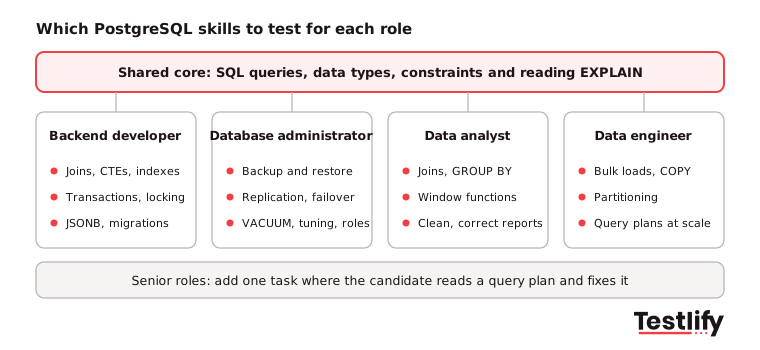
Start from the job description, not from a generic topic list. Write down the three to five PostgreSQL tasks the person will do in their first 90 days, then pick test topics that match them. The SQL developer job description template is a useful starting list of duties.
The pay level shows why a wrong hire is costly. According to the US Bureau of Labor Statistics, database administrators and architects earned a median of $126,760 in 2025, and the field expects about 7,300 openings a year over the next decade.
Which test format fits each hiring stage?
Test format should match the stage: short coding and multiple-choice tests work best for the first screen, while take-home projects and live sessions belong later, when only a few candidates remain. Putting a long project at the top of the funnel slows hiring and loses good applicants.
Format | Best stage | Typical time | What it shows | Main risk |
|---|---|---|---|---|
Multiple choice | First screen | 10 to 20 min | Concepts and terms | Rewards memory over skill |
Coding (query) tasks | First screen | 15 to 45 min | Can write correct, working SQL | Copy-paste from AI tools |
Take-home project | Final rounds | 2 to 4 hours | Design and code quality | Candidate drop-off |
Live interview | Final rounds | 45 to 60 min | Reasoning and communication | Interviewer time, nerves |
For most roles, a first-round test that mixes a few concept questions with one or two real query tasks gives the best signal for the time it takes. Pair a PostgreSQL test with a general SQL test when the role also touches other databases.
How to simplify candidate screening with PostgreSQL test: 6 steps
Simplifying candidate screening with a PostgreSQL test takes six steps: define the role's skills, build a short test, invite candidates early, run it fairly, score against a cut-off, and interview only the top group. The steps below combine what works across hiring teams and testing vendors into one workflow.
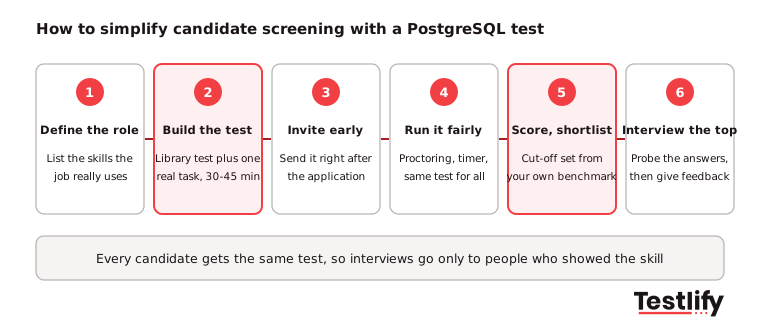
- Define what the role needs: List the PostgreSQL skills and experience the job requires, such as database design, query optimization, indexing or normalization, and agree on them with the hiring manager before you build anything.
- Build a short, realistic test: Start from a ready-made PostgreSQL test and add one task from your own work, such as designing a schema for a feature or fixing a slow query. Mix concept checks with hands-on tasks.
- Set the time and difficulty: Match both to seniority. Aim for 15 to 45 minutes in the first round. The test should separate strong candidates from weak ones without being so hard that good people give up.
- Tell candidates what to expect: Share the format, length, topics and rules before they start, and say whether documentation is allowed. Send the invite right after the application, before the recruiter call.
- Run it under fair conditions: Use the same test, timer and rules for everyone, with proctoring for remote candidates. Then score answers against a cut-off and shortlist those above it.
- Interview, give feedback and refine: Use the results to shape the technical interview, give every candidate short feedback, and update the test each year based on feedback from candidates and hiring managers.
Pro tip: Run the test on two or three people already doing the job well before you send it to candidates. If they struggle or finish in five minutes, fix the difficulty first.
What do good PostgreSQL screening tasks look like?
Good PostgreSQL screening tasks look like the work the person will actually do: a report query, a slow query to fix, or a data problem with a clear right answer. Each task should take 5 to 15 minutes and have an answer a reviewer can check without guessing.
- Customer spend report: Given orders and customers tables, return each customer's total spend in the last 90 days, including customers with no orders. A strong answer uses a LEFT JOIN, COALESCE for zero totals and a correct date filter.
- Top products per category: Return the three best-selling products in each category. A strong answer uses ROW_NUMBER or RANK with PARTITION BY and handles ties on purpose.
- Fix a slow query: Show an EXPLAIN plan with a sequential scan on a table of 10 million rows filtered by customer and date. A strong answer proposes a composite index in the right column order and names the write cost it adds.
- Query a JSONB column: Pull one field from event data stored as JSONB and filter on it. A strong answer uses the right operators and suggests a GIN index if the query runs often.
- DBA scenario: A table keeps growing although rows are deleted. A strong answer checks autovacuum activity, explains table bloat, and describes how to test a restore from backup.
Skip trivia such as release dates or obscure function names. Candidates can look those up in seconds, and the questions say little about how they will perform.
How do you read PostgreSQL test results and set a cut-off?
PostgreSQL test results are most useful when you read them against your own benchmark. Set the cut-off from the scores of people already doing the job well, check the per-skill breakdown for anyone near the line, and treat time taken as a tiebreaker, not a filter.
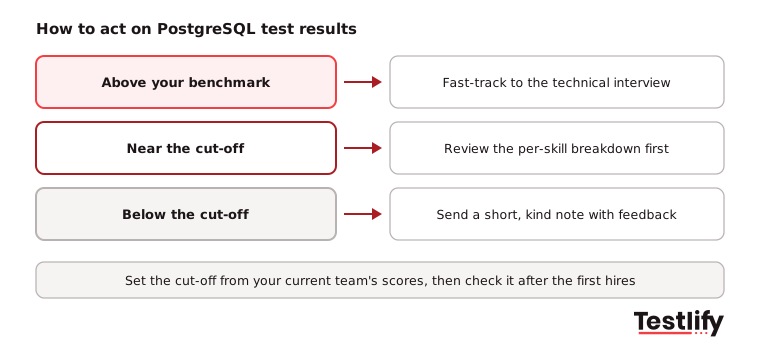
- Above your benchmark: Move the candidate straight to the technical interview.
- Near the cut-off: Look at the skill breakdown. A candidate who aced queries but missed one administration question may still fit a developer role.
- Below the cut-off: Send a short, kind note with the areas to improve. Candidates remember how a rejection felt.
Vendor pass marks we reviewed range from 55% to 70%, but a default number ignores your role and your bar. Compare accuracy, time to complete and the level of skill shown with what the job needs, then weigh soft skills, team fit and experience in the interviews that follow.
After the first hires, compare their test scores with their 90-day performance and adjust the cut-off. The LinkedIn report above found that 89% of talent leaders expect measuring quality of hire to matter more, yet only 25% feel highly confident they can do it, so this simple check puts you ahead.
Key takeaway: The test score opens or closes the door to the interview. The hiring decision still belongs to people who look at the evidence, the interview and the candidate's fit with the team.
What mistakes slow PostgreSQL screening down?
PostgreSQL screening slows down when the test comes too late, runs too long or measures the wrong things. The most common mistakes are easy to fix once you know them.
- Testing after the interviews: The test saves the most time when it comes first. Used last, it only confirms what interviewers already spent hours learning.
- Tests that are too long: First-round tests of more than an hour lose good candidates who have other offers. Keep long projects for the final round.
- Trivia instead of tasks: Definitions and syntax recall reward memory. Real query and design tasks show skill.
- No cheating controls: AI assistants can write a basic query in seconds. Use proctoring, randomized questions and a follow-up interview where candidates explain their own answers.
- An outdated question bank: PostgreSQL ships a new major version about once a year and supports each for five years, according to the PostgreSQL project's versioning policy. Review questions yearly so they match the versions you run.
- No feedback to candidates: Silence after a test hurts your employer brand. A short note on strengths and gaps takes minutes with a scored report.
- Skipping the human checks: Reference checks and a conversation about how candidates work with others still matter, especially for roles that own production data.
How does Testlify simplify PostgreSQL screening?
Testlify simplifies PostgreSQL screening by putting the test, the scoring and the shortlist in one place. You send a ready-made PostgreSQL test, add your own tasks if you need them, and get ranked, scored results that sync back to your ATS.
- Ready-made PostgreSQL test: The Testlify PostgreSQL test is an intermediate coding test of 8 questions in 15 minutes, covering queries, database design, performance tuning, JSONB, materialized views, security and backup. Subject matter experts build each test, and it is peer reviewed before release.
- Your own tasks: Add coding questions in a live IDE that supports 45+ programming languages, or any of 25+ question types, and combine the PostgreSQL test with SQL or role tests from a library of 3,500+ tests. The AI test builder can draft an assessment from your job description in under a minute.
- Fair, proctored tests: 20+ proctoring checks, including full-screen enforcement, copy and paste blocking, tab tracking, webcam snapshots and AI assistance detection. See anti-cheating and proctoring.
- Scores you can act on: Automated scoring, a per-skill breakdown, benchmarking and score thresholds that shortlist candidates automatically.
- Fits your stack: Two-way sync with 100+ ATS and HRIS tools through Testlify integrations, so recruiters keep working in the system they already use.
For the interview round that follows, use these PostgreSQL manager interview questions or the database administrator interview questions.
Ready to screen your next PostgreSQL hire?
Start a 7-day free trial of Testlify, no credit card required, add the PostgreSQL test to an assessment and send it to your next batch of applicants. Hiring for several data roles at once? Book a demo to see how teams run skills-first screening at volume.
Frequently asked questions

Wordpress Developer
Yash Patel is a Wordpress and SEO Specialist at Testlify with 3+ years of experience in technical SEO, on-page optimization, and content strategy. He works on improving Testlify's organic presence and produces content focused on hiring, talent assessment, and HR technology.
LinkedInRelated resources
View all
HR & recruitment
How to reduce recruitment costs without sacrificing quality in 2026

HR & recruitment
How to hire top talent using postgresql test

HR & recruitment
How to incorporate Git test into your recruitment strategy

HR & recruitment
How to simplify candidate screening with git test

HR & recruitment
How to hire top talent using git test

HR & recruitment
How to incorporate Scrum Master test into your recruitment strategy
Get started.
Hire on proof, not resumes.
Run your first skills-based assessment free — no credit card required.