
How to screen QA testers: skills, tests and interview questions
A six-step way to screen QA testers: pick the role type, test real skills, run a short bug hunt and score every candidate on one scorecard.

To screen QA testers well, you check how a candidate thinks about risk, not how many tools they list. A good QA screening process names the role type first, filters resumes against a few must-have skills, runs a short skills test, gives a timed bug hunt on your own product and ends with structured interviews scored on one scorecard.
Quality assurance (QA) testers are the people who find what breaks before your customers do. A weak hire lets defects reach production. A strong one makes every release safer and faster. This guide brings together the skills to test, the exercises that reveal real ability, the questions to ask and the red flags to watch for.
TL;DR:
- Screen QA testers in six steps: define the role type, screen resumes, run a 30 to 60 minute skills test, give a timed work sample, hold structured interviews, then score and check references.
- Decide first whether you need a manual tester, an automation engineer or an SDET. The title covers three different jobs with different first filters.
- The best single signal is a 45-minute bug hunt on your own product, judged on reproduction steps, expected versus actual results and a defensible severity call.
- Test reasoning before tools: a candidate who can explain what to test and what to skip beats one who only knows Selenium syntax.
- Score every candidate on the same weighted scorecard and drop polygraphs, pre-offer medical exams and social media sweeps from a QA funnel.
- The US median wage for software QA analysts and testers was $104,300 in May 2025, so a mis-hire is expensive.
 ChatGPT
 Gemini
 Claude
 Grok
 Perplexity
What does a QA tester do?
A QA tester checks that software works as intended before users see it. QA testers plan tests, run manual and automated test cases, log defects for developers and confirm fixes do not break anything else. The O*NET profile for software QA analysts and testers lists documenting defects in a bug tracking system and designing test plans among the core tasks.
Roles and responsibilities:
- Test planning: Writes test plans that set out how to verify functionality, find defects and confirm requirements are met.
- Test execution: Runs manual and automated test cases to find bugs and odd behavior.
- Defect reporting: Documents defects with enough detail for developers to reproduce and fix them.
- Regression testing: Confirms fixed issues stay fixed and new changes did not create new problems.
- Quality advocacy: Pushes for good testing habits and agreed quality standards inside the team.
Typical tasks: Test case creation, performance, load and stress testing, compatibility testing, usability testing, security testing, validation of requirements and documentation of test results.
What a good QA tester adds to the business:
- Better user experience: Issues are caught before release, which protects customer satisfaction and loyalty.
- Lower cost of defects: A bug found during development is far cheaper to fix than one found by a customer.
- Faster releases: Reliable testing gives the team the confidence to ship on schedule.

Which QA role are you screening for?
QA roles split into three jobs that often share one title: manual or exploratory testers, QA automation engineers and software development engineers in test (SDETs). Each needs a different first filter and a different work sample, so decide which one you are hiring before you write the job post or pick a test.
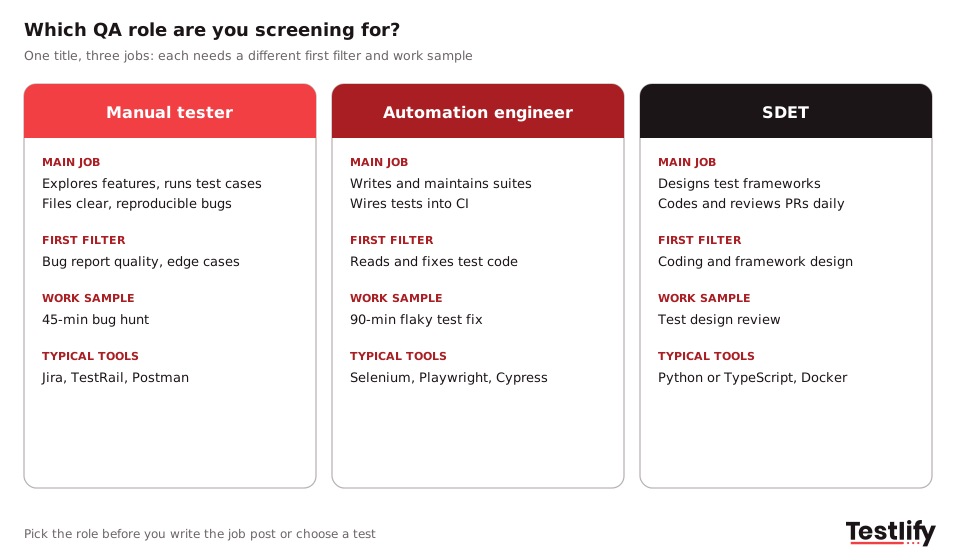
Manual or exploratory tester | QA automation engineer | SDET | |
|---|---|---|---|
Main job | Explore features, run test cases, file clear bugs | Write and maintain automated suites, wire them into CI | Design test frameworks, write code daily, review pull requests |
First filter | Bug report quality and edge-case thinking | Reading and fixing existing test code | Coding and framework design |
Typical tools | Jira, TestRail, Postman | Selenium, Playwright, Cypress, Appium, Jenkins | Python or TypeScript, Docker, custom frameworks |
Best work sample | 45-minute bug hunt on your product | 90-minute flaky test fix | Framework or test design review |
Choose it when | Developers test their own code and you need exploratory coverage | You have a suite that needs to grow and stay stable | You are building test infrastructure across services |
A simple rule helps. If engineers already write unit tests and you need more exploratory coverage, hire a manual tester. If you are maintaining an existing suite, hire an automation engineer. If you are building the framework itself, hire an SDET.
How do you screen QA testers step by step?
To screen QA testers, run six stages in order: define the role and scorecard, screen resumes against must-have skills, send a short online skills test, give a timed work sample, hold structured interviews, then score, check references and decide. Most teams can finish all six in two to three weeks.
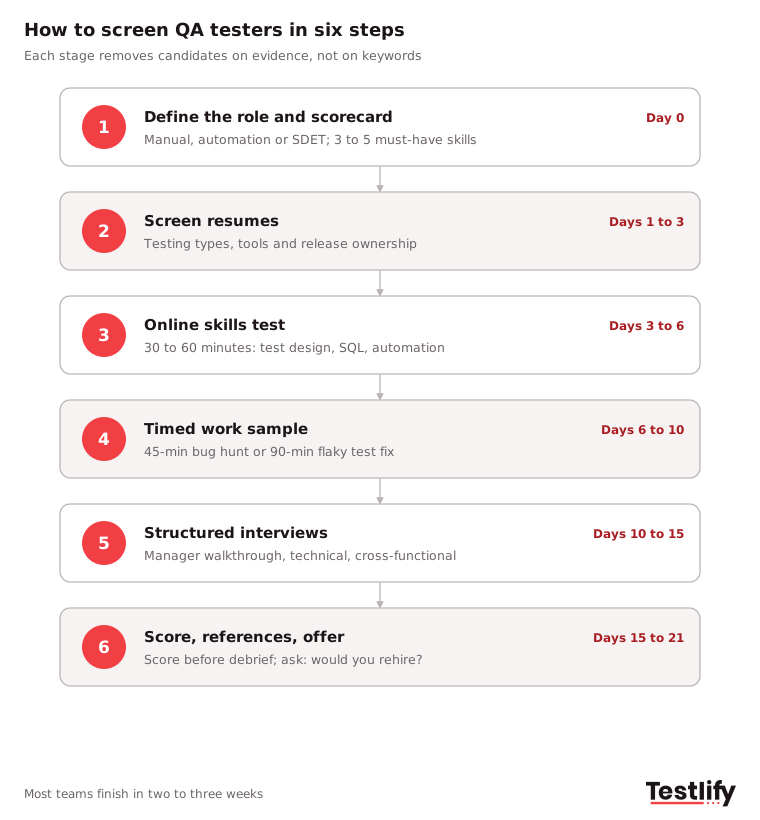
- Define the role and the scorecard: Agree on three to five non-negotiable skills and how each will be scored before you see a single resume. Use a test engineer job description or a software tester job description as a starting point.
- Screen resumes: Look for release ownership, regression work and clear evidence of testing types and tools that match your stack. Treat a long tool list with no outcomes as weak evidence.
- Send a short online skills test: A 30 to 60 minute test on testing concepts, test design, SQL or automation basics filters the pool on proof instead of keywords. This is where the candidate's first written communication also shows: reply speed, tone and clarity in early emails tell you a lot about how they will write bug reports.
- Give a timed work sample: Ask shortlisted candidates to test a real flow in your product and file what they find. Keep it under two hours.
- Hold structured interviews: Use the same questions for every candidate: a hiring manager walkthrough of the work sample, a technical round with an engineer and a short cross-functional round on how they explain bugs to non-engineers.
- Score, check references and decide: Score each candidate against the scorecard before the debrief, then check references. Ask each reference one question that tells you more than ten others: "Would you hire this person again?"
Pro tip: Keep candidates updated after each stage. Strong QA testers often have several offers, and a silent week loses them to faster employers. See how to reduce time to hire without cutting steps.
What hard skills should you test in QA testers?
The hard skills to test in QA testers are test design, defect reporting, knowledge of testing types, test automation, programming or scripting, database and SQL skills, API testing and fluency with test management tools. Weight automation and coding by role type: essential for automation engineers and SDETs, a bonus for manual testers.
Hard skill | What good looks like | How to assess it |
|---|---|---|
Test design | Covers boundary, negative and edge cases, prioritizes by risk | Ask for test scenarios for one feature in priority order |
Defect reporting | Steps to reproduce, expected vs actual result, environment, severity | Bug hunt, or rewrite a weak bug report |
Testing types | Knows when to use functional, regression, performance, security and usability testing | Scenario questions; QA aptitude test |
Test automation | Writes and maintains stable scripts, handles flaky tests | Review code samples; QA test automation test or Selenium test |
Programming and scripting | Reads and writes Java, Python or JavaScript test code | Short coding task in the candidate's language |
Testing frameworks | Has used JUnit, TestNG, Cypress or Playwright to organize and run tests | Ask how they structured a past suite |
Database and SQL | Writes queries to check data integrity | SQL test or a query task |
API testing | Tests endpoints, status codes and payloads | API testing test |
Test management and bug tracking | Uses Jira or TestRail to manage cases and track defects | Ask them to walk through a defect from report to closure |
For manual roles, the manual testing test covers test case writing, defect life cycle and testing types in one sitting.
Which soft skills matter most for QA testers?
The soft skills that matter most for QA testers are attention to detail, clear communication, critical thinking, adaptability, time management, teamwork and written reporting. These shape how a tester works with developers and whether their bug reports get acted on, so assess them with real examples, not self-ratings.
- Attention to detail: Ask about a subtle bug they caught that others missed. An attention to detail test gives you a scored baseline.
- Communication: Ask how they explained a complex issue to a non-technical stakeholder. A communication test helps at volume.
- Critical thinking: Give a hypothetical test scenario and listen for root-cause reasoning. A critical thinking test adds a consistent score.
- Adaptability: Ask about a time priorities changed mid-sprint and how they adjusted the test plan.
- Time management: Ask how they decide what to test when the deadline will not move.
- Teamwork: Ask about a disagreement with a developer and how it was resolved.
- Written reporting: Review sample defect reports for clarity and completeness.
What should a QA tester work sample look like?
A QA tester work sample should mirror the real job: a short, timed task on your own product or a realistic copy of it, graded on a rubric shared with every candidate. For manual testers that is a bug hunt. For automation roles it is fixing or reviewing existing test code, not writing a suite from scratch.
- Bug hunt (manual testers, 30 to 45 minutes): Give a real flow, such as sign-up or checkout, and ask for the three most important bugs in any format. Judge the report as the developer receiving it would: reproduction steps, expected versus actual behavior, environment and severity.
- Bug report rewrite (all levels, 15 minutes): Hand over a deliberately vague bug report and ask the candidate to rewrite it so a developer could reproduce it first time.
- Test scenario list (all levels, 20 minutes): Share a one-page feature note and ask for test scenarios, edge cases and the order they would test in.
- Flaky test fix (automation engineers and SDETs, up to 90 minutes): Share a small repository with one unstable test and ask them to find the root cause, fix it and write a short note. Give extra credit when they add a test for the fix.
- Defect reporting simulation (high volume): Use a simulated environment where candidates log defects against a known list, which makes scoring fast and fair.
Protect your product secrets by using a staging build or a public demo app, and keep every take-home under two hours. Long unpaid assignments push your best candidates out of the process.
Which screening methods work for QA testers?
The screening methods that work best for QA testers are skills tests, sample job tasks and structured interviews, backed by resume screening and reference checks. General tools such as cognitive and personality tests add context. Polygraphs, physical tests and medical exams do not belong in a QA funnel.
Screening method | Use it for QA testers? | Why |
|---|---|---|
Resume or ATS screen | Yes, first filter | Fast check for testing types, tools and domain; review the shortlist yourself |
Skills test | Yes, core | Proves testing knowledge, test design and tool skills at scale |
Sample job tasks (work sample) | Yes, core | The closest view of on-the-job performance |
Structured interview | Yes, core | Same questions and scoring for everyone; see structured interviews |
One-way video interview | Yes, early rounds | Shows communication without scheduling; candidates answer set questions on their own time |
Cognitive ability test | Optional | Useful for juniors to gauge learning speed; see this guide to cognitive ability tests |
Aptitude test | Optional | Measures how fast someone learns new skills; helpful for entry-level and associate roles |
Personality and behavioral test | Optional, never alone | Context on work style; see how personality tests are used |
Language proficiency test | When needed | For teams that write bug reports in a second language or work across regions |
Cover letter screen | Optional | Shows written clarity and whether they follow instructions |
Integrity test | Rarely | Overt and covert integrity testing suits roles handling sensitive data |
Reference check | Yes, final stage | Confirms the work behind the resume |
Paid trial project | For final one or two candidates | Real work on real code when you still need certainty |
Polygraph, physical ability test | No | Not related to QA work |
Medical exam | No, not before an offer | Allowed only after a conditional job offer |
US employers can require a medical exam only after a conditional job offer, according to the EEOC guidance on pre-employment medical exams. Skip social media sweeps too: they surface protected traits that can bias the decision and say little about testing skill.
How do you screen QA testers for AI-era skills?
Screening QA testers for AI-era skills means checking two abilities: reviewing tests and code that AI tools write, and testing products that use AI. The Stack Overflow Developer Survey 2025 found 84% of developers use or plan to use AI tools, so your next QA hire will review AI output daily.
Trust is the gap a good tester fills. In the Stack Overflow Developer Survey 2025, 45.7% of developers said they distrust the accuracy of AI output while only 32.7% trust it. The same survey found 17.9% already do most of their code testing with AI and 27.5% do part of it.
- Ask: "An AI tool generated 40 unit tests for this function. How would you check they are worth keeping?" Strong answers mention checking assertions, missing edge cases and tests that pass for the wrong reason.
- Ask: "How would you test a chatbot or a feature that gives different answers to the same input?" Look for ideas such as test sets, acceptance ranges and human review.
- Watch for: Candidates who accept AI-written tests without reading them, or who refuse to use AI tools at all.
What interview questions should you ask QA testers?
The interview questions to ask QA testers should cover soft skills, hard skills and general QA practice, asked in the same order to every candidate and scored against the same rubric. Here are 15 questions, five in each group. For deeper banks by level, see these interview questions for QA engineers.
Soft skills:
- Describe a time your communication resolved a conflict with a team member or client.
- How do you handle sudden changes in project priorities or requirements?
- Share an example of when your attention to detail uncovered a critical defect.
- Tell me about a complex issue you solved with a creative approach.
- How do you work with developers to make sure a product ships with quality?
Hard skills:
- Which automation tools and frameworks have you used, and how did you apply them on past projects?
- Which programming languages do you use to write test scripts, and how?
- What is the difference between regression, performance and security testing, and when do you use each?
- Walk me through your process for reporting a defect. What details do you always include?
- How do you design test cases to cover a feature completely?
General QA practice:
- Which QA methods, such as Agile or Waterfall, have you worked with, and which do you prefer and why?
- How does version control such as Git help in QA testing?
- Name a few testing tools you have used and what each is best for.
- How do you keep regression testing effective as the product changes?
- Describe a bug you missed or a release that went wrong. What did you change afterwards?
The last question matters most. Candidates who cannot name a single missed bug either lack experience or lack honesty, and both are risks in QA.
How do you score QA tester candidates fairly?
Scoring QA tester candidates fairly means rating everyone on the same five or so criteria, on a 1 to 5 scale, before the team debrief. A shared interview scorecard stops the loudest interviewer or a first impression from deciding the hire.
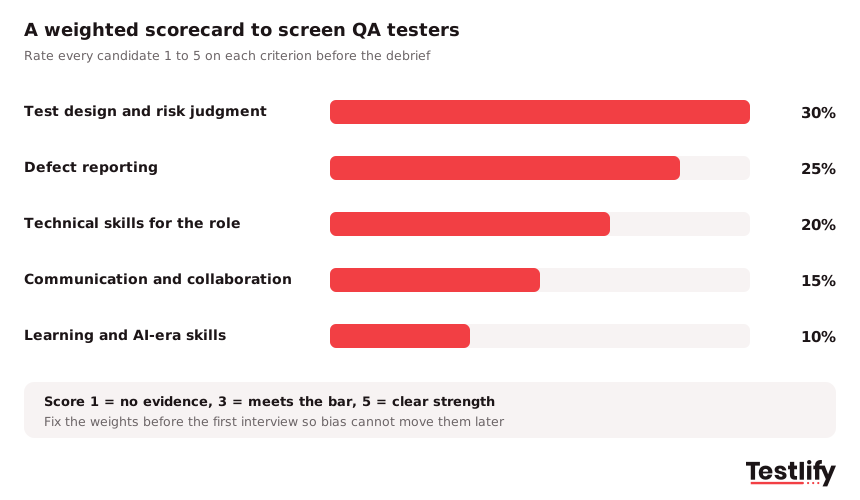
Criterion | Weight | What a 5 looks like |
|---|---|---|
Test design and risk judgment | 30% | Covers edge cases, explains what to skip and why |
Defect reporting | 25% | Reports a developer can act on without follow-up questions |
Technical skills for the role | 20% | Passes the skills test; for automation, fixes flaky code cleanly |
Communication and collaboration | 15% | Explains bugs clearly to engineers and non-engineers |
Learning and AI-era skills | 10% | Reviews AI output critically, keeps skills current |
Key takeaway: Decide the weights before you meet candidates. Changing them after an interview is how bias creeps back in.
A few habits keep the process fair:
- Challenge your first impression: If you strongly prefer one candidate, check whether the scorecard supports it or whether something else is driving the choice.
- Look for culture add, not culture fit: Ask what the person brings that the team lacks, rather than whether they blend in.
- Read their questions for you: The questions a candidate asks at the end show how well they prepared and how much they want the role.
What red flags should you watch for when you screen QA testers?
The main red flags when you screen QA testers are vague bug reports, tool lists with no outcomes, and an inability to explain what they would not test. Each one predicts slow, noisy QA work that developers learn to ignore.
- One-line bug reports with no steps, environment or expected behavior.
- Treating test case count or coverage percentage as proof of quality.
- Wanting to automate everything before understanding what breaks.
- Cannot name a missed bug or a release that went wrong.
- Describes developers as adversaries rather than partners.
- Years of scripted UI tests but no experience debugging a flaky suite.
- Spelling and grammar errors across the resume and written answers, which suggest weak attention to detail.
- Answers that sound right but fall apart when you ask one follow-up question.
Where can you find QA tester candidates?
QA tester candidates are easiest to find through job boards, referrals, QA communities and specialist recruiters, with remote hiring widening the pool further. Cast a wide net, then let the skills test do the filtering.
- Job boards: LinkedIn, Indeed, Glassdoor and tech-specific boards. Post a detailed listing that names your stack and the role type.
- Employee referrals: Your engineers often know testers they trust.
- QA communities: Testing meetups, conferences, webinars and online forums. Open-source contributions on GitHub show real work.
- Universities: Internship programs and career fairs bring in juniors who can grow into the role.
- Freelance platforms: Useful for project-based or contract-to-hire testing work.
- Recruitment agencies: Agencies that specialize in tech and QA can move faster on senior roles.
- Global talent: Remote and offshore testers broaden the pool; see this guide to hiring global QA talent.
How much does a QA tester cost in the US?
A QA tester in the US costs about $104,300 a year at the median, based on the US Bureau of Labor Statistics figure for software quality assurance analysts and testers in May 2025. Pay rises with automation skills, seniority, location and industry.
BLS counted about 187,600 jobs in this occupation in 2025 and projects 6% growth from 2025 to 2035. Manual testers usually sit below the median, while automation engineers and SDETs sit above it. Benchmark your offer every six months, since a stale salary range is one of the most common reasons strong QA candidates turn down offers.
QA tester job description template
A clear job description is the first screening tool, because it tells the wrong candidates not to apply. Adapt this template to your role type and stack.
About us: A short introduction to your company, mission and what makes the team worth joining.
Responsibilities:
- Create, maintain and run test cases to ensure the quality of software products.
- Perform manual and automated testing, then find and report defects.
- Work with product and engineering to understand requirements and design test plans.
- Run regression, performance, security and compatibility testing.
- Document results, track defects and provide clear reports so issues get fixed.
- Help improve testing processes and keep up with new tools and practices.
Qualifications:
- Degree in computer science or a related field, or equivalent experience.
- Proven experience as a QA tester or in a similar software testing role.
- Experience with automation tools such as Selenium or Appium and a scripting language such as Python or Java.
- Strong knowledge of testing methods, testing types and defect management.
- Familiarity with Jira or TestRail and version control such as Git.
- Strong analytical, communication and collaboration skills.
- ISTQB or similar certification is a plus.
Benefits: Competitive salary, health cover, retirement plan, paid time off, flexible work and a training budget. Add anything specific to your company.
How to apply: Ask candidates to send a resume and any certifications, with "QA Tester Application" in the subject line, and tell them the next step is a short online skills test.
Screen QA testers faster with Testlify
Testlify gives hiring teams one place to screen QA testers on proof instead of resumes. Pick ready-made tests such as the QA engineer test or the test automation engineer test from 3,500+ tests, or generate a custom assessment from your job description with the AI test builder.
- Real tasks, not just quizzes: 25+ question types, including coding, file upload and practical tasks, plus a live coding environment in 45+ programming languages.
- Resume screening built in: The AI resume screener gives each applicant a match score and fit label, then advances or rejects by threshold.
- Fair, cheat-resistant results: 20+ anti-cheating and proctoring checks and automated scoring, so every candidate is ranked on the same criteria.
- Fits your stack: 100+ ATS and HRIS integrations with two-way sync, so scores land where your recruiters already work.
Browse the Testlify test library, start a 7-day free trial with no credit card, or book a demo to see a ranked QA shortlist on your own roles.
Frequently asked questions
Related resources
View all
Hiring Guide
How to Hire a Taxi Driver (2026 Hiring Guide)

Hiring Guide
How to Hire a Retail Merchandiser: Skills & Interview Questions

Hiring Guide
How to hire a solar technician: 2026 hiring guide

Hiring Guide
How to hire a sanitation worker?

Hiring Guide
How to hire a room attendant: a step-by-step guide for hotels

Hiring Guide
How to hire a retail sales associate?
Get started.
Hire on proof, not resumes.
Run your first skills-based assessment free — no credit card required.