
Employee referrals: how they work and how much weight to give them
Employee referrals bring in loyal hires fast but can narrow your pipeline. Learn how they work, what they cost and how much weight to give.

Employee referrals are job candidates recommended by someone who already works at the company. They are one of the smallest sources of applicants and one of the strongest sources of hires, which is why most hiring teams run a referral program. A referral deserves real weight in a hiring decision, and it also deserves a ceiling: it should speed a candidate up, never lower the proof they have to show.
TL;DR.
- Employee referrals make up a small share of applications but convert well, with 40% reaching an interview in Ashby's 2025 data.
- Referrals can improve hiring speed and retention, but they may also narrow access and reinforce existing team networks.
- Give referrals faster access to recruiters, not an easier evaluation process. Every candidate should complete the same skills assessments and structured interviews.
- Set referral bonuses by role and tie payouts to retention, often after 90 days. Bigger bonuses do not necessarily bring better candidates.
- Track referral-to-interview rates, assessment pass rates, retention, demographic mix and employee participation to measure program quality.
- Use skills assessments to verify capability and keep hiring decisions based on evidence, not personal recommendations.
 ChatGPT
 Gemini
 Claude
 Grok
 Perplexity
What are employee referrals?
Employee referrals are candidates who enter your hiring process because a current employee recommended them, usually through a formal employee referral program that records who referred whom and pays a reward if the hire stays. The referrer vouches for the person. The referrer is not certifying the person's skills.
A simple example: a support team lead at a SaaS company sees an opening for a customer success manager and submits a former colleague she worked beside for two years. She notes that the colleague handled enterprise renewals and stayed calm on escalation calls. The candidate is flagged as a referral in the ATS, gets a recruiter call within two days, and then takes the same assessment and structured interview as every other applicant.
That line between vouching and certifying is where most referral trouble starts. "She was great to work with at my last job" tells you something genuine about reliability, communication and whether this person will stay. The same sentence usually tells you little about whether she can run a quarterly forecast or write production code, because the referrer never watched her do that exact work, or watched a different version of it years ago.
So a referral arrives with a built-in imbalance: high confidence about character, low confidence about capability. Good hiring processes price that in. Weak ones round the whole thing up to "trusted candidate" and start skipping steps.

What are the types of employee referrals?
Employee referrals usually fall into four types, and each one carries a different amount of first-hand knowledge about the candidate.
- Direct work referrals: The employee has worked with the candidate before and has seen their output. These carry the most useful signal, because the referrer can describe specific work.
- Personal network referrals: A friend, relative or acquaintance the employee knows outside work. The referrer can speak to character and interest in the role, but rarely to job skills.
- Social or shared-post referrals: The employee shares a job post on LinkedIn or in a community, and someone applies through their link. Many programs count these as referrals even though the employee may not know the applicant at all.
- Alumni and boomerang referrals: Former employees refer people, or a former employee is referred back. Former staff know the culture well, which makes their referrals close to direct work referrals in value.
Some teams also count customer, partner or candidate referrals, where someone outside the company recommends a person. Whatever types you accept, record the type on the application, because a shared post and a two-year working relationship should not be read as the same signal.
How do employee referrals work?
Employee referrals work in five steps: the company opens a role and tells employees, an employee submits someone from their network, the candidate goes through the normal evaluation, the hiring team decides on the evidence, and the referrer earns a reward once the hire stays past a qualifying period. The qualifying period is the step people forget.
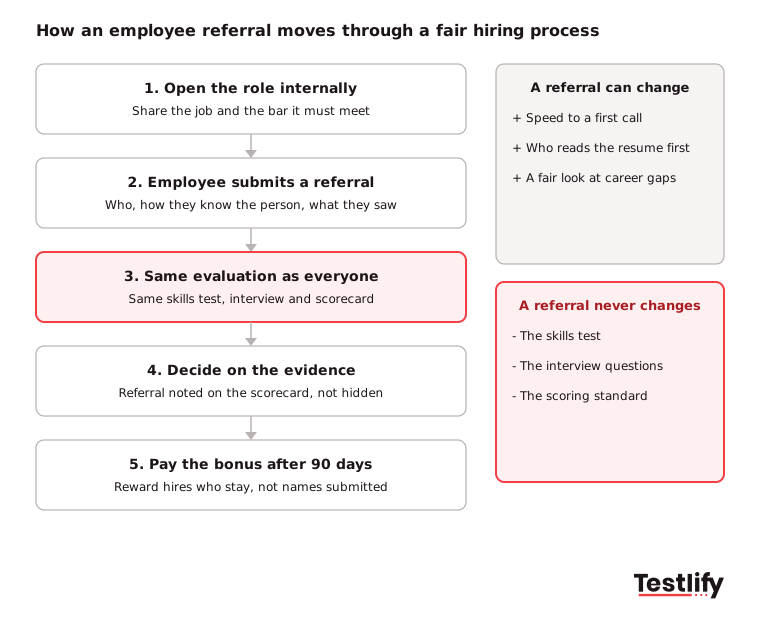
- Publish the open role internally, with the bar attached: Share more than the job title. Employees refer better when they know what the role actually needs, and worse when all they have is a headline and a bonus figure.
- Capture the referral with context: Record who referred the candidate, how they know each other, how recently they worked together and what the referrer has actually seen this person do.
- Run the same evaluation everyone else runs: Same skills test, same structured interview, same scorecard. This step protects both the company and the referrer.
- Decide on the evidence: The referral is one visible input on the scorecard, not a thumb on the scale nobody writes down.
- Pay the reward after a qualifying period, often 90 days: Paying on signature rewards volume. Paying after the hire has stayed and performed rewards judgment.
Most programs get steps 1, 2 and 5 right and quietly fail at step 3. The referred candidate gets a friendlier interviewer, a shorter loop or a pass on the test, and six months later nobody can explain why that hire is struggling.
Do employee referrals actually work?
Employee referrals work well as a small, high-converting channel. Recent hiring data shows referrals make up a tiny share of applications but reach interviews far more often than other applicants, and the research on retention points the same way. Where they work less well is reach: referrals mostly bring in people who look like your current team.
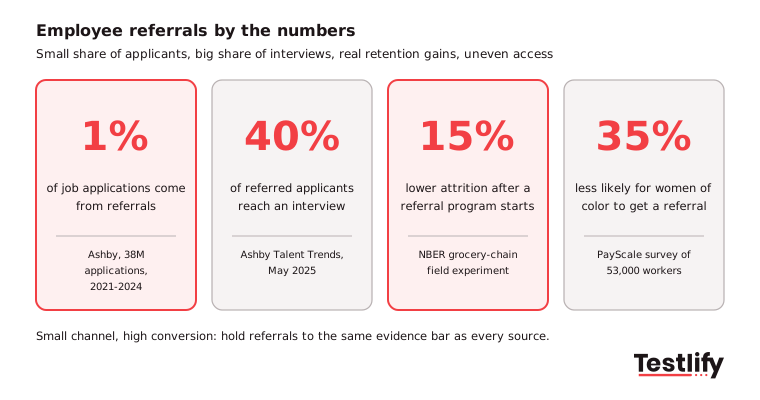
Here is what the most useful current numbers say:
- Referrals are a small slice of applicants: ATS vendor Ashby's Talent Trends report (May 2025), built on 38 million applications across 93,000 jobs from 2021 to 2024, found referrals averaged just 1% of applications, falling from 2% in early 2021 to under 1% by early 2024.
- Referrals convert far better: In the same dataset, 40% of referred applicants reached an interview and 16% of interviewed referrals went on to an offer.
- Small employers see the same pattern: CareerPlug's 2025 Recruiting Metrics Report, which covers 2024 hiring at more than 60,000 small businesses, found referrals and custom sources produce the highest-quality candidates yet the lowest share of applicants, while job boards supply 61% of applications.
- Retention is where the money is: A randomised field experiment across a grocery chain, published by the National Bureau of Economic Research, found that introducing a referral program cut attrition by about 15%.
For context on how low the retention bar is: median employee tenure in the United States was 4.1 years in January 2026, and just 3.0 years for workers aged 25 to 34, according to the U.S. Bureau of Labor Statistics. Against that baseline, a channel that reliably holds people a few months longer is worth protecting.
What are the benefits of employee referrals?
Employee referrals bring four main benefits: candidates who already want the job, faster first conversations, lower sourcing cost and better retention, including among staff who never refer anyone.
- Candidates arrive with intent: Someone they trust has already told them the job is worth it, so fewer referred candidates drop out between the first call and the offer.
- Speed to a first conversation: A referral flags the person as worth talking to, which compresses the time from application to first call.
- Lower sourcing cost: You still pay a bonus and still pay for assessment and interview time, but you skip job-board spend and agency fees for that hire. The saving is real and smaller than many vendors claim.
- Retention, twice over: Referred hires tend to stay longer, and the grocery-chain experiment found something almost nobody writes about: most of the drop in attrition came from non-referred staff staying longer, not from the referred hires. The researchers' best explanation is that employees value having a say in who gets hired.
Read that last point again, because it changes what a referral program is for. The biggest return may not be the people it brings in. It may be what it does for the people you already have, which means a program can be worth running in a quarter where it produces almost no hires.
What are the disadvantages of employee referrals?
Employee referrals have four real disadvantages: they narrow who gets access to your jobs, bigger bonuses attract weaker referrals, they invite favoritism inside the process, and rejecting a referral costs more socially than rejecting a stranger.
The access gap: Between April and August 2017, PayScale asked 53,000 workers whether they had been referred for their current job. Holding industry, location and other factors constant, white women were 12% less likely to have been referred than white men, men of color 26% less likely and women of color 35% less likely. Out of every 100 referred employees, 44 were white men, against white men making up 34% of the labour market.
Nobody designed that. People know people like themselves, so a referral-heavy pipeline produces a narrower shortlist without any biased recruiter involved. Our guide to common types of hiring bias covers how the same pattern shows up elsewhere in hiring.
The compliance angle: The U.S. Equal Employment Opportunity Commission's compliance manual on race and color discrimination says word-of-mouth recruiting in a non-diverse workforce "is a barrier to equal employment opportunity if it does not create applicant pools that reflect the diversity in the qualified labor market." The guidance dates from 2006, so check current rules with counsel, but the practical lesson holds: never let referrals be your only source for a role.
The bonus trap: The same NBER experiment found that larger bonuses raised the number of referrals and lowered their quality. Pay more, get more names, get weaker names.
Favoritism and awkward rejections: A referral links the hiring decision to a colleague who will see the outcome, which quietly pushes interviewers toward yes. Nobody writes "I advanced her because Dev vouched for her" on a scorecard. It still happens. And teams that have not planned how to reject a referral either stop referring or start advancing people they should not.
Here is the split that matters when you decide how much a referral should move a decision:
A referral is good evidence of | A referral is not evidence of |
|---|---|
The candidate wants to work here, and someone they trust said it was worth it | That they can do this role at the level you need right now |
They are likely to settle in quickly and stay longer than average | That they will outperform a stronger candidate who applied cold |
Your employees are engaged enough to attach their name to someone | That your pipeline reaches anyone outside your team's existing networks |
Basic reliability: showing up, meeting deadlines, being decent to work with | That this is the best available candidate for the job you have open |
How much weight should employee referrals carry in a hiring decision?
Employee referrals should carry enough weight to earn a candidate a prompt first conversation and the benefit of the doubt on resume gaps, and no weight at all on whether the candidate can do the work. That evidence has to come from the same skills assessment and structured interview every other candidate takes, scored the same way.
The reason to be strict is not fairness alone. A referral tells you about intent and character; a work sample or role-based test tells you about capability. Mixing the two lets a strong signal on one question stand in for a missing answer on the other.
What a warm referral should and should not change
A warm referral works when the team agrees, in writing, what the referral is allowed to change. Let it change speed, access and attention, and the channel pays for itself. Let it change the standard of proof, and you have built a side door.
In practice, a referral can earn someone a reply within 48 hours instead of a week in the queue, a real conversation with the hiring manager and a fair reading of a non-linear career. It should not earn them a skipped assessment, a softer interviewer or a scorecard filled in with the referrer's name in mind.
Pro tip: add one required field to your referral form: "What have you actually seen this person do?" Referrals that answer with a specific project are worth fast-tracking for a conversation. Referrals that answer "we worked together and she is great" are worth processing like any other application. That single question separates a useful signal from a friendly one, and it costs nothing to add.
How much should an employee referral bonus be?
Employee referral bonuses commonly range from a few hundred dollars for hourly roles to a few thousand for professional roles, paid only after the new hire passes a qualifying period. Size matters less than structure: a modest bonus paid on retention beats a large bonus paid on signature.
An AAIM HR Trend Survey from February 2024 of 82 employers, most with fewer than 250 staff, gives a useful benchmark. Treat it as a guide, not a national average:
Role level (AAIM, Feb 2024) | Average bonus per referral |
|---|---|
Production, maintenance and service (non-union) | $924 |
Office, clerical and technical (non-exempt) | $2,397 |
Supervisory, managerial and professional (exempt) | $2,536 |
All positions (52 employers) | $1,936 |
The same survey shows how employers pay: most wait for the 90-day mark, many split the bonus into instalments (for example, part at 90 days and the rest at six months or one year), and most exclude HR staff and anyone in the hiring chain for that role. One respondent noted that raising the bonus several times did not lift participation, which matches the NBER finding that bigger bonuses buy volume, not quality.
A sensible structure for most teams: a fixed bonus by job level, paid in two parts tied to retention, plus visible recognition for every referral that reaches interview. Raise the cash only for roles that genuinely will not fill.
How do you run a fair employee referral program?
A fair employee referral program writes the rules down, applies the same evaluation to every candidate, pays on retention rather than on signature, and checks where referrals come from. SHRM's referral program toolkit lands in the same place: a program behaves predictably once eligibility, process and payout terms are written down instead of assumed.
- Document eligibility and payout before you launch: Who can refer, who cannot, what happens with a duplicate referral and when the bonus pays. Our guide to designing a successful employee referral program walks through the policy detail.
- Keep one evaluation standard: Same assessment, same structured questions, same scoring, referral or not. Make the referral visible on the scorecard so reviewers can account for it instead of being nudged by it.
- Ask employees to refer outside their immediate circle: Former colleagues from other industries, people in other cities, contacts from communities the team is not already part of. This is the cheapest counterweight to the access gap PayScale measured.
- Never fill a role from referrals alone: Post the role on at least one open channel so the applicant pool reflects the qualified labour market, as the EEOC guidance suggests.
- Pay on a qualifying period: A 90-day condition aligns the referrer with what you actually want, a hire who stays.
- Close the loop with referrers: Tell them what happened and why, in a sentence. A referrer who gets a straight answer refers again. One who hears nothing assumes the program is for show. Ready-made referral email templates make this quick.
Who should be allowed to refer?
Almost everyone should be able to refer, with two sensible exclusions: anyone in the decision chain for that specific role, and anyone in HR or talent acquisition who would process the referral themselves. A hiring manager referring into their own open role is a conflict, not a referral.
Beyond that, keep eligibility open. Narrowing it by tenure or seniority sounds prudent and mostly shrinks the pool to people whose networks already match the company's. A new joiner who knows a strong candidate in month two brings the network most likely to reach outside your existing bubble.
Which employee referral metrics should you track?
Employee referral metrics should show three things: whether referrals produce capable hires, whether those hires stay, and whether the channel is narrowing your pipeline. Six numbers reviewed once a quarter are enough for most teams.
Metric | What it tells you | Warning sign |
|---|---|---|
Referral share of applications and of hires | How much you depend on the channel | Hires share far above applications share with no quality check |
Referral-to-interview rate | Whether employees understand the bar | Falling rate after a bonus increase |
Assessment pass rate, referred vs non-referred | Whether referrals are capable, not just familiar | Referrals pass less often but get hired more often |
90-day and 12-month retention by source | Whether the retention benefit is real for you | Referred hires leave as fast as others |
Demographic mix of referrals vs all applicants | Whether the channel is narrowing access | Referral pool much less diverse than applicants |
Share of employees who have referred | Whether the program reaches beyond a few teams | Most referrals come from one team or level |
The third row is the one to watch. If referred candidates pass assessments at a visibly lower rate but get hired at a higher one, the process has a leak and the bonus is paying for it. Tracking quality of hire by source lets the data decide which referrers and teams refer well, instead of guessing from the org chart.
Key takeaway: referrals are a small channel that converts and retains well. Keep them, measure them by source, and hold every referred candidate to the same evidence bar.
Where do skills assessments fit with employee referrals?
Skills assessments are what make a referral safe to accept. They give the referred candidate a way to prove the thing the referrer could not vouch for, on the same terms as everyone else, and they give the hiring team something to measure.
Run the two together and the awkwardness mostly disappears. Hiring on demonstrated skills turns "we did not advance your friend" into "the work sample came in below the bar for this role", a sentence a referrer can accept and repeat.
Picture a 400-person contact center hiring 30 agents a quarter, with roughly a third of applicants arriving through referrals (an illustrative scenario, not a customer). Every candidate takes the same customer-communication and typing assessment before any interview. The referral still matters: it decides who gets contacted first and who gets a second look after a near-miss score. But the shortlist is built from assessment results, so the hiring manager spends the first call on judgment instead of re-checking basic skills.
Testlify is one way to run that evidence step: a library of 3,500+ skills tests, structured AI interviews and automated scoring that sit alongside the ATS a team already uses through 100+ integrations. It does not replace a referral program. It is the step that lets a referral be a welcome shortcut to attention rather than a quiet exemption from scrutiny.
Put the same evidence bar behind every referral
If referrals are a real channel for your team, add one evidence step that every candidate clears, referred or not. Browse the test library for the roles you hire most, or start a 7-day free trial (no credit card) and run your next referred candidate through the same assessment as everyone else.
Frequently asked questions (FAQs)

Related resources
View all
HR & recruitment
What role does integrity testing play in pre-hiring evaluations?

HR & recruitment
How to incorporate aptitude assessment into your recruitment strategy

HR & recruitment
How to overcome a limited budget for recruiting in 2026

HR & recruitment
Are pre-hiring assessments scalable for high volume hiring?

HR & recruitment
How can HRs ensure pre-hiring assessments comply with regulations

HR & recruitment
Risks of skipping pre-hiring background checks and how to avoid them
Get started.
Hire on proof, not resumes.
Run your first skills-based assessment free — no credit card required.