
Document control clerk interview questions and what good answers sound like
Ask these document control clerk interview questions, score answers on one scale, spot red flags and add a short filing task before hiring.

One misfiled revision can send a site team building from the wrong drawing. Document control clerks are the people who stop that from happening.
Document control clerk interview questions should show whether a candidate can file, log, version and retrieve documents accurately, and keep restricted files private. Confident talkers often sound careful in an interview, but carelessness only shows up in the work.
TL;DR:
- The best document control clerk interview questions test five skills: accuracy, version control, confidentiality, document management systems and organized handling of volume.
- A document control clerk files, scans, logs and retrieves documents under procedures someone else owns. A document controller designs and runs the system, so interview the clerk on execution, not on writing procedures.
- Ask every candidate the same questions and score each answer from 1 to 4 against written criteria. Unscored, unstructured interviews reward confidence over care.
- Add a 20-minute work sample, such as finding errors in a revision log. It shows accuracy faster than any interview answer.
- The biggest red flag is a candidate who "fixes" a record by overwriting it. Good clerks keep the history visible and log every change.
- File clerk jobs in the US are projected to fall 16% from 2025 to 2035, per BLS, so the clerks you hire now need digital system skills, not just filing.
 ChatGPT
 Gemini
 Claude
 Grok
 Perplexity
What does a document control clerk do?
A document control clerk keeps an organization's controlled documents accurate, current and easy to find. The clerk receives new and revised documents, checks them against the template and approval rules, gives them the right number and revision, files or uploads them, sends them to the right people, and withdraws superseded copies.
According to the O*NET profile for file clerks, the core of the job is keeping records of materials filed or removed, finding and copying information for authorized users, and adding new material to records. O*NET's File Clerks profile also names Adobe Acrobat and Microsoft SharePoint among the main software and attention to detail as the top work style.
Document control clerks work wherever documents carry legal or safety weight: construction and engineering projects, manufacturing plants, pharma and medical device companies, healthcare providers, banks and insurers. The title changes (document control assistant, records clerk, document management clerk), but the job does not.
Many teams mix this role up with the senior one. Use this table to level the role before you write the interview plan.
Comparison point | Document control clerk | Document controller |
|---|---|---|
Main job | Follows the document control procedure | Designs and owns the procedure |
Typical tasks | Numbering, filing, scanning, uploading, distributing, withdrawing old revisions | Setting up the system, approval workflows, audits, training others |
Decisions | Escalates exceptions | Decides how exceptions are handled |
Experience | Entry level to 3 years | Usually 3+ years, often with a certification |
What to interview for | Accuracy, care, speed, following rules | Process design, stakeholder management, audit readiness |
If your role is closer to the right-hand column, our list of document control specialist interview questions covers the senior skills in depth.

What skills should document control clerk interview questions test?
Document control clerk interview questions should test five skills: accuracy, version control, confidentiality, comfort with a document management system (DMS), and the focus to handle volume without errors. Every question below maps to at least one of them, so you can check that your interview covers all five.
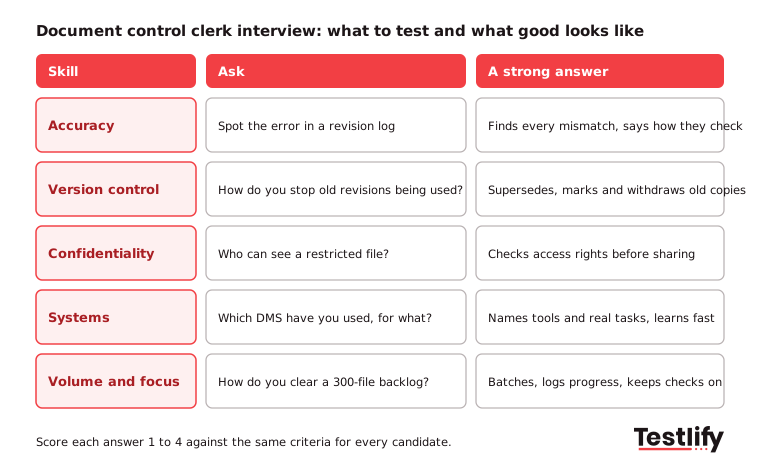
- Accuracy: Spots wrong numbers, missing signatures, wrong templates and mismatched revisions before a document goes out.
- Version control: Knows that only the current approved revision should be in use, and makes sure old copies are marked, withdrawn or archived.
- Confidentiality: Checks who is allowed to see a document before sharing it, and never sends a restricted file "just this once".
- Systems: Has used at least one DMS, shared drive structure or records tool, and learns new ones quickly.
- Volume and focus: Keeps the same care on the 300th document as on the first, and asks for help before a backlog becomes a risk.
Pro tip: Decide before the interview which skill each question tests and what a 4 out of 4 answer contains. Writing this down first is what turns a chat into a structured interview.
What general and background questions should you ask?
General and background questions should confirm the candidate's real experience with documents, systems and procedures. Ask for specifics: which system, how many documents, what kind.
Vague answers here usually mean the experience is lighter than the resume suggests.
- What kinds of documents have you controlled or filed in past roles, and roughly how many per week?
- Which document management systems or shared drive setups have you used, and what did you do in each?
- Walk me through what happens, step by step, when a new revised document arrives on your desk.
- How do you check that a document is complete and approved before you file or issue it?
- Have you worked with both paper and electronic records? How did you keep the two in step?
- What document numbering or naming rules have you followed? Give an example of a document number and what each part meant.
- How do you track who has received a controlled copy of a document?
- What does a typical day look like for you when the workload is heavy?
- Which part of document control do you enjoy most, and which part do you find hardest?
- What did your last supervisor rely on you for?
What to look for: Named tools, real volumes and a clear sequence of steps. A candidate who can describe their old numbering scheme from memory usually followed it carefully.
What technical document control questions should you ask?
Technical document control questions check whether the candidate understands why the rules exist, not just that they exist. A clerk who knows the reason behind revision control or retention schedules makes fewer mistakes when something unusual turns up.
- What is the difference between a document and a record?
- What is a revision, and how do you make sure people only use the current one?
- What does "superseded" mean, and what do you do with a superseded document?
- What metadata do you usually enter when you upload a document, and why does it matter?
- What is a transmittal, and when would you send one?
- What is a retention schedule? How do you know when a record can be destroyed?
- How would you handle a document that arrives without an approval signature?
- What is an audit trail, and why should a change to a record never hide the old entry?
- How do you scan a 60-page document so it is complete, legible and searchable?
- How would you organize a shared folder so a new team member can find any file in under a minute?
What to look for: For question 11, a document can still change while a record is final evidence of something that happened. For question 18, regulated industries take this seriously.
The US rule for electronic records in FDA-regulated work, 21 CFR 11.10, requires secure, time-stamped audit trails and says record changes shall not obscure previously recorded information. Candidates do not need to quote the rule, but they should know never to overwrite history.
For records-heavy roles, candidates who know ISO 15489-1:2016 have an edge, since the standard sets out the concepts and principles for creating, capturing and managing records. Treat it as a bonus, not a requirement, for a clerk.
What behavioral questions reveal how a clerk really works?
Behavioral questions reveal how a document control clerk acted in real situations, which predicts how they will act in yours. Ask for one specific example each time and follow up with "what exactly did you do?" until you hear the candidate's own actions.
A behavioral interview works best when you score the example, not the storytelling.
- Tell me about a time you found an error in a document that others had already approved. What did you do?
- Describe a time you had to process a large batch of documents under a tight deadline. How did you keep the error rate down?
- Tell me about a time someone asked you for a document they were not authorized to see.
- Describe a time you had to learn a new document system or procedure quickly.
- Tell me about a mistake you made in filing or logging. How did you find it and fix it?
- Describe a time a colleague kept sending documents that did not follow the template. How did you handle it?
- Tell me about a time you had to find a missing document urgently.
- Describe a repetitive task you did for weeks. How did you stay accurate?
What to look for: The candidate owns the action ("I checked", "I logged", "I escalated") and names a result. Honest answers to question 25 are a good sign: everyone misfiles something eventually, and good clerks have a habit for catching it.
What situational questions test judgment on the job?
Situational questions test judgment by putting the candidate in a realistic scene from your workplace and asking what they would do next. They work well for entry-level candidates who have little past experience to draw on, and they make answers easy to compare.
- A site engineer emails you a drawing marked revision C, but the system shows revision D is current. What do you do?
- You find the same contract saved in three folders with slightly different file names. What are your next steps?
- A manager asks you to delete an old record "to tidy up" before an audit. How do you respond?
- You have 200 scanned invoices to index by end of day, and the scanner fails at 2 pm. What do you do?
- A new hire asks you to email them the full employee records folder for a project. How do you handle it?
- You notice the file numbering in a folder jumps from 0045 to 0049. What do you check?
- Two departments send you conflicting versions of the same procedure on the same day. Who do you contact, and what do you file?
What to look for: Strong candidates stop, check the system, ask the document owner and log what happened. Weak candidates guess, fix things quietly or follow the loudest request.
Question 31 is a quick test of integrity: a good clerk checks the retention schedule and asks the records owner before destroying anything.
Which questions fit regulated or sector-specific roles?
Sector-specific questions check whether the candidate can work under the rules that apply to your industry. Pick two or three that match your setting and add them to the core set.
- Construction and engineering: How do you log incoming drawings and transmittals so the site team never builds from an old revision?
- Pharma and medical devices: What would you do if you saw a colleague correct a batch record by writing over the original entry?
- Healthcare: How do you protect patient information when you scan, file or release records?
- Financial services and insurance: How do you handle a request to release a customer file to a third party?
- Manufacturing: How do you make sure the shop floor only has the current work instruction?
- Legal or HR records: How do you handle a litigation hold on records that are due for destruction?
- Any sector: Which law or company policy have you followed most closely in past document work?
What to look for: The candidate knows that rules exist, follows the written procedure and escalates when unsure. You are not hiring a compliance officer, so do not expect legal detail.
How should a document control clerk answer the key questions?
A strong document control clerk answers the key questions with a clear routine, a named check and a real example. Use these sample answers as a guide to what a 4 out of 4 looks like, not as a script to match word for word.
Walk me through what happens when a new revised document arrives.
Look for: A sequence that includes checking approval, numbering, updating the register and withdrawing the old copy.
Sample answer: "First I check that it is on the right template and has every approval signature. Then I compare it with the current revision in the system to confirm it is really the next one.
"I upload it with the right number, revision and metadata, update the register and send it to the distribution list. Last, I mark the old revision as superseded and ask anyone with a printed copy to return or destroy it."
How do you make sure people only use the current revision?
Look for: Control of both electronic and printed copies, and a habit of checking.
Sample answer: "In the system, only the current revision is visible to general users and older ones sit in an archive. For paper, I stamp controlled copies, keep a list of who holds them and swap them out on every update.
"I also spot-check work areas each month, because printed copies are where old revisions usually survive."
Tell me about a mistake you made in logging a document.
Look for: Honesty, a quick fix and a lasting change to their routine.
Sample answer: "I once logged a drawing against the wrong project number, so it did not show up when the site team searched. I noticed it during my end-of-day check, corrected the entry with a note in the change log, and told the engineer.
"Since then I read the project number back against the transmittal before I save."
What does a weak answer sound like? A weak answer to any of these skips a check, has no example, or describes changing a record without logging it.
"I just make sure it is right" is not an answer. Ask how.
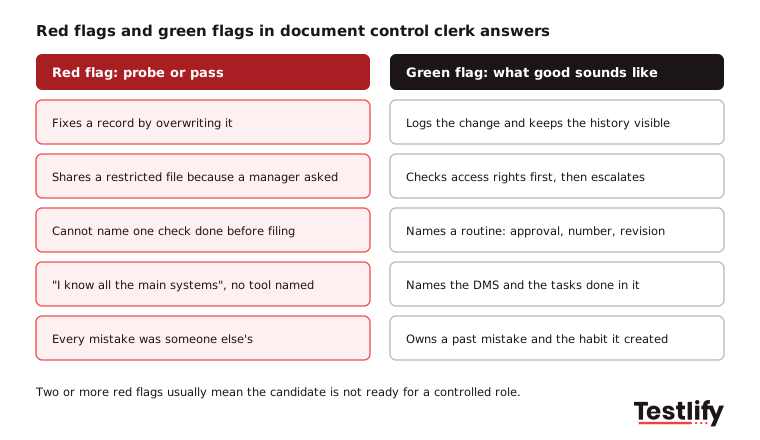
What red flags should you watch for in a document control clerk interview?
The red flags in a document control clerk interview are signs of carelessness with accuracy, history or access. One red flag is worth a follow-up question. Two or more usually mean the candidate is not ready for a controlled environment.
How do you score document control clerk interview questions consistently?
You score document control clerk interview questions consistently by writing the criteria first, rating every answer on the same 1 to 4 scale, and having each interviewer score alone before the debrief. This keeps the decision on evidence and makes it easy to compare candidates seen on different days.
Score | What the answer shows | Example signal |
|---|---|---|
1 | No relevant example or a risky approach | Would overwrite a record, or share a restricted file without checking |
2 | General answer with little detail | "I am very organized" with no method |
3 | Clear example with the right steps | Checks approval, logs the change, withdraws old copies |
4 | Clear example plus a habit that prevents repeat errors | Adds a read-back check or an end-of-day audit after a mistake |
Key takeaway: Weight accuracy and version control highest for this role. A candidate who scores 4 on communication but 2 on accuracy is a risk in a controlled environment, however good the conversation felt.
What practical task should you add to the interview?
A practical task shows a document control clerk's accuracy directly, which interview answers can only describe. Keep it short (about 20 minutes), use dummy documents and score it with a simple checklist.
A simple task that works for most teams:
- Give the material: Hand the candidate a one-page document register with 20 entries and a folder of 10 dummy documents.
- Set the job: Ask them to find every mismatch between the register and the documents: wrong revision, missing approval, wrong number, wrong title.
- Ask for the fix: Have them write how they would correct each entry without losing the history.
- Score it: Count the errors found (plant 6 to 8), check whether any correction overwrites history, and note the time taken.
Candidates who find most of the planted errors and keep the history intact are usually the ones who stay accurate on the job. Tell candidates what the task is for and how long it takes, and offer adjustments to anyone who asks for them.
When should you use skills tests for a document control clerk?
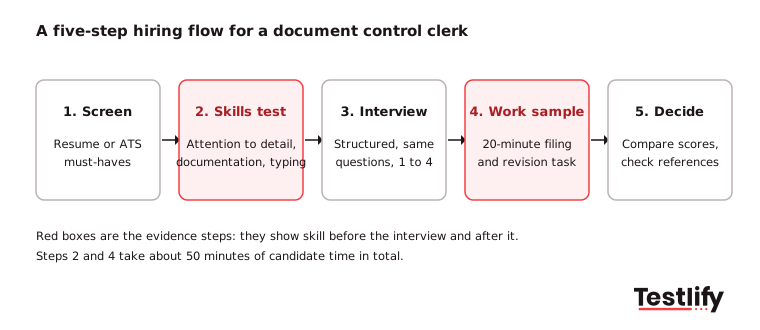
Skills tests work best before the interview, as a filter on the skills that interviews struggle to measure: attention to detail, data entry speed and accuracy, and document handling. They save interview time for the candidates who already show the basics, which matters most when you hire several clerks at once.
The labor market makes this more important, not less. The BLS Occupational Outlook Handbook reports that file clerks earned a median pay of $45,430 in May 2025 and projects employment to fall 2% from 2025 to 2035, as electronic filing replaces paper.
The clerks who remain need digital skills, such as scanning, uploading and working in a DMS, so test for them.
Useful Testlify tests for this role:
- Documentation: The documentation test checks how candidates create, organize and maintain documents.
- Attention to detail: The attention to detail test checks how well candidates spot errors and inconsistencies in text.
- Data entry: The data entry clerk test checks speed and accuracy on the kind of indexing work clerks do every day.
- Systems: The SharePoint test fits teams that run document control in Microsoft SharePoint.
Testlify has 3,500+ tests in its test library, and you can combine several into one assessment with your own questions. Its 20+ anti-cheating and proctoring checks help make sure the candidate did the work.
Hiring for similar roles? Explore our file clerk interview questions and records management specialist interview questions.
Ready to hire your next document control clerk?
Pair these document control clerk interview questions with a short skills test, and you will see who is accurate before anyone sits in an interview room. Start a 7-day free trial with no credit card, or book a demo to see how a role-specific assessment comes together.
Frequently asked questions (FAQs)

Wordpress Developer
Yash Patel is a Wordpress and SEO Specialist at Testlify with 3+ years of experience in technical SEO, on-page optimization, and content strategy. He works on improving Testlify's organic presence and produces content focused on hiring, talent assessment, and HR technology.
LinkedInRelated resources
View all
HR & recruitment
60 Insurance Claims Assistant interview questions to ask job applicants

HR & recruitment
Loan assistant interview questions: 40 questions and what to look for

HR & recruitment
60 Billing Clerk interview questions to ask job applicants

HR & recruitment
25 Financial Planner Assistant interview questions to ask job applicants

HR & recruitment
60 Demand Planner Assistant interview questions to ask job applicants

HR & recruitment
Best network technician interview questions
Get started.
Hire on proof, not resumes.
Run your first skills-based assessment free — no credit card required.