
Aligning HR strategy with business strategy in 6 steps
A practical 6-step method to tie HR plans to business goals, with an alignment map, shared KPIs, real examples and where hiring fits in.

Aligning HR strategy with business strategy means every major people program, from hiring to pay to training, can be traced back to a specific business goal, and is measured by whether that goal moves. It is a working method, not a slogan: you start from what the business has to win this year, work out what that needs from people, then fund, measure and review HR against it.
Most HR teams agree with the idea. Far fewer have done it. In SHRM's 2025 survey of 212 CHROs, just 18% said their HR strategy was fully integrated with the business, and SHRM links misalignment to slower profit growth. The six steps below close that gap.
TL;DR:
- Aligning HR strategy with business strategy means every HR program traces back to a named business goal and is judged by whether that goal moves.
- Only 18% of CHROs in SHRM's 2025 survey said their HR strategy is fully integrated with business goals.
- Start with the business plan, not the HR plan: write one people contribution for each business goal before you design any program.
- Fund the few programs that serve those contributions and stop at least one that does not.
- Measure HR with shared KPIs that business leaders already watch, such as revenue per employee, time to productivity and quality of hire.
- Review the alignment map every quarter, in the same meeting where the business reviews its own plan.
- Hiring is the fastest lever: hiring for the skills the strategy needs shows up in business numbers within months.
 ChatGPT
 Gemini
 Claude
 Grok
 Perplexity
What does aligning HR strategy with business strategy mean?
Aligning HR strategy with business strategy is the practice of setting HR priorities, budgets and measures directly from the organization's business goals, so people decisions support how the company plans to grow, compete or cut costs. The test is simple: for any HR program, someone can name the business goal it serves and the number that shows it worked.
In practice, alignment covers the whole people lifecycle:
- Workforce planning: how many people, with which skills, in which roles and locations, and by when. See workforce planning for the basics.
- Hiring: which skills to hire for and how to check them, so new hires can deliver the plan.
- Development: which capabilities to build in the people you already have.
- Performance and pay: what you reward, so behavior matches what the strategy needs.
- Culture and structure: how teams are organized and how decisions get made.
This is the core of strategic HRM: HR as a partner in running the business, not only a service function.

How is HR strategy different from business strategy?
HR strategy and business strategy answer different questions. Business strategy decides where the company will compete and how it will win: which markets, products, customers and margins. HR strategy decides how the organization will get, grow and keep the people and capabilities that plan needs. The business strategy comes first, and the HR strategy is one of the main ways it gets delivered.
Aspect | Business strategy | HR strategy |
|---|---|---|
Main question | Where do we compete and how do we win? | What people and skills do we need to win there? |
Owner | CEO and executive team | CHRO or CPO, with business leaders |
Typical goals | Revenue growth, market entry, margin, customer retention | Critical roles filled, skills built, retention, productivity |
Time frame | 1 to 5 years, reviewed yearly | Follows the business plan, reviewed every quarter |
Measured by | Revenue, profit, market share, customer metrics | Shared KPIs that link people results to business results |
When the two are aligned, the right column reads like the people half of the left column. When they are not, HR goals look sensible on their own but nobody outside HR can say what they are for.
Why do HR and business strategy drift apart?
HR and business strategy usually drift apart for practical reasons, not because anyone disagrees with alignment. HR joins planning after the big decisions are made, goals are written in HR language that leaders do not use, and programs keep running long after the business priority behind them has changed.
The most common causes include:
- Late involvement: HR sees the plan once budgets are set, so it can only react.
- No translation step: business goals go straight to HR programs, with no statement of what the business needs from people.
- Too many priorities: every program stays, so none gets enough money or attention.
- HR-only metrics: HR reports training hours and headcount filled, while leaders track revenue, margin and customer numbers.
- Budget pressure: in the SHRM 2025 CHRO priorities survey, 61% of CHROs named wage inflation and 31% named HR budget constraints as major challenges, so programs that cannot show business value are the first to be cut.
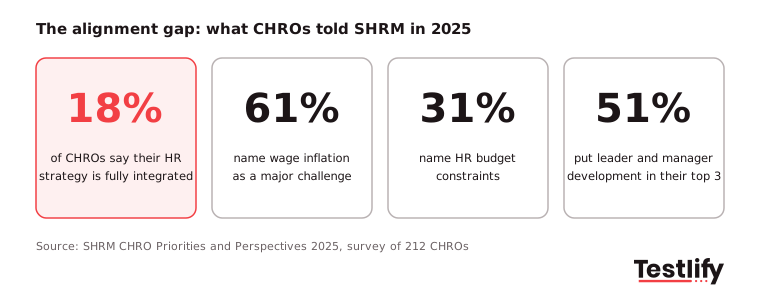
The cost of drift is real: wasted spend, slower execution and an HR team seen as a cost center. If you need the business case for leaders first, read our piece on the importance of aligning HR strategy with business strategy. The rest of this guide is about how to do it.
How do you align HR strategy with business strategy in 6 steps?
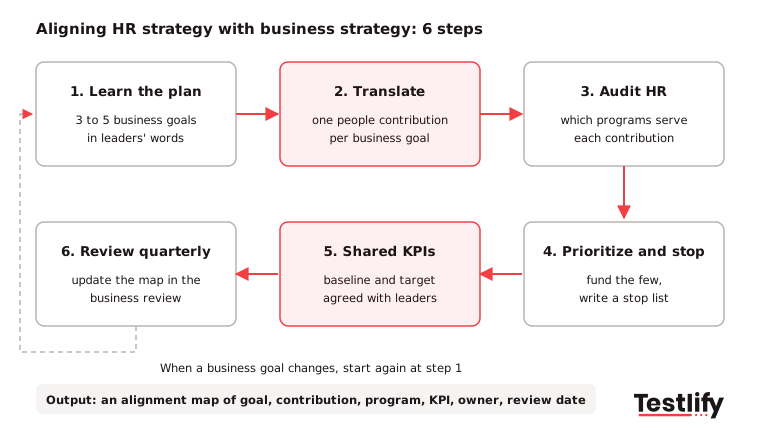
Aligning HR strategy with business strategy takes six steps: learn the business strategy, translate each goal into a people contribution, audit current HR work against those contributions, prioritize and stop low-value work, agree shared KPIs with business leaders, and review the whole map every quarter. Each step produces one concrete output.
Step 1: Learn the business strategy in plain language
Start with the strategy documents, then talk to the CEO, CFO and the leaders who own the biggest goals. Ask three questions: what must go right this year, what could stop it, and which roles or skills are hardest to find. Write the answers in one page, in the leaders' own words.
Output: a one-page summary of the 3 to 5 business goals that matter most, which a business leader would sign off as accurate.
Step 2: Translate each business goal into a people contribution
For each business goal, write one sentence that says what the business needs from its people. For example: "To open two new markets by Q4, we need country managers and sales teams hired and productive within 90 days of launch." This is the step most teams skip, and the one that makes the rest work.
Output: one people contribution per business goal, agreed with the leader who owns that goal.
Step 3: Audit current HR programs against those contributions
List every HR program, policy and major spend: recruiting, onboarding, learning, performance reviews, pay, benefits, HR tech. Next to each, write which contribution it serves. Some will serve one clearly. Some will serve none. A strategic human resource plan is the usual place to record this.
Output: a list of programs marked "serves a contribution", "partly" or "no clear link", plus the gaps where a contribution has no program behind it.
Step 4: Prioritize, fund and stop
Put money and people behind the programs that serve the top contributions, and close the gaps. Then stop or shrink at least one program with no clear link. Alignment that only adds work does not last, because the HR team runs out of capacity.
Output: a short list of funded priorities and a written stop list, both shared with leadership.
Step 5: Agree shared KPIs with business leaders
Pick one or two measures for each contribution that the business leader already cares about, and set a baseline and a target. Time to productivity for new sales hires, or regretted attrition in engineering, means more to a CFO than training hours. Our list of HR KPIs is a good starting set.
Output: an alignment map with goal, people contribution, HR program, KPI, owner and review date on each row.
Step 6: Review alignment every quarter
Review the map in the same quarterly business review where leaders check their own plan. When a business goal changes, the contribution, program and KPI below it change too. Report HR results in the business's terms: progress against the goal, not activity.
Output: an updated map each quarter and a short note to leadership on what moved, what did not and what changes.
Pro tip: Put the alignment map in front of business leaders before you show it to the HR team. If a sales or operations leader cannot recognize their own goal in it, rewrite it until they can.
Which HR KPIs show that HR strategy supports business goals?
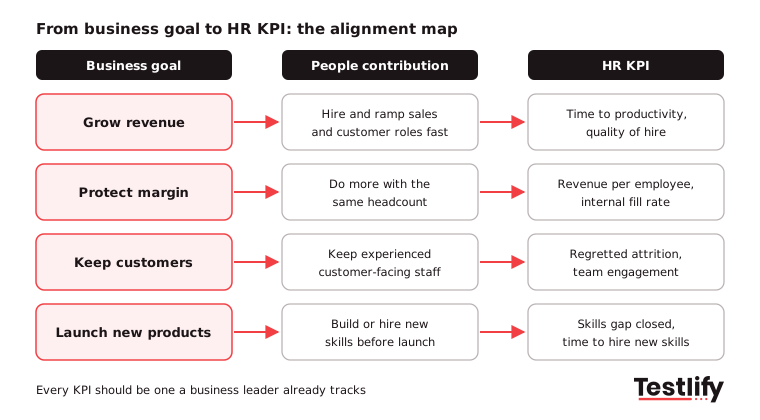
HR KPIs show alignment when they connect a people result to a business result the leadership team already tracks. The strongest ones sit between the two: time to productivity, quality of hire, regretted attrition in critical roles, internal fill rate, revenue per employee and engagement in the teams that carry the plan.
Engagement belongs on most maps because it moves so many business numbers. The Gallup State of the Global Workplace report puts global employee engagement at 20%, down from 23% in 2022, and estimates that low engagement cost the world economy about $10 trillion in lost productivity, or 9% of global GDP. For more measures, see our guide to key HR metrics.
Key takeaway: If a KPI on your map would not appear in a business review, swap it for one that would, or pair it with the business number it is meant to move.
How does hiring connect HR strategy to business results?
Hiring connects HR strategy to business results faster than almost any other lever, because every new hire either adds the skills the plan needs or does not. Development and culture programs take a year or more to show up in business numbers. A strong or weak hiring decision shows up within months, in output, ramp time and early attrition.
To make hiring part of the alignment, not just a service:
- Start from the contribution: Turn each people contribution from step 2 into a skills profile for the roles that deliver it, not a copy of the old job description.
- Check skills, not resumes: Use role-based skills tests and structured interviews so every candidate is judged on the skills the plan needs.
- Measure quality of hire: Track performance and retention of new hires against the KPI on your map. The quality of hire calculator gives you a simple baseline.
- Report in business terms: Say "new account executives reached quota two months sooner", not "we filled 40 roles".
This is where Testlify fits. Testlify is an AI-native skills assessment and interviewing platform: hiring teams can turn a job description into a role-specific assessment, choose from 3,500+ validated tests across technical and non-technical roles, and add structured AI interviews scored against the same criteria for every candidate. Results sync to 100+ ATS and HRIS tools, so the skills data sits next to the hiring metrics on your alignment map.
Ready to hire for the skills your strategy needs?
Once your alignment map names the skills each business goal depends on, the next step is to hire for them on evidence. Browse the Testlify test library to find tests for the roles on your map, or start a 7-day free trial, no credit card needed.
Frequently asked questions (FAQs)

People and Talent Partner
Arushi Shah runs day-to-day talent acquisition and candidate experience at Testlify. She writes on interviewing, structured hiring, and giving candidates a fair, fast process.
LinkedInRelated resources
View all
HR & recruitment
How to align HR strategies with business objectives

HR & recruitment
How to build and maintain strong HR partnerships with other departments

HR & recruitment
How to promote employee well-being and mental health in the workplace

HR & recruitment
How to handle employee turnover and develop a retention strategy

HR & recruitment
How to develop and implement employee training programs for professional development

HR & recruitment
How to implement effective employee satisfaction surveys
Get started.
Hire on proof, not resumes.
Run your first skills-based assessment free — no credit card required.