
Organizational change communication: a step-by-step guide for HR
How to plan and run organizational change communication: the message, the messengers, channels, legal notice rules and how to measure it.

Organizational change communication is the planned way an organization tells employees about a change, explains why it is happening and what it means for them, and listens to their response until the change sticks. Done well, it turns a restructure, merger, new system, or layoff from a rumor mill into a process people can follow.
 ChatGPT
 Gemini
 Claude
 Grok
 Perplexity
TL;DR
- Organizational change communication is a plan, not an announcement: what you say, who says it, when, through which channels, and how you check people understood.
- Trust is the starting problem. Gartner found 79% of employees have low trust in change, and only 32% of leaders said their last change was adopted well.
- Every change message should answer six things: why, what is changing, what it means for me, what is not changing, what we do not know yet, and when the next update comes.
- Senior leaders explain the business reason. Direct managers explain the personal impact. HR equips both with talking points and an FAQ.
- Repeat the core message across several channels, and tell managers before their teams so nobody hears it first from a rumor.
- Layoffs and restructures carry legal notice duties: in the US, the WARN Act requires 60 days' written notice for covered plant closings and mass layoffs.
- Measure understanding, not just reach: short pulse surveys, questions asked, and whether people are doing the new work.

What is organizational change communication?
Organizational change communication is the set of messages, channels, and conversations an organization uses to prepare employees for a change, move them through it, and keep the new way of working in place. It covers the first announcement, but most of the work happens after it.
The changes it applies to are wide. Common ones for mid-size and large companies are:
- Structure: A reorganization, new reporting lines, merged teams, or a merger or acquisition.
- People: Layoffs, redeployment, new roles, or a hiring freeze.
- Process and technology: A new HRIS or ATS, a new performance process, or AI tools added to daily work.
- Strategy and policy: A new market, a return-to-office policy, or a pay and benefits redesign.
Each type of organizational change needs a different tone, but the same building blocks apply. Change communication is one part of wider change management, which also includes training, support, and reinforcement.
Why does organizational change communication matter?
Organizational change communication matters because most change fails on adoption, not on design. People do not resist the plan on paper; they resist what they do not understand or what they hear secondhand.
The numbers show how wide the gap is. An April 2025 Gartner survey of more than 2,850 employees found 79% have low trust in change, and only 32% of mid-to-senior business leaders said their last change achieved healthy adoption, according to Gartner's July 2025 HR research. The same research found organizations with better-than-average change adoption report two times higher year-over-year revenue growth.
A follow-up Gartner study from October 2025 found that just 45% of employees realized the change goals their organization set, and 36% of leaders said their team is more likely to hesitate and wait to see if a change will stick.
Clear communication is what employees ask for. Gallup's January 2026 engagement report found that clarity about what is expected at work fell nine points since 2020, and 35% of employees said better communication would most help them understand what is expected of them.
Key takeaway: A change that people do not understand is a change that does not happen, however good the plan is.
What should employees hear when change is announced?
Employees need six answers when a change is announced. Leaving any of them out creates the space where rumours grow.
Question employees ask | What the message must cover | Example line |
|---|---|---|
Why is this happening? | The business reason and the cost of not changing | "Our two support teams answer the same customers twice. Merging them cuts wait times." |
What exactly is changing? | Scope, dates, who is affected | "From March 1, both teams report to one director." |
What does it mean for me? | Role, pay, location, workload, tools | "Your role, pay and location stay the same. Your manager may change." |
What is not changing? | The things people can stop worrying about | "Benefits, hybrid policy and review cycle are unchanged." |
What do we not know yet? | Open questions, honestly stated | "We have not decided the team structure below director level." |
When will we hear more? | A date for the next update, then keep it | "We will share the structure on February 10 in your team meeting." |
Two of these are often skipped. "What is not changing" calms people faster than any reassurance, because it is specific. "What we do not know yet" sounds risky, but saying it with a date for the next update builds more trust than silence. When employees notice a gap, they fill it themselves.
Pro tip: Write the FAQ before the announcement. If HR cannot answer a question in one plain sentence, the decision is not ready to announce.
How do you build an organizational change communication plan?
An organizational change communication plan is built in seven steps, from defining the change to reinforcing it months later. HR usually owns the plan and works with the change sponsor, internal communications, and line managers.
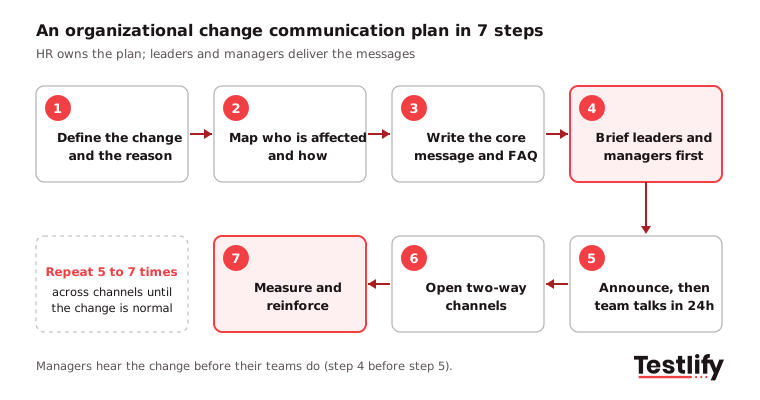
- Define the change and the reason: Write one paragraph a new employee could understand: what changes, when, why, and what happens if the company does nothing.
- Map who is affected and how: List each group (for example, a merged team, their managers, other teams that work with them, and new hires in the pipeline) and the impact on each one. Impact decides the message, not seniority.
- Write the core message and the FAQ: One core message for everyone, then a short version for each group that answers "What does it mean for me?" Keep facts the same across versions.
- Brief leaders and managers first: Tell managers before their teams, give them talking points, the FAQ, and a way to escalate questions. A manager who learns about a change at the same time as their team cannot support anyone.
- Announce and follow up the same day: Announce to the whole group at once where you can, then hold team conversations within 24 hours so people can ask questions in a smaller room.
- Open two-way channels: Q&A sessions, an anonymous question form, and manager one-to-ones. Publish answers to common questions on one page and keep it updated.
- Measure and reinforce: Check understanding and sentiment, fix gaps, and keep repeating the message until the new way of working is normal. Change messages lose force quickly once leaders move on to the next topic.
For a wider template you can reuse outside of change projects, see this guide to building a workplace communication plan.
Who should deliver each change message?
Each change message should come from the person employees trust for that kind of information. Senior leaders are believed on the business reason; direct managers are believed on what it means for the team and the individual. Prosci's change management research makes the same split between business messages from leaders and personal messages from supervisors.
Sender | Best for | HR's role |
|---|---|---|
CEO or executive sponsor | Why the change is happening, the direction, commitment from the top | Draft the message, check it answers the six questions |
Department head | What it means for the function, timelines | Align facts with the core message |
Direct manager | What it means for each person, day-to-day impact, listening to concerns | Brief first, give talking points and FAQ, collect questions |
HR business partner | Policy, pay, benefits, legal process, support options | Own the FAQ and individual cases |
Change champions | Peer examples, informal questions | Recruit early adopters from affected teams |
General day-to-day HR communication to employees builds the trust that change messages later rely on. If people already trust HR as a straight source, change messages land faster.
Which channels work for employee communications during change?
Employee communications during change work best when each channel has a job. A single email is not a change communication plan; neither is a single town hall.
Channel | Use it for | Watch out for |
|---|---|---|
All-hands or town hall | The announcement, the why, live Q&A | Questions people will not ask in public |
Team meeting | What it means for this team, first reactions | Managers going off message |
One-to-one | Individual impact, role changes, concerns | Saving it too late |
Email or intranet page | The written record, dates, FAQ | Long text nobody finishes |
Chat (Slack or Teams) | Short updates, reminders, links to the FAQ | Rumours in side threads |
Anonymous form or pulse survey | Honest questions and sentiment | Asking and not answering |
Repetition matters more than most leaders expect. Prosci recommends repeating key messages five to seven times, through more than one channel. Face-to-face conversation is still the strongest channel for personal impact, which is why manager conversations matter most. For hybrid and remote teams, record the announcement, hold sessions across time zones, and put every answer on one page.
How do you handle resistance and rumors during change?
Resistance and rumors are handled by speed, honesty, and listening, not by repeating the announcement louder. Most resistance is a reasonable question that has not been answered yet.
- Expect three groups: A small group will support the change early, most people will wait and watch, and a small group will push back. Use early supporters as champions, give the middle group facts and time, and talk one-to-one with the people pushing back to learn what they are worried about.
- Correct rumors in the open: When a rumor spreads, address it on the FAQ page and in team meetings, without blame. Silence reads as confirmation.
- Separate concern from refusal: "I do not know how my job changes" needs information. I do not agree with this" it needs a conversation. Neither needs a lecture.
- Show what you changed because of feedback: Publish what you adjusted after employees spoke up. People keep giving feedback when they see it used.
- Watch for change fatigue: Gartner's October 2025 research found 39% of leaders believe change is a significant source of stress for their teams. Bundle related changes and avoid announcing several unrelated ones in the same month.
Layoffs need their own playbook, with individual meetings before any group announcement and support for the people who stay. For the terms and basics, see this definition of a layoff.
What legal notice rules apply to layoffs and restructuring?
Legal notice rules apply when a change leads to job losses, and HR has to build them into the communication timeline. Announcing before or without the required notice creates legal risk; delaying the conversation beyond it damages trust.
- United States: Under the WARN Act, an employer with 100 or more employees (excluding part-time) cannot order a plant closing or mass layoff until 60 days after written notice to employee representatives (or each affected employee), the state rapid response unit and the local government, as set out in 29 U.S. Code 2102. Several states have their own, stricter rules.
- United Kingdom: According to GOV.UK guidance on redundancy consultations, an employer making 20 or more employees redundant at one establishment within 90 days must consult collectively: at least 30 days before the first dismissal for 20 to 99 redundancies, and 45 days for 100 or more.
- Other countries: EU member states, Canada, India and others have their own consultation and notice rules. Check local law with counsel before you set the announcement date.
This section is general information, not legal advice. Build the legal dates into step 1 of the plan so the communication timeline never conflicts with them.
How do you measure whether change communication worked?
Change communication works when people understand the change and act on it, so measure understanding and behavior, not only how many people opened an email.
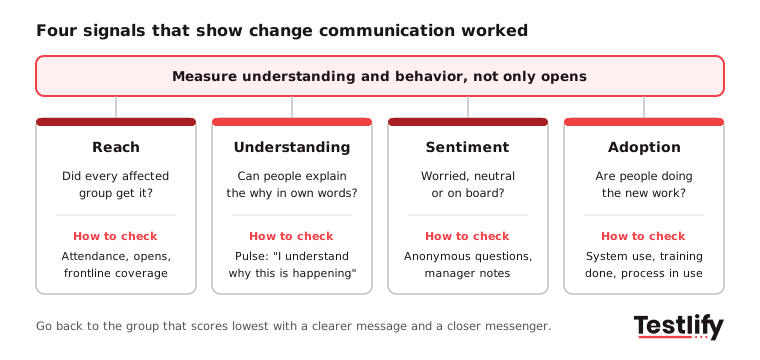
- Reach: Did the message get to every affected group? Track attendance and opens, especially for frontline and remote staff.
- Understanding: Can people say what is changing and why in their own words? Ask two or three pulse questions such as "I understand why this change is happening" and "I know what it means for my role".
- Sentiment: Are people worried, neutral or on board? Read anonymous questions and manager notes for repeated themes.
- Adoption: Are people doing the new work? Track usage of the new system, completion of training, or the new process in use.
Gartner's October 2025 research also found that employees who practiced the core skills a change needs were 3.5 times more likely to adopt it in a healthy way, which is why measurement should feed straight into training and support. This is the most direct answer to how to improve communication during organizational change: find the group whose understanding is lowest and go back to them with a better message and a better messenger. Gallup's 2026 engagement findings are a useful benchmark for the clarity questions.
How does change communication connect to skills and redeployment?
Change communication connects to skills because many changes ask people to do different work. A reorganization, a new system or an AI rollout often means some roles grow, some shrink, and some people move. Employees want to know two things: what skills the new roles need, and how the company will decide who fills them.
Answering that clearly is part of communicating change fairly:
- Publish the skills each new or changed role needs: People can see where they fit and what to learn.
- Use the same objective check for everyone: Internal candidates for a new role take the same skills assessment, so decisions do not look like favouritism. A skills gap analysis shows where training is needed before the change goes live.
- Assess the change skills themselves: Leaders and managers carry most of the communication load, so their own change and communication skills matter.
Testlify's test library includes ready-made tests for this, such as the change management test, the adaptability test and the communication test, among 3,500+ tests covering technical and non-technical roles.
Ready to help your people through the change?
Good organizational change communication answers the why, the what and the what-it-means-for-me, from the right person, more than once. When the change means new roles or internal moves, back the message with a fair, consistent skills check. Browse the Testlify test library or start a 7-day free trial, no credit card needed.
Frequently asked questions (FAQs)

Wordpress Developer
Yash Patel is a Wordpress and SEO Specialist at Testlify with 3+ years of experience in technical SEO, on-page optimization, and content strategy. He works on improving Testlify's organic presence and produces content focused on hiring, talent assessment, and HR technology.
LinkedInRelated resources
View all
HR & recruitment
How to handle sensitive HR issues with confidentiality: A practical guide

HR & recruitment
Continuous learning culture: how to build one that lasts

HR & recruitment
How to design and implement effective employee development programs

HR & recruitment
How to implement effective employee feedback mechanisms for continuous improvement

HR & recruitment
How to build strong employer-employee relationships in the workplace

HR & recruitment
How to develop and maintain strong HR partnerships with other departments
Get started.
Hire on proof, not resumes.
Run your first skills-based assessment free — no credit card required.