
Talent assessment best practices: 10 rules for hiring teams
Ten talent assessment practices that keep candidate testing fair and job-relevant, from job analysis and scoring to adverse impact checks.

Talent assessment best practices are the rules that keep candidate testing accurate, fair and quick. Start from a job analysis, test only what the job needs, mix methods, score every candidate against criteria agreed in advance, tell candidates what to expect, check pass rates for adverse impact, and track whether high scorers go on to perform well.
TL;DR / Key Takeaways
- The best talent assessments start from a job analysis: list the 4 to 6 skills that separate strong performers in the role, then test only those.
- Use 2 or 3 assessment methods per role, for example a skills test plus a work sample plus a structured interview, not one test for everything.
- Agree on scoring rules, weights and the pass mark before the first candidate applies, and pilot the test on current employees.
- Keep the test under 60 minutes, explain the format up front and offer accommodations. Long or vague tests lose good candidates.
- Check pass rates by group with the four-fifths rule, and keep a person in the loop for every rejection an AI tool makes.
- Track quality of hire after launch. LinkedIn found 89% of TA teams expect it to matter more, but only 25% are highly confident they can measure it.
 ChatGPT
 Gemini
 Claude
 Grok
 Perplexity
What are talent assessment best practices?
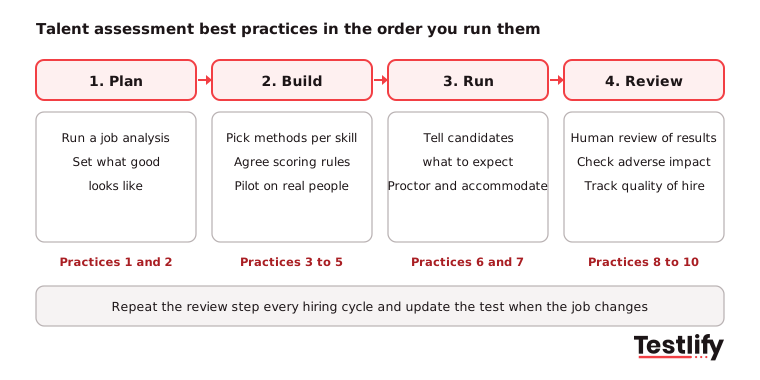
Talent assessment best practices are the habits that make a skills test, work sample or structured interview predict job performance instead of just adding a step. They cover four phases: plan the assessment from the job, build it with agreed scoring, run it the same way for every candidate, and review the results against real hires.
If you are new to the topic, start with what talent assessments are. This guide assumes you already use some form of testing and want it to work better.

Why do talent assessment best practices matter now?
Talent assessment best practices matter because hiring teams are being asked to hire faster and prove hire quality at the same time. SHRM's 2025 Talent Trends report found that 69% of organizations still struggle to fill full-time roles, and AI use in HR tasks jumped to 43% in 2025 from 26% a year earlier.
More tests and more AI do not automatically mean better hires. LinkedIn's Future of Recruiting 2025 report found that 93% of talent acquisition professionals say accurately assessing skills is crucial to improving quality of hire. A badly built test adds time, loses candidates and can create legal risk, while a well-built one shortens the shortlist and gives hiring managers evidence they trust.
Across the teams we work with, the gap is rarely the test itself. It is the missing steps around it: no agreed pass mark, no pilot, nobody checking results six months later.
What are the 10 talent assessment best practices?
The 10 talent assessment best practices below follow the order you run them, from defining the job to reviewing results after hire. The same hiring assessment best practices apply whether you test 10 candidates or 10,000, so treat them as a checklist for every new role and every yearly review.
1. Start with a job analysis
A job analysis lists the tasks, skills and behaviors that separate strong performers from average ones in the role. Talk to 2 or 3 top performers and their manager, read the job description, and agree on 4 to 6 skills that matter most. A SHRM contributor article from September 2026 makes the same point: hiring evaluations should not simply measure what is easy to test. See the job analysis glossary entry for a template.
2. Define what good looks like before you test
Write down what a strong, acceptable and weak answer looks like for each skill. Agree on the weight of each skill and the pass mark with the hiring manager before the role opens. If you set the bar after you see the scores, you will move it to fit the candidate you already like.
3. Match assessment methods to each skill
Pick the method that measures each skill most directly. Coding is best tested with a coding task, judgment with a situational judgment test, and communication with a recorded or live answer. Use 2 or 3 methods per role so no single score decides the outcome. The table in the next section maps assessment methods in hiring to the roles they suit.
4. Keep it short and job-relevant
Every question should trace back to a skill from the job analysis. Most roles need 30 to 60 minutes of testing in total. Remove anything you cannot explain to a candidate in one sentence, such as general knowledge questions or puzzles unrelated to the work.
5. Pilot the test before rollout
Run the assessment with 5 to 10 current employees whose performance you know. If your best performers do not score near the top, the test measures the wrong thing. A pilot also shows how long the test really takes and which questions confuse people.
Pro tip: Run the pilot in the same tool and settings candidates will use, including proctoring, so you catch technical issues before they cost you applicants.
6. Tell candidates what to expect
Explain the format, the time needed, what is being measured and how results will be used in the invite. Offer a practice question and a clear way to request accommodations, such as extra time or screen reader support. Clear communication improves completion rates and candidate experience.
7. Protect the integrity of results
Remote tests need checks that fit the stakes of the role. Use question randomization, time limits and browser checks for screening tests, and add webcam or screen monitoring for senior or high-volume roles where answers can be shared. Keep the checks proportionate, and tell candidates which ones are on.
8. Use a structured interview for what tests cannot measure
Tests are strong on skills and weak on motivation and context. Follow the assessment with a structured interview that asks every candidate the same questions, probes their test answers and is scored with the same rubric. Ask about culture add and job-related behaviors, not vague "culture fit", which invites bias.
9. Keep people in charge of decisions
Assessment scores should inform a decision, not make it. Train recruiters and hiring managers to read score reports, look at strengths per skill rather than one total, and review borderline cases. When an AI tool scores or ranks candidates, a person should review every rejection and be able to explain it.
10. Check fairness and update on a schedule
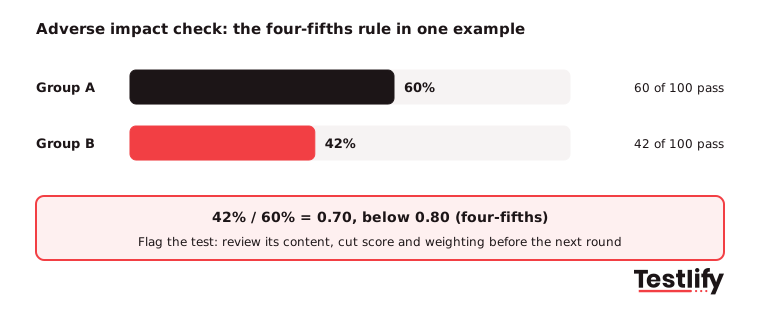
Compare pass rates across groups after every hiring round. Under the federal Uniform Guidelines, 29 CFR 1607.4 treats a selection rate for any group below four-fifths (80%) of the highest group's rate as evidence of adverse impact. Review the test at least once a year, or sooner when the role, tools or market change.
Key takeaway: The order matters. Teams that skip practices 1, 2 and 5 usually end up with a test that is long, hard to defend and ignored by hiring managers.
Which assessment methods in hiring fit which roles?
Assessment methods in hiring work best when each one measures a skill it is designed for. Use the table to pick 2 or 3 methods per role and avoid stacking tests that measure the same thing.
Method | What it measures | Best for | Watch out for |
|---|---|---|---|
Role-specific skills test | Job knowledge and hard skills | Most roles, early screening | Questions that drift from the job analysis |
Work sample or simulation | How the candidate does the real task | Tech, sales, support, finance | Taking too long; keep under 45 minutes |
Coding test or live coding | Problem solving in code | Engineering, data | Generic puzzles instead of real tasks |
Cognitive ability test | Learning speed and reasoning | Roles with complex, changing work | Using it alone; check pass rates by group |
Situational judgment test | Decisions in realistic scenarios | Customer-facing and people managers | Scenarios that do not match your workplace |
Personality or behavioral test | Work style and preferences | Development, team fit discussions | Using it as a hard pass or fail filter |
Language test (CEFR) | Reading, writing, speaking level | Global, BPO and support roles | Testing a level the job does not need |
Structured interview | Motivation, context, follow-up on test answers | Every role, after the test | Unscored, free-form conversations |
For volume roles such as contact center or retail, a short skills test plus a language or typing test usually filters well. For senior roles, a work sample plus a structured interview gives hiring managers more to discuss than any single score.
How do you evaluate hiring methods after launch?
Evaluating hiring methods means checking, every hiring cycle, whether the assessment predicts performance, treats groups fairly, keeps candidates in the process and saves time. If a method fails one of these checks, fix or drop it.
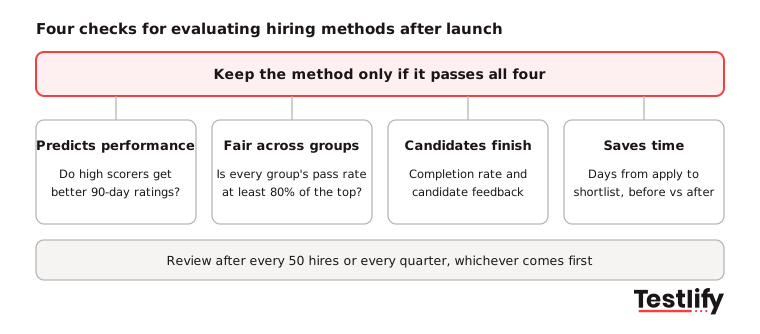
- Predicts performance: Compare assessment scores with 90-day or 6-month performance ratings for the people you hired. High scorers should, on average, perform better.
- Fair across groups: Run the four-fifths check on pass rates and review any question with a large gap between groups.
- Candidates finish: Track the completion rate and ask candidates for one line of feedback. A sudden drop usually points to length or a technical issue.
- Saves time: Measure days from application to shortlist before and after the assessment.
LinkedIn's Future of Recruiting 2025 found that the most common quality-of-hire measures are job performance ratings (66%), new hire retention (60%) and hiring manager satisfaction (44%). Use the same three, so your assessment results connect to numbers leadership already watches. LinkedIn also found that companies doing the most skills-based searching were 12% more likely to make a quality hire.
What mistakes weaken a talent assessment?
Talent assessments usually fail for process reasons, not because of the questions. These are the mistakes we have seen most often in hiring teams that replaced manual screening with testing:
- One test for every role: A generic aptitude test for engineers, sales and support tells you little about any of them.
- Setting the pass mark after scoring: This lets bias back in through the cut-off.
- Testing too much: Two hours of tests for an entry-level role drives strong candidates to employers who ask for less.
- Ignoring cheating: Unproctored tests with a fixed question set can be shared online, so scores stop meaning anything.
- Leaving AI scoring unchecked: In New York City, Local Law 144 bars employers from using an automated employment decision tool unless it had a bias audit within the past year, the results are public, and candidates get notice 10 business days before use.
- Never revisiting the test: Roles change. A test written two years ago may measure tools your team no longer uses.
For the legal side, read the potential legal risks of pre-hiring assessments, and see how recruiting assessments feed into the final hiring decision.
How does Testlify support these practices?
Testlify supports these talent assessment best practices by turning a job description into a role-specific assessment and scoring every candidate against the same criteria. Hiring teams can apply each practice in one place:
- Job-relevant tests: 3,500+ validated tests, and an AI test builder that drafts an assessment from your job description in under a minute, with suggested skills and scoring criteria.
- Mixed methods: Skills tests, coding tasks, simulations, situational judgment, language tests (CEFR A1 to C2) and AI interviews in one assessment.
- Consistent scoring: Automated and weighted scoring, per-skill reports and benchmarks, so hiring managers compare candidates on the same evidence.
- Integrity: 20+ proctoring checks, including AI assistance detection and question randomization. See anti-cheating and proctoring.
- Fairness and reach: A third-party bias audit of the matching model under NYC Local Law 144, completed June 16, 2023, and assessments in 15+ languages. Details on the NYC bias audit page.
- Fits your stack: 100+ ATS and HRIS integrations with two-way sync.
If you are comparing tools, see this roundup of the best talent assessment tools.
Ready to put these practices into your next hire?
Pick one open role, run a short job analysis and build a 30 to 45 minute assessment from it. Browse the Testlify test library to find tests for the role, or start a 7-day free trial with no credit card and pay only when a candidate starts an assessment.
Frequently asked questions

Content Writer
Yashika Khandelwal is a Content Writer with 3+ years of experience creating research-backed content on hiring, talent assessment, and HR technology. She is a registered Organizational Psychologist and subject matter expert who combines behavioral science with practical recruitment insights to produce accurate, evidence-based content.
LinkedInRelated resources
View all
HR & recruitment
How to implement psychometric tests in recruitment
HR & recruitment
Remote technical skills assessments: Challenges and best practices

HR & recruitment
Best platforms for freelance hiring in 2026: 8 compared

HR & recruitment
Virtual recruiting: how to hire and assess skills remotely

HR & recruitment
Virtual attention to detail tests: Adapting to remote hiring

HR & recruitment
7 Challenges of using cognitive ability tests in recruitment (and how to fix each One)
Get started.
Hire on proof, not resumes.
Run your first skills-based assessment free — no credit card required.