
11 best employee engagement tools for HR teams in 2026
A shortlist of 11 employee engagement tools by type, with a comparison table, buying criteria and the metrics that show a tool is working.

Employee engagement tools are software platforms that help companies measure how committed and connected people feel at work, then act on it through surveys, recognition, internal communication and growth conversations. The best ones turn engagement from a once-a-year survey into a steady habit that managers use every week.
TL;DR / Key Takeaways
- The best employee engagement tools in 2026 are Culture Amp, Microsoft Viva Glint, Qualtrics EmployeeXM and Workday Peakon for listening; Bonusly, Achievers, Motivosity and Vantage Circle for recognition; Workvivo by Zoom for communication; Lattice and 15Five for performance and growth.
- Gallup's 2026 report puts global engagement at 20%, down from 23% in 2022, and prices low engagement at about $10 trillion in lost productivity.
- Only 22% of employees get the right amount of recognition, and well-recognized employees are 45% less likely to leave within two years, according to Gallup.
- Most mid-market teams need just two tools to start: one survey platform and one recognition platform.
- Choose on fit with your HRIS, Slack or Microsoft Teams, anonymity and action planning, not on the length of the feature list.
- Judge any tool on participation, action taken and turnover by team after one quarter.
- Engagement starts at hiring: people hired for proven skills ramp faster and carry less load for their teams.
 ChatGPT
 Gemini
 Claude
 Grok
 Perplexity
What are employee engagement tools?
Employee engagement tools are digital platforms that measure, analyze and improve how motivated and connected employees feel at work. They include survey and listening tools, recognition and rewards platforms, internal communication hubs, performance and growth software, and well-being apps. Each type addresses a different driver of engagement, so most companies combine two or three.
The difference from an old annual survey is speed. A modern tool collects feedback in short pulses, shows results by team and manager the day a survey closes, and suggests actions. That makes engagement something a manager can work on, rather than a number HR reports once a year.
You will also see the same category sold as employee engagement software, an employee engagement platform or employee engagement solutions. The names overlap. What matters is which problem the tool solves.

Why do employee engagement tools matter in 2026?
Employee engagement tools matter because engagement is falling and the cost is large. Gallup's State of the Global Workplace 2026 report found global engagement dropped to 20% in 2025, from a peak of 23% in 2022. Manager engagement fell harder, from 27% to 22% in a single year. Gallup puts the cost of low engagement at about $10 trillion in lost productivity, or 9% of global GDP.
Gallup's State of the Global Workplace report also shows why managers are the place to start: when managers disengage, their teams follow. Tools that give managers clear data and simple actions address the problem where it starts.
Recognition is the cheapest lever and the most underused. Gallup and Workhuman found that only 22% of employees get the right amount of recognition for their work, and that well-recognized employees were 45% less likely to have changed employers two years later. For a 500-person company, even a small cut in turnover can outweigh the cost of a recognition tool. Use our attrition rate calculator to see your own baseline.
Key takeaway: Engagement is a retention and productivity problem first. Pick tools by the problem they solve, not by how many features they list.
What types of employee engagement tools are there?
Employee engagement tools fall into five types: survey and listening platforms, recognition and rewards platforms, internal communication platforms, performance and growth platforms, and well-being and perks platforms. Survey tools tell you what is wrong. The other four are how you fix it.
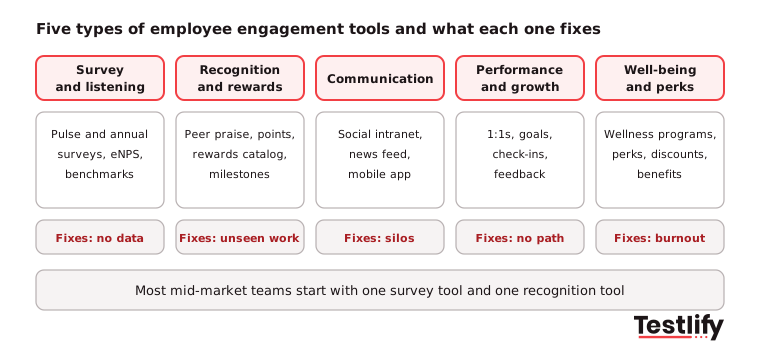
- Survey and listening: Annual engagement surveys, pulse surveys, eNPS, lifecycle surveys for onboarding and exit, and benchmarks. Read our guide to pulse surveys if you are new to short-cycle feedback.
- Recognition and rewards: Peer-to-peer and manager recognition, points, reward catalogs and service milestones. People repeat behavior that gets noticed, and Gallup's recognition research ties high-quality recognition to lower turnover.
- Internal communication: Social intranets, news feeds and mobile apps that reach every employee, including frontline and deskless staff.
- Performance and growth: One-on-ones, goals, check-ins and feedback. Growth is one of the top reasons people stay, so clear development paths lift both engagement and retention.
- Well-being and perks: Wellness programs, discounts and benefits portals that reduce stress and show care.
Managers sit across all five. Strong managers turn engagement tools into real behavior change, so any tool you buy should make the manager's job easier, not add another dashboard.
What are the best employee engagement tools in 2026?
The best employee engagement tools in 2026 are the 11 below, grouped by type. We picked them from the tools that appear most often across the top-ranking reviews and vendor directories for this search, then checked each vendor's current product pages. We left out prices because most vendors quote per employee and change plans often.
1. Culture Amp
Culture Amp is a survey and people analytics platform known for engagement surveys and benchmarks. Its Engage product offers more than 40 research-backed survey templates, pulse, onboarding and exit surveys, and benchmarks drawn from over 1 billion survey responses, according to Culture Amp's product page. An AI coach summarizes comment themes and helps managers turn results into action plans.
- Best for: Mid-market and enterprise teams that want strong benchmarks and manager action planning.
- Watch for: Survey design and analytics depth can take time to learn.
2. Microsoft Viva Glint
Microsoft Viva Glint is the engagement survey tool inside the Microsoft Viva suite. It runs organization-wide surveys with templates for engagement, onboarding, exit and inclusion, and shows results by team as soon as a survey closes. Microsoft has integrated Glint with Viva Insights, so leaders can compare engagement scores with work patterns such as meeting load and one-on-one time. Microsoft's Viva documentation explains how Glint, Viva Pulse and Viva Insights fit together.
- Best for: Enterprises already on Microsoft 365 and Teams.
- Watch for: Most value comes when the rest of the Viva suite is in place.
3. Qualtrics EmployeeXM
Qualtrics EmployeeXM is an enterprise employee experience platform for engagement, lifecycle and pulse surveys with advanced analytics. It suits large organizations that have analysts to run deep survey programs.
- Best for: Large enterprises with a people analytics team.
- Watch for: More platform than a small HR team needs.
4. Workday Peakon Employee Voice
Workday Peakon Employee Voice is a continuous listening tool that runs frequent short surveys and flags drivers of engagement and attrition risk by team. Because it sits inside Workday, results connect to HR data without extra integration work.
- Best for: Companies that already run Workday HCM.
- Watch for: Less attractive if your HRIS is not Workday.
5. Lattice
Lattice combines performance reviews, goals, one-on-ones and engagement surveys in one people platform. Managers see engagement results next to performance and growth data, which helps them act on what they learn.
- Best for: Growing companies that want performance and engagement in one place.
- Watch for: Engagement is an add-on to the core performance product.
6. 15Five
15Five is a performance management platform built around weekly check-ins, one-on-ones, reviews and engagement surveys. Its strength is the manager and employee rhythm: short weekly updates surface problems before they show up in an annual survey.
- Best for: Teams that want to build a manager coaching habit.
- Watch for: Weekly check-ins only work if managers reply to them.
7. Bonusly
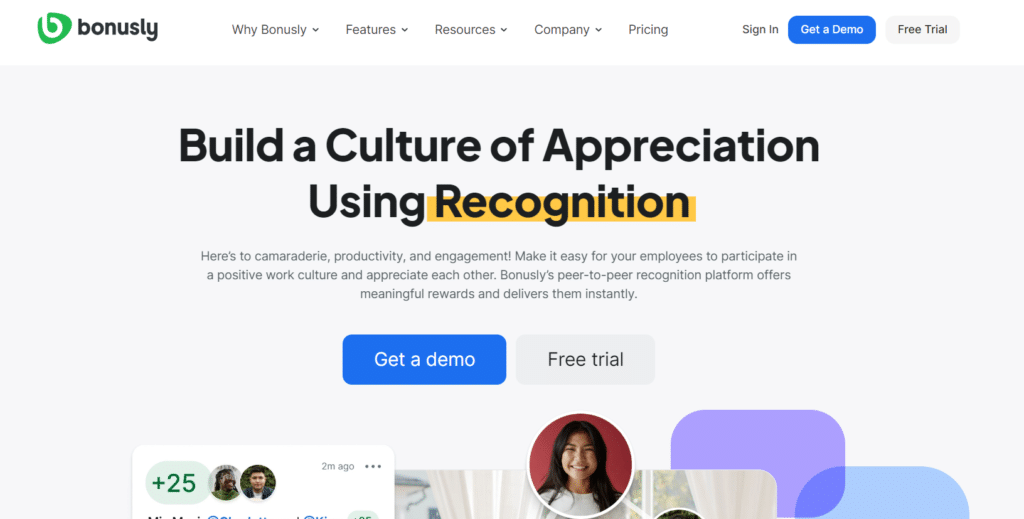
Bonusly is an employee recognition and rewards platform where colleagues give each other small, public recognition tied to company values. Employees collect points and redeem them in a rewards catalog. It plugs into Slack and Microsoft Teams, so recognition happens where people already work.
- Best for: Peer-to-peer recognition that people actually use day to day.
- Watch for: Needs a clear budget and rules so points do not lose meaning.
8. Achievers
Achievers is an enterprise recognition and rewards platform with peer and manager recognition, a rewards marketplace, service awards and listening features. It is built for large, distributed workforces that need recognition programs across countries.
- Best for: Large enterprises running recognition across regions.
- Watch for: Program setup takes planning and a dedicated owner.
9. Motivosity
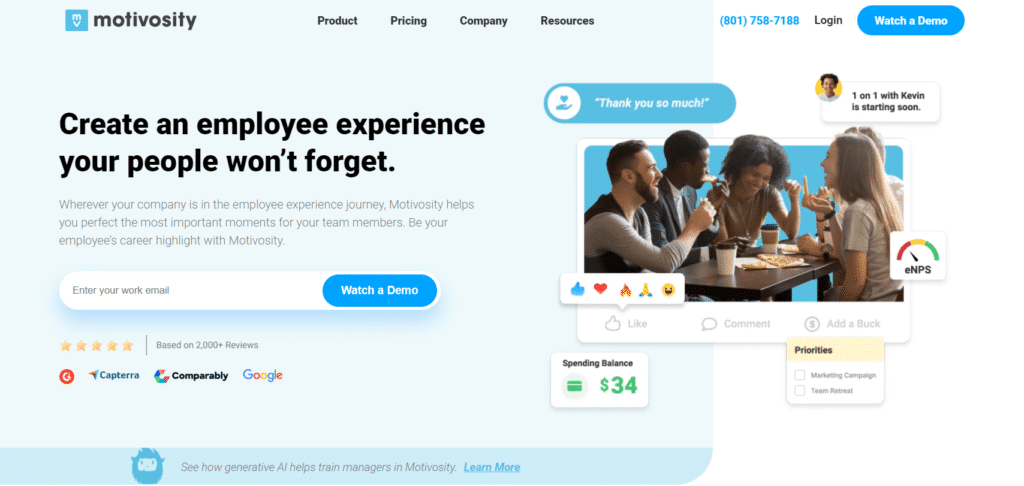
Motivosity is an employee recognition and feedback platform that encourages peer-to-peer appreciation alongside continuous feedback, goal tracking and reporting. It focuses on the connection between employees and their managers.
- Best for: Mid-sized companies that want recognition and manager feedback together.
- Watch for: Lighter survey analytics than a dedicated listening platform.
10. Vantage Circle
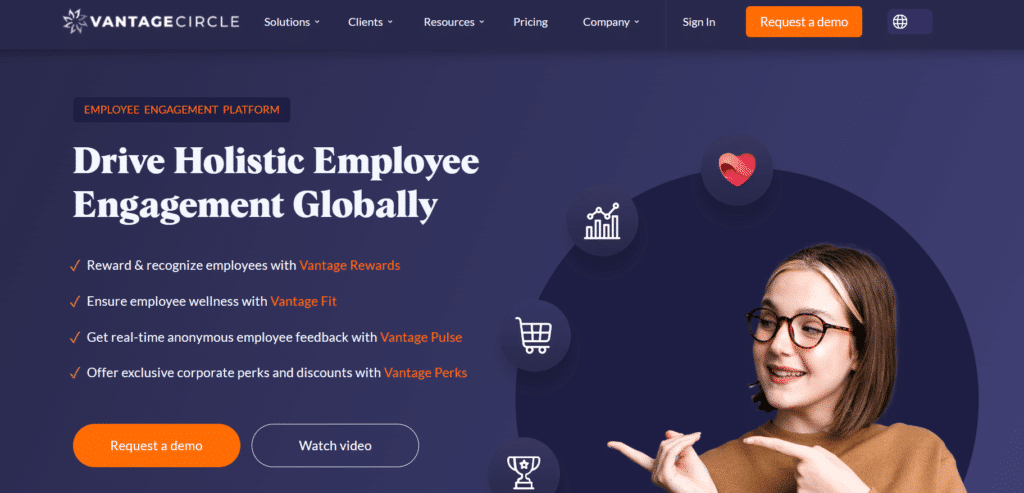
Vantage Circle is an employee engagement platform that bundles rewards and recognition, perks and discounts, wellness programs and service milestones. It suits companies that want recognition and well-being in one employee app.
- Best for: Combining recognition with perks and wellness.
- Watch for: Perk catalogs vary by country, so check coverage for your locations.
11. Workvivo by Zoom
Workvivo by Zoom is an employee experience platform that combines a social intranet, news feed, recognition, surveys and a mobile app. Zoom acquired Workvivo in 2023 and added Workvivo AI, powered by Zoom AI Companion, in 2025. It works well for reaching frontline and remote staff who rarely open email.
- Best for: Internal communication across large, spread-out workforces.
- Watch for: Best value when leadership commits to posting and replying.
Note: Fond, a rewards and perks platform listed in earlier versions of this article, was acquired by Reward Gateway in 2023, which is now part of Edenred. Teams that used Fond should look at Reward Gateway's platform instead.
How do the top employee engagement tools compare?
The top employee engagement tools compare most clearly by type and by the company size they suit. Use this table to build a shortlist of two or three, then run a pilot.
Tool | Type | Best for | Company size | Works with |
|---|---|---|---|---|
Culture Amp | Survey and listening | Benchmarks, manager action plans | Mid-market, enterprise | HRIS, Slack, Teams |
Microsoft Viva Glint | Survey and listening | Microsoft 365 companies | Enterprise | Microsoft 365, Teams |
Qualtrics EmployeeXM | Survey and listening | Advanced people analytics | Enterprise | HRIS, data platforms |
Workday Peakon | Survey and listening | Workday customers | Mid-market, enterprise | Workday HCM |
Lattice | Performance and growth | Performance plus engagement | Mid-market | HRIS, Slack, Teams |
15Five | Performance and growth | Weekly check-ins, coaching | Mid-market | HRIS, Slack, Teams |
Bonusly | Recognition and rewards | Peer recognition | Mid-market | Slack, Teams, HRIS |
Achievers | Recognition and rewards | Global recognition programs | Enterprise | HRIS, Teams |
Motivosity | Recognition and rewards | Recognition plus feedback | Mid-market | Slack, Teams, HRIS |
Vantage Circle | Recognition, perks, wellness | Rewards with well-being | Mid-market, enterprise | HRIS, Slack, Teams |
Workvivo by Zoom | Communication | Frontline and remote reach | Enterprise | Zoom, HRIS |
Check each vendor's integration page before you buy. Integration depth varies, and "works with" can mean anything from single sign-on to full two-way data sync.
How do you choose an employee engagement tool?
Choosing an employee engagement tool starts with the problem, not the product. Name what you need to fix, pick the tool type that fixes it, check it fits your stack, pilot it with one team and decide on the data.
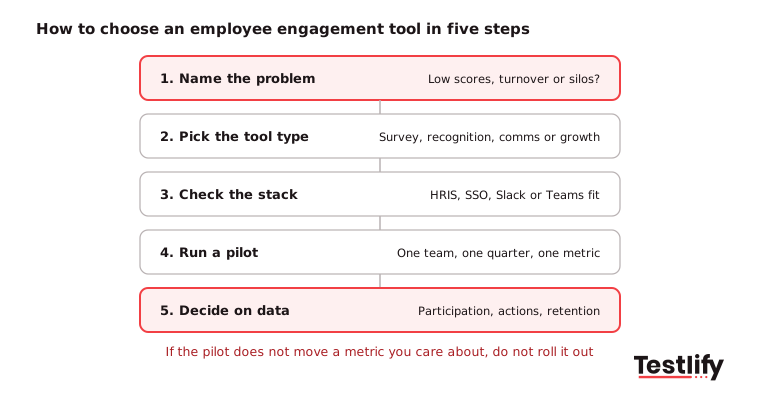
- Name the problem: Low survey scores, rising turnover on one team, poor communication with frontline staff, or managers who never give feedback each point to a different tool type.
- Pick the tool type: Survey tools diagnose. Recognition, communication and performance tools treat. If you have no data yet, start with a listening tool.
- Check the stack: Confirm the tool connects to your HRIS, single sign-on, and Slack or Microsoft Teams. A tool that lives outside daily workflows gets ignored.
- Run a pilot: Give one or two teams the tool for a quarter with one clear metric, such as survey participation or recognition sent per person.
- Decide on data: Roll out only if the pilot moved the metric. If it did not, the problem may be managers or process, not software.
When you compare vendors, score each one on these criteria:
- Anonymity and trust: Employees answer honestly only when they trust that small teams cannot be identified. Ask how the tool hides results below a minimum group size.
- Action planning: The tool should help managers move from results to two or three actions, not just show charts.
- Ease of use: If giving recognition or answering a pulse takes more than a minute, participation will drop.
- Reporting by team and manager: Company-wide averages hide the teams that need help.
- Security and compliance: Check GDPR, SOC 2 or ISO 27001 coverage and where data is stored, especially for EU staff.
- Total cost: Most tools price per employee per month, often with a yearly minimum. Add rewards budgets for recognition tools.
Pro tip: Ask every vendor for a customer of your size and industry you can call. A tool built for 50-person startups often struggles with 2,000 employees in five countries.
Which employee engagement tool stack fits your company size?
The right employee engagement tool stack depends on company size and how mature your listening program is. Mid-market companies usually need two tools; enterprises often need three or more that share data through the HRIS.
Company size | Start with | Add next | Why |
|---|---|---|---|
200 to 500 employees | One survey tool or a performance platform with surveys (Lattice, 15Five, Culture Amp) | A recognition tool (Bonusly, Motivosity) | Small HR teams need few tools that managers will actually open |
500 to 2,000 employees | A dedicated listening platform (Culture Amp, Workday Peakon) | Recognition plus manager one-on-one tools | Results by team and manager become essential |
2,000+ employees, several countries | Enterprise listening (Qualtrics EmployeeXM, Viva Glint) | Global recognition (Achievers, Vantage Circle) and communication (Workvivo by Zoom) | Reach, local rewards and data residency matter |
If you are building or growing the team that runs these programs, our employee engagement interview questions help you hire a coordinator who can run surveys and act on results. For program ideas beyond software, see our guide to employee engagement strategies.
How do you measure whether engagement tools work?
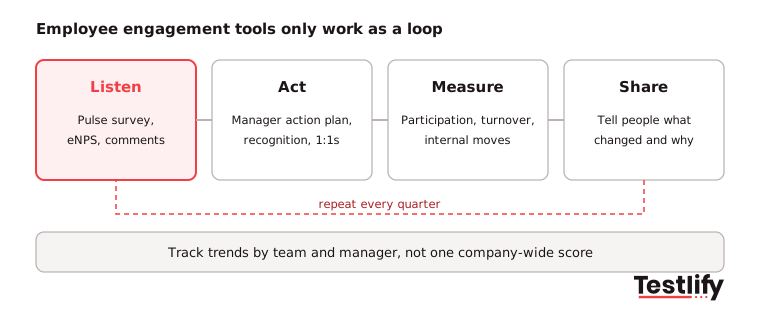
Measuring whether engagement tools work means combining survey signals with behavioral signals and tracking both over time by team. A single annual score tells you little. Trends by team and manager tell you where to act.
- Survey signals: Engagement score, eNPS and pulse results show how people feel in near real time. Our free eNPS calculator gives you a quick baseline.
- Participation: Survey response rate and recognition sent per employee show whether people trust and use the tool. Falling participation is often the first warning sign.
- Behavioral signals: Turnover, regretted attrition, absenteeism and internal moves reveal what surveys miss. Rising attrition on one team is a reason to investigate before a survey confirms it.
- Action rate: The share of managers who shared results and agreed on actions. Acting visibly on results is what convinces employees the next survey is worth answering honestly.
Review these numbers every quarter. Share what changed with employees, then run the next pulse. That loop of listening, acting, measuring and sharing is what separates tools that change behavior from tools that collect dust.
How does better hiring support employee engagement?
Better hiring supports employee engagement because the right people in the right roles ramp faster, contribute sooner and stay longer. A mis-hire drags on the whole team: colleagues pick up the slack, managers spend time on performance issues, and engagement scores fall for reasons no recognition tool can fix.
Skills-based hiring lowers that risk. When candidates prove the skills a role needs before an offer, fewer people start in jobs they cannot do or do not want. See the data in our roundup of skills-based hiring statistics.
Testlify is a skills assessment and AI interviewing platform, not an engagement tool, but it covers both ends of this link. Hiring teams use its library of 3,500+ tests, including personality and culture assessments, to hire on proof. After hiring, Testlify's 360 degree feedback assessment collects input from managers, peers and reportees to spot skill gaps and plan development, which feeds the growth side of engagement.
AI can help on both sides. It can screen resumes, surface patterns in survey comments and personalize learning. But trust is built by people. Use automation to handle scale and free managers from busywork, then keep coaching, recognition and final decisions human.
Build engagement from the first hire
Engaged teams start with the right people in the right roles. Browse the Testlify test library or start a 7-day free trial, no credit card needed, and use skills-based assessments to hire people who fit, contribute and stay.
Frequently asked questions (FAQs)

Content Writer
Yashika Khandelwal is a Content Writer with 3+ years of experience creating research-backed content on hiring, talent assessment, and HR technology. She is a registered Organizational Psychologist and subject matter expert who combines behavioral science with practical recruitment insights to produce accurate, evidence-based content.
LinkedInRelated resources
View all
HR & recruitment
10 Best Performance Management Tools for Enterprise HR Teams (2026)

HR & recruitment
Top 10 Employee Monitoring Tools in 2026 (Ranked and Compared)

HR & recruitment
Top 10 staffing tools for enterprise hiring teams (2026)

HR & recruitment
11 best time tracking tools for HR managers in 2026

HR & recruitment
Top 10 Workforce Management Tools for 2026 (Compared and Ranked)

HR & recruitment
Top 5 Core HR tools
Get started.
Hire on proof, not resumes.
Run your first skills-based assessment free — no credit card required.