
How to evaluate critical thinking skills in candidates
A practical guide to testing, interviewing and scoring candidates for critical thinking, with sample questions and a reusable rubric.
To evaluate critical thinking skills in candidates, give every candidate the same reasoning tasks, watch how they work through them, and score the result against a fixed rubric. Critical thinking is the ability to interpret information, question assumptions, weigh evidence and reach a conclusion you can explain. Resumes and confident answers say little about it, so hiring teams need a test, a structured interview and a real task from the role.
TL;DR / Key Takeaways
- Critical thinking is interpreting information, questioning assumptions, weighing evidence and reaching a conclusion you can explain.
- Interpretation, analysis, evaluation, inference and explanation.
- AI writes many answers, so hiring teams need tasks that show how candidates reason.
- Critical thinking tests, situational judgment tests, case tasks and structured interviews.
- Screen with a short test, probe in a structured interview, confirm with a case task, then decide on combined scores.
- Use the same questions and follow-ups for every candidate, and score each skill from 1 to 5 against a written rubric.
 ChatGPT
 Gemini
 Claude
 Grok
 Perplexity
What are critical thinking skills at work?
Critical thinking skills at work are the habits that let someone turn messy information into a sound decision. A candidate with strong critical thinking reads a problem carefully, separates facts from opinions, notices what is missing and changes course when the evidence changes.
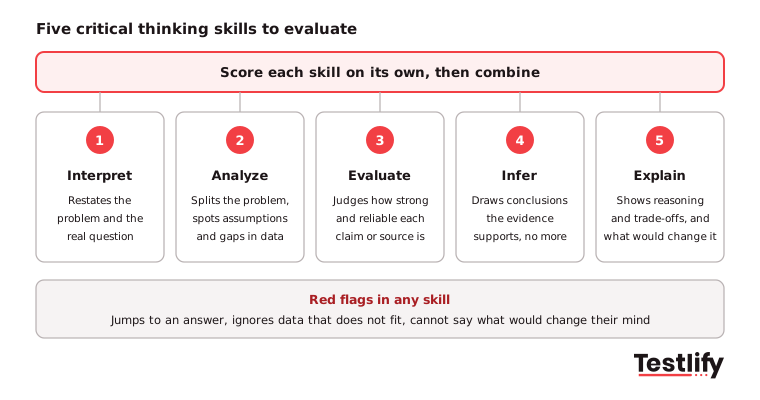
Most hiring teams can break critical thinking into five skills they can observe and score:
- Interpretation: understanding what a problem, report or request actually asks.
- Analysis: splitting the problem into parts and spotting the assumptions behind each one.
- Evaluation: judging how strong and reliable a claim, source or data set is.
- Inference: drawing conclusions the evidence supports, and stopping there.
- Explanation: laying out the reasoning, the trade-offs and what would change the decision.
Critical thinking overlaps with problem-solving and analytical skills, but the focus is different. Problem-solving is about reaching a fix. Critical thinking is about the quality of the judgment on the way there, including knowing when the obvious fix is wrong.

Why should hiring teams evaluate critical thinking skills?
Hiring teams should evaluate critical thinking skills because employers rank thinking skills at the top of their wish lists, and because they are among the hardest skills to see on a resume. A degree, a title or a polished cover letter does not show how someone reasons when the data is incomplete.
Recent research points the same way:
- The World Economic Forum Future of Jobs Report 2025 names analytical thinking as the top core skill employers look for, and employers expect 39% of current skills to change or become outdated by 2030.
- In an August 2026 article, SHRM reports that 56% of organizations name critical thinking an important priority for the next five years, and 45% name judgment and decision-making.
- NACE's Job Outlook 2026 Spring Update found employers want early-career candidates to show evidence of problem-solving, teamwork and communication.
The payoff of testing for it is also clearer. SHRM's 2026 study The Skills-First Movement found that about 85% of HR professionals believe a reliable skills assessment makes a candidate more likely to meet job requirements, even without a degree. Organizations that can assess skill proficiency were more likely to meet or beat their financial goals (63% vs 51%).
How do you measure critical thinking skills?
Critical thinking skills are measured by giving candidates a reasoning task with a right or better answer, then scoring both the answer and the reasoning. You cannot measure critical thinking by asking candidates to rate themselves, and a general chat about "how you approach problems" mostly measures how well someone talks.
Good measures share three traits:
- Same task for every candidate: Everyone sees the same problem, the same time limit and the same information, so scores are comparable.
- Observable output: The candidate picks an answer, writes a recommendation or talks through a decision you can score.
- A fixed scoring guide: Reviewers score each of the five skills against written descriptions, not gut feel.
Pro tip: Decide before the first interview what a 1, 3 and 5 looks like for each skill. Teams that write the rubric after meeting candidates tend to write it around the person they already liked.
Which methods work best to evaluate critical thinking?
The best way to evaluate critical thinking is to combine a standardized test for early screening with a structured interview and a short case task for finalists. Each method shows a different side of the skill, and no single method covers all five sub-skills well on its own.
Method | What it shows | Candidate time | Best stage | Watch out for |
|---|---|---|---|---|
Critical thinking test | Spotting assumptions, judging arguments, drawing valid conclusions | 10 to 15 min | Screening a large pool | Generic content; pair with role context later |
Judgment in realistic work dilemmas | 10 to 20 min | Screening or shortlist | Scenarios must match the role | |
Logical, numerical and verbal reasoning speed | 10 to 20 min | Screening | Measures raw reasoning, not judgment in context | |
Case study or work sample | Analysis and recommendation on a real problem | 30 to 60 min | Finalists | Take-home tasks invite AI help; run live or proctored |
How the candidate reasons, explains and handles pushback | 30 to 45 min | Shortlist and final | Charisma can pass for reasoning without a rubric | |
Brain teasers and puzzles | Little that predicts work output | 5 to 10 min | Not recommended | Feel clever, add stress, rarely job-related |
SHRM's skills-first research also found that organizations using project-based assessments were more likely to report low or very low turnover (46% vs 34%). That supports keeping a real task from the job in the final stage, not only a test and a conversation.
For a deeper look at picking a test, see our guide to choosing a critical thinking skills assessment.
How do you run a critical thinking assessment in your hiring process?
A critical thinking assessment works best in four stages: screen with a short test, probe in a structured interview, confirm with a case task, then decide on combined scores. The order matters because each stage costs more of your team's time than the one before it.
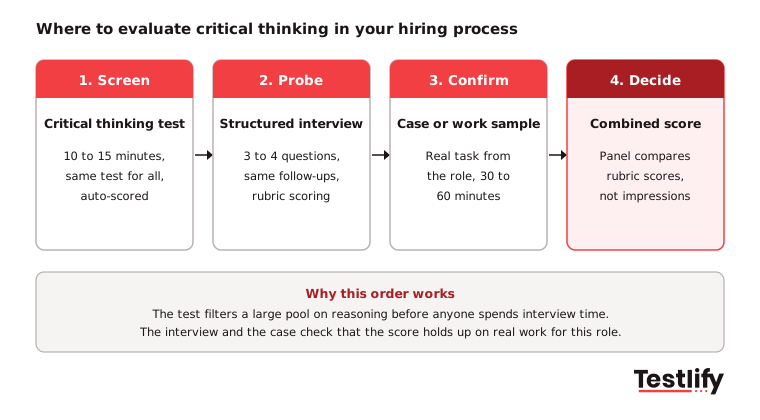
- Screen: Send a 10 to 15 minute critical thinking test to every applicant who meets the basic requirements. Set a minimum score instead of only taking the top few, so you do not drop strong candidates on a narrow margin.
- Probe: In the interview, ask three or four critical thinking questions (below), with the same follow-ups for every candidate. Score each answer right after the interview, before the panel talks.
- Confirm: Give finalists a short case built from a real problem in the role: a messy data set for an analyst, an escalated ticket for a support lead, a flawed project plan for an operations manager. Ask for a recommendation and the reasons behind it.
- Decide: Combine the test, interview and case scores with agreed weights. Discuss gaps between them; a high test score with a weak case usually means the candidate reasons well in the abstract but needs help applying it.
Across the teams we work with, the biggest gain comes from step 1. When the test runs before resume review, hiring managers spend interview time on people who have already shown they can reason, and the shortlist is less shaped by school names or past employers.
What interview questions reveal critical thinking?
Interview questions that reveal critical thinking ask candidates to describe a real decision, the evidence they used and what they would do differently. Follow-up questions do most of the work, because the first answer is often rehearsed.
Question | What it tests | Follow-ups to ask |
|---|---|---|
Tell me about a time you found a flaw in a plan everyone else had agreed to. | Evaluation, explanation | How did you know it was a flaw? How did you raise it? What happened next? |
Describe a decision you made with incomplete information. | Inference under uncertainty | What did you assume? What would have changed your decision? |
Tell me about a time you changed your mind because of new evidence. | Openness, evaluation | What was the evidence? How did you check it was reliable? |
Walk me through how you would check whether this number is right. (Show a chart or metric.) | Interpretation, analysis | What else would you want to see? What could explain the trend? |
Describe a time you had to choose between two good options. | Analysis, trade-offs | What did you give up? How did you explain the choice to others? |
An AI tool gives you a confident answer for a report due today. What do you do before you use it? | Evaluation of sources, judgment with AI | What would make you trust it? What would you check first? |
Use the same questions and follow-ups for every candidate in a role. For more question sets, browse our structured interview glossary entry.
How should you score critical thinking answers?
Critical thinking answers should be scored skill by skill on a 1 to 5 scale, using written descriptions for a 1, a 3 and a 5. Scoring each of the five skills separately stops one strong impression, like a confident delivery, from lifting every score.
Skill | 1: weak | 3: solid | 5: strong |
|---|---|---|---|
Interpretation | Answers a different question from the one asked | Restates the problem correctly | Restates it and names what is unclear or missing |
Analysis | Treats the problem as one block | Breaks it into parts | Breaks it into parts and names the assumptions in each |
Evaluation | Accepts any data or source at face value | Questions weak sources when prompted | Checks reliability unprompted and explains why |
Inference | Jumps to a conclusion the facts do not support | Reaches a reasonable conclusion | Reaches it, states the confidence level and the limits |
Explanation | Cannot explain how they got there | Explains the main steps | Explains steps, trade-offs and what would change the call |
Add the five scores for a total out of 25, and agree a minimum for each stage before you start. Two reviewers who score separately and then compare will catch more bias than one reviewer scoring alone.
Key takeaway: A rubric with written anchors is what turns "they seemed sharp" into a score you can compare, defend and improve.
What does strong critical thinking look like by role?
Strong critical thinking looks different in each role, so the tasks and examples you use should come from the job. The five skills stay the same; the material changes.
Role | Good sign | Task to use |
|---|---|---|
Data or business analyst | Questions how a metric was built before drawing conclusions | Messy data set with one misleading trend |
Operations manager | Weighs cost, risk and people impact before changing a process | Flawed process change proposal |
Customer support lead | Separates the stated complaint from the root cause | Escalated ticket thread with conflicting facts |
Software engineer | Tests assumptions about a bug before writing a fix | Bug report with a red herring in the logs |
Finance or compliance | Flags gaps and inconsistencies without being asked | Short report with a buried error |
For analyst, finance, legal and strategy roles, consider the Advanced Critical Thinking and Reasoning Test, which covers inference, assumptions, deduction and argument evaluation at an advanced level.
How does AI change critical thinking assessment?
AI changes critical thinking assessment in two ways: candidates can use it to answer your tasks, and judging AI output has become a critical thinking skill in its own right.
On the first point, a Gartner survey released in July 2025 found that 39% of candidates used AI during the application process, 6% admitted to interview fraud, and Gartner predicts that by 2028 one in four candidate profiles worldwide will be fake. Unsupervised take-home tasks are the easiest to hand to a chatbot.
Three practical changes keep critical thinking assessment honest:
- Run timed tests with proctoring: Short, timed tests with checks like tab tracking, copy-paste blocking and webcam snapshots make outside help harder. Testlify includes 20+ proctoring checks.
- Move case tasks into the interview: Ask finalists to talk through the case live, then change one fact and see how they adjust.
- Test AI judgment directly: Give candidates an AI-written summary with one wrong claim and ask what they would check before using it. Spotting the error is critical thinking applied to the tools your team actually uses.
What mistakes should you avoid when you evaluate critical thinking?
The most common mistake when you evaluate critical thinking is confusing confidence and fluency with good reasoning. A candidate who talks smoothly can sound sharp while skipping evidence entirely.
Other mistakes to watch for:
- Using brain teasers: Puzzles about golf balls in a plane feel clever but rarely reflect the work, and they add stress that hurts some candidates more than others.
- Changing questions between candidates: Different questions make scores impossible to compare and open the door to bias.
- Scoring body language: Eye contact, posture and accent are not critical thinking and can disadvantage neurodivergent and non-native candidates.
- One overall score: A single "strong thinker" rating hides which skill is weak, so you cannot plan onboarding or training.
- Skipping the role context: A general test is a good filter, but the final decision needs a task from the actual job.
How can Testlify help you evaluate critical thinking skills?
Testlify helps hiring teams evaluate critical thinking skills with ready-made tests, structured interviews and automatic scoring in one place. You can screen every applicant on the same tasks before anyone reads a resume.
- Ready-made tests: the Critical Thinking Test takes 10 minutes and covers strengthening and weakening arguments, conclusions, facts versus inferences and judgments, and assumptions. It is one of 3,500+ tests in the test library, so you can pair it with role skills in one assessment.
- Custom tasks: the AI test builder creates an assessment from a job description, and 25+ question types (including open-ended, case-style, video and audio answers) let you add your own role scenarios.
- Structured AI interviews: run the same questions for every candidate, with scored responses and explainable results reviewed by your team.
- Fair, consistent scoring: automated scoring, per-skill breakdowns and 20+ proctoring checks keep results comparable across candidates.
Testlify offers a 7-day free trial with no credit card. To see it with your own roles, book a demo.
Frequently asked questions

Wordpress Developer
Yash Patel is a Wordpress and SEO Specialist at Testlify with 3+ years of experience in technical SEO, on-page optimization, and content strategy. He works on improving Testlify's organic presence and produces content focused on hiring, talent assessment, and HR technology.
LinkedInRelated resources
View all
HR & recruitment
Top 7 recruitment trends in product manager hiring

HR & recruitment
5 tips to evaluate communication skills

HR & recruitment
5 tips to evaluate data analysis skills

HR & recruitment
5 tips to evaluate customer service skills

HR & recruitment
How to evaluate problem-solving skills in candidates

HR & recruitment
10 Key computer skills to assess during job interviews
Get started.
Hire on proof, not resumes.
Run your first skills-based assessment free — no credit card required.