
How to create a game-changing talent strategy?
Learn how to create a game-changing talent strategy! Discover essential steps to attract, develop, and retain top talent for your organization’s success.
A good talent strategy is the spine of any successful organization. It enables businesses to attract, develop, and keep the right people who can deliver long-term success to an organization.
Understanding and creating an effective talent strategy can ensure the success of recruiters in building skills, knowledge, and a high-performing workforce.
In this blog, we’ll break down talent strategy, why you might need one, and how to create one that aligns with your organization’s goals.
 ChatGPT
 Gemini
 Claude
 Grok
Grok Perplexity
What is a talent strategy?
At its core, a talent strategy would focus on planning how an organization will attract, develop, and retain the professionals needed to achieve business goals. It aligns people’s processes with the company’s mission, vision, and values.
A successful talent strategy has great things to do with hiring beyond just assigning positions. Rather, it creates a defined process of the entire talent lifecycle, from recruitment to development and retention.

Why do you need a talent strategy?
A talent strategy goes beyond filling a vacancy: it ensures you have the right people in the right roles at the right time. With a strong talent strategy, you can
Align talent with business goals: Ensure your workforce has the skills needed to drive organizational success.
Enhance employee engagement: Employees who feel valued and see a clear career path are more likely to stay and contribute their best work.
Reduce turnover: By focusing on retention, you can reduce hiring costs and maintain institutional knowledge.
Foster diversity and inclusion: A thoughtful talent strategy helps create a diverse and inclusive workplace where everyone can thrive.
Key components of a talent strategy
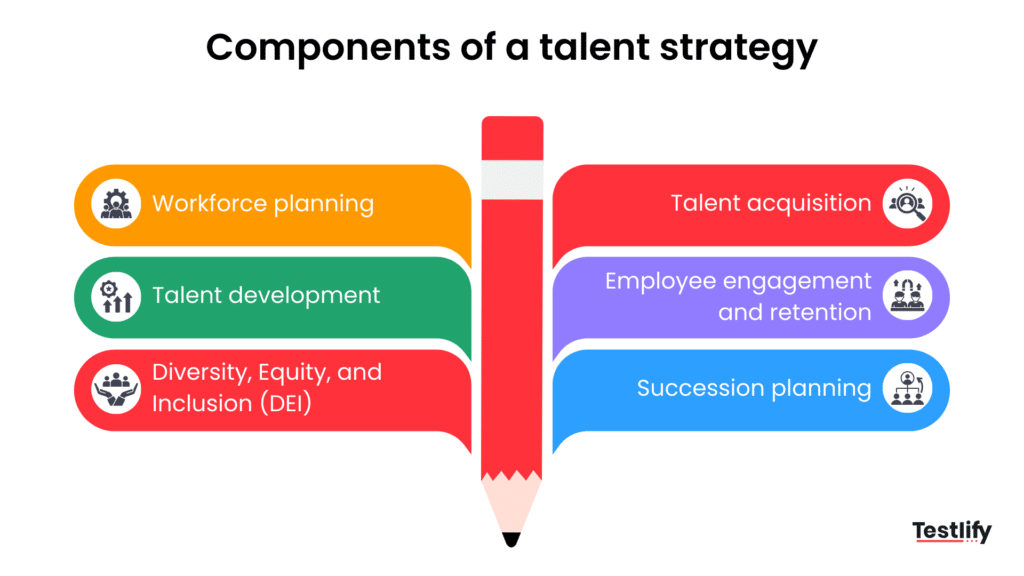
A successful talent strategy is built on several core components that cover everything from workforce planning to retention. By understanding these key areas, you can create a comprehensive approach to managing and developing talent within your organization.
1. Workforce planning
Workforce planning is the core of a talent strategy. It incorporates an analysis of your current workforce, identification of future talent needs, and plans to bridge gaps. It requires insight into business goals and the requisite skills to achieve them.
Read more: Check out case studies of workforce planning in our blog to learn more.
2. Talent acquisition
Once you’ve identified your talent needs, the next step is to attract top candidates. This includes defining your employer brand, creating a smooth recruitment process, and using data to make informed hiring decisions.
3. Talent development
Hiring the right people is just the beginning. A talent strategy includes continuous learning and development opportunities for employees. This can be through training programs, mentorship, and on-the-job learning.
4. Employee engagement and retention
If you want to retain the best talent for the long term, this should be part of your strategy. According to Gallup, companies with highly engaged employees outperform their competitors by 147% in earnings per share. Continuous feedback, recognition programs, and career growth opportunities should be incorporated to boost employee engagement and retention.
5. Diversity, Equity, and Inclusion (DEI)
Diversity and inclusion can inspire innovation and lead to better decision-making. Your talent strategy has to be full of DEI initiatives focused on creating inclusive opportunities and a friendly culture.
6. Succession planning
Succession planning ensures you have a talent pipeline ready to step into critical roles when needed. This is important for minimizing disruption and maintaining business continuity.
Steps to developing a talent strategy
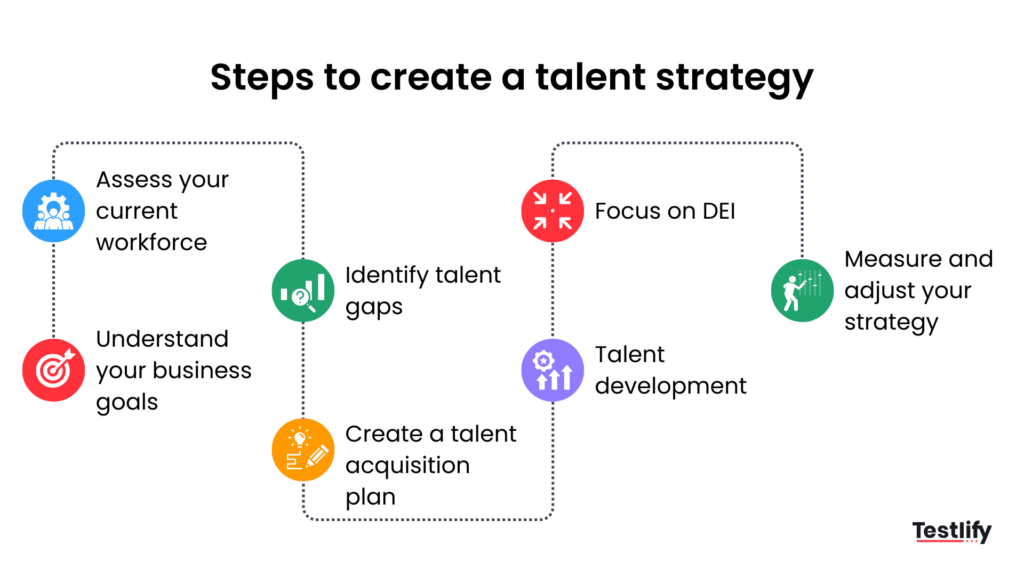
Crafting a talent strategy requires a step-by-step process that aligns with your business goals. By following these structured steps, recruiters can build a sustainable workforce that meets the company’s current and future needs.
Step 1: Understand your business goals
Your talent strategy must fit into the organization’s overall goals. Do you need to grow fast? Expand geographically? Do you want to focus on innovation? These objectives will help you determine what kind of skills and competencies your workforce needs.
Step 2: Assess your current workforce
You must analyze the missing skills, performance levels, and potential for progression among your current workforce. You can use a range of tools, from a skills inventory to mapping the present capability of your team.
Pro tip: Use skills assessment tools like Testlify to assess employee’s skills.
Step 3: Identify talent gaps
Once you know your workforce well, you will understand the areas needing filling. It may be the lack of skills in performing a particular activity or a lack of leadership potential in specific areas. This will give you useful information about acquiring and developing talent.
Step 4: Create a talent acquisition plan
Your talent acquisition plan should also outline how you will attract and bring on board the right people. Everything depends on writing job descriptions and selecting the best recruitment channels. Consider technology that simplifies hiring, such as ATS and AI-powered talent assessment tools.
Step 5: Talent development
Offer continuous development opportunities to help your employees grow in multiple skills and advance in their careers. This can include:
Training programs: Offering technical as well as soft-skill training.
Mentorship programs: Linking employees with mentors to assist them in career development.
Learning platforms: Select online learning platforms and offer flexible, on-demand learning.
Step 6: Implement employee engagement initiatives
Employees who feel engaged are more productive and also don’t leave. Introduce initiatives like:
Employee recognition: Reward employees for excellent work performed and contributions.
Regular feedback: Build an open communication culture through regular check-in.
Career pathing: This enables employees to know their career development and advancement.
Step 7: Focus on DEI
According to Forbes, companies with diverse teams are 33% more likely to outperform their competitors. A strong strategy of DEI creates an inclusive workplace in which everyone has a say and value is created. Diverse hiring practices, equal development opportunities, and a culture of belongingness can accomplish this.
Step 8. Measure and adjust your strategy
Like any other business strategy, yours should be measured and adjusted regularly. You can check out the effectiveness of your strategy with key metrics such as employee retention, engagement scores, and time-to-hire. If a certain initiative does not work, do not hesitate to pivot and try something else.
Role of HR in talent strategy
HR plays a pivotal role in bringing a talent strategy to life, bridging leadership and employees. From data-driven decision-making to fostering workplace culture, HR is responsible for implementing initiatives that support the organization’s long-term goals.
Strategic partnership with leadership
Your role is to align the talent strategy with the business goals excellently. When well-coordinated with leadership, talent initiatives will support the company’s long-term vision.
Data-driven decision making
Contemporary HR uses data in making talent decisions. Through HR analytics, you may get insights about the trends in the workforce and high-potential employees and can forecast future talent needs.
Culture building
You should also establish a positive work culture within the organization. The greatest corporate culture keeps talent and fosters engagement and motivation within the employee.
Common challenges in developing a talent strategy
Developing a talent strategy comes with its challenges, such as addressing skills gaps and retaining top talent. Understanding these obstacles can help recruiters create more effective strategies adaptable to changing workforce dynamics.
1. Skills gap
One of the major challenges is the skills gap, the difference between the employees’ skills and the skills the company requires. According to McKinsey & Company, 87% of employers say they have skills gaps in their workforce or expect to have them within a few years. Upskilling and reskilling initiatives can help you narrow this gap.
2. Struggles with retention
Keeping top talent is a common challenge, especially in competitive industries. Focusing on employee engagement, recognition, and development can boost retention rates.
3. Rapid changes in the workforce
The workforce trends are evolving rapidly through remote work, the gig economy, and digital transformation. You can withstand this by being agile and updating your talent strategy to change trends.
Best practices for a winning talent strategy
By adopting best practices, recruiters can fine-tune their talent strategy to attract, develop, and retain top talent. These tips and insights will help create a strategy that evolves with the company and its workforce needs.
1. Prioritize employee experience
A positive employee experience is the secret to attracting and keeping the best talent. Support inclusiveness and employee engagement as foundational building blocks for a great workplace.
2. Leverage technology
Leverage the power of technology to streamline the recruitment process, track performance, and enhance employee development opportunities. You will see how your talent strategy improves in the provided toolkit with assistance from ATS, talent assessment tools, LMS, and HR analytics.
3. Review your strategy periodically
A talent strategy does not have to be ‘set in stone’ as it is supposed to follow the growth of the business and the workforce. Review and update your strategy periodically to see if this fits the organization’s needs.
4. Collaborate across departments
Talent strategy is not just the job of an HR. It is interdepartmental work. Leaders in every department should be aligned with your strategy and strive for common goals.
Conclusion
Building a strong talent strategy becomes important in a scenario that helps build a high-performing workforce that can drive long-term success.
Considering factors such as workforce planning, talent acquisition, development, employee engagement, and diversity helps you to design a strategy that will appeal to the best talent and be kept in the workplace.
You are uniquely positioned to make this strategy a reality as a recruiter. Align talent initiatives with business objectives, deliver results, make decisions through data-driven insights, and stay focused on developing the right employees to allow your organization to outpace the fast-changing business environment.
FAQs

Content Writer
Yashika Khandelwal is a Content Writer with 3+ years of experience creating research-backed content on hiring, talent assessment, and HR technology. She is a registered Organizational Psychologist and subject matter expert who combines behavioral science with practical recruitment insights to produce accurate, evidence-based content.
LinkedInRelated resources
View all
HR & recruitment
Integrating AI into leadership development for a stronger talent pipeline
HR & recruitment
10 Proven strategies to expand your reach as a recruiter and attract top talent
HR & recruitment
What are pink collar jobs? A definitive guide
HR & recruitment
Inbound Recruiting: How to Attract Top Talent in 2026
HR & recruitment
What is a talent gap and how to address one?

HR & recruitment
What Is Resume Parsing? How It Works, Types, and Tips (2026)
Get started.
Hire on proof, not resumes.
Run your first skills-based assessment free — no credit card required.