
Talent Lifecycle: 5 Stages and HR’s Role (2026 Guide)
The talent lifecycle covers stages from hiring to offboarding. Discover each stage and how HR plays a key role in nurturing and retaining top talent.
The talent lifecycle is the full journey an employee takes with your company, from the first time they hear your name to the day they walk out the door. It runs across five stages: recruitment, onboarding, engagement, learning and development, and offboarding.
Treat those stages as one connected experience, and you keep good people longer. Treat them as separate handoffs between teams and you quietly leak talent at every gap.
Here is the part most HR plans miss. The median worker now stays in a job for about two years and three months, according to Indeed Hiring Lab data. Your workforce moves through these stages faster than most plans assume, so the quality of each stage compounds.
This guide covers all five stages, what HR owns at each, how the lifecycle differs from talent lifecycle management, and which stage model to pick when three of them claim to be the standard.
TL;DR
- The talent lifecycle has five stages: recruitment, onboarding, engagement, learning and development, and offboarding.
- The lifecycle is the journey. Talent lifecycle management is the discipline of running that journey on purpose, with a named owner and one number per stage.
- Most companies lose people at the seams between stages, not inside them. The handoff from recruiter to manager is where good hires go quiet.
- Onboarding is the weakest stage almost everywhere, making it the cheapest to fix first.
- Pick one metric per stage and watch the trend for a year. A deliberate lifecycle beats a longer one nobody manages.
 ChatGPT
 Gemini
 Claude
 Grok
Grok Perplexity
What is the talent lifecycle?
The talent lifecycle is the end-to-end journey of an employee, from their first contact with your brand through recruitment, onboarding, daily engagement, growth, and eventual exit. For HR, it is a single map of every moment that shapes whether someone joins, performs, stays, and speaks well of you after they leave. Get one stage wrong, and the next one inherits the damage.
People often use "talent lifecycle" and "employee lifecycle" to mean the same thing, and in practice they nearly do. The small but useful difference: the talent lifecycle includes the attraction and sourcing work that happens before anyone is hired, while the employee lifecycle tends to start on day one. If you own sourcing, you own the talent lifecycle.
Talent management life cycle vs talent lifecycle
This is the pair that causes the most confusion, and the honest answer is that the two terms have drifted into each other. Used carefully, they are not the same thing.
The talent lifecycle is the journey: what actually happens to a person, in order, whether or not anyone is steering it. Every company has one. The talent management life cycle, also written as the talent management cycle or talent management lifecycle, is the practice: the set of decisions, owners, and data a company applies to that journey to make it work better. A talent cycle exists by default. Managing it is a choice.
The practical test: if you can name who owns each stage and what number they watch, you have a talent management cycle. If you cannot, you have a talent lifecycle that is running you. In most organizations, the early stages get that attention and the later ones do not, which is why development and offboarding tend to be the two running on autopilot.

What is talent lifecycle management?
Talent lifecycle management is the practice of running all five stages as one connected system rather than five separate projects. It means each stage has a named owner, a decision it exists to make, a data source behind that decision, and a review cadence. The goal is not more process. It is fewer places where a good hire quietly falls through.
The idea that makes this work is a feedback loop. Recruiters must connect pre-hire evidence to what happens after someone starts, then feed that back into how you hire next time. Score the skills a role genuinely needs before the offer, keep that record through onboarding and internal moves, and after a year you can see which pre-hire signals actually predicted good performance.
The caveat worth stating plainly: This needs post-hire outcome data you have to collect yourself, and most companies do not have it in usable shape. Start with one role family and one outcome measure, not a company-wide dashboard you will abandon in a quarter.
What are the 5 stages of the talent lifecycle?
The five stages are recruitment, onboarding, engagement, learning and development, and offboarding. They are not a tidy line. They loop. A good offboarding can send you a referral that starts a new recruitment, and a stalled development plan quietly becomes an engagement problem. Here is the whole lifecycle on one page before we go stage by stage.
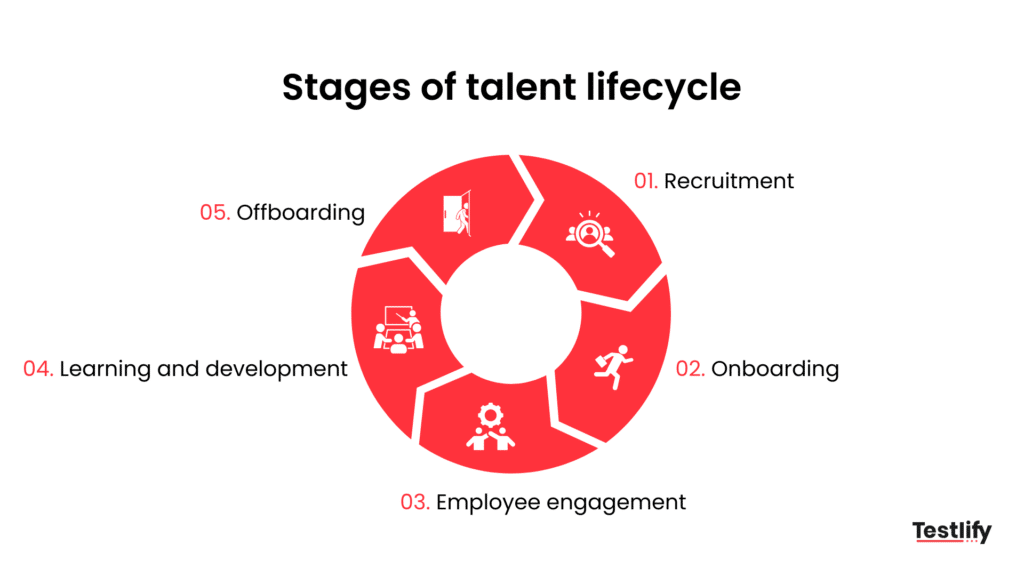
1. Recruitment
Recruitment is where the lifecycle starts and where the most expensive mistakes get made. This is the work of writing a clear role, sourcing candidates through job boards, referrals, and networks, and then deciding who can actually do the job. The trap is hiring on resumes and gut feel. A sharper approach is to score the skills the role needs before the first interview, using a short skills assessment so your shortlist is ranked on evidence, not on who interviews well.
The math is blunt. Gallup estimates that replacing a person costs roughly 40% of their salary for a frontline role and up to 200% for a leader, and that 42% of voluntary turnover is preventable. A weak hire is not a one-time cost. It pays out across every stage that follows.
2. Onboarding
Onboarding is the bridge between a signed offer and a productive teammate, and it is the stage companies fumble most. Gallup found that only 12% of employees strongly agree their organization does a great job onboarding.
This represents a significant opportunity for organizations to differentiate their employee experience. Effective onboarding extends beyond administrative formalities.
It begins with preboarding, followed by a structured 30-60-90 day plan, introductions to the organization’s culture and key stakeholders, and role-specific training that gives new hires a clear understanding of expectations and what success looks like from the outset.
Pro Tip: Assign every new hire one onboarding buddy and one 30-day goal they can actually hit. The buddy answers the small questions people are embarrassed to ask their manager, and the early win builds confidence before the hard work starts.
3. Employee engagement
Engagement is not a pizza party or a perks list. It is whether people feel their work matters and their manager has their back. An engaged employee is more productive and far less likely to quit. HR moves this number with the boring stuff that works: regular check-ins, real two-way feedback, recognition that lands, and a clear engagement strategy managers are trained to run.
The uncomfortable part is that engagement is mostly a manager problem wearing an HR badge. Surveys tell you which teams are struggling. They do not fix a manager who has never been taught to run a one-to-one, and no amount of survey frequency will.
4. Learning and development
Learning and development is how you keep people growing instead of leaving to grow somewhere else. Start with a skills gap analysis so you know what the business actually needs, then build paths to close it: on-the-job training, courses, mentoring, and stretch projects.
The honest caveat is that much of the L&D budget can go toward courses employees never finish or apply. Decades of research on training transfer, including the widely cited meta-analysis by Blume and colleagues in the Journal of Management, suggests that learning is more likely to stick when managers support and expect employees to use it.
Tie development to a clear career path and give managers a role in reinforcing it, and learning becomes more meaningful because employees are building skills for a specific destination, not simply completing another course.
5. Offboarding
Offboarding is the most ignored stage and the one that shapes your reputation the most. When someone leaves, whether by resignation, retirement, or a layoff, a clean exit protects the people who stay and keeps the door open for boomerang hires. Run a real exit interview to learn why they are going, transfer their knowledge before the laptop goes dark, and close out access and final pay without a mess. A bad exit gets posted publicly. A good one gets you a referral six months later.
What are the biggest talent lifecycle challenges?
Knowing the five stages is the easy part. Running them well, at the same time, for a growing workforce is where it gets difficult. These are the challenges that trip up most HR teams.
1. Attracting the right talent
A tight talent market makes it harder to find people with the right skills and fit, which can stretch hiring timelines. Screening for relevant skills early helps narrow the pool and move qualified candidates through the process faster.
2. Onboarding that actually works
A shaky start can leave even a strong hire feeling lost, disconnected, or unsure of what is expected. Without clear goals, resources, and support early on, that uncertainty can quickly turn into disengagement or an early exit.
3. Keeping employees engaged
Personalized recognition becomes harder as headcount grows, while workload, feedback, and communication can easily fall through the cracks. Engagement needs consistent ownership rather than being treated as something that happens automatically.
4. Funding employee development
Effective learning and development requires both time and money, and keeping opportunities relevant and accessible across a growing workforce adds another layer of complexity. HR teams need to balance employee development with business priorities and available resources.
5. Managing exits with dignity
Offboarding often gets rushed during layoffs or periods of high turnover, but how someone leaves shapes how they remember the organization. A poorly handled exit can damage employer reputation and undermine the talent brand you worked hard to build.
How is the talent lifecycle changing in 2026?
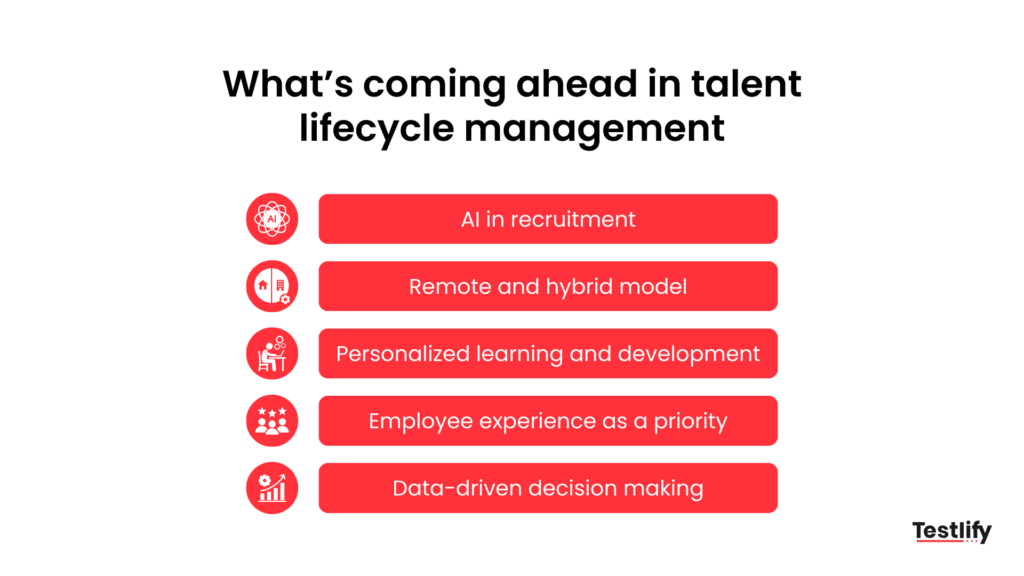
Talent lifecycle management is becoming more technology-driven, personalized, and employee-focused. These trends are likely to shape how organizations attract, develop, engage, and retain talent.
1. AI in recruitment
AI will take on more repetitive recruitment tasks, from sourcing and screening candidates to scheduling interviews and analyzing applications. The focus will increasingly shift toward using AI to improve efficiency while keeping human oversight in decisions that affect candidates.
2. Remote and hybrid work models
Remote and hybrid work will remain an important part of how organizations attract and manage talent. HR teams will need better ways to support distributed employees, maintain collaboration, build connection, and create consistent experiences regardless of where people work.
3. Personalized learning and development
Employees increasingly expect development opportunities that match their skills, goals, and career paths. Organizations will use skills data and personalized learning platforms to recommend training, identify gaps, and help employees build capabilities that support both their careers and business needs.
4. Employee experience as a priority
Employee experience will become a bigger part of talent strategy, covering everything from onboarding and communication to recognition, wellbeing, development, and offboarding. Organizations that treat these interactions as one connected experience will be better positioned to improve engagement and retention.
5. Data-driven decision-making
HR teams will rely more heavily on workforce data to understand what is happening across the talent lifecycle. Hiring metrics, engagement data, performance trends, retention rates, and skills information can help organizations identify problems earlier and make better decisions about where to invest in their people.
Hire and keep great talent with Testlify
The fastest way to lift the whole lifecycle is to get the first stage right, because every later stage inherits the quality of your hire. Score the skills that matter before the interview, keep that data through onboarding and internal moves, and you turn a string of handoffs into one connected experience. Want to see how skills-based assessment fits your stages?
Start free with the Testlify test library, or book a demo and we will map it to your lifecycle.
FAQs about the talent lifecycle

Content Writer
Yashika Khandelwal is a Content Writer with 3+ years of experience creating research-backed content on hiring, talent assessment, and HR technology. She is a registered Organizational Psychologist and subject matter expert who combines behavioral science with practical recruitment insights to produce accurate, evidence-based content.
LinkedInRelated resources
View all
HR & recruitment
The five main responsibilities of a human resources director

HR & recruitment
100 key recruitment statistics to hire better in 2026
HR & recruitment
What is an internal talent marketplace and how does it work?
HR & recruitment
Skills mismatch: types, causes, and how to fix it in 2026
HR & recruitment
What is a skills inventory and how to create one?
HR & recruitment
How to build autonomous teams?
Get started.
Hire on proof, not resumes.
Run your first skills-based assessment free — no credit card required.