
PHP online screening test: how to build and run one
How to build a PHP online screening test: topics by level, the right length, cut scores, cheating controls and how to read the results.

A PHP online screening test is a short, timed assessment that candidates take online before the first interview. It checks core PHP, object-oriented code, database and security basics, and the framework the role uses, then scores every applicant on the same criteria. Recruiters get a ranked shortlist backed by evidence instead of a pile of similar resumes, and engineers only interview people who can already write working PHP.
Demand keeps the applicant count high. The US Bureau of Labor Statistics expects about 13,600 openings a year for web developers and digital designers through 2035, with a median pay of $99,520 in May 2025. That is a lot of PHP hiring to do by hand.
TL;DR / Key Takeaways
- A PHP online screening test is a 30 to 45 minute online test that every applicant takes before an interview, scored the same way for all.
- Test four areas: core PHP 8, object-oriented code, SQL with PDO and security basics, and the role's framework (Laravel, Symfony or WordPress).
- Match the test to the level: syntax and debugging for juniors, design and performance judgment for seniors.
- Set the cut score from a pilot with your own PHP team, and have a person review every result within 10 points of it.
- Use proctoring and code you can replay. Recall questions are easy to answer with AI tools, so ask candidates to read, fix and extend code.
- In Testlify, the AI test builder drafts a PHP screening test from the job description in under a minute, and results sync to 100+ ATS tools.
 ChatGPT
 Gemini
 Claude
 Grok
 Perplexity
What is a PHP online screening test?
A PHP online screening test is the first skills check in a PHP developer hiring process. Candidates open a link, answer multiple-choice and coding questions in a browser within a time limit, and get scored automatically. The goal is narrow: separate people who can write and reason about PHP from people who cannot, before anyone spends an hour on an interview.
A PHP screening test is not the whole assessment. Deeper work, such as system design, code review and team fit, belongs in later rounds. For the full process from sourcing to reference checks, see our guide on how to screen PHP developers. This post covers the test stage itself: what goes in it, how long it runs, how to score it and how to keep it fair.

Why screen PHP developers with an online test first?
PHP developer roles attract a wide range of applicants, from WordPress site builders to engineers running large Laravel platforms. The Stack Overflow Developer Survey 2025 found that 18.9% of all respondents and 19.1% of professional developers used PHP in the past year, so the pool is large and the job titles hide very different skill levels.
An online test first fixes three problems:
- Resumes say little: "5 years of PHP" can mean modern PHP 8 with tests and static analysis, or one legacy codebase that never moved past PHP 5. A short test shows which.
- AI-written applications look alike: Cover letters and take-home answers are easy to generate. A timed, proctored PHP developer test shows what the candidate can do in the moment.
- Engineer time is expensive: Every first-round interview costs a senior developer an hour. Screening online first means engineers only meet candidates who passed the same bar.
Across the teams we work with, the biggest change after adding a PHP online screening test is speed: the shortlist exists within days of the job going live, not after weeks of phone screens.
What should a PHP online screening test cover?
A PHP online screening test should cover four areas: core PHP, object-oriented design, data and security, and the framework the role uses. The weight of each area changes with the level you hire for. Juniors are tested on syntax and debugging, seniors on design choices and performance.
Area | Junior (0 to 2 years) | Mid-level (2 to 5 years) | Senior (5+ years) |
|---|---|---|---|
Core PHP 8 | Syntax, arrays, strings, control flow, error messages | Types, enums, match, closures, exceptions | Readonly classes, attributes, performance of built-ins |
Object-oriented PHP | Classes, methods, visibility | Interfaces, traits, namespaces, Composer autoloading | Design patterns, dependency injection, refactoring legacy code |
Data and security | Basic SELECT queries, form handling | PDO prepared statements, sessions, input validation | Query performance, N+1 problems, access control, injection risks |
Framework | Reading a simple route or template | Laravel or Symfony controllers, Eloquent or Doctrine | Queues, caching, service design, testing with PHPUnit |
Coding task | Fix a short bug | Write a function against test cases | Extend or refactor working code under time limits |
Check the PHP version your codebase runs on. The official PHP supported versions page lists PHP 8.4 and 8.5 in active support, 8.2 and 8.3 on security fixes only, and 8.0 and 8.1 as end of life. A candidate who only knows features that died with PHP 7 will struggle on a modern codebase, so include a few questions on current syntax.
Pro tip: Add the framework only when the job needs it. A Laravel role gets a Laravel section; a role on plain PHP or a custom framework does not. Testing Laravel on a WordPress job filters out people you actually want.
How do you build a PHP online screening test in Testlify?
Building a PHP online screening test in Testlify takes four steps: start from the job description, add the PHP tests that match the level, add a coding question and set the rules for scoring and proctoring. The AI test builder drafts the first version in under a minute, and the rest is review.
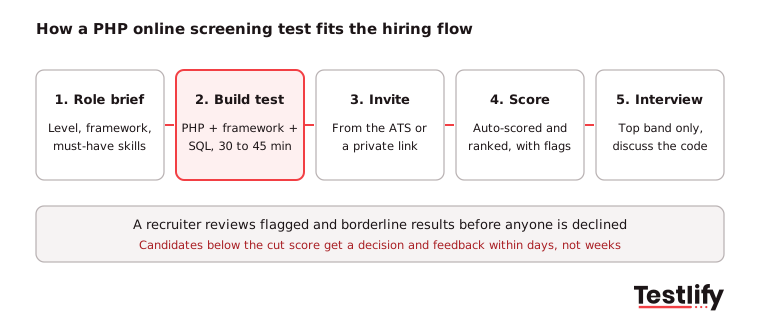
- Start from the job description: The AI test builder turns a job description into a role-specific assessment in under a minute and suggests the skills and scoring criteria to use.
- Pick the PHP tests: The Testlify library has 3,500+ tests. For PHP roles, teams usually start with the test php assessment for core skills, then add the Laravel test or the SQL test where the role needs them.
- Add a coding question: A PHP coding question runs in an online editor against hidden test cases, so the score reflects working code, not a description of it. Testlify supports 25+ question types, including coding, file upload and video answers.
- Set scoring, proctoring and invites: Weight the sections that matter most, switch on anti-cheating checks, set a score threshold for the auto-shortlist and connect your ATS so invites go out at the right pipeline stage.
Key takeaway: Keep the core PHP section and the coding question the same for every opening at that level. A stable test gives you benchmarks you can compare month to month.
How long should a PHP screening test be?
A PHP screening test should take 30 to 45 minutes for most roles. That is long enough for 15 to 25 multiple-choice questions and one coding task, and short enough that strong candidates with jobs still finish it. Senior roles can stretch to 60 minutes if the extra time goes to a coding task, not more trivia.
A practical mix for a mid-level PHP developer test:
- Core PHP and OOP: 10 to 12 multiple-choice questions, about 15 minutes.
- SQL and security: 5 to 6 questions on PDO, joins and input handling, about 8 minutes.
- Framework: 4 to 6 questions on the framework in the job ad, about 7 minutes.
- Coding task: one problem with test cases, about 15 minutes.
Say in the job ad that an online test comes before the first interview, and how long it takes. Candidates finish more often when they know what to expect.
How do you score results and set a cut score?
PHP screening test results are scored automatically, but the cut score is a decision your team makes. The best way to set it is a pilot: ask 3 to 5 PHP developers already on your team to take the test, note where they land, then set the bar a little below your solid performers.
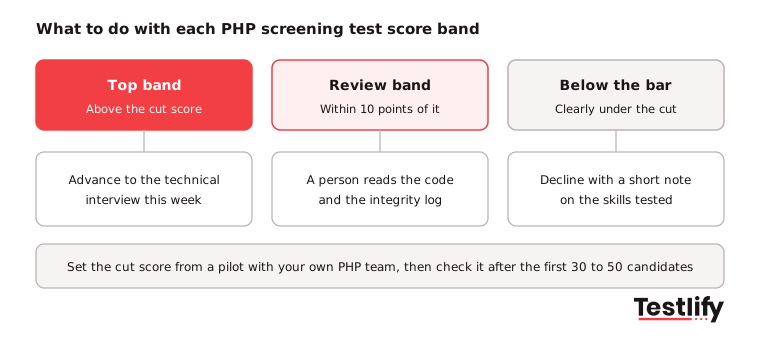
Use three bands rather than one hard line:
- Top band: Above the cut score. Invite to the technical interview the same week.
- Review band: Within 10 points of the cut score. A person reads the code and the integrity log before deciding.
- Below the bar: Clearly under the cut score. Decline with a short note on the skills tested.
Look past the total. A candidate with a strong coding score and a weak framework score may be a good hire for a team that can teach Laravel. In Testlify, per-skill breakdowns, AI-written pros and cons and suggested follow-up questions show where each candidate is strong, and weighted scoring lets the coding task count for more than multiple choice. Recheck the cut score after the first 30 to 50 candidates: if almost nobody passes, the test is too hard for the market, not the market too weak.
How do you keep the PHP screening test fair and stop cheating?
A fair PHP screening test asks job-related questions, gives every candidate the same conditions and makes cheating hard without treating candidates as suspects. In practice that means role-based questions, clear instructions, accommodations on request and proctoring that flags problems for a person to review instead of rejecting automatically.
AI tools change how cheating looks. Recall questions such as "What does array_map return?" are easy to answer with an AI assistant in a second tab. Full Scale, a software staffing firm, made the same point in October 2026: recall-based PHP questions no longer show whether a candidate knows the material. Questions that hold up better ask candidates to read, fix and extend code:
- Spot the flaw: Show a function that builds SQL from user input and ask what is wrong. Injection is still in the OWASP Top 10:2025, along with broken access control.
- Debug the output: Give a short script and its wrong output and ask for the fix.
- Extend working code: Add a feature to an existing class without breaking the tests.
Testlify includes 20+ proctoring checks, such as full-screen enforcement, tab and copy-paste tracking, webcam snapshots, AI assistance detection and question randomization. You can set how many violations a candidate may make before the test ends. See anti-cheating and proctoring for the full list.
Which mistakes make a PHP developer test fail?
PHP developer tests usually fail for the same few reasons, and each one is easy to fix before the first invite goes out:
- Testing trivia: Questions on rarely used functions reward memory, not skill. Ask about code people write every week.
- One test for every level: A senior test sent to juniors rejects everyone; a junior test sent to seniors tells you nothing.
- No coding question: Multiple choice alone cannot show whether someone writes working PHP.
- A take-home that runs for days: Long unpaid tasks push strong candidates away. Keep the screen under an hour and save larger tasks for finalists.
- Ignoring the version: Testing PHP 5 habits for a PHP 8.4 codebase screens for the wrong skills.
- Auto-rejecting on flags: Proctoring flags need a human look. A shared room or a dropped connection is not cheating.
After the test, move passing candidates into structured interviews. Our list of PHP developer interview questions picks up where the screening test stops.
Start screening PHP developers with Testlify
Testlify gives hiring teams a PHP online screening test without building one from scratch: core PHP, Laravel and SQL tests from a library of 3,500+, live coding questions, 20+ proctoring checks and results that sync back to 100+ ATS integrations. Candidates can take tests in 15+ languages, and you pay only when a candidate starts an assessment.
Browse the PHP and Laravel tests in the Testlify library or start a 7-day free trial with no credit card needed.
Frequently asked questions (FAQs)

Wordpress Developer
Yash Patel is a Wordpress and SEO Specialist at Testlify with 3+ years of experience in technical SEO, on-page optimization, and content strategy. He works on improving Testlify's organic presence and produces content focused on hiring, talent assessment, and HR technology.
LinkedInRelated resources
View all
HR & recruitment
How important is background screening before hiring
HR & recruitment
Hire the right talent with AI-driven candidate scoring

HR & recruitment
Chat simulation assessments: what they measure and how to run one

HR & recruitment
Types of Assessment Questions and How to Use Them in Hiring

HR & recruitment
9 benefits of cognitive testing in hiring, and how to get them

HR & recruitment
Developer test: how to use one to hire engineers in 2026
Get started.
Hire on proof, not resumes.
Run your first skills-based assessment free — no credit card required.