
DISC hiring: how to use DISC profiles without screening people out
Where DISC belongs in a hiring process, what a DISC profile can and cannot tell you, and how to use it without screening good people out.

DISC hiring means using a DISC behavioral profile as one input in your hiring process, to plan interview questions, discuss how a role works and onboard the person you hire. DISC can help with all of that. DISC should not decide who moves forward, because a profile describes how someone prefers to work, not whether they can do the job.
TL;DR:
- Use DISC in hiring to shape interviews and onboarding, never as a pass/fail or ranking screen.
- A DISC profile shows working style (pace, communication, how someone handles conflict). It does not measure skill, knowledge or ability.
- Everything DiSC, the best-known DISC product, tells employers not to use its results for hiring, screening or other selection decisions.
- Put DISC after the skills screen, at the same stage and in the same way for every shortlisted candidate.
- Let skills evidence decide. LinkedIn found 93% of TA pros say accurately assessing skills is crucial to quality of hire.
- Personality tests fall under Title VII and the ADA in the US, so tell candidates why you use DISC and keep results out of reject decisions.
 ChatGPT
 Gemini
 Claude
 Grok
 Perplexity
What is DISC hiring?
DISC hiring is the practice of adding a DISC assessment to the recruiting process so the hiring team understands a candidate's preferred working style before or during interviews. The candidate answers a short questionnaire, and the report places them on four styles: Dominance, Influence, Steadiness and Conscientiousness.
Most teams that try DISC hiring want a shortcut to "fit". The problem is that fit with a working style is not the same as fit with a job. A highly steady candidate can run a fast sales desk well, and a high-D candidate can be a careful analyst. That is why every serious DISC vendor now draws the same line: use the profile to understand people, not to sort them.
If you want the background on where DISC comes from and how much weight the science can carry, read our deep dive on the DISC personality test. This guide stays on the practical question: how to use DISC in a hiring process without hurting fairness or quality of hire.

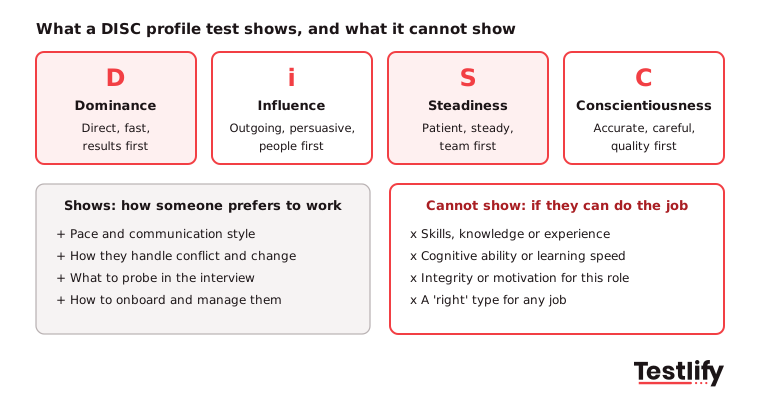
What does a DISC profile test measure?
A DISC profile test measures four behavioral tendencies at work: how direct and fast someone is (Dominance), how outgoing and persuasive (Influence), how patient and steady (Steadiness), and how careful and accuracy-focused (Conscientiousness). Most people show a mix, with one or two styles leading.
DISC style | Typical behavior at work | Good interview follow-up |
|---|---|---|
D (Dominance) | Decides fast, pushes for results, speaks directly | "Tell me about a time you slowed down to get buy-in." |
i (Influence) | Builds relationships, persuades, enjoys variety | "How do you keep detailed records when the work gets repetitive?" |
S (Steadiness) | Patient, reliable, prefers stable routines | "Describe a sudden change you had to lead or adapt to." |
C (Conscientiousness) | Checks details, follows standards, plans carefully | "When did you ship something before it was perfect, and why?" |
What a DISC profile test does not measure matters just as much. It does not measure skills, job knowledge, problem solving, learning speed or integrity. It also has no "right" result for a role, because people adapt their style to the job in front of them. For help reading individual reports, see how to interpret DISC results.
Should you use DISC to screen candidates?
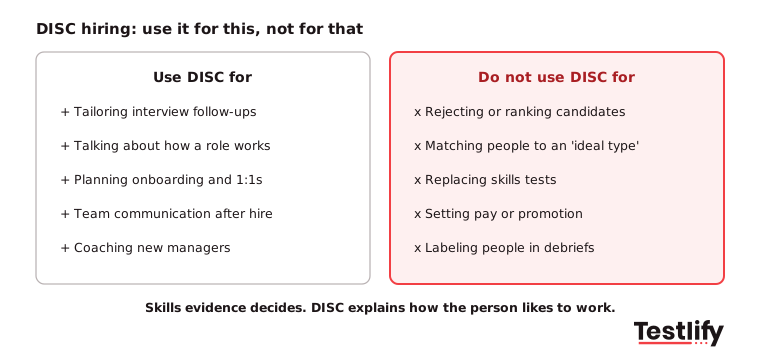
DISC should not be used to screen candidates in or out. A DISC profile describes preferred behavior, so rejecting someone for a "wrong" style removes people who could do the job and adds legal risk without improving quality of hire.
The tool makers agree. The Everything DiSC guidance from Wiley says plainly: "Don't use DiSC results for hiring, screening, promotion, compensation, or other selection decisions." TTI Success Insights, another DISC publisher, wrote in February 2026 that DISC was not originally designed as a pre-employment screening tool and should sit alongside interviews and other methods. Online DISC Profile says DISC is "not designed to be used as a standalone hiring filter or pre-employment candidate cut-off tool."
That leaves a clear verdict for recruiting teams:
- Use DISC as context: It improves the conversation with shortlisted candidates and the first 90 days after hire.
- Do not use DISC as a gate: No cut-off scores, no "we only hire high-D for sales", no ranking finalists by style.
- Decide on job evidence: Skills tests, work samples and structured interviews carry the decision.
Key takeaway: DISC tells you how a person likes to work. Skills evidence tells you whether they can do the job. Hire on the second, manage with the first.
Where does DISC fit in a hiring process?
DISC fits after the skills screen and before the structured interview, for shortlisted candidates only. At that point it costs candidates little time, it cannot knock out qualified people early, and interviewers can use each profile to plan follow-up questions.
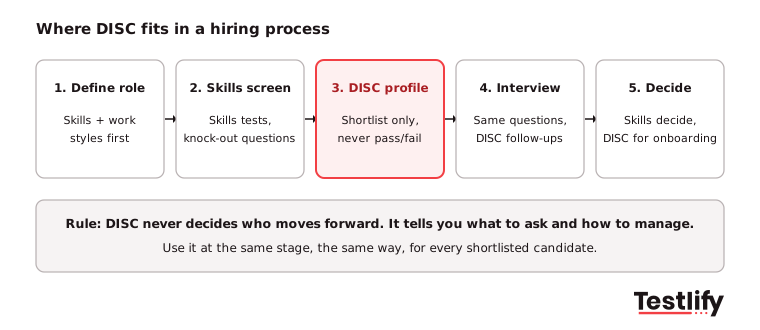
- Define the role: Agree on the skills and the work behaviors the job needs before you post it.
- Screen on skills: Use skills tests and knock-out questions so the shortlist is built on what people can do.
- Add the DISC profile: Send it only to shortlisted candidates, the same way for everyone.
- Run a structured interview: Ask the same core questions of every candidate, then use the DISC report to add one or two follow-ups.
- Decide and onboard: Score candidates on job evidence. Share the DISC report with the hiring manager to plan onboarding.
The order matters most in volume hiring. A contact center or customer support team screening hundreds of applicants for one role should never send DISC to the full pool: it adds time for candidates, tells you nothing about skill, and creates a record of style data on people you never interviewed.
Keeping skills evidence in front matches where hiring teams already are. LinkedIn's Future of Recruiting 2025 found that 93% of talent acquisition pros say accurately assessing a candidate's skills is crucial for quality of hire, and companies with the most skills-based searches are 12% more likely to make a quality hire.
The same report found 89% expect measuring quality of hire to grow in importance, yet only 25% feel highly confident they can measure it. A style profile used as a gate makes that measurement harder, not easier.
How do you run DISC hiring step by step?
DISC hiring works best as a short, repeatable routine: define the behaviors the role needs, profile only the shortlist, plan interview follow-ups from each report, score on job evidence and carry the profile into onboarding. Here is the routine in six steps.
- Write the behavior brief before you see any profile: List the three or four work behaviors that matter in the role, such as attention to detail, stress tolerance or initiative. The O*NET Work Styles list from the US Department of Labor gives 21 standard work styles you can borrow, so you describe behaviors instead of inventing an "ideal DISC type".
- Pick the stage and keep it fixed: Profile every shortlisted candidate at the same point. Changing the stage from one candidate to the next is how bias creeps in.
- Tell candidates what DISC is for: Explain in the invite that the profile helps plan the interview and onboarding, and that no one is rejected on their style.
- Plan one or two follow-ups per candidate: Use the report to probe areas that matter for the role. A high-i candidate for a compliance role gets a question about detailed record keeping; a high-C candidate for a fast sales role gets one about acting on incomplete information.
- Score on job evidence only: Interview scorecards rate skills and behaviors from the brief, with examples. The DISC letter never appears on the scorecard.
- Hand the report to the hiring manager after the offer: Use it to plan the first 1:1s, how feedback is given and how the new hire fits into the team's working rhythm.
Pro tip: Do not add DISC scores to an automatic shortlist rule in your ATS or assessment platform. Keep auto-advance thresholds for skills tests only, so a style result can never move someone out of the process without a person looking.
For a wider view of combining personality and skills data, see how to use psychometric tests and skill tests together and our guide to structured interviews.
What are the risks of DISC hiring?
The main risks of DISC hiring are screening out qualified people, stereotyping candidates by a letter, candidates shaping their answers to look "right", and legal exposure if results feed reject decisions. Each risk has a simple control.
Risk | What it looks like | Control |
|---|---|---|
Screening out good people | "We only hire high-D for sales" | No cut-offs; DISC only after the skills screen |
Stereotyping | Debriefs that say "she's an S, too soft to manage" | Ban DISC letters from scorecards and debrief notes |
Faking and masking | Candidates answer as the style they think you want | Treat the profile as a prompt for questions, never as proof |
Uneven use | Some candidates get DISC, others do not | Same stage, same invite, every shortlisted candidate |
Legal exposure | Style results line up with a protected group and drive rejections | Keep DISC out of decisions; review outcomes by stage |
The faking risk deserves a note. A candidate who knows the role is "customer facing" can lean their answers toward Influence. That does not make DISC useless, but it is one more reason the profile should start a conversation rather than settle it.
Is it legal to use DISC in hiring?
Using DISC in hiring is legal in the US when it is applied the same way to every candidate and does not screen out protected groups or people with disabilities. The legal risk comes from how results are used, not from the questionnaire itself.
- Title VII: The EEOC's guidance on employment tests says Title VII covers both disparate treatment and disparate impact. If a test result drives rejections that fall harder on one race, sex or national origin, the employer must show the test is job related.
- ADA: The same guidance says employers cannot use tests that screen out people with disabilities unless the test is job related and consistent with business necessity.
- Consistency: Give the same test, at the same stage, with the same instructions, to everyone in the pool.
- Records: Keep a short note of why DISC is used and that it plays no part in the decision. That note is your best answer to a candidate complaint.
Outside the US, check local rules on candidate data and automated decisions before you add any profile to your process. If you hire in the EU or UK, tell candidates what the data is used for and how long you keep it.
How do you explain a DISC profile test to candidates?
A DISC profile test should be explained to candidates in two or three plain sentences in the invite: what it is, what it is used for, and what it is not used for. Some of the top search results for DISC hiring are Reddit and LinkedIn threads where candidates question being judged on a "personality quiz", so being direct protects your employer brand.
A script you can adapt:
"As part of the next step, we ask shortlisted candidates to complete a short DISC profile. It describes how you prefer to work and communicate. We use it to plan your interview and, if you join, your onboarding. There are no right or wrong results, and no one is rejected based on their profile."
Offer to share the report with the candidate. People are more open in the interview when they have seen what the interviewer has seen.
How does Testlify support DISC hiring?
Testlify includes a DISC test in its library of 3,500+ tests, so teams can run DISC alongside the skills tests that should drive the decision. The Testlify DISC test uses statement-based questions on a 4-point scale plus situational questions, and sits with other psychometric tests such as the SMART personality test and a culture fit test.
- Skills first, DISC second: Build a multi-stage pipeline where role-specific skills tests run first and the DISC test goes only to candidates who pass.
- Thresholds on skills only: Set auto-shortlist score thresholds on skills tests and leave the DISC test out of them, so a person reviews every decision.
- Evidence in one report: AI candidate insights give a per-skill breakdown and suggested follow-up questions, next to the DISC result, ready for the structured interview.
- Integrity checks: 20+ anti-cheating and proctoring checks keep skills results trustworthy.
- Fits your stack: Results sync to 100+ ATS and HRIS tools, so recruiters do not copy scores by hand.
Ready to build a fairer shortlist?
Put skills evidence first and use DISC where it helps: better interviews and better onboarding. Browse the Testlify test library or start a 7-day free trial, no credit card required. Hiring at enterprise scale? Book a demo and we will map DISC and skills tests to your hiring stages.
Frequently asked questions

Content Writer
Yashika Khandelwal is a Content Writer with 3+ years of experience creating research-backed content on hiring, talent assessment, and HR technology. She is a registered Organizational Psychologist and subject matter expert who combines behavioral science with practical recruitment insights to produce accurate, evidence-based content.
LinkedInRelated resources
View all
HR & recruitment
Top 10 advantages of using the DISC Personality test in the Hiring Process
HR & recruitment
What is a DISC personality test for jobs? How employers use it
HR & recruitment
Case studies of companies with successful talent pools
HR & recruitment
How to hire restaurant hospitality staff?
HR & recruitment
How to hire hotel hospitality staff?
HR & recruitment
How to interpret the results of an Emotional Intelligence test
Get started.
Hire on proof, not resumes.
Run your first skills-based assessment free — no credit card required.