
60 SEO interview questions to hire the right SEO specialist
Ask these 60 SEO interview questions to test keyword, technical, AI search and analytics skills, then score every answer the same way.

SEO interview questions are the questions a hiring team asks to check whether an SEO specialist can research keywords, fix technical problems, measure results and explain them to the business. The best ones ask for real examples and decisions, not definitions, so you can tell someone who has done the work from someone who has read about it.
This list has 60 questions grouped by skill area, with what a strong answer includes for each one. You also get sample answers, red flags, a scoring rubric and a practical task, so the whole interview panel judges candidates the same way.
Getting this right matters because good candidates have options. The US Bureau of Labor Statistics projects 7% growth for market research analysts and marketing specialists, the group that includes SEO roles, from 2025 to 2035, with a median pay of $78,760 in May 2025.
TL;DR:
- Good SEO interview questions test six areas: keyword research and intent, on-page and content, technical SEO, links, analytics, and AI search.
- Ask for a real example on every core question. "Walk me through the last audit you ran" beats "What is an audit?"
- Match depth to level: junior candidates should explain crawling, indexing and on-page basics; senior ones should diagnose traffic drops and tie SEO to revenue.
- Google says there are no special optimizations needed to appear in AI Overviews, so treat candidates who sell "AI search hacks" with care.
- Watch for red flags such as ranking guarantees, tool exports passed off as audits and no experience working with developers.
- Score every answer on a 1 to 5 scale against the same criteria, and add a short practical task or skills test before the final round.
 ChatGPT
 Gemini
 Claude
 Grok
 Perplexity
What should SEO interview questions test in 2026?
SEO interview questions should test six skill areas: keyword research and search intent, on-page and content optimization, technical SEO, link building, analytics and reporting, and AI search. Most roles need all six. The level you hire for decides how deep each answer has to go.
The role has also widened. O*NET's profile of search marketing strategists lists tasks such as optimizing text, graphics and multimedia for search, analyzing web metrics like traffic and conversion rates, and reporting search results to marketing executives. Google Analytics is flagged there as an in-demand technology. An SEO hire who cannot read data or talk to leadership will struggle, however strong their keyword skills.
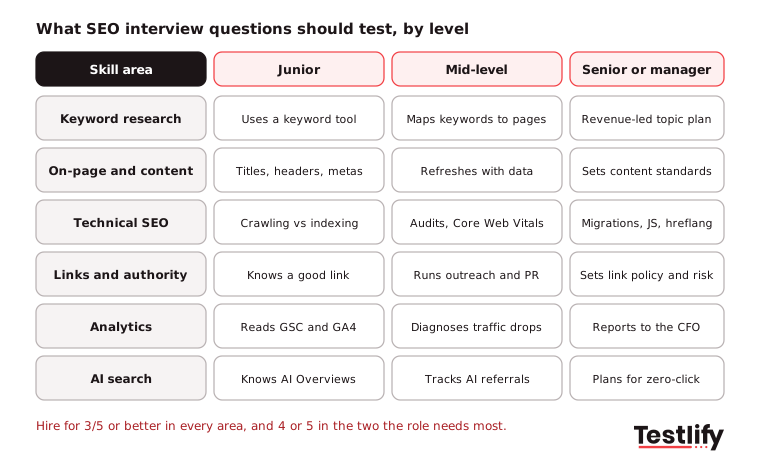
Skill area | Junior (0 to 2 years) | Mid-level (2 to 5 years) | Senior or manager (5+ years) |
|---|---|---|---|
Keyword research and intent | Uses a keyword tool, explains intent | Maps keywords to pages, avoids cannibalization | Builds topic strategy tied to revenue |
On-page and content | Writes title tags, headers, meta descriptions | Refreshes and prunes content with data | Sets content standards for a team |
Technical SEO | Knows crawling vs indexing, sitemaps, redirects | Runs audits, fixes Core Web Vitals and duplicates | Plans migrations, JavaScript and international SEO |
Links and authority | Knows what makes a link valuable | Runs outreach and digital PR | Sets link policy and manages risk |
Analytics and reporting | Reads Search Console and GA4 | Builds dashboards, diagnoses drops | Reports SEO impact to the CFO |
AI search | Knows what AI Overviews are | Tracks AI visibility and referrals | Adjusts strategy for zero-click search |
Pro tip: Before the first interview, list the three skill areas that matter most for this role and agree on them with the hiring manager. Use the SEO manager job description template or the SEO consultant job description to set expectations with candidates.

How should you structure an SEO interview?
An SEO interview works best in five stages: a short screen, a skills test, a technical interview, a practical task and a final interview on strategy and fit. Each stage uses a different set of the questions below, so no candidate is asked the same thing twice.
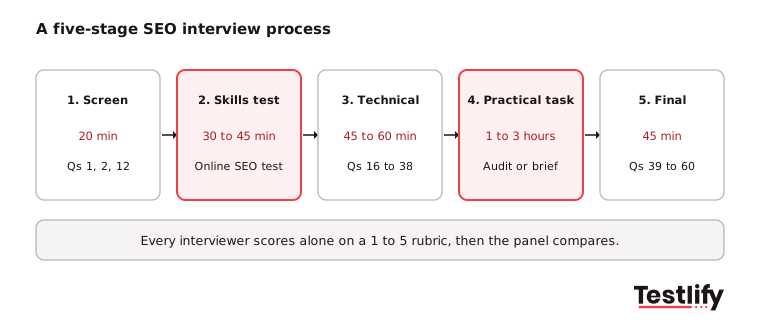
- Screening call (20 minutes): Ask questions 1, 2 and 12 to confirm real SEO experience and basic vocabulary.
- Skills test (30 to 45 minutes): Use an online SEO test to check keyword, on-page and technical knowledge before anyone spends an hour in an interview.
- Technical interview (45 to 60 minutes): Ask the technical and AI search questions (16 to 38). An experienced SEO or developer should sit on this panel.
- Practical task (1 to 3 hours): Give a short audit or content brief on a real page. Keep it small and pay for anything longer.
- Final interview (45 minutes): Use behavioral and working-style questions (39 to 60) and ask the candidate to present their task.
A skills test before the interviews matters because SEO resumes are hard to verify. LinkedIn's Future of Recruiting 2025 found that 93% of talent acquisition professionals say accurately assessing skills is crucial to quality of hire, and companies that search most by skills are 12% more likely to make a quality hire.
What are the best general SEO interview questions?
The best general SEO interview questions cover keyword research, search intent, on-page optimization, content, links and measurement. Ask them in the screening call and first interview. Each one below comes with what a good answer includes.
- Can you walk me through your SEO experience and the result you are proudest of? Listen for: a specific site, the problem, what they changed and a measured outcome such as organic sessions, sign-ups or revenue.
- How do you approach keyword research for a new website? Listen for: understanding the audience first, using tools such as Google Keyword Planner or Search Console, checking volume, difficulty and intent, then mapping keywords to specific pages.
- How do you find long-tail keywords worth targeting? Listen for: autocomplete, People Also Ask, Search Console queries and customer language from sales or support calls. Strong candidates explain why long-tail terms convert better.
- How do you decide the search intent behind a keyword, and how does it change the page you build? Listen for: checking the current results page. A list of articles means a guide; product pages mean a commercial page.
- Which on-page elements do you optimize first, and why? Listen for: title tags, headings, meta descriptions, internal links, image alt text and content quality, ranked by impact rather than recited as a checklist.
- How do you integrate SEO with content marketing? Listen for: keyword research feeding the content calendar, briefs with intent and outline, and promotion that earns links.
- What is your approach to optimizing existing content? Listen for: a content audit, updating pages that are losing clicks, merging thin pages and pruning pages with no value.
- How do you approach internal linking? Listen for: descriptive anchor text, linking from strong pages to pages that need support, and fixing orphan pages.
- What strategies do you use to earn high-quality backlinks? Listen for: linkable assets, digital PR, broken link building and partnerships. Strong candidates stress relevance over volume and mention Google's spam policies.
- How do you judge the quality of a backlink? Listen for: relevance of the linking site, real traffic, editorial placement and natural anchor text. Weak answers rely only on one third-party authority score.
- How do you analyze competitors' SEO? Listen for: comparing keywords, content gaps, backlinks and SERP features, then turning gaps into a prioritized plan.
- Which metrics and KPIs do you use to measure SEO success? Listen for: organic clicks, conversions and revenue from organic search, plus leading indicators such as impressions and rankings. Rankings alone are a weak answer.
- How have you improved local search visibility? Listen for: Google Business Profile, consistent name, address and phone details, reviews and location pages.
- What SEO strategies have you used for e-commerce sites? Listen for: category page optimization, faceted navigation control, product schema and handling out-of-stock pages.
- How do paid search and social media fit with your SEO work? Listen for: using paid search data to test keywords and titles, and using social to spread content that can earn links. Paid ads do not lift organic rankings directly.
Which technical SEO interview questions should you ask?
Technical SEO interview questions check whether a candidate can keep a site crawlable, indexable and fast. Ask them in the technical round, ideally with a developer on the panel. Junior candidates should handle 16 to 21; mid-level and senior candidates should handle all fifteen.
- How do you run a technical SEO audit, and what do you check first? Listen for: a crawl with a tool such as Screaming Frog, Search Console coverage reports, indexation, site structure, speed and mobile issues, then a list ranked by impact.
- What is the difference between crawling and indexing, and how do you check whether a page is indexed? Listen for: crawling is discovery, indexing is storage, and the URL Inspection tool in Search Console confirms status.
- When would you use robots.txt and when a noindex tag? Listen for: robots.txt controls crawling, noindex controls indexing, and a page blocked in robots.txt cannot show Google its noindex tag.
- How do you find and fix crawl errors? Listen for: Search Console reports, server logs, finding the root cause (broken links, server errors, redirect chains) and fixing the source, not only the symptom.
- How do you handle duplicate content? Listen for: canonical tags, 301 redirects, consistent internal links and parameter handling.
- When do you use a 301 redirect versus a 302? Listen for: 301 for permanent moves, 302 for temporary ones, and avoiding chains and loops.
- How do you plan a site migration so rankings survive it? Listen for: a full URL map, 301 redirects, updated internal links and sitemaps, a pre-launch crawl on staging, and close monitoring after launch.
- What steps improve page speed, and which Core Web Vitals do you watch? Listen for: image compression, caching, a CDN and less render-blocking code. Google's Search Central documentation sets good thresholds of LCP within 2.5 seconds, INP under 200 milliseconds and CLS under 0.1. A candidate who still names First Input Delay is out of date.
- How do you make sure a site performs under mobile-first indexing? Listen for: responsive design, the same content and structured data on mobile and desktop, and fast mobile pages. Google's old Mobile-Friendly Test was retired, so a current answer uses Lighthouse or Search Console.
- How do you approach international SEO? Listen for: hreflang tags, a clear URL structure (country domains, subdomains or subfolders) and localized content rather than machine translation alone.
- What does schema markup do, and how do you test it? Listen for: structured data helps search engines understand a page and can earn rich results. Testing with Google's Rich Results Test.
- How do you structure URLs and site navigation? Listen for: short, descriptive URLs with hyphens, a logical hierarchy, few parameters and important pages within a few clicks of the home page.
- How do you make sure JavaScript content gets indexed? Listen for: checking the rendered HTML, server-side rendering or prerendering for key content, and links as real anchor tags.
- How would you diagnose a sudden drop in organic traffic? Listen for: checking dates against Google updates, tracking or tagging changes, technical issues, manual actions and seasonality before changing anything.
- A page sits on page two for its main keyword. What do you change first? Listen for: comparing it with the pages that rank, matching intent, improving depth and internal links, then earning a few relevant links.
Which SEO interview questions cover AI search and analytics?
AI search and analytics questions show whether a candidate keeps up with how search works today and can prove the value of their work. Most top-ranking question lists now include AI search, and these questions separate current knowledge from old habits.
- How do Google's AI Overviews change your SEO approach? Listen for: more zero-click searches, more focus on being cited, clear answer-first content and tracking impressions as well as clicks.
- What would you tell a client who wants special files or markup to "optimize for AI search"? Listen for: Google's own guidance. Its Search Central page on AI features says there are no additional requirements or special optimizations to appear in AI Overviews or AI Mode; a page must be indexed and eligible to show with a snippet.
- How do you track visibility and traffic from AI search? Listen for: referral traffic from AI assistants in GA4, brand mentions in AI answers, and honesty about how limited the data still is.
- How do you use Google Search Console in a normal week? Listen for: performance reports by query and page, indexing issues, Core Web Vitals and manual actions.
- How do you use GA4 to improve SEO? Listen for: landing page reports for organic traffic, conversion events, engagement and comparing segments. A Google Analytics test can confirm this skill before the interview.
- What does E-E-A-T mean for the content you produce? Listen for: experience, expertise, authoritativeness and trust shown through real authors, first-hand examples and accurate sources, especially on money or health topics.
- Clicks fell while rankings stayed flat. What could explain it? Listen for: AI Overviews or other SERP features taking clicks, a weaker title or snippet, seasonality, or tracking changes.
- How would you report SEO results to a CFO or head of sales? Listen for: organic revenue or pipeline, cost compared with paid channels, and a few simple numbers instead of ranking screenshots.
Key takeaway: Questions 29, 30, 32 and 37 are the strongest filters in this list. They have no single textbook answer, so they show how a candidate thinks.
What behavioral SEO interview questions reveal real experience?
Behavioral SEO interview questions ask candidates to describe what they did in a real situation. Use them in the final round. Strong candidates name the site, the problem, their actions and the result, and they admit what went wrong.
- Can you tell me about a challenging SEO project and how it turned out? Listen for: a clear problem, a structured plan and a measured result.
- Describe a time a Google algorithm update hit your rankings. What did you do? Listen for: calm analysis before action, comparing affected pages and fixing content quality rather than chasing tricks.
- Can you tell me about a time you convinced a stakeholder to act on an SEO recommendation? Listen for: data, a business case in the stakeholder's terms and patience with pushback.
- Tell me about an SEO effort that did not deliver. What did you learn? Listen for: ownership, analysis of why and a change in approach.
- Describe a link-building campaign you led. What made it work? Listen for: a real asset or story, targeted outreach and links from relevant sites.
- How did you prioritize when several SEO projects competed for your time? Listen for: impact versus effort, alignment with business goals and clear communication about what waits.
- When did data make you change a campaign while it was running? Listen for: a metric they watched, what it showed and the change they made.
- How have you worked with developers or content teams to ship SEO changes? Listen for: clear tickets, shared priorities and follow-up. A candidate who has never filed a ticket with a developer may struggle in a technical role.
- What gap have you found in a site's SEO strategy, and how did you fill it? Listen for: how they found it (data, competitor review, customer questions) and what changed.
- How have you used user experience principles in your SEO work? Listen for: page layout, readability, speed and navigation that help users and search engines alike.
- How did you present your last audit to a client or team? Listen for: a short summary, ranked priorities and owners, not a raw tool export.
- What would you do in your first 90 days in this role? Listen for: learning the business and data in month one, quick technical fixes in month two and a roadmap by month three.
Which personality and working-style SEO interview questions should you ask?
Personality and working-style questions show how a candidate learns, handles pressure and works with others. SEO changes with every major update, so curiosity and steady habits matter as much as skill.
- How do you keep up with SEO trends and algorithm updates? Listen for: Google Search Central, the Search Status Dashboard, trusted practitioners and their own tests, not only newsletters.
- How do you stay motivated in a field that changes this often? Listen for: real interest, personal projects and enjoying the problem-solving.
- Can you describe a time you worked under a tight deadline? Listen for: planning, scoping down and communicating early.
- How do you handle feedback on your SEO strategy? Listen for: listening, testing the feedback against data and changing course when it is right.
- Can you describe a time you solved an SEO problem creatively? Listen for: a structured diagnosis followed by an unusual but sound fix.
- Have you led an SEO project or team? How did it go? Listen for: setting goals, delegating and supporting others.
- How do you organize your week across many SEO tasks? Listen for: a system for priorities, recurring checks and time for deep work.
- Can you give an example of adapting to an unexpected change? Listen for: quick reassessment and a clear next step.
- How do you handle conflicting opinions inside a project? Listen for: respect for other views, data to settle disputes and a shared goal.
- What difficult decision have you made that changed an SEO plan? Listen for: weighing options, explaining trade-offs and owning the outcome.
What do strong answers to SEO interview questions sound like?
Strong answers to SEO interview questions are specific: a named situation, the steps taken, the tools used and a measured result. The sample answers below show the level of detail to expect from a mid-level candidate.
Sample answer to question 2 (keyword research): "I start with the audience and what they need, then pull ideas from Search Console, Google Keyword Planner and competitor pages. I check volume, difficulty and the current results page for intent. Then I map one primary keyword to each page so pages do not compete, and prioritize by business value, not volume alone."
Sample answer to question 19 (crawl errors): "I check Search Console's indexing reports and run a crawl with Screaming Frog. For broken links I fix the source link and redirect only when a page has moved. For duplicates I set canonical tags and clean up internal links. Then I recheck after the next crawl."
Sample answer to question 12 (KPIs): "I tie SEO to business goals first. For a lead-generation site that means organic sign-ups and pipeline, with clicks, impressions and rankings as early signals. On my last site, we set a target for organic sign-ups, tracked it monthly and reached it in two quarters by fixing intent mismatches on our top pages."
Sample answer to question 41 (convincing a stakeholder): "Our client did not want to invest in content. I showed the search demand for their product terms, the traffic competitors were getting and a simple estimate of leads. They agreed to a three-month pilot on ten pages, and the results got the rest of the plan approved."
Sample answer to question 42 (an effort that did not deliver): "A campaign missed its traffic goal. I reviewed keyword performance, on-page work and links, and found we had targeted terms with the wrong intent. We moved to long-tail terms with clear intent, improved content depth and widened our link sources, and the next quarter beat the original goal."
What red flags should you watch for in SEO interviews?
The biggest red flags in SEO interviews are ranking guarantees, vague answers with no examples and outdated tactics. Any one of them is a reason to probe harder; two or more usually mean a weak hire.
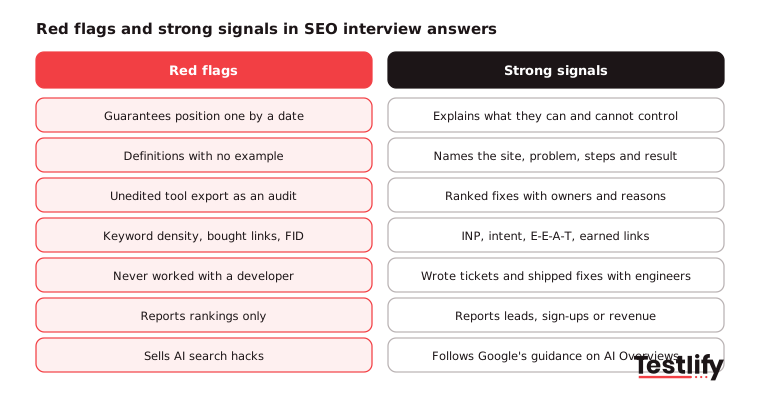
- Ranking guarantees: Nobody controls Google's results. A candidate who promises position one by a date is either inexperienced or overselling.
- No examples: Answers made of definitions with no site, problem or result behind them.
- Tool exports as audits: An "audit" that is an unedited tool report with no priorities or business reasons.
- Outdated tactics: Keyword density targets, exact-match anchor text schemes, buying links or naming First Input Delay as a Core Web Vital.
- No developer experience: No story about working with engineers to ship a technical fix.
- Vanity metrics: Success measured only in rankings or traffic, never in leads, sales or sign-ups.
- AI search hype: Selling special files, markup or tricks for AI Overviews that Google says are not needed.
How do you score answers to SEO interview questions?
Score each answer to SEO interview questions on a 1 to 5 scale against criteria agreed before the interview. Every interviewer scores alone, then the panel compares. A shared rubric stops one confident answer from outweighing a weak skill area.
Score | What the answer shows | Example signal |
|---|---|---|
1 | No real knowledge or a wrong answer | Confuses crawling with indexing |
2 | Textbook definition, no example | Defines canonical tags but has never set one |
3 | Correct answer with a basic example | Describes fixing duplicate pages on one site |
4 | Clear process, real example and a result | Explains a migration plan and how traffic held |
5 | Process, result, trade-offs and lessons | Explains what they would do differently and why |
Hire for at least a 3 in every core skill area and a 4 or 5 in the two areas the role needs most. For more ways to judge these skills, read tips to evaluate SEO skills and the guide to finding the right senior SEO specialist.
When should you use SEO skill assessments in hiring?
SEO skill assessments belong right after the screening call and before the technical interview. Interviews show how a candidate explains their work; a skills test shows whether they can apply SEO knowledge, so you spend interview time only on people who can do the job.
Hiring pressure makes this step worth it. SHRM's 2025 Talent Trends found that 69% of organizations still struggle to fill roles, and 28% now require new skills for full-time roles. A test filters a large applicant pool quickly and on the same criteria for everyone.
These four assessment types cover most SEO roles:
- Technical SEO assessment: Website structure, crawling and indexing, XML sitemaps, schema markup, site speed and canonicalization, often with scenarios to diagnose.
- Keyword research and analysis assessment: Finding relevant keywords, judging competition and intent, and prioritizing by value.
- On-page optimization assessment: Title tags, headers, URL structure, keyword placement and content quality, while keeping the page useful for readers.
- Link building and off-page assessment: Link strategies, outreach and judging the quality of a backlink profile.
Testlify's test library has ready-made tests for each level: the SEO specialist beginner test for junior roles, the SEO specialist test for mid-level roles and the senior SEO specialist test for senior hires. You can combine one with a Google Analytics or SEO copywriting test, add your own questions, and use Testlify's 20+ proctoring checks to keep results honest. For the full process from job post to offer, see the SEO specialist hiring guide.
Ready to hire your next SEO specialist?
Pair these SEO interview questions with a skills test so every interview starts from evidence. Testlify has 3,500+ tests, including SEO, Google Analytics and content tests, and its AI test builder can turn your job description into an assessment. Browse the Testlify test library or start a 7-day free trial, no credit card needed. For a guided walkthrough, book a demo.
Frequently asked questions

Wordpress Developer
Yash Patel is a Wordpress and SEO Specialist at Testlify with 3+ years of experience in technical SEO, on-page optimization, and content strategy. He works on improving Testlify's organic presence and produces content focused on hiring, talent assessment, and HR technology.
LinkedInRelated resources
View all
HR & recruitment
60 Marketing Analyst interview questions to ask job applicants

HR & recruitment
40 content manager interview questions with sample answers

HR & recruitment
Best Social Media Coordinator interview questions to ask job applicants

HR & recruitment
60 Digital Marketing Manager interview questions to ask job applicants

HR & recruitment
60 Marketing Specialist interview questions to ask job applicants

HR & recruitment
40 interview questions for marketing coordinator roles
Get started.
Hire on proof, not resumes.
Run your first skills-based assessment free — no credit card required.