
50 public relations manager interview questions to ask in 2026
Fifty public relations manager interview questions by skill, with what to listen for, sample answers, red flags and a scorecard to use.

Public relations manager interview questions help a hiring team check whether a candidate can protect and grow a company's reputation: pitch the press, plan campaigns tied to business goals, measure results, lead through a crisis and advise executives. The best interviews mix general, behavioral and scenario questions, and score every answer on the same criteria.
TL;DR / Key Takeaways
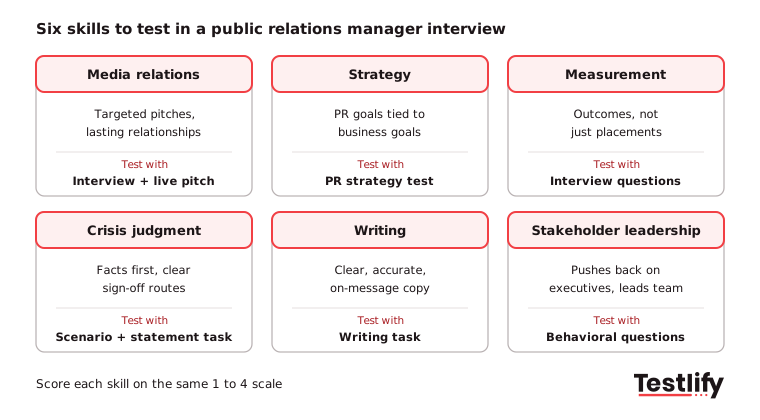
- Ask 8 to 12 public relations manager interview questions per round, drawn from six skills: media relations, strategy, measurement, crisis judgment, writing and stakeholder leadership.
- The most telling question is "How do you measure PR success?" Strong candidates go past placements and impressions to share of voice, sentiment and a business result.
- Every candidate should get one AI question: 75% of PR professionals now use generative AI at work, according to Muck Rack's 2025 State of AI in PR report.
- Test writing and crisis skills with a short work task, not only with talk. A press release or holding statement shows more than any answer.
- Red flags include activity-only results, no measurement method, blaming journalists and no view on AI fact-checking.
- Score each answer on a shared 1 to 4 scale per skill, then compare scorecards before anyone shares a gut feeling.
 ChatGPT
 Gemini
 Claude
 Grok
 Perplexity
What does a public relations manager do?
A public relations manager plans and runs the communication that shapes how the public, the press and other stakeholders see an organization. The role covers media relations, campaign strategy, executive counsel, crisis response and team leadership, so interview questions need to test all of these, not only writing.
The US Bureau of Labor Statistics lists the core duties as building the organization's image, picking the right audiences and channels, preparing information for the media, advising executives and spokespeople, and supervising staff. BLS also notes that most public relations managers need five or more years of related experience, often as a PR specialist first.
The role is also in demand. BLS Occupational Outlook Handbook data shows about 80,800 public relations manager jobs in the US in 2025, a median pay of $146,910 in May 2025 and 6% projected growth from 2025 to 2035. A role at that pay level justifies a structured interview, not an informal chat.
Before you write your questions, agree on the role with a clear public relations manager job description.

What skills should public relations manager interview questions test?
Public relations manager interview questions should test six skills: media relations, strategy and planning, measurement, crisis judgment, writing and stakeholder leadership. Some skills show up well in conversation. Others, such as writing and structured thinking, are easier to judge with a short task or a skills test before the interview.
The O*NET profile for public relations managers backs this up: its top tasks are media and client relationships, supervising PR staff, audience and communication planning, and crisis communication plans, and its top skills are speaking, active listening, reading, writing and critical thinking.
Pro tip: Run a public relations strategy test before the first interview. You then spend interview time on judgment and experience instead of checking basics.
What general public relations manager interview questions should you ask?
General public relations manager interview questions open the conversation and show how the candidate thinks about the job. Use them in the first round to check motivation, range and fit with your team, then move to deeper skill questions.
- Walk me through your PR career and the result you value most: Listen for a clear thread and one result tied to a business goal, not a list of employers.
- Why this role, at this company, now? Listen for research on your business, recent coverage and one communication problem they could help solve.
- How do you explain the difference between PR and marketing to a new executive? Listen for "marketing builds demand, PR builds trust" and a healthy view of working together.
- Which media outlets and newsletters do you read every week, and why? Listen for named sources that fit your sector, plus one recent idea they used.
- Have you worked in-house, at an agency or both, and what changed in how you worked? Listen for an honest view of each setting and how they adjust.
- What does your first 90 days in this role look like? Listen for a listening phase, an audit of coverage and messaging, then a first proof point.
- Which PR tools do you use daily, and what does each one do for you? Listen for media databases, monitoring and analytics tools tied to tasks.
- What kind of manager brings out your best work? Listen for self-awareness and a fit with how your comms leader runs the team.
What media relations questions should you ask a public relations manager?
Media relations questions show whether a candidate earns coverage through relevance and trust, or through volume. Strong public relations managers know what each reporter covers, pitch fewer but better stories, and keep relationships steady even after a reporter says no.
- How do you build a media list for a new announcement? Listen for beat research, past coverage and a short, ranked list.
- Pitch me our latest product as if I were a top-tier reporter: Listen for a news hook, why it matters now and a clear ask in about 60 seconds.
- How do you keep in touch with journalists when you have nothing to pitch? Listen for useful contact: data, expert access, sharing their work.
- Tell me about a story you placed that changed how people saw a brand: Listen for the angle, the outlet choice and what happened after it ran.
- How do you handle a reporter who gets a fact wrong? Listen for a calm, private correction request backed by evidence.
- When would you offer an exclusive, and when would you go wide? Listen for trade-offs between depth of coverage and reach.
- How do you prepare an executive for a tough media interview? Listen for key messages, likely hard questions and practice runs.
Hiring at a more junior level? The public relations specialist interview questions go deeper on pitching and press release basics, and the media relations coordinator interview questions cover entry-level support roles.
What strategy and measurement questions should you ask?
Strategy and measurement questions separate senior public relations managers from tactical ones. A PRSA Jobs guide for 2026, citing Muck Rack and Cision research, reports that 52% of agencies and 51% of in-house teams name connecting PR to business growth as their biggest challenge, and over 40% still measure activity rather than outcomes.
- How do you measure PR success? Listen for outputs (coverage, message pull-through), outtakes (share of voice, sentiment) and outcomes (site traffic, leads, reputation). Naming the AMEC Barcelona Principles is a plus.
- How do you link a PR plan to company goals? Listen for starting with the business goal, then audience, message and channel.
- Build a PR plan for a product launch with a small budget: Listen for priorities, one hero tactic and how they would prove impact.
- Tell me about a time data changed your strategy: Listen for the data source, the pattern spotted and what they stopped or changed.
- How do you report PR results to a CEO or board? Listen for a short dashboard of business results, not a clip book.
- How do you decide which stories the company should not tell? Listen for reputation risk, timing and audience fit.
- How would you build a measurement practice from scratch? Listen for stakeholder goals, a baseline, a simple tool stack and a review rhythm.
What crisis communication questions should you ask?
Crisis communication questions test judgment under pressure. A strong public relations manager does not rush to post a statement. Instead, the candidate checks the facts, brings in legal and leadership, decides who hears first and only then speaks in public, with speed balanced against accuracy.
- A major customer just posted a viral complaint about us. Walk me through your first hour: Listen for triage (reach, accuracy), who they call, private outreach and when to reply in public.
- Tell me about the hardest crisis you have handled: Listen for the steps, the people involved and the result 30 days later.
- What goes into a crisis communication plan? Listen for roles, approval routes, holding statements, channels and a contact list.
- How do you work with legal when they want to say nothing? Listen for respect for legal risk and a case for timely, honest communication.
- When should a company apologize, and who should say it? Listen for clear criteria and a fit between the issue and the spokesperson.
- How do you tell employees about bad news before it reaches the press? Listen for internal-first sequencing and manager talking points.
- How do you review a crisis once it is over? Listen for a written review, lessons learned and plan updates.
What behavioral questions should you ask a public relations manager?
Behavioral public relations manager interview questions ask for real past examples, because past behavior is the best guide to how someone will act in your team. Ask candidates to answer in the STAR format (situation, task, action, result) and push for numbers and their own part in the result.
- Tell me about a campaign that failed and what you learned: Listen for ownership and a specific change they made afterwards.
- Describe a time you pushed back on an executive: Listen for courage, tact and knowing when to escalate or let go.
- Tell me about a time you had several launches and an issue at once: Listen for how they ranked work, what they delegated and how they told stakeholders.
- Describe working with a difficult stakeholder or client: Listen for empathy and a fix, not blame.
- Tell me about a time you had to learn a new industry fast: Listen for a repeatable way of learning: experts, reports, customers.
- Describe a time you disagreed with a reporter and kept the relationship: Listen for firmness on facts and respect for the reporter's job.
- Tell me about a time you explained a complex topic to a general audience: Listen for plain language and a check that the audience understood.
Structured interviews work best when every candidate hears these questions in the same order.
What digital, social and AI questions should you ask?
Digital, social and AI questions check whether a public relations manager can work across owned, earned and social channels and use AI tools safely. Muck Rack's 2025 State of AI in PR report found that 75% of PR professionals use generative AI at work, while 55% of agencies have no clear AI guidelines.
- How do you use AI in your PR work today, and where do you never use it? Listen for drafting and research help, plus human fact-checking, quotes and sensitive news kept out of AI.
- How would you write an AI use policy for a comms team? Listen for disclosure, fact-checking, data privacy and approval rules.
- How do you fit social media into a PR campaign? Listen for channel roles, timing and measuring engagement against goals.
- How do you handle a wave of negative comments online? Listen for listening first, a clear reply policy and when to move to private channels.
- How do you work with creators or influencers while keeping the brand safe? Listen for vetting, clear briefs and disclosure rules.
- How do you track how AI search tools describe our brand? Listen for awareness of AI answers as a new channel and a way to monitor them.
What leadership and stakeholder questions should you ask?
Leadership and stakeholder questions matter most for senior public relations manager roles, where the person owns a budget, leads a team and advises the C-suite. Strong candidates describe a working rhythm with executives and can show how communication input changed a business decision.
- How do you build and defend a PR budget? Listen for building from the strategy, tracking return and cutting what does not work.
- How do you hire and develop people on your team? Listen for a clear hiring bar, coaching and examples of people they promoted.
- How do you work with the CEO and other executives? Listen for a regular briefing rhythm, media training and trust.
- Tell me about a time your input changed a business decision: Listen for PR being in the room before the decision, not after.
- How do you choose and manage a PR agency? Listen for a clear brief, measures of success and regular reviews.
- How do you keep messaging consistent across marketing, sales and HR? Listen for a shared message house and regular check-ins.
- How do you uphold ethics when a leader wants to stretch the truth? Listen for a firm line on accuracy, often with reference to the PRSA Code of Ethics.
- Where do you think the PR profession is heading in the next three years? Listen for a clear point of view backed by a named source.
Use a stakeholder management test to check this skill in a consistent way across candidates.
What do strong answers to public relations manager interview questions sound like?
Strong answers to public relations manager interview questions are specific, honest about the candidate's own part and tied to a measurable result. The samples below show the shape to listen for. Treat them as a guide for interviewers, not a script candidates should match word for word.
Sample answer to question 16, "How do you measure PR success?": "I measure on three levels. Outputs are the coverage and how often our key messages appear. Outtakes are share of voice against two competitors and sentiment. Outcomes are what the business sees: traffic from earned media, demo requests and, for the employer brand, applications. On my last launch, share of voice rose from 18% to 27% in a quarter, and earned media became our second-largest source of demo requests."
Sample answer to question 23, the viral complaint: "First I check the facts with customer success and see how fast the post is spreading. I brief legal and the account owner within the hour. The customer gets a private call first. If the post is accurate, we reply in public with an acknowledgement and a fix date. If it is not, we correct the facts calmly. Afterwards, I write a short review."
Sample answer to question 31, pushing back on an executive: "Our CEO wanted to announce a partnership before the contract was signed. I explained the risk of a public reversal and suggested a teaser at the event with full news after signing. The CEO agreed. The deal slipped two weeks, so the delay saved us a correction."
Sample answer to question 37, AI use: "I use AI to summarize coverage, draft first versions of media lists and test headlines. I never use it for final quotes, facts or anything about a crisis, and a person checks every claim. Our team policy says when we disclose AI use to clients."
Sample answer to question 10, the live pitch: "Most hiring teams lose a day per role to manual screening. Our new release cuts that to an hour, and three customers have results they will share on the record. I can offer you the first interview with our CEO before Tuesday's announcement."
What red flags should hiring managers watch for?
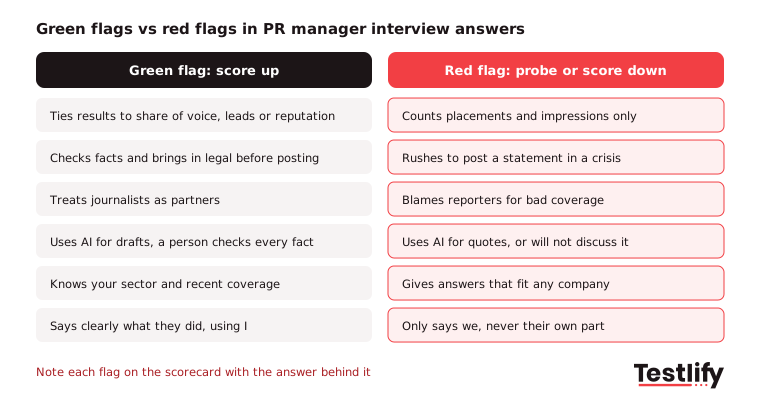
Red flags in public relations manager interviews are answers that sound polished but show no method, no ownership or weak judgment. Watch for these patterns across rounds, and note them on the scorecard so the debrief rests on evidence.
- Activity-only results: "We got 50 placements" with no link to reach, sentiment or a business result.
- No measurement method: cannot name how they would track success beyond impressions.
- Blaming the press: describes journalists as enemies rather than partners with a job to do.
- Rushing to post in a crisis: recommends a public statement before checking facts or involving legal.
- No AI guardrails: uses AI for quotes or facts with no human check, or refuses to discuss AI at all.
- Generic answers: knows nothing specific about your company, sector or recent coverage.
- Only "we," never "I": cannot say what they personally did in a team campaign.
Key takeaway: A polished answer is not a strong answer. Score the method, the candidate's own part and the result, and ignore delivery style unless the role is mainly spokesperson work.
How should you score public relations manager interview answers?
Hiring teams should score public relations manager interview answers on a shared 1 to 4 scale for each skill, with each interviewer scoring alone before the debrief. A shared scale keeps the decision on evidence, makes candidates comparable and cuts the bias that creeps in when people agree on a favorite first.
Score | Media relations | Measurement | Crisis judgment | Stakeholder leadership |
|---|---|---|---|---|
4: Strong | Targeted pitches, named lasting relationships, clear results | Outputs, outtakes and outcomes tied to a business goal | Facts first, clear roles, balanced speed and accuracy | Has pushed back on executives and changed decisions |
3: Good | Sound process, some examples | Tracks share of voice or sentiment, some business link | Solid plan, minor gaps | Works well with executives, some influence |
2: Weak | Mass pitching, few specifics | Placements and impressions only | Rushes to respond or freezes | Follows direction, rarely advises |
1: Poor | No clear process | No method | No plan | Avoids conflict or blames others |
Add writing and strategy rows from your work sample and skills test. Our guide to the interview scorecard shows how to set weights and anchors for each skill.
How do you run a fair public relations manager interview process?
A fair public relations manager interview process tests skills before the panel, gives every candidate the same questions and tasks, and scores answers on agreed criteria. Most teams finish in five steps over two to three weeks, with a work sample that shows real writing and crisis judgment.
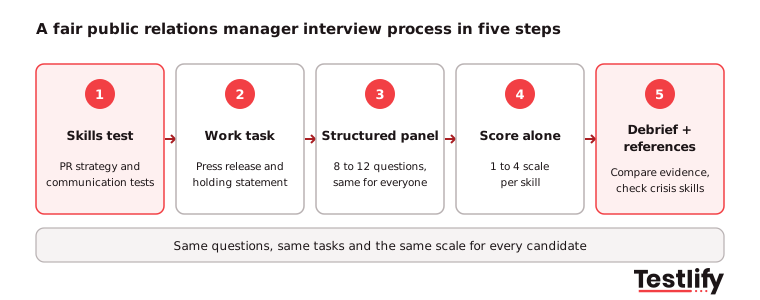
- Screen with a skills test: Use a PR strategy test and a business communication test to build a shortlist on proof, not only on resumes.
- Set a short work task: Ask for a press release and a 150-word holding statement for a made-up issue. Keep it under two hours and the same for everyone.
- Run a structured panel: Pick 8 to 12 questions from the lists above, assign skills to each panelist and ask follow-ups for detail.
- Score alone, then debrief: Each panelist fills in the scorecard before the group meets, then the team compares evidence skill by skill.
- Check references on the key skill: Ask past managers about crisis judgment and executive trust, the two skills hardest to judge in an interview.
Keep every question job-related. The EEOC guidance on prohibited practices explains why questions about age, family plans, religion or health have no place in the panel.
Hire your next public relations manager with proof, not guesswork
Testlify lets you screen public relations manager candidates with ready-made tests such as the public relations strategy test and the strategic communication test, alongside your own writing task, in one assessment. Every response is scored, and results rank candidates so your panel only meets the strongest people.
Browse the Testlify test library of 3,500+ tests, start a 7-day free trial with no credit card, or book a demo to see it on a real role.
Frequently asked questions

Wordpress Developer
Yash Patel is a Wordpress and SEO Specialist at Testlify with 3+ years of experience in technical SEO, on-page optimization, and content strategy. He works on improving Testlify's organic presence and produces content focused on hiring, talent assessment, and HR technology.
LinkedInRelated resources
View all
HR & recruitment
60 Customer Relationship Manager interview questions to ask job applicants

HR & recruitment
60 Project coordinator interview questions to ask job applicants

HR & recruitment
60 Key Account Manager interview questions to ask job applicants

HR & recruitment
60 Category Manager interview questions to ask job applicants

HR & recruitment
60 Data Analyst interview questions to ask job applicants

HR & recruitment
60 Communications Manager interview questions to ask job applicants
Get started.
Hire on proof, not resumes.
Run your first skills-based assessment free — no credit card required.