
Emotional intelligence test for employees: an HR guide
How HR teams use an emotional intelligence test for employees: what it measures, test types, sample questions, hiring steps and limits.

Two candidates can share the same CV and the same skills score, yet one calms an angry client and the other loses the account. An emotional intelligence test for employees helps you see that gap before you hire.
The test scores how a person recognizes, manages and uses emotions at work, both their own and other people's. Used next to skills tests and a structured interview, it suits people-heavy roles and coaching for current staff.
Below you will find what the test measures, the main types, sample questions, hiring steps and legal limits. Use them to start with one role this week.
TL;DR:
- An emotional intelligence test for employees measures five things: self-awareness, self-regulation, motivation, empathy and social skills.
- For hiring, use a scenario-based or ability format. Self-report questionnaires are easier to fake and suit coaching better than selection.
- EI matters most in support, sales, healthcare, HR and team lead roles, where the job is mostly dealing with people.
- Test shortlisted candidates after the skills screen, read scores in bands, and probe low areas in the interview. Never reject on an EI score alone.
- In the US, the test must be job-related and offered with accommodations. In the EU, AI that reads emotions from faces or voices at work has been banned since 2 February 2025.
- Pick a test with published job-related evidence, clear scoring, fair results across groups and a privacy policy you can explain to candidates.
 ChatGPT
 Gemini
 Claude
 Grok
 Perplexity
What is an emotional intelligence test for employees?
An emotional intelligence test for employees is a short assessment that shows how someone handles emotions in work situations: staying calm under pressure, reading a colleague's mood, or repairing a tense client call. The US Office of Personnel Management defines emotional intelligence as a social competence: the ability to monitor your own and others' emotions and use that information to guide thinking and action.
Emotional intelligence (EI, often called EQ) is different from IQ and from personality. IQ tests reasoning, while a personality test describes preferences, such as how outgoing someone is.
An EI test looks at skills that show up in behavior and can be developed over time. For a plain definition, see the emotional intelligence glossary entry.
Most EI tests for work take 10 to 30 minutes. Candidates either rate statements about themselves or choose the best response to workplace scenarios.
Scores are then compared with a reference group. The result reads as a profile of strengths and gaps, not a pass or fail.

Why does emotional intelligence matter at work?
Emotional intelligence matters at work because most jobs depend on people working well together, and technical skill alone does not get a project over the line. Employers now rank these skills highly: in the World Economic Forum's Future of Jobs Report 2025, four EI skills (motivation, self-awareness, empathy and active listening) sit in the top 10 of 26 core skills, according to the Harvard Gazette.
The same report, as summarized by SHRM's 2025 article on human-centered skills, expects a net increase in demand for resilience, flexibility and agility (66% of employers) and for leadership and social influence (58%). SHRM also points out that resumes and unstructured interviews are poor at showing these skills, which is why teams turn to assessments.
Here is where higher EI shows up day to day:
Area | What high EI looks like | What hiring teams gain |
|---|---|---|
Team collaboration | Listens, handles disagreement without escalating | Fewer conflicts, faster decisions |
Leadership | Reads the team, gives clear and fair feedback | Higher trust and engagement |
Customer relations | Spots frustration early, calms tense calls | Better service and retention of customers |
Communication | Clear, considerate messages, also under stress | Fewer misunderstandings |
Stress and change | Stays composed, adapts when plans shift | Lower burnout risk |
Problem solving | Considers other views before acting | Better, calmer decisions |
Retention | Builds good working relationships | Lower turnover and rehiring costs |
Key takeaway: EI does not replace skills. It explains why two equally skilled people get very different results with the same team or customer.
What does an emotional intelligence test measure?
An emotional intelligence test usually measures five components, based on Daniel Goleman's widely used model. Each one is scored based on how the person says they act, or how they choose to act, in realistic work situations.
- Self-awareness: Recognizing your own emotions, strengths and weaknesses, and how they affect others.
- Self-regulation: Managing emotions and impulses, especially in tense situations, and thinking before reacting.
- Motivation: Setting goals and keeping going after setbacks.
- Empathy: Understanding how other people feel and why, and responding with care.
- Social skills: Communicating clearly, building rapport, resolving conflict and working well in a team.
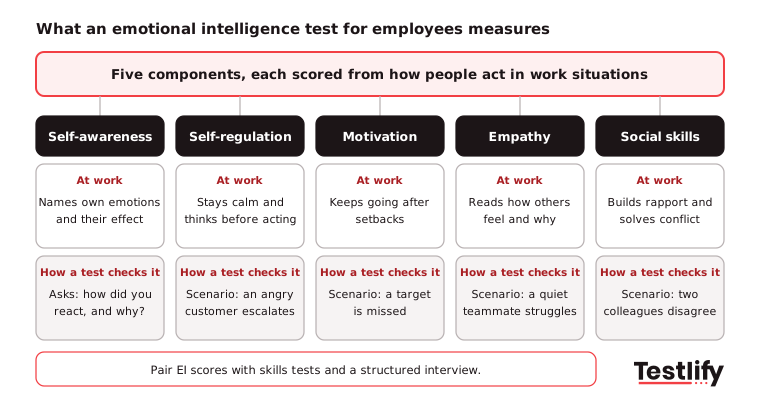
Some tests use a four-part version of the same idea (self-awareness, self-management, social awareness and relationship management). The labels differ, but the skills are the same.
What types of emotional intelligence tests are there?
Emotional intelligence tests come in five main types: self-report questionnaires, ability-based tests, mixed-model tests, situational judgment tests (SJTs) and 360-degree feedback. The US Office of Personnel Management notes that ability-based tests help predict job performance where relationships matter, while self-reports are easier to fake.
Type | How it works | Best for | Watch out for |
|---|---|---|---|
Self-report | Rate statements such as "I stay calm when plans change" | Coaching, team workshops | Easy to fake; measures self-image |
Ability-based | Solve emotion tasks, such as reading faces or predicting reactions | Selection where accuracy matters | Longer, costlier to run |
Mixed-model | Combines self-report items with skill tasks | Broad profiles for development | Long; check what is scored |
Situational judgment (SJT) | Pick the best response to a work scenario | Hiring at volume, customer-facing roles | Scenarios must match the role |
360-degree feedback | Colleagues, managers and reports rate the person | Current employees and leaders | Not usable for external candidates |
For hiring, an SJT or ability format gives the cleanest signal because candidates have to show judgment, not describe themselves. Self-report tools work well once someone is in the team and wants honest feedback for growth.
Testlify's own emotional intelligence test uses the situational judgment format.
What do emotional intelligence test questions look like?
Emotional intelligence test questions are usually short workplace scenarios with several possible responses, or statements you rate on an agree-to-disagree scale. The scenario style is harder to game, because the best answer depends on reading the situation, not on picking the most positive-sounding option.
Three examples in the scenario style:
- Self-regulation: A customer shouts at you about a delayed refund that is not your fault. What do you do first? (a) Explain that another team caused the delay. (b) Acknowledge their frustration and tell them what you will do next. (c) Transfer the call to a manager. A strong answer is (b): it calms the customer and keeps ownership.
- Empathy: A usually active teammate has gone quiet in meetings for two weeks. What is your best move? (a) Ignore it, everyone has off weeks. (b) Mention it in the team meeting. (c) Check in with them privately and ask how things are going. A strong answer is (c).
- Social skills: Two colleagues disagree on a deadline and the discussion is getting personal. You lead the project. What do you do? A strong answer moves the talk back to facts and options, agrees on a decision, and follows up with each person later.
A rating-scale item looks like this: "When I feel frustrated at work, I can usually name what caused it." Candidates answer from strongly disagree to strongly agree.
Good tests repeat ideas in different words to check that answers are consistent.
Pro tip: Write two or three scenarios from real situations in your own team and use them as structured interview questions after the test. They show whether a candidate's score holds up when you ask for a real example.
Which roles need an emotional intelligence test most?
Roles that need an emotional intelligence test most are those where the main work is dealing with people: customer support, sales, healthcare, HR, and anyone who leads a team. In these jobs, poor emotional skills cost customers, deals or good employees, so a structured EI check is worth the extra 20 minutes.
Role | EI skills to prioritize | Pair with |
|---|---|---|
Customer service and contact center agents | Self-regulation, empathy | customer service test, typing or chat simulation |
Sales and account managers | Social skills, motivation, empathy | Role-specific sales test, structured interview |
Team leads and managers | Self-awareness, social skills, self-regulation | leadership test, 360 feedback once hired |
Healthcare staff | Empathy, self-regulation under stress | Clinical skills checks |
HR and recruiters | Empathy, social skills | Situational judgment test |
Project managers | Social skills, self-regulation | Project management skills test |
For leadership hiring in particular, read more on the role of emotional intelligence in leadership and hiring.
How should you use an emotional intelligence test in hiring?
An emotional intelligence test works best in hiring as one scored step in a structured process: define the EI skills the role needs, pick a test that measures them, give it to every shortlisted candidate under the same rules, then check low areas in a structured interview. A person makes the final decision using all the evidence.
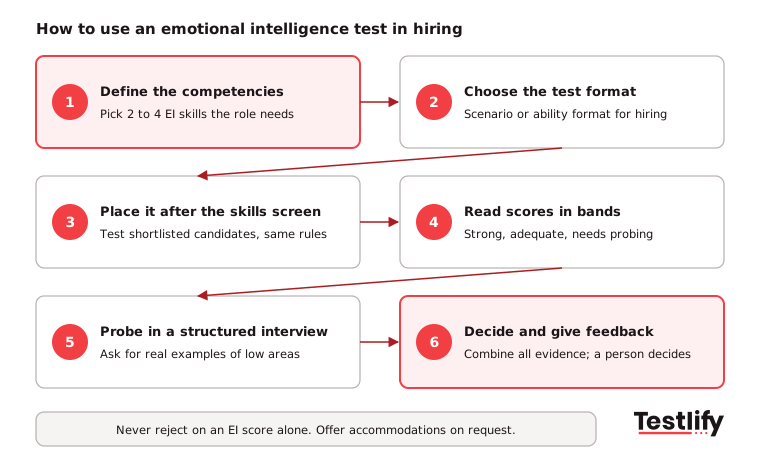
A good test only helps if the process around it is sound. These six steps take you from choosing the skills to reviewing results, so every candidate is judged on the same evidence.
- Define the EI competencies: Pick two to four skills the role really needs. A support role might need self-regulation and empathy. A team lead role might need self-awareness and the ability to motivate others. Write down what good looks like for each.
- Choose a reliable test: Use a test with clear scoring, evidence that it relates to work outcomes, and an SJT or ability format for selection. Run a small pilot with current employees first to see whether scores match what you know about them.
- Place it at the right stage: Most teams test shortlisted candidates after a basic skills screen, so EI adds detail rather than filtering everyone out early. For high-volume support hiring, it can run in the first assessment next to skills tests, as long as nobody is rejected on EI alone.
- Combine it with other methods: Read EI scores next to skills tests, work samples, a structured interview and reference checks. Each method covers a different part of the candidate.
- Train HR and interviewers: Make sure everyone who reads results knows what each scale means, how to probe a low score in the interview, and why a single score is not a verdict.
- Give feedback and keep reviewing: Offer candidates short feedback on their strengths. Each year, compare scores with how hires actually perform and adjust the competencies or the test.
According to SHRM's 2024 Talent Trends report, 78% of HR professionals say pre-employment assessments have improved the quality of their hires. Across the teams we support, the strongest results come when the EI test, the interview questions and the scorecard all measure the same few skills.
Can you use an emotional intelligence test for current employees?
An emotional intelligence test can be used with current employees, and that is often where it helps most: spotting coaching needs, preparing new managers, and building self-awareness in teams. For staff, a self-report or 360-degree format works well, because the goal is honest reflection and growth, not selection.
Good practice for employee testing:
- Make it developmental: Tell people the results support coaching and will not be used for pay or performance ratings. People answer more honestly when the stakes are low.
- Combine self-view and others' view: A 360 review shows the gap between how someone sees their behavior and how colleagues experience it.
- Turn results into a plan: Pick one skill to work on, agree how progress will be measured, and retest after six to twelve months.
- Use team results carefully: Share team-level patterns, not individual scores, in group sessions.
EI is not fixed. People improve self-regulation and empathy with practice, feedback and good role models, so a low score is a starting point.
See how teams use results to plan learning in this guide to using the emotional intelligence test to find training and development needs.
How do you read emotional intelligence test results?
Emotional intelligence test results are best read as a profile of strengths and gaps across each component, compared with a reference group, rather than as one overall number. Look at the two or three scales that matter for the role, then use the interview to check any low area with real examples.
- Use bands, not a hard cut-off: Group scores as strong, adequate or "needs probing". A rigid cut-off on one scale can screen out good people for small differences.
- Check consistency: Many tests flag answer patterns that look inconsistent or overly positive. Treat a flagged result as a reason to ask more questions.
- Compare like with like: Compare candidates for the same role who took the same test version under the same conditions.
- Look for patterns across evidence: A low empathy score plus a weak answer to an empathy interview question is a real signal. A low score with strong examples from past jobs probably is not.
For a step-by-step walkthrough, read how to interpret the results of an emotional intelligence test.
What are the limits of emotional intelligence tests?
Emotional intelligence tests have four main limits: candidates can fake self-report answers, results can reflect cultural differences in how emotions are expressed, a score is a snapshot of one moment, and some items may not suit neurodivergent people. None of these is a reason to skip EI, but each shapes how you use the results.
- Faking: Candidates know EI is valued, so on self-report tests they may describe an ideal version of themselves. Scenario formats, consistency checks and follow-up interview questions reduce this.
- Cultural differences: Assertiveness reads as confidence in one culture and as rudeness in another. Check that scenarios fit your markets, involve diverse reviewers, and interpret results in context.
- A snapshot, not a ceiling: A score shows how someone responds today. EI grows with experience and coaching, so a candidate with a lower score and strong skills may still be a great hire.
- Accessibility: The Workplace Strategies for Mental Health EI self-assessment notes that it was built mainly around neurotypical experience, which applies to many EI tools. Offer accommodations, and do not read a low score as a lack of ability without other evidence.
- Limited predictive power on its own: Technical skills, experience and motivation for the role still matter more for many jobs. EI adds to them; it does not replace them.
Keep your EI tool under review as well: check results across groups every year and update scenarios when roles change.
What legal and privacy rules apply to emotional intelligence tests?
Emotional intelligence tests used in hiring must follow the same rules as any employment test: they must be job-related, fair across groups, accessible to people with disabilities, and handled under data privacy law. In the EU, AI tools that infer emotions at work face an outright ban, which is different from a test the candidate answers.
- Job-related and fair (US): The EEOC's guidance on employment tests says a test that screens out a protected group more often than others must be job-related and consistent with business necessity. Document why each EI skill matters for the role.
- Disability and accommodations (US): Under the ADA, employers must provide reasonable accommodations in how tests are given, and may not require medical examinations, which can include some psychological tests, before a conditional job offer. Keep EI items about workplace behavior, never about mental health.
- Privacy (EU, UK and more): Under GDPR, tell candidates what the test measures, why, who sees the results and how long you keep them. Limit access to people involved in the decision. Testlify explains its approach on the GDPR compliance page.
- AI that reads emotions (EU): Article 5(1)(f) of the EU AI Act bans AI systems that infer a person's emotions in the workplace and in education, except for medical or safety reasons, and the ban has applied since 2 February 2025. Avoid any tool that claims to read emotions from video.
- Automated decisions (New York City): If an AI-scored assessment substantially helps decide who moves forward for a New York City job, Local Law 144 requires a bias audit and candidate notice.
How do you choose an emotional intelligence test for employees?
To choose an emotional intelligence test for employees, start from the job: list the EI skills it needs, then pick a test that measures exactly those skills in a format that fits your use, scenario-based for hiring and self-report or 360 for development. Then check the evidence, fairness, candidate experience and how results fit your hiring tools.
Use this checklist when you compare tests:
- Measures the skills you need: The scales match your competencies, not a generic EQ score.
- Right format for the use: SJT or ability-based for selection; self-report or 360 for coaching.
- Evidence it relates to work: The provider can show how scores connect to job performance in similar roles, and how the test was built and reviewed.
- Fair across groups: The provider checks results by gender, age and ethnicity and fixes items that create gaps.
- Clear scoring and reports: Scores by component, plain-language explanations and suggested interview questions.
- Reasonable length: About 10 to 30 minutes keeps candidates engaged.
- Integrity controls: Question randomization and proctoring for remote tests.
- Privacy and integrations: Clear data handling and a link to your ATS, so results do not live in spreadsheets.
How does Testlify help you test emotional intelligence?
Testlify helps hiring teams test emotional intelligence with a ready-made Emotional Intelligence (EI) test: 30 situational judgment questions in about 20 minutes, covering skills such as recognizing your own emotions, managing impulses, understanding others' feelings, building rapport and pursuing goals. You can add it to any assessment next to role-specific skills tests.
- One assessment for the whole role: Combine the EI test with skills, cognitive and situational judgment tests from a library of 3,500+ tests, or add personality tests such as Big Five-based, DISC and culture fit from the psychometric tests range.
- Fair, comparable results: Every candidate gets the same questions and automated scoring, with per-skill breakdowns and benchmarking.
- Integrity built in: 20+ anti-cheating and proctoring checks, such as question randomization, tab tracking and webcam snapshots.
- Fits your stack: Results sync to 100+ ATS and HRIS tools through Testlify integrations.
Ready to add emotional intelligence to your hiring?
Emotional intelligence testing is easiest to start with one role. Pick a people-heavy role you hire for often and add the EI test to your existing skills assessment.
Compare results with your interview scores for the next ten hires. Start a 7-day free trial, no credit card needed, or book a demo for a walkthrough.
Frequently asked questions (FAQs)

People and Talent Partner
Arushi Shah runs day-to-day talent acquisition and candidate experience at Testlify. She writes on interviewing, structured hiring, and giving candidates a fair, fast process.
LinkedInRelated resources
View all
HR & recruitment
Emotional intelligence test for hiring is a must-have
HR & recruitment
How to scale R&D teams without losing innovation

HR & recruitment
How can the Emotional Intelligence test help you identify training and development needs?

HR & recruitment
Pros and Cons of Emotional Intelligence Test in Hiring

HR & recruitment
Find product managers with our scenario-based evaluations
HR & recruitment
Should the Emotional Intelligence test be Used In Hiring?
Get started.
Hire on proof, not resumes.
Run your first skills-based assessment free — no credit card required.