
How to evaluate insurance agent candidates: a 2026 guide
A six-step way to judge insurance agent candidates: license check, skills test, structured interview, role play and a weighted scorecard.

Knowing how to evaluate insurance agent candidates means checking the same evidence, in the same order, for every applicant: a valid state license, five job skills scored separately, a structured interview, a short role play, and one weighted scorecard agreed before anyone sees a result. Done this way, the hire rests on proof of how a person sells, explains and stays compliant, not on how well they interview.
Most insurance teams do not lack candidates. They lack a shared way to compare them. In the Testlify and SHRM Labs Skills-First Talent Report 2026, only 8.4% of HR and talent leaders said they were very confident their process picks the best candidate rather than the best interviewer. This guide fixes that for agent roles, whether you hire three producers a year or run monthly agent classes for a contact center.
TL;DR:
- Evaluate insurance agent candidates in six steps: verify the license, screen the application, run a skills test, hold a structured interview, add a role play, then decide on one scorecard.
- Check the license first through your state insurance department or NIPR, including the lines of authority. Never let a test screen on a credential.
- Score five skills separately: sales behavior (30%), product and policy knowledge (25%), compliance judgment (20%), customer handling (15%) and numeracy (10%). Adjust the weights by line of business.
- Ask every candidate the same questions in the same order, and include one integrity scenario, such as a client asking the agent to misstate an application.
- Keep candidate time under about one hour before a human conversation. Strong agents usually have other offers.
- Insurance sales agents earned a median $62,280 in May 2025, with about 43,100 openings a year, so a mis-hire costs a salary, a ramp period and a book of renewals.
 ChatGPT
 Gemini
 Claude
 Grok
 Perplexity
What does it mean to evaluate an insurance agent candidate?
Evaluating an insurance agent candidate means collecting job-related evidence on whether the person can sell, explain and service policies within the rules, then scoring that evidence against criteria set before testing starts. The US Bureau of Labor Statistics lists the qualities the role needs: analytical skills, communication, initiative, interpersonal skills and self-confidence.
A good evaluation separates three things that hiring teams often blur:
- Eligibility: Is the candidate licensed, or able to get licensed in time, for the lines you sell?
- Ability: Can the candidate do the work today: explain coverage, handle an objection, check a premium, stay calm with an upset customer?
- Fit for your model: Can the candidate work your lead flow, whether that is warm inbound calls in a contact center or self-generated prospects in an independent agency?
Keep these apart in your process. A license tells you nothing about sales ability, and a strong pitch tells you nothing about compliance judgment. Before you start, write the role scope down. The insurance agent job description template is a quick starting point.

How to evaluate insurance agent candidates step by step
Insurance agent candidates are best evaluated in six steps, each answering one question: is the person eligible, do they meet the basics, can they do the work, how do they reason, how do they act with a real customer, and how do they compare with everyone else. The full sequence takes under two hours of candidate time.
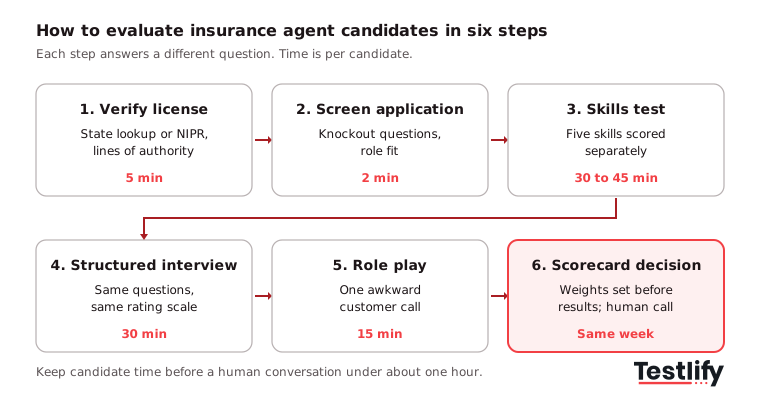
Step | What it proves | Method | Candidate time |
|---|---|---|---|
1. Verify license | Eligible to sell the lines you need | State insurance department lookup or NIPR | None (recruiter, 5 minutes) |
2. Screen application | Hard requirements and role fit | Knockout questions on the application | Under 2 minutes |
3. Skills test | The five job skills, scored separately | Role knowledge, situational judgment, numerical and audio or video questions | 30 to 45 minutes |
4. Structured interview | The reasoning behind the scores | Same questions, same order, same rating scale | 30 minutes |
5. Role play | Behavior in a live customer moment | One recorded or live call scenario | 15 minutes |
6. Scorecard decision | Who to hire, against an agreed bar | Weighted scorecard, human final call | Same week |
Two rules hold the sequence together. First, put the cheap checks first: a license lookup and two knockout questions cost minutes and remove people who cannot legally do the job. Second, move fast. Agent candidates often weigh more than one offer, so a process that takes three weeks loses the people with the most options.
Pro tip: Book the interview slot at the same time you send the test invite. Candidates who pass go straight to a booked conversation instead of waiting for someone to schedule it.
How do you verify an insurance agent's license?
Insurance agent licenses are verified through the state insurance department's public lookup or through NIPR, the National Insurance Producer Registry, which holds producer records across states. Check that the license is active, that it covers the lines of authority the role sells, and that it is valid in every state the agent will serve.
Licensing rules are set by each state. Agents must be licensed in the states where they work, life and health and property and casualty need separate licenses, and agents who sell securities also need a FINRA license. That makes three checks worth doing on every candidate:
- Status: Active, not lapsed or pending.
- Lines of authority: Life, health, property, casualty or personal lines, matching the job.
- States: Valid where the agent will sell, or a clear plan for non-resident licenses.
Unlicensed candidates are not automatically out. Many carriers and agencies hire for potential and sponsor licensing. If you do, record it as a condition with a deadline in the offer, and judge the candidate on ability, not on the missing license.
Which skills should you test in insurance agent candidates?
Insurance agent candidates should be tested on five skills: sales behavior, product and policy knowledge, compliance judgment, customer handling, and numeracy. Score each one separately and agree a minimum for each, because one strong total can hide the single weakness that costs you a client or a complaint.
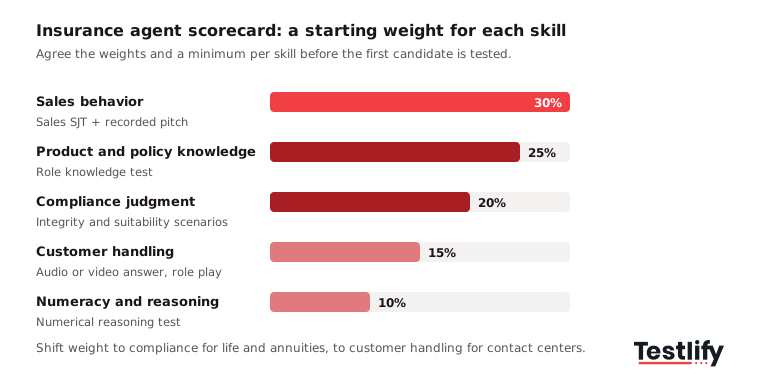
Skill | What good looks like | Best evidence | Starting weight |
|---|---|---|---|
Sales behavior | Qualifies the need, handles a price objection, asks for the next step | Sales situational judgment questions plus a recorded pitch | 30% |
Product and policy knowledge | Explains coverage, exclusions and renewals in plain words | Role knowledge test | 25% |
Compliance judgment | Knows what cannot be promised and escalates instead of guessing | Integrity and suitability scenarios | 20% |
Customer handling | Stays clear and calm with a confused or angry customer | Audio or video answer, then the role play | 15% |
Numeracy and reasoning | Checks a premium calculation and spots the error | Numerical reasoning questions | 10% |
You do not have to build this from scratch. A ready-made insurance assessment covers sales, communication and people skills for agent roles. For specific lines, the personal lines insurance sales agent test adds coverage knowledge, and a sales aptitude test covers candidates with no insurance background.
Testing skills instead of past job titles also widens your pool. LinkedIn Economic Graph research from March 2025 found that a skills-based approach led to a median 6.1x increase in the talent pool globally. For agent roles that matters: many strong agents come from retail, hospitality or call-center work, not from insurance.
How do you run a structured interview for insurance agents?
A structured interview for insurance agents asks every candidate the same questions in the same order and rates every answer on the same scale. The US Office of Personnel Management describes this structured interview standard as predetermined questions with responses evaluated against the same rating scale and standards.
Use the test results to pick where to probe. If a candidate scored low on compliance judgment, spend more of the 30 minutes there. These questions work well for agent roles, with what a strong answer sounds like:
Question | What a strong answer sounds like | Weak sign |
|---|---|---|
A client wants to cut coverage to hit a budget. What do you do? | Explains the risk in plain words, offers options, records the client's choice | Drops coverage to close, or refuses to adjust |
A client asks you to leave a past claim off an application. How do you respond? | Declines, explains why, offers an honest path forward | Agrees, hedges, or says "it depends" |
Explain a deductible to someone who has never bought insurance. | Uses a short, everyday example and checks understanding | Jargon or brochure language |
A renewal client shows you a cheaper competitor quote. What happens next? | Compares coverage line by line before talking price | Matches price without a review |
Tell me about a week when nothing closed. What did you change? | Names the specific activity they changed and the result | Blames leads or the market |
How do you build a pipeline without marketing support? | Names channels, a referral habit and a weekly routine | Waits for leads to be handed over |
Score each answer on a 1 to 5 scale with written anchors for 1, 3 and 5 before the first interview. Testlify's guide to structured interviews has more on writing anchors.
How do you use a role play or work sample for agent roles?
A role play for agent roles is a short, realistic customer call that the candidate handles live or on video, scored with the same rubric for everyone. The OPM notes that work samples and simulations closely mirror real tasks, relate highly to job performance and are often seen by applicants as very fair.
Keep the role play small and specific. Three scenarios that work:
- The confused renter: A customer thinks their renters policy covers a flooded basement. The candidate has to explain what is and is not covered without losing the customer.
- The price shopper: A small business owner says a competitor is 15% cheaper. The candidate has to find out what the quotes actually cover.
- The partial claim: A customer is upset that a claim was only partly paid. The candidate has to explain why and say what happens next.
Score three things: did they ask before they told, did they stay accurate, and did they end with a clear next step. A two-minute recorded answer works for early rounds. Use a live call with a manager playing the customer for finalists.
How do you score insurance agent candidates on one scorecard?
Insurance agent candidates are scored on one scorecard by combining the test, interview and role play results with the weights you agreed before testing, plus a minimum score for each skill. A candidate who misses the compliance minimum does not advance, even with a strong total.
Set three things before the first invite goes out:
- Weights: Use the starting weights above and adjust them for the role.
- Minimums: For example, at least 60% on compliance judgment and product knowledge, whatever the total.
- Decision owner: Name who makes the final call and who can override a minimum, and how they record why.
A simple worked example: candidate A scores 90% on sales behavior but 50% on compliance judgment. Candidate B scores 75% on sales and 80% on compliance. With the weights above, their totals are close, but A misses the compliance minimum, so B moves forward. Without a minimum, A often wins on charisma in the debrief.
Key takeaway: Agree the weights, minimums and decision owner before anyone sees a score. A bar set after the results is a preference with a number attached.
What red flags should you watch for when evaluating insurance agents?
Red flags when evaluating insurance agents are patterns that predict compliance problems, early exits or a weak book, and they often show up across steps rather than in one score. Look for:
- Hedging on integrity questions: Any answer to the misstated-application scenario that is not a clear no.
- Overpromising coverage: Saying "you're covered" before asking about the loss.
- No prospecting routine: For producer roles, no named channels or weekly activity.
- Blaming others for slow periods: Leads, managers or the market, with nothing they changed.
- Unverified license claims: A license number that does not match the lookup, or lines that do not match the role.
- Rushed or copied answers: Very fast completion with strong scores, or written answers that read like a script. Check proctoring signals before you trust the result.
One red flag is a prompt to probe, not an automatic rejection. Two or more across different steps usually decide the outcome.
How should evaluation change for life, P&C and contact-center agents?
Evaluation for life, P&C (property and casualty insurance), and contact-center agents keep the same five skills but shifts the weights and the scenarios, because each role fails in a different way. Life roles fail on suitability, P&C roles on coverage detail, and contact-center roles on consistency across many calls a day.
Role type | Weight more on | Role play scenario | Watch for |
|---|---|---|---|
Life and annuities | Compliance judgment, needs analysis | A family choosing between term and permanent cover | Pushing the bigger product |
Property and casualty | Product knowledge, numeracy | A homeowner asking about a water damage exclusion | Vague coverage answers |
Commercial lines | Product knowledge, compliance | A business owner with a new delivery van | Guessing instead of checking |
Contact-center personal lines | Customer handling, consistency | An angry caller after a premium increase | Tone dropping under pressure |
Independent producer | Sales behavior, self-generated pipeline | A referral who is happy with their current agent | No plan beyond waiting for leads |
For high-volume hiring, such as monthly agent classes, use score thresholds to move candidates who meet every minimum straight to interview, and review the borderline band by hand. Kin Insurance used Testlify to standardize bilingual hiring for licensed insurance agents, which is the same idea applied at scale.
How do you keep the evaluation fair and defensible?
A fair and defensible evaluation tests only skills the job needs, treats every candidate the same at each step, and keeps records of how each decision was made. In the US, EEOC guidance on employment tests says a selection procedure that screens out a protected group must be job related and consistent with business necessity.
The same guidance makes a point many teams miss: the employer stays responsible for its tests even when a vendor supplies the documentation. In practice:
- Test only what the job description lists: No general trivia, no skills the role never uses.
- Keep steps identical: Same questions, order, time limits and scoring at each stage.
- Watch pass rates by group: Check for adverse impact after each hiring round, and review a step that screens out one group far more than others.
- Offer accommodations: Extra time or another format when a candidate asks.
- Keep the record: Weights, scores, interview ratings and who made the call, for every candidate.
Treat personality results as interview prompts, not as a pass or fail. They describe preferences, so they help you decide what to ask, not who to reject.
How do you know your evaluation of insurance agents worked?
An evaluation of insurance agents works when the people who scored well also perform well after they start. Check it at 90 days and again at 12 months by comparing each hire's scorecard with leading indicators the agent controls: calls made, quotes issued, follow-ups completed and compliance errors.
This matters because the cost of a wrong hire is high and arrives late. The BLS reports a median salary of $62,280 for insurance sales agents in May 2025, about 572,600 jobs and roughly 43,100 openings a year. A mis-hire who leaves at month seven costs most of a year's pay, the licensing and training spend, the renewals nobody worked, and a repeat search.
If high scorers are not performing better, review the weights first, then the questions. The Skills-First Talent Report 2026 found that 44.5% of HR leaders say nobody formally checks their assessments. A short review after each hiring round puts you ahead of that.
How Testlify helps you evaluate insurance agent candidates
Testlify gives insurance hiring teams the steps above in one place, so every candidate is judged the same way:
- Test library: 3,500+ tests, including insurance agent, personal lines, sales aptitude, numerical reasoning and situational judgment tests, plus custom tests built from your job description.
- Audio and video answers: One-way video and audio questions and AI interviews for the customer-handling and role-play steps, through the video interviewing tool.
- Weighted scoring and thresholds: Weights per test, score thresholds for auto-shortlisting and benchmarking against other candidates.
- Integrity checks: 20+ proctoring checks, including AI assistance detection and copy-paste tracking, described on the anti-cheating and proctoring page.
- ATS sync: 100+ ATS and HRIS integrations, so results land where your recruiters already work.
- 15+ languages: Useful for bilingual agent teams and contact centers.
Ready to evaluate your next insurance agent class?
Pick the insurance agent test, add one role-play question, set your weights and run it on your next opening. Start a 7-day free trial with no credit card, or book a demo to walk through it with your own job description.
Frequently asked questions (FAQs)

Senior SEO Specialist
Soham is a senior SEO specialist specializing in B2B HR tech. He covers search, answer, and generative engine optimization (SEO/AEO/GEO) for talent acquisition, skills-based hiring, and assessment-driven recruiting audiences.
LinkedInRelated resources
View all
Skill assessment
Mechanical reasoning assessment: how to evaluate candidates in 2026

Skill assessment
How to measure empathy in candidates: methods, questions and a scoring rubric

Skill assessment
How to evaluate candidates’ skills with a SpringBoot assessment

Skill assessment
How to evaluate candidates’ skills with a C++ assessment

Skill assessment
How to evaluate candidates’ skills with a PHP assessment

Skill assessment
How to evaluate candidates’ skills with a React Native assessment
Get started.
Hire on proof, not resumes.
Run your first skills-based assessment free — no credit card required.