
What is e recruitment? Types, process, pros and cons in 2026
A plain guide to e recruitment: how online hiring works, its main types, pros and cons, and how to keep it fair and fraud-resistant in 2026.

Post one job online and the applications arrive by the hundred. Most read the same, and many were written by AI.
E-recruitment is the use of online tools to find, screen, assess and hire people, from the job post to the first day at work. Almost every hiring team now runs some of its process this way.
The question in 2026 is no longer whether to recruit online. It is how to sort the flood of applications fairly, without losing good candidates.
TL;DR:
- E-recruitment means running the whole hiring cycle online, not only posting jobs while screening paper resumes by hand.
- Online hiring widens reach and speeds up screening, but one job post can now draw hundreds of near-identical applications.
- AI has changed both sides: candidates polish resumes with it, and employers rank applicants with it, so resumes say less about skill.
- The fix is to test skills early, because a short role-based test gives every eligible applicant the same chance and cuts resume reading.
- Fairness needs safeguards: proctored tests, identity checks, human final decisions and bias audits of automated tools.
- Track source of hire, time to hire and quality of hire by channel and role, so you know what works.
 ChatGPT
 Gemini
 Claude
 Grok
Grok Perplexity
What is e-recruitment?
E-recruitment (also written e recruitment, and called online recruitment, internet recruiting or digital recruitment) is the use of web-based tools to run hiring. Employers post jobs, attract applicants, screen and test them, interview them, make offers and onboard new hires online, while candidates search, apply and track their applications from any device.
E-recruitment covers the whole hiring cycle, not only job ads. A company that posts on job boards but screens paper resumes by hand is only partly recruiting online.
A full e-recruitment setup links every stage through software, so candidate data moves from the application form to the assessment, interview notes and the offer without retyping.
One note on the term: in India and some other countries, "e-recruitment portal" also names the government websites where people apply for public sector jobs. This guide covers e-recruitment from the employer's side, for teams that hire in the private sector.

How does e-recruitment work?
E-recruitment works by moving every candidate through the same online stages: attract, apply, screen, assess, interview and hire. Each stage uses a tool, and an applicant tracking system (ATS) ties them together so recruiters see every candidate's status, scores and notes in one place.
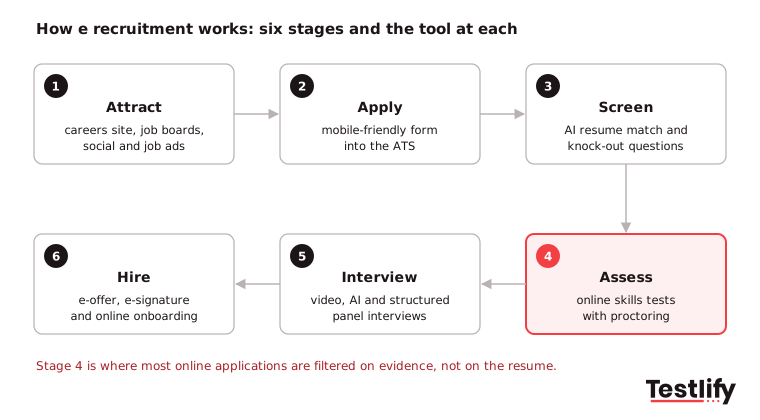
- Attract. The team publishes the job on its careers site, job boards and social channels, often with paid job ads targeted by location and skills.
- Apply. Candidates apply through a short, mobile-friendly form. The application lands in the ATS.
- Screen. Knock-out questions and AI resume matching sort applicants by basic fit, such as location, work rights and must-have experience.
- Assess. Shortlisted or all eligible applicants take an online skills test or job simulation, so the next cut rests on what people can do, not on how well the resume is written.
- Interview. One-way video, AI interviews or live video panels follow, ideally with the same questions and scorecard for every candidate.
- Hire. The offer letter goes out for e-signature and onboarding starts online.
The candidate sees the other side of the same flow: job alerts, a short application, a test link, interview invitations and status updates by email, SMS or WhatsApp.
What are the main types of e-recruitment?
The main types of e-recruitment are job boards, company careers sites, social and professional networks, paid job ads, applicant tracking systems, online assessments, video and AI interviews, and virtual hiring events. Most teams combine several of them, because each one solves a different part of the hiring cycle.
- Job boards. General and niche boards are still where most people look. In iHire's 2025 State of Online Recruiting report, 79.5% of workers said they rely on general job boards to search for jobs.
- Careers site. Your own careers page carries your employer brand, open roles and the application form. Candidates who find a job elsewhere usually check it before they apply.
- Social and professional networks. LinkedIn, Facebook, Instagram and community groups help reach passive candidates. Our guide to social media recruiting covers the channels in detail.
- Paid and programmatic job ads. Ads placed by software across many sites, with the budget moved to the sources that bring qualified applicants.
- Applicant tracking systems and recruiting CRMs. The ATS manages active applications; a CRM keeps a pool of past and future candidates warm.
- Online assessments. Skills tests, coding tasks, language tests and job simulations taken in the browser.
- Video and AI interviews. One-way recorded answers, AI-led interviews and live video panels replace most first-round phone screens.
- Virtual hiring events. Online job fairs and webinars for campus and volume hiring.
How is e-recruitment different from traditional recruitment?
E-recruitment differs from traditional recruitment in where each step happens. Traditional hiring relies on print ads, walk-ins, paper resumes and in-person interviews.
E-recruitment runs the same steps through software, which widens the reach and speeds up screening, but also brings far more applications and new risks such as fake candidates.
Factor | Traditional recruitment | E-recruitment |
|---|---|---|
Where jobs are posted | Newspapers, notice boards, agencies, word of mouth | Job boards, careers site, social networks, paid job ads |
Reach | Local or regional | National or global, including remote candidates |
Application volume | Low to moderate | High; one post can draw hundreds of applicants |
Screening | Manual resume review | ATS filters, AI resume matching, online skills tests |
Interviews | In person | Video, AI and live online panels, then in person if needed |
Speed | Weeks per stage | Days per stage when stages are automated |
Cost per hire | Higher (print ads, travel, agency fees) | Lower per applicant, with software subscriptions |
Data | Paper files, hard to compare | Every step logged and measurable |
Main risks | Small talent pool, slow process | Volume overload, fake or AI-written applications, bias in automated tools |
What are the benefits of e-recruitment?
The benefits of e-recruitment are a wider talent pool, faster screening, lower cost per applicant, consistent evaluation and better data. For mid-size and large employers hiring many people at once, the time saved on manual screening is usually the biggest gain.
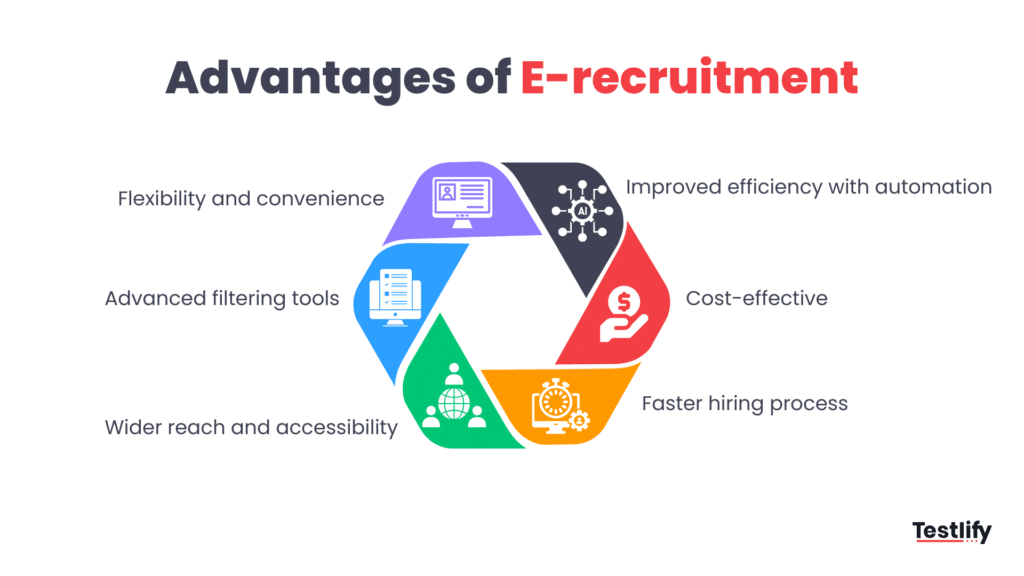
- Wider reach. Online job posts remove the limit of geography, which matters for niche and remote roles.
- Faster hiring. Automated screening, test scoring and interview scheduling cut days from each stage. LinkedIn's Future of Recruiting 2025 found that recruiting teams using generative AI save about 20% of their work week.
- Lower cost per applicant. Free and paid online channels cost far less per applicant than print ads, travel and agency fees.
- Consistent evaluation. Every candidate can take the same test and answer the same interview questions, which makes comparison fairer.
- Better data. Each step is logged, so the team can see which sources bring good hires and where candidates drop out.
- Better candidate experience. Candidates can apply, test and interview on their own schedule and get faster updates.
What are the disadvantages of e-recruitment?
The disadvantages of e-recruitment are application overload, fake and AI-written applications, a less personal experience, bias in automated screening, data security risk and uneven access for some candidates. Most of these problems got sharper in 2025 and 2026 as job seekers started applying with AI tools.
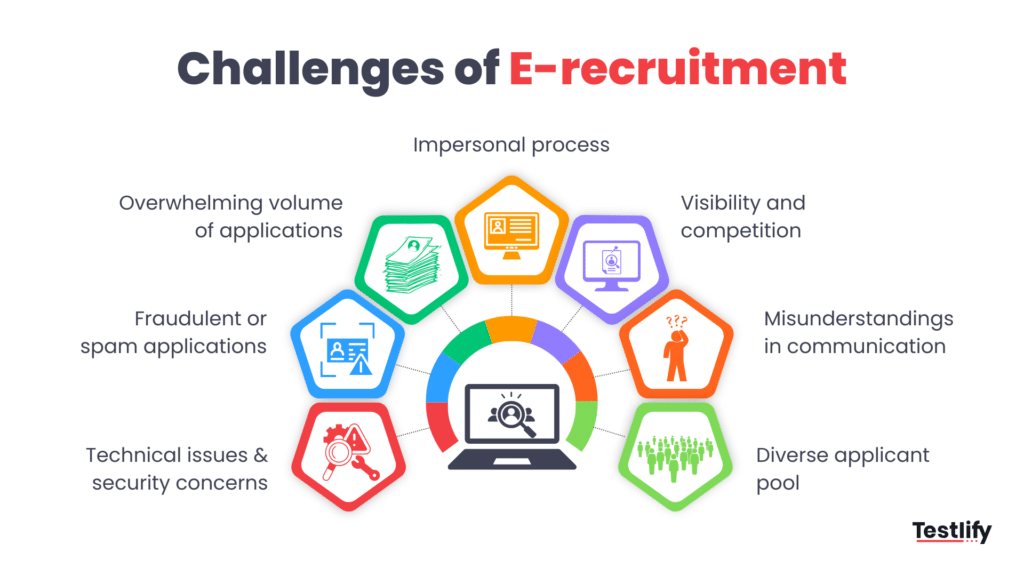
- Too many unqualified applications. One click makes applying easy, so volume rises faster than quality. In the iHire 2025 report, 60% of hiring managers said they receive too many underqualified applicants.
- Fake and AI-written applications. Resumes and cover letters written by AI look alike and all match the job ad. Gartner predicts that by 2028, 1 in 4 candidate profiles worldwide could be fake, and 6% of the 3,000 candidates it surveyed admitted to interview fraud.
- Less personal contact. Automated emails and recorded interviews can feel cold, and strong candidates may drop out if they never speak to a person.
- Bias in automated tools. Screening models trained on past hiring data can repeat past bias, and keyword filters can reject good people with unusual resumes.
- Data security and privacy. Candidate data is personal data. Weak vendor security or careless sharing creates legal and reputational risk under laws such as GDPR and CCPA.
- Uneven access. Candidates with poor internet access or low digital confidence can be left out, which matters most in blue-collar and frontline hiring.
How has AI changed e-recruitment?
AI has changed e-recruitment on both sides of the process. Candidates use AI to write resumes and answer questions, and employers use AI to write job ads, rank applicants and run first-round interviews.
The result is more applications that look the same, and more pressure to judge people on proof of skill.
Adoption is rising fast. SHRM's 2025 Talent Trends survey of 2,040 HR professionals found that 43% of organizations use AI in HR tasks, up from 26% a year earlier, while 69% still struggle to fill roles.
LinkedIn reports that 37% of organizations are integrating or experimenting with generative AI in hiring, up from 27%. Among US employers in the iHire study, 25.9% use AI in recruiting, compared with 14.7% in 2024.
AI is most useful in e-recruitment for:
- Writing and improving job descriptions and outreach messages
- Matching resumes to the job and flagging must-have gaps
- Scoring online tests and summarising interview answers
- Scheduling interviews and answering routine candidate questions
- Running structured AI interviews at volume
AI should not make the final hiring decision on its own. Our guide to AI in recruitment covers where automation helps and where people need to stay in charge.
How do you set up an e-recruitment process?
Setting up an e-recruitment process takes seven steps: define the roles, pick the tools, build the careers site, write and post the jobs, screen and assess online, interview in a structured way, and hire and onboard digitally. The order matters, because the tools should follow the hiring plan, not the other way round.
- Define roles and goals. Agree with hiring managers on headcount, the skills each role needs on day one, and targets such as time to hire and quality of hire.
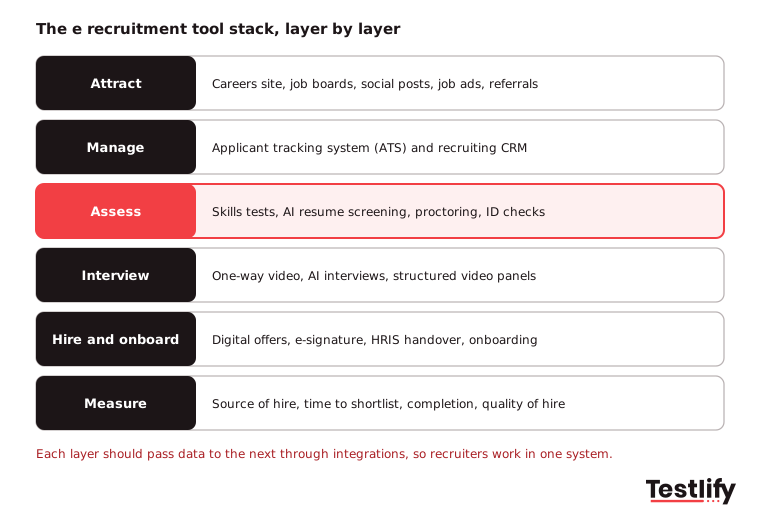
- Pick the tool stack. Choose an ATS that fits your size, then add the assessment, interview and onboarding tools that connect to it. Check integrations before you buy.
- Build the careers site. Show open roles, pay range where the law asks for it, culture and benefits. Keep the application form short and mobile-friendly.
- Write and post the jobs. Use clear, specific job postings with the real must-have skills, then post on job boards, social channels and niche sites.
- Screen and assess online. Use knock-out questions for hard requirements, then a short role-based skills test. The Testlify test library has 3,500+ tests for tech and non-tech roles.
- Interview in a structured way. Give every candidate the same questions and scorecard. See our guide to structured interviews.
- Hire and onboard digitally. Send digital offers for e-signature and move the new hire into your HRIS and onboarding flow without re-entering data.
Pro tip: Put the skills test before the manual resume review, not after it. When every eligible applicant takes the same short test first, recruiters read fewer resumes, and AI-polished resumes stop deciding who gets a call.
How do you keep e-recruitment fair and fraud-resistant?
Keeping e-recruitment fair and fraud-resistant takes five safeguards: test skills early, proctor online tests, confirm identity before final rounds, keep people in charge of decisions, and audit automated tools for bias. Together they protect the employer from fake candidates and protect candidates from unfair screening.
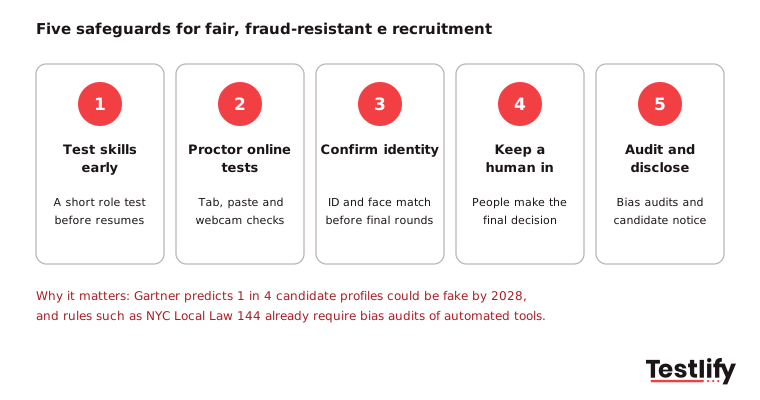
- Test skills early. A short work-sample test is harder to fake than a resume and gives every applicant the same chance.
- Proctor online tests. Tab switching, copy-paste and webcam checks show whether the person did the work alone.
- Confirm identity. ID and face checks before the final interview stop proxy candidates who swap in someone else.
- Keep a human in the loop. Use AI scores to rank and explain, and let a recruiter or hiring manager make the call.
- Audit and disclose. New York City's Local Law 144 requires a bias audit within one year of using an automated employment decision tool, a public summary of the results and notice to candidates. The EU AI Act lists AI used to filter applications and evaluate candidates as high-risk.
Which metrics show whether e-recruitment is working?
The metrics that show whether e-recruitment is working are source of hire, apply conversion rate, time to shortlist, assessment completion rate, time to hire, offer acceptance rate, candidate satisfaction and quality of hire. Track them by channel and by role, so you can move budget and effort to what works.
Metric | What it tells you | Warning sign |
|---|---|---|
Source of hire | Which channels bring people you actually hire | Most applicants come from a channel that produces few hires |
Apply conversion rate | Share of job page visitors who finish applying | A low rate often points to a long or broken form |
Time to shortlist | Days from job post to a ranked shortlist | Grows with volume, a sign screening is still manual |
Assessment completion rate | Share of invited candidates who finish the test | A sharp drop means the test is too long or poorly explained |
Time to hire | Days from application to accepted offer | Strong candidates accept other offers first |
Offer acceptance rate | Share of offers accepted | Low rate points to pay, process or experience problems |
Candidate satisfaction | How applicants rate the process | Low scores hurt your employer brand on review sites |
Quality of hire | Performance and retention of new hires | Fast hiring with weak first-year results |
Quality of hire is the metric most teams want and few can measure. In LinkedIn's 2025 research, 89% of talent leaders said measuring quality of hire will matter more, but only 25% were highly confident they can measure it well.
Linking assessment scores to later performance is one practical way to start. Our guide to recruitment metrics goes deeper.
Where does Testlify fit in an e-recruitment stack?
Testlify fits in the assess and interview layers of an e-recruitment stack. Hiring teams use it to test every eligible applicant on role skills before resume review, run AI interviews, and send ranked results back to the ATS.
- Skills tests. 3,500+ tests across technical, role-specific, cognitive, language and personality areas, plus custom tests.
- AI resume screening. The AI resume screener gives each resume an explainable match score and a High, Medium or Low fit label.
- Proctoring. 20+ anti-cheating and proctoring checks, including tab, copy-paste and webcam monitoring.
- Integrations. 100+ ATS and HRIS integrations with two-way sync, so scores land where recruiters already work.
- Fairness. The matching model behind Testlify passed a third-party NYC Local Law 144 bias audit, completed on June 16, 2023.
Key takeaway: E-recruitment solved the reach problem years ago, but the 2026 problem is judging hundreds of similar online applications fairly and fast. Skills tests placed early in the funnel are the most direct fix.
Want to see how Testlify skills tests, AI interviews and advanced proctoring features help you identify top talent for your open roles? Book a demo with the Testlify team today to learn more.
Frequently asked questions (FAQs)

Related resources
View all
HR & recruitment
11 core HR functions every recruiter should know in 2026
HR & recruitment
Interview to hire ratio: A complete guide for hiring teams

HR & recruitment
Revenue per FTE: Formula, Benchmarks, and How to Improve It

HR & recruitment
What is job restructuring and how to do it?

HR & recruitment
Cost-effective employee training solutions: using SCORM-compliant authoring tools to create E-learning courses

HR & recruitment
7 tips on recruiting students for HR professionals
Get started.
Hire on proof, not resumes.
Run your first skills-based assessment free — no credit card required.