
AI in recruitment: The complete 2026 strategy guide
AI in recruitment in 2026: tools, use cases, challenges, and a step-by-step plan to implement AI with skills-based hiring and human oversight.

AI in recruitment means using AI tools to initiate or support hiring tasks like sourcing, screening, skills evaluation, interview structuring, recruiting analytics, and hiring workflow automation.
While AI tools can now surface thousands of candidates in seconds for volume hiring, they’ve also created a serious quality problem. It’s not just recruiters using AI, but candidates are using it too.
Candidates are using AI to build polished resumes (Gartner found 54% of candidates used AI to generate resume/CV text). Some also impersonate during assessments and attempt to bypass proctoring. This makes it harder to verify who actually has the skills. In a Gartner survey, 6% of candidates admitted to interview fraud (impersonation/proxy).
To tackle these issues, there are plenty of AI interviewing and recruitment tools out there, but in 2026 just having powerful AI hiring tools is not enough. You need to have a clear strategy in place to execute a smooth recruitment process with integrity. So, here’s your 2026 guide to use AI in recruitment effectively.
 ChatGPT
 Gemini
 Claude
 Grok
Grok Perplexity
TL;DR – Key takeaways
- Blue-collar jobs are in high demand, and skilled workers are harder to find.AI in recruitment helps teams source, screen, and evaluate candidates faster, but it works best as decision support, not an autopilot.
- Resume quality is getting harder to trust, so skills-first evaluation and consistent scoring matter more in 2026.
- The biggest risks are fairness, explainability, and process integrity, so human oversight must stay in key decision points.
- The best AI setup is a connected stack: ATS/CRM, sourcing, skills assessment, interview structure, and analytics.
- Start small: fix one bottleneck, run a pilot, measure results, then scale role by role.

What is AI in recruitment?
AI in recruitment is the use of artificial intelligence (AI) and machine learning (ML) in hiring tools to help recruiters find, screen, and evaluate candidates faster and more consistently.
AI recruiting tools can automate repetitive tasks like resume screening, shortlisting, and scheduling. They also support decision-making using models that spot patterns in data, like role-fit indicators, assessment performance, and pipeline trends.
The old way was relying heavily on keyword and title searches. For example, you searched for “Sales Manager” and missed great candidates who called themselves “Account Executives.” AI-based matching can understand that both roles involve similar core skills. It can surface both profiles. This is what sets AI recruiting apart from traditional hiring.
Difference between artificial intelligence and machine learning?
Recruiters often use these terms interchangeably, but in your recruitment tech stack, they do two very different jobs. Here’s the easiest way to understand the difference:
Artificial intelligence
AI refers to systems that can perform tasks that usually need human intelligence, like understanding language, making recommendations, recognizing patterns, or helping with decisions.
In recruitment, AI can power things like resume screening, candidate matching, interview note summarization, and workflow automation.
Machine learning
Machine learning (ML) is a subset of AI. ML models learn from data and improve their outputs over time without being manually programmed with fixed rules.
In hiring, ML often drives ranking and prediction tasks. It can score role fit based on skills signals, spot patterns in assessment performance, and flag pipeline trends.
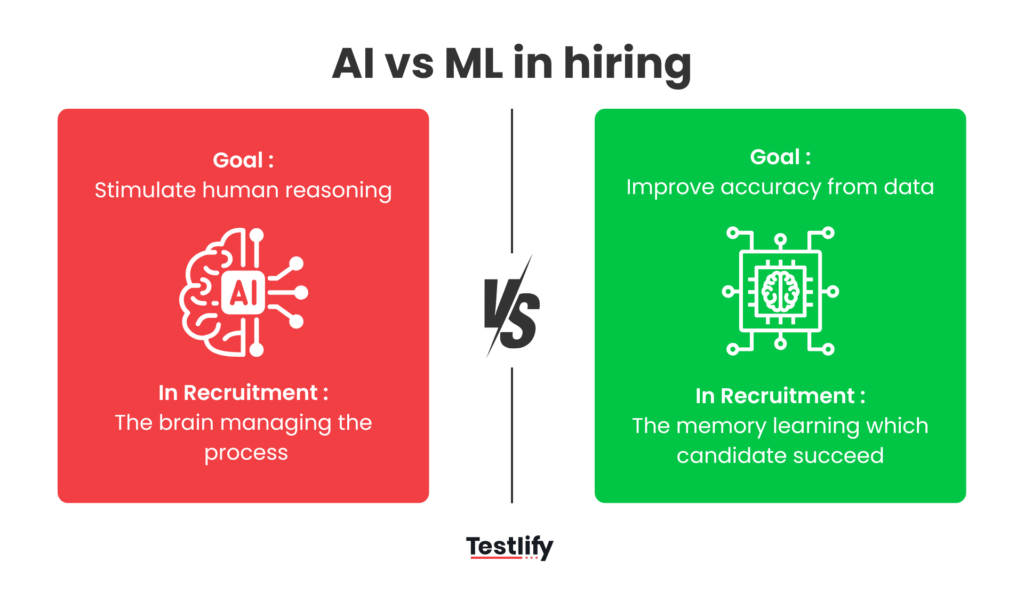
Feature | Artificial Intelligence (AI) | Machine Learning (ML) |
|---|---|---|
Goal | To simulate human intelligence and reasoning. | To learn from data to improve accuracy. |
Logic | Follow rules and patterns to make smart decisions. | Adjusts its own rules based on new information. |
In recruitment | The Brain that manages the whole process. | The memory that learns which candidates succeed. |
Why is AI important for recruiting in 2026?
If 2024 was the year of AI experimentation, 2026 is the year of AI integration. The importance of AI in today’s recruitment landscape goes down to three critical factors:
Resume inflation
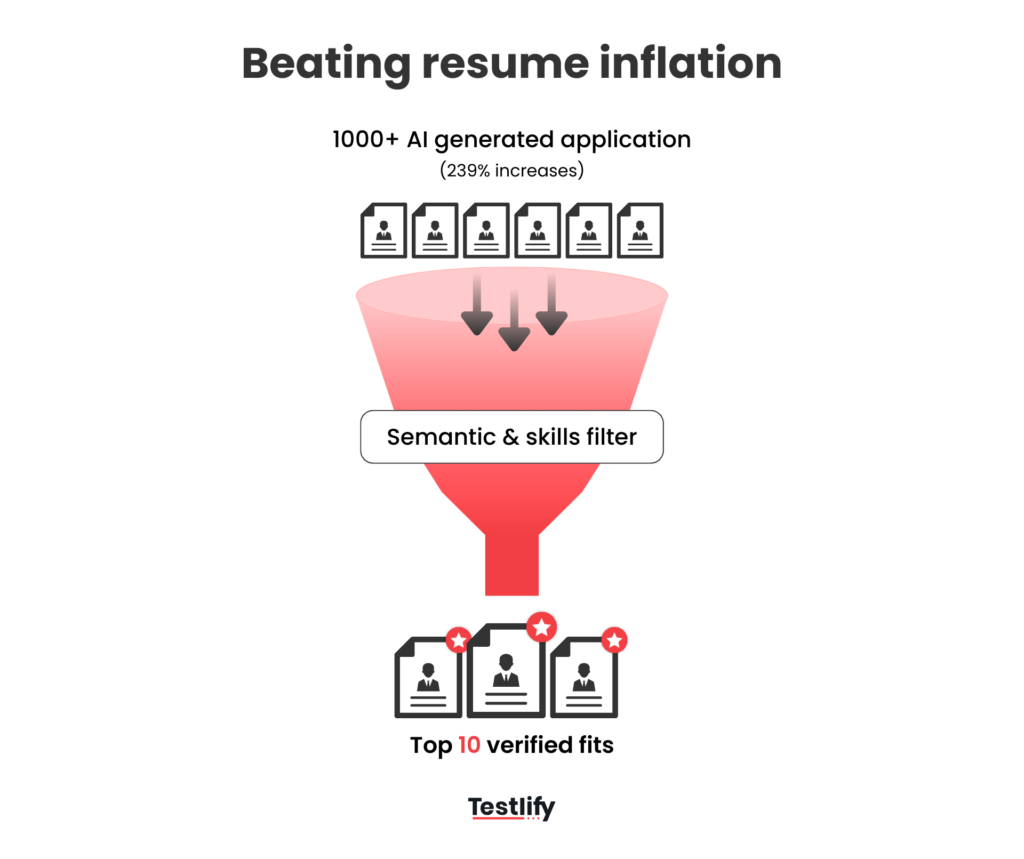
In 2026, nearly every candidate uses generative AI to create their resume. As a result, every application looks like a perfect 10/10 match on paper to the recruiters. Traditional keyword-based screening is not so useful nowadays.
Modern recruitment AI tools look past the text. They use semantic analysis and skills-based assessments to verify if a candidate actually has the talent. In practice, teams also need a way to compare how different models reason over the same candidate data before they rely on AI outputs in screening. Using a workspace that can compare AI models makes it easier to test consistency, cost, and output quality.
In practice, teams also need a way to compare how different models reason over the same candidate data before they rely on AI outputs in screening. Using a workspace that can compare AI models makes it easier to test consistency, cost, and output quality across hiring workflows.
Managing high-volume application
Because applying is so easy, applicant volume has skyrocketed. Recruiters are seeing 239% more applications per role than they did three years ago.
With AI in place, you can carry out instant shortlisting. You can filter 1,000+ applications down to the top 10 in minutes. In simple words, your AI recruiter can find talent while you focus on something more important.
Shifting to skills-first hiring
Degrees and job titles are becoming secondary. According to hiringlab, only about 17.8% of US job postings required a graduate degree or higher (down from 20.4% five years earlier). AI is the only way to map skill adjacencies. This opens up a 25% larger, more diverse talent pool that traditional hiring methods completely miss.
Companies using an AI-led strategy are seeing a 50%-75% reduction in time-to-hire and a significant boost in quality-of-hire.
Explore More: Benefits of AI in recruitment
What are the challenges of using AI in recruitment?
Implementing AI in recruitment is not without risks. As we move through 2026, three major challenges have taken center stage for HR leaders:
Trust & fairness risks
The trust gap is real. Candidates are increasingly skeptical of algorithms that reject them without explanation.
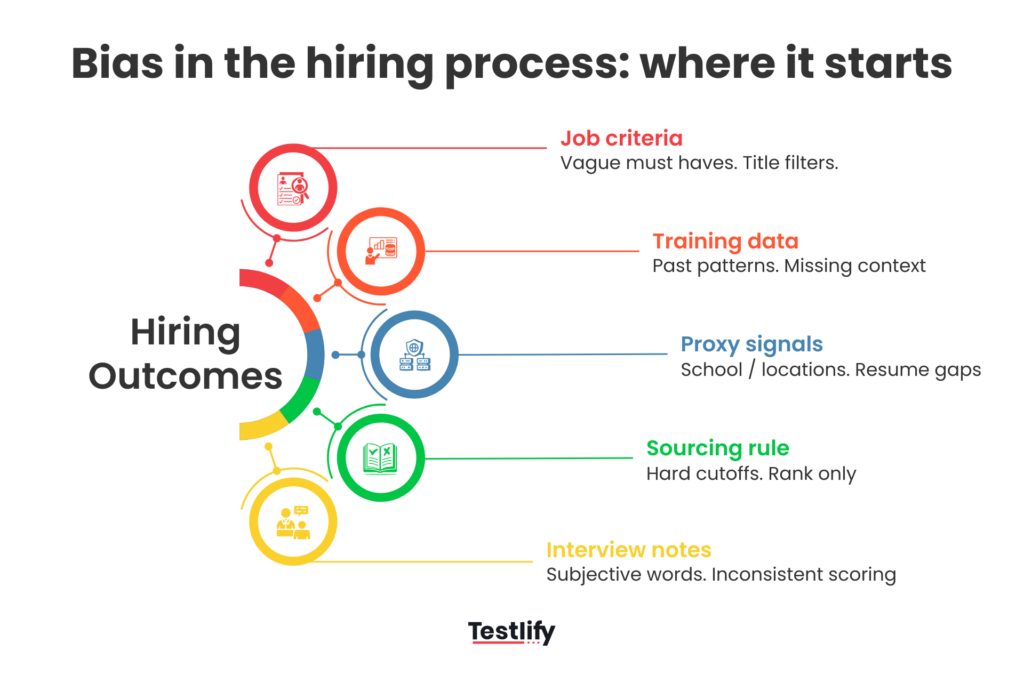
If an AI is trained on historical hiring data where only certain demographics were hired, it can repeat those patterns. This is how bias can show up. Some research suggests that some LLMs score candidates lower based on regional accents or cultural expressions, even if they are highly qualified.
Legal/compliance & documentation
If your AI tool is used to screen, rank, recommend, or make decisions, you may be expected to show how it works, how you assessed risk, and what you did to reduce bias.
- In New York City Department of Consumer and Worker Protection, Local Law 144 requires employers using automated employment decision tools to have an independent bias audit, publish a summary, and provide notices.
- Under the European Union AI Act framework, AI used in employment-related contexts is treated as high-risk in the Act’s high-risk use-case list, which comes with additional obligations.
Operational risks
- Over-automation makes hiring brittle: When teams automate too much too early, they end up rejecting good candidates for the wrong reasons. Recruiters then bypass the system, and adoption dies.
- Bad inputs create bad outputs: AI doesn’t fix messy job descriptions, unclear scorecards, inconsistent interview notes, or noisy resume data. It just scales whatever you feed it.
- Integration gaps turn AI into extra work: If the tool doesn’t integrate well with ATS, scheduling, assessments, or reporting, recruiters end up duplicating steps. That kills the ROI.
- Security and privacy risk expands with more tools: More vendors, more data flows, more access points. You need clear controls around data retention, access, and audit trails.
How is AI used in recruitment?
The use of AI in the recruitment process has evolved into a practical partnership between tech and human recruiters. Let’s explore some of the examples.
AI across the hiring workflow
AI now sits across the full recruitment process, but the best teams use it in a simple way: AI handles speed and consistency, human recruiters handle judgment. Here’s what that looks like stage by stage.
1. Job descriptions
AI has changed job descriptions from static text into a working blueprint. It can flag wording that pushes away certain job seekers, and it can suggest skills that reflect what the market is actually hiring for. The final version still needs human oversight, because the tool can’t fully understand your real expectations for success in the role.
Try Our New: Free Job Description Generator
2. Sourcing and talent pool building
Modern talent acquisition teams use AI to expand the talent pool beyond exact titles. Instead of filtering people out early, AI can surface candidates based on adjacent skills and real work patterns, which helps you find “hidden” fits that manual search often misses. This is useful only when humans control the rules, otherwise automation can drift into volume without relevance.
3. Screening and shortlisting
Resume screening is shifting from title-matching to meaning. Using natural language processing, AI can interpret experience in context and surface candidates based on what they’ve actually done. This reduces the risk of rejecting strong profiles because they don’t match a perfect keyword list.
Explore: AI Resume Screener | Automate Job-Fit Shortlisting
4. Skills evaluation
The biggest challenge now is that many profiles look perfect on paper. Candidates are using AI to polish resumes and sometimes even try to game evaluation steps, so verifying skills matters more than ever. This is where skills-based assessments become the backbone of improving candidate quality, because they give evidence that’s harder to fake.
Platforms like Testlify support this stage by helping teams assess role-relevant skills consistently, while keeping the decision with humans.
5. Interviewing
AI reduces administrative tasks that slow teams down, especially around coordination. When tools can schedule interviews quickly and keep feedback structured, recruiters get time back. They can probe deeper, validate claims, and assess communication and cultural fit.
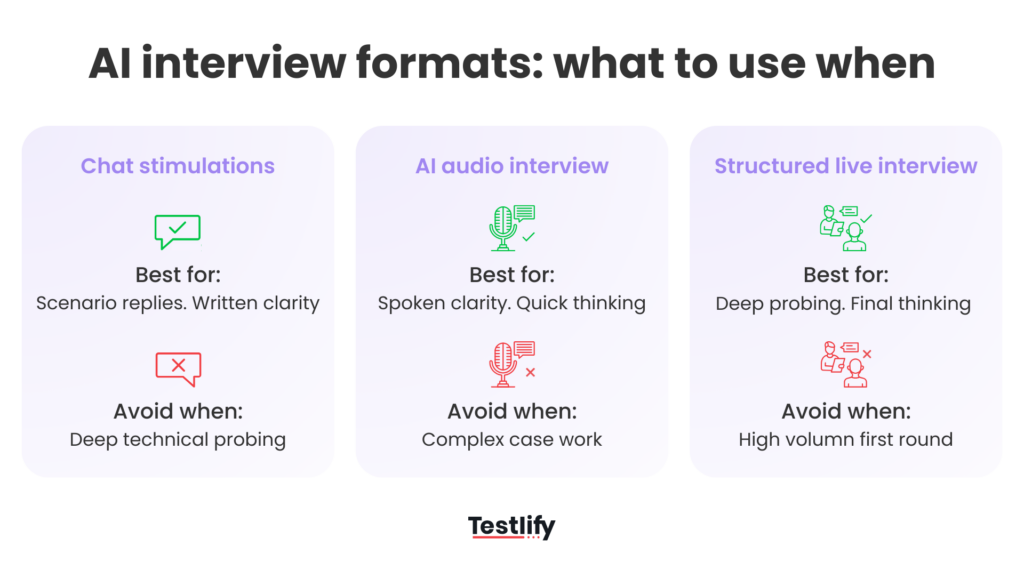
In 2026, this also includes AI interview formats like chat-based roleplays and chat simulations. It can also include AI audio interview rounds where candidates answer spoken prompts on the spot. These formats help you assess consistency and job-readiness at scale. But the final decision should stay with humans. Use the interview as structured evidence, not an automatic verdict.
6. Selection and decision support
At the selection stage, AI is most useful when it helps teams become more data driven without turning the process into a black box. It can compile indications from screening, assessments, and interviews into a consistent view, which makes decisions easier to compare.
It can also highlight patterns that may point to human biases and potential bias in the hiring process, giving human resources a chance to review and correct issues early. Final accountability still has to stay with humans.
7. Predictive analytics
Predictive analytics can help forecast bottlenecks, drop-offs, and time-to-hire issues by learning from how your pipeline behaves. Used carefully, it improves the process rather than predicting a person’s future. This is where guardrails and human oversight matter most, because the goal is operational clarity.
AI in recruitment (successful examples)
- Unilever: Uses AI interview to process high-volume applicants. Result? A 75% drop in time-to-hire and reduced cost-per-hire.
- L’Oreal: By implementing AI chatbots, L’Oréal transformed their candidate experience. The bots handle 24/7 engagement, providing instant responses and automated scheduling.
- Nestle: Automated their interview scheduling and FAQ handling. Result? They saved 8,000 hours of admin work per month.
What are the best AI recruitment tools in 2026?
In 2026, best usually doesn’t mean one tool that does everything. It means a stack that fits your hiring workflow, integrates cleanly with your ATS.
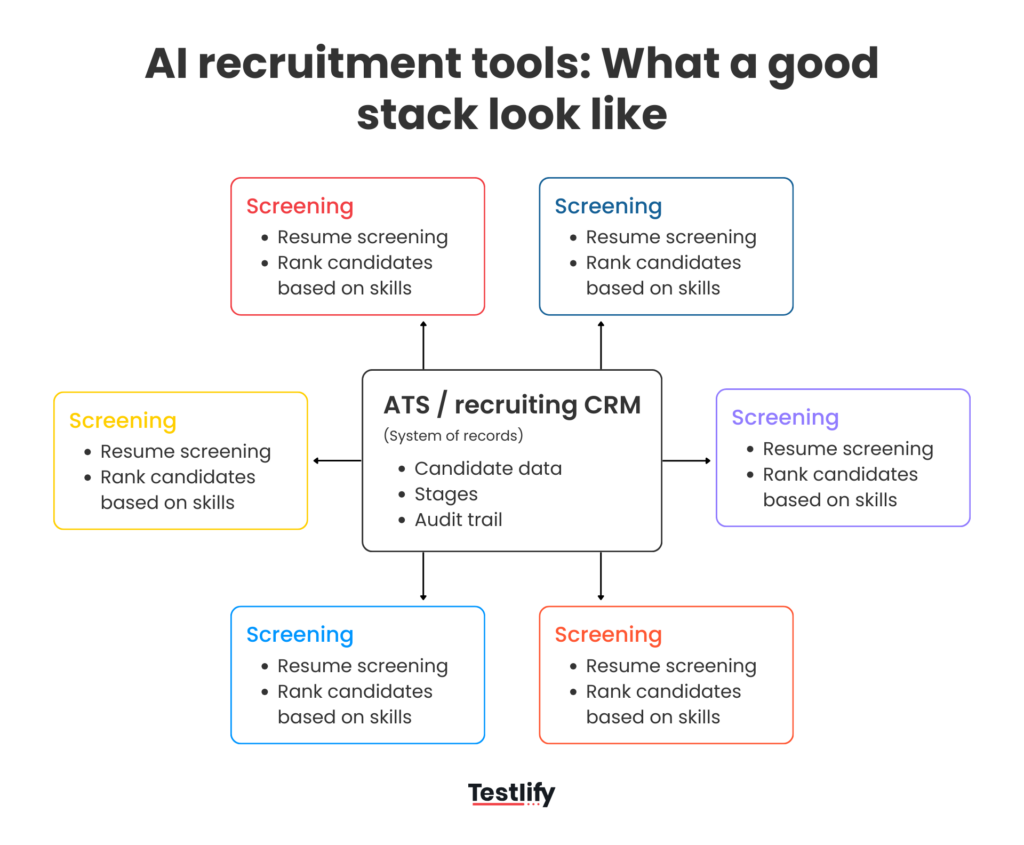
LinkedIn’s recruiting research points to a practical reality. Teams are already using GenAI to speed up everyday recruiting work, like writing job descriptions and other routine tasks. So tool choices need to balance productivity with safe use.
Tool categories that matter in 2026
Start with an ATS & recruiting CRM. This is where your candidate data, stages, and approvals live. If this foundation is messy, every AI feature on top becomes unreliable.
Next, use candidate engagement tools (chatbots or conversational AI) to reply faster, answer common questions, and reduce drop-offs. This category is becoming mainstream. For example, Workday acquiring Paradox shows how serious companies are about this.
Then, add sourcing and matching tools that go beyond exact job titles. These tools help you find candidates based on skills and related experience, so you build a better talent pool.
After that, focus on skills assessment and structured evaluation. Resumes are easy to polish now, so proof of skill matters more. This is where platforms like Testlify fit naturally, because they help you test job-relevant skills early and compare candidates in a consistent way.
Finally, use interview tools and analytics to keep hiring structured. Interview tools can support scorecards and formats like chat or audio screening. Analytics helps you track bottlenecks, drop-offs, and stage performance so you can improve over time.
How to choose the right tool
Start by being clear about what you want AI to do. The safest wins are usually workflow speed-ups (scheduling, follow-ups, summarization). The highest value wins usually come from better evaluation (skills evidence, structured interviews). If a tool can’t explain what it’s doing or why it made a recommendation, it becomes hard to trust and hard to scale.
Next, apply a responsible AI lens during selection. The NIST AI Risk Management Framework is a useful way to think about this: you’re not only buying features, you’re buying risk. You want tools that support transparency, monitoring, and clear accountability, so you can manage errors, bias, and drift over time.
Finally, treat procurement like due diligence. Use an AI-specific vendor checklist alongside your normal security review. OneTrust suggests adding AI-focused questions to existing vendor assessments (training data, model behavior, controls, and oversight), which is exactly what you need in hiring use cases.
A tool is right when it integrates into your workflow, improves decisions you can explain, and supports human oversight at the points where hiring outcomes are actually determined.
Recommended: AI recruitment platforms: Buyer’s guide
How to implement AI in recruitment: Step-by-step
Implementing AI in recruitment isn’t about buying a tool and switching it on. It’s about fixing the parts of your hiring workflow where time, effort, and quality are leaking, and then using AI to make those steps faster and more consistent, without losing human control.
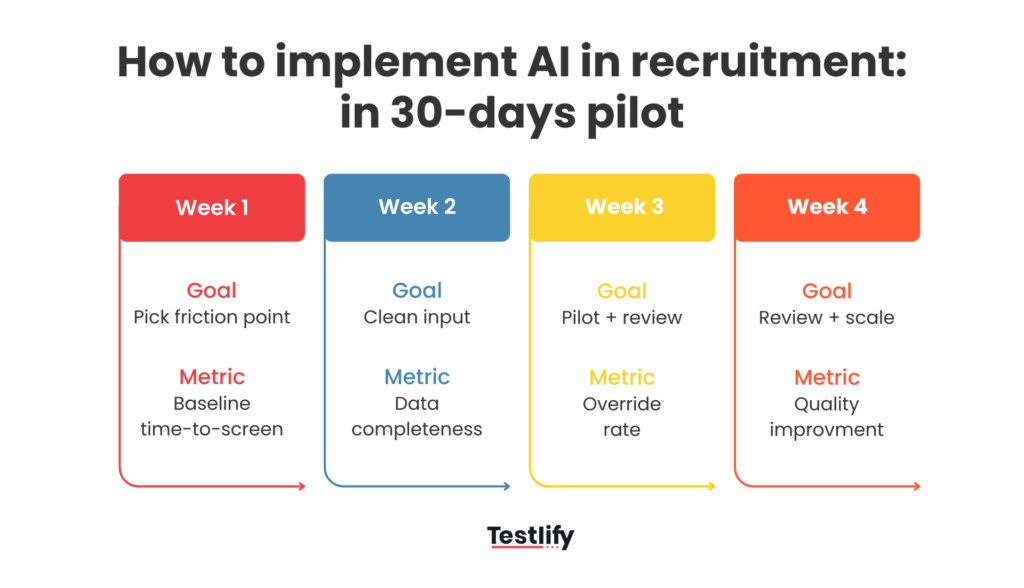
Step 1: Identify the friction points
Start by looking at your current recruitment process and asking one simple question: where are we wasting the most time, or losing the best candidates? For some teams, the problem is volume, too many low-quality applications that slow down screening.
For others, it’s admin work, endless back-and-forth to schedule interviews, follow-ups, and coordination. If you don’t know the biggest bottleneck, AI will just automate the wrong thing and you’ll still feel stuck.
Step 2: Fix your inputs first
AI is only as good as what you feed it. If your ATS is filled with outdated profiles, inconsistent job titles, or unclear role requirements, the tool will produce confident but unreliable outputs.
Before you connect any AI tool, clean up the basics: standardize job titles, define must-have skills, and make sure your evaluation criteria is written down. When “what good looks like” is clear, AI can actually support the workflow instead of adding noise.
Step 3: Choose tools you can explain
In 2026, black-box hiring is a bad idea. If a tool ranks candidates, you should be able to explain why. Not with vague promises, but with clear signals: what criteria it used, what it ignored, and whether there’s an audit trail for decisions.
During vendor evaluation, a simple test works well: ask the tool to justify why Candidate A is ranked above Candidate B. If it can’t give a clear, job-related reason, you’ll struggle to trust it internally and you’ll struggle to defend it externally.
Step 4: Run a small pilot with human review
Don’t roll AI across the whole funnel in one go. Pick one role, one team, or one department and pilot it with a “human-in-the-loop” setup. Let AI assist with shortlisting or evaluation signals, but keep the final review with recruiters and hiring managers.
Compare the AI shortlist with a manual shortlist for a few hiring cycles. You’re not looking for perfection. You’re checking whether it improves speed, consistency, and quality without filtering out strong candidates for the wrong reasons.
Step 5: Train your team and stay transparent
Even the best tool fails if the team doesn’t know how to use it. Recruiters need to understand what AI outputs mean, when to override them, and how to handle edge cases. Hiring managers also need alignment, otherwise they’ll treat an AI score like a final verdict.
At the same time, candidate trust matters more now because candidates know AI is involved. If AI is used in evaluation, be transparent about where it’s used and keep a clear path for human review.
Will AI in recruitment replace human recruiters?
AI will definitely change recruiting, but it won’t remove the need for human recruiters. In most companies, AI is becoming the engine that speeds up repetitive work like shortlisting support, interview scheduling, note summarization, and basic communication.
In 2026, the recruiter role shifts from doing everything manually to running a structured process with strong human oversight. The teams that win will use AI for speed, but keep humans responsible for fairness, final decisions, and the candidate experience.
Read more:Will AI in recruitment replace human recruiters?
Take the next step with Testlify
AI in recruitment is moving fast, but the teams that win in 2026 will be the ones that balance automation with clear oversight and skills-based decisions. Use this guide as your starting point, pick one workflow area to improve, and build from there with measurable outcomes.
If you want a clean, skills-first way to put this into action, book a demo and see how Testlify can support your hiring workflow.
Frequently asked questions (FAQs)

Related resources
View all
AI in recruitment
Best practices for hiring data analysts using assessments?

AI in recruitment
How to run role simulations through video interview prompts?

AI in recruitment
What tools offer AI-generated questions for custom assessments?

AI in recruitment
How does Testlify’s AI scoring handle open-ended answers and code quality?
AI in recruitment
How to use AI in recruiting using Testlify
AI in recruitment
AI recruitment platforms: Buyer’s guide
Get started.
Hire on proof, not resumes.
Run your first skills-based assessment free — no credit card required.