
HR policies and procedures: how to create and implement them
What HR policies and procedures are, the 12 core policies every company needs, and a 7-step process to write, roll out and review them.

HR policies and procedures are the written rules and step-by-step instructions an organization uses to manage its people. A policy states the rule and why it exists. A procedure explains how the rule is applied, by whom, in which order and with which records. Together they keep decisions on hiring, pay, leave, conduct and discipline fair, consistent and legal across every team and location.
TL;DR / Key Takeaways
- HR policies and procedures are an organization's written people rules (policies) and the steps for applying them (procedures), so every employee is treated the same way.
- A policy answers "what and why". A procedure answers "how, who and when". Keep them in separate sections so steps can change without rewriting the rule.
- Every company needs about 12 core policies: equal opportunity, anti-harassment, hiring, pay, leave, health and safety, conduct, discipline, remote work, data protection, IT and social media, and AI use.
- AI use is the most common gap in 2026: Gallup found only 30% of employees say their organization has guidelines or formal policies for AI use.
- Hiring policies now carry legal weight. NYC requires a yearly bias audit for automated hiring tools, and EU pay transparency rules require pay ranges before the interview.
- Build each policy in 7 steps: spot the need, research the law, draft in plain language, review with legal and employees, approve, communicate and train, then monitor.
- Review every policy at least once a year, and again whenever a law, a location, a tool or an incident changes the picture.
 ChatGPT
 Gemini
 Claude
 Grok
 Perplexity
What are HR policies and procedures?
HR policies and procedures are formal written statements that set out how an organization manages its relationship with employees, plus the steps HR, managers and staff follow to apply them. They set expectations for behavior, give consistent answers to common situations, explain employee rights and duties, and keep the company within employment law. Most organizations collect them in an employee handbook or a policy portal on the HRIS.
HR policies and procedures cover the whole employee lifecycle: recruitment and hiring, onboarding, pay and benefits, performance reviews, leave, conduct, discipline and termination. The purpose is a fair, predictable approach to people decisions that does not depend on which manager, office or country an employee sits in.

What is the difference between an HR policy and an HR procedure?
An HR policy defines the organization's position or rule: the "what" and the "why". An HR procedure defines the specific steps taken to apply that rule: the "how", "who" and "when". The policy rarely changes; the procedure changes whenever a form, system or approver changes.
Family leave shows the difference well. Under the US Family and Medical Leave Act, eligible employees can take up to 12 workweeks of job-protected leave in a 12-month period, and private employers with 50 or more employees are covered.
HR policy | HR procedure | |
|---|---|---|
Answers | What is the rule, and why? | How is it applied, by whom, and when? |
Leave example | Eligible employees may take up to 12 workweeks of family and medical leave a year | Employee gives 30 days' notice where possible, submits the request form, HR confirms eligibility within 5 business days, manager plans cover |
Written by | HR leadership with legal review | HR operations with the teams that run it |
Changes when | The law or company stance changes | A system, form or approver changes |
Lives in | Employee handbook | Process guide, HRIS workflow, manager toolkit |
Pro tip: Keep the policy and its procedure in separate sections of the same document. HR can then update a step, such as moving leave requests into the HRIS, without sending the whole policy back through legal approval.
Why are HR policies and procedures important?
HR policies and procedures matter because they replace case-by-case judgment with clear, shared rules. That protects employees from unfair treatment, protects the company from legal claims, and gives managers a consistent answer to the same question in every team.
Clarity is the first gain. According to Gallup's employee engagement data, only 49% of US employees said they know what is expected of them at work as of May 2026, and only 31% were engaged. Written policies are one of the simplest ways to close that gap.
- Clarity and consistency: Employees know what they should and should not do, what their managers expect, and how things work, wherever they sit in the company.
- Fair treatment and culture: Policies on inclusion, recognition and work-life balance show what the company values, and organizational culture follows what is written and enforced.
- Career growth: Policies on training, performance reviews and succession planning show employees how they can progress, which helps retention.
- Employee relations and trust: When people know their rights, duties and how to raise a concern, conflicts are handled earlier and more fairly.
- Legal protection: Consistent, documented decisions are far easier to defend than ones that differ from manager to manager.
What HR policies should every company have?
Every company should have a core set of written HR policies that cover equal opportunity, harassment, hiring, pay, leave, safety, conduct, discipline, remote work, data protection, technology use and AI. The table below lists 12 core policies, what each covers and the main law behind it in the US, UK and EU.
The legal stakes are real. The EEOC's fiscal year 2024 report shows 88,531 new discrimination charges, an increase of 9.2% on the year before. Clear, enforced policies on equal opportunity, harassment and retaliation are the first line of defense.
Policy | What it covers | Main legal driver |
|---|---|---|
Equal employment opportunity and anti-discrimination | Protected characteristics in hiring, pay, promotion and exit | Title VII and EEOC rules (US), Equality Act 2010 (UK), EU equal treatment law |
Anti-harassment and anti-retaliation | Definitions, reporting channels, investigations, protection for people who report | EEOC guidance (US), Equality Act 2010 (UK) |
Recruitment and hiring | Job ads, selection criteria, interviews, assessments, background checks, AI tools | EEO laws, NYC Local Law 144, EU pay transparency rules |
Compensation and benefits | How pay is set, bonuses, overtime, benefits eligibility | FLSA (US), state pay transparency laws, EU Directive 2023/970 |
Leave and time off | Vacation, sick leave, family leave, holidays, bereavement | FMLA (US), 5.6 weeks statutory holiday (UK), state sick leave laws |
Health and safety | Risk assessment, accident reporting, emergencies, workplace violence | OSHA (US), Health and Safety at Work Act 1974 (UK) |
Code of conduct and ethics | Honesty, conflicts of interest, gifts, nepotism, confidentiality | Good practice; required by some industry regulators |
Discipline and grievance | Warnings, investigations, appeals, termination | Acas Code of Practice (UK), at-will rules applied consistently (US) |
Remote and hybrid work | Eligibility, hours, equipment, working from another state or country | UK day-one right to request flexible working, local tax and labor rules |
Data protection and confidentiality | Employee and candidate data, retention, access rights | GDPR (EU and UK), CCPA (California) |
IT, social media and electronic communications | Acceptable use, monitoring, cyber security, personal accounts | NLRA Section 7 limits on restricting talk about pay and conditions (US) |
AI use | Approved tools, data that must never be entered, human review of AI output | EU AI Act, NYC Local Law 144 for hiring tools |
Depending on your industry and size, add policies on attendance and punctuality, drugs and alcohol, dress code, diversity and inclusion, travel and expenses, and exit and termination. In the US, many handbooks also open with an at-will employment statement. This table is a starting point, not legal advice: confirm the rules for each location with employment counsel.
What should a hiring and recruitment policy include?
A hiring and recruitment policy should include how roles are approved, how jobs are advertised, the selection criteria for each role, how candidates are assessed and interviewed, how background and reference checks work, and how hiring tools, including AI, are used and audited. The goal is that every candidate for the same role is judged on the same evidence.
Hiring is where policy meets the most legal and reputational risk, because every decision touches people outside the company. Two rules changed what a hiring policy must say:
- Automated hiring tools: Under New York City's Local Law 144, an automated employment decision tool can only be used if it had a bias audit within the past year, a summary of the results is public, and candidates get notice before it is used.
- Pay transparency: EU Directive 2023/970, which member states had to bring into national law by 7 June 2026, requires employers to share the starting pay or pay range before the interview and bans questions about pay history. Several US states have similar pay transparency laws.
A practical hiring policy also sets these rules:
- Approved roles and hiring plan: Every opening is tied to an approved hiring plan and a job description with the skills the role needs.
- Same criteria for every candidate: Selection criteria are written before sourcing starts, and the same skills test or work sample is used for every applicant to a role.
- Structured interviews: Interviewers use the same questions and a scorecard, as in structured interviews, which cuts the common types of hiring bias.
- Human review: A person reviews every rejection that an automated tool recommends.
- Records: Scores, notes and decisions are kept for the period local law requires.
Why does every company now need an AI use policy?
Every company now needs an AI use policy because employees already use AI tools at work, often without any rules. Gallup's 2025 research found that only 30% of employees say their organization has general guidelines or formal policies for AI use, while 44% say their organization has started integrating AI.
Gallup's study of AI at work also found that the share of US employees who use AI at work a few times a year or more nearly doubled in two years, from 21% to 40%. Use is outrunning the rules.
An AI use policy should cover:
- Approved tools: Which AI tools are allowed, and who approves new ones.
- Data rules: What must never be entered, such as candidate and employee personal data, pay data and client information.
- Human review: Any AI output used in a decision about a person, such as a hiring or performance decision, is checked by a person.
- Disclosure: When employees and candidates must be told that AI is used.
- Accountability: Who owns the policy and how breaches are reported.
How do you create HR policies and procedures?
HR policies and procedures are created in 7 steps: identify the need, research the law and good practice, draft the policy and procedure, review with stakeholders, get approval, communicate and train, and monitor and update. The same cycle works for one new policy or a full handbook rewrite.
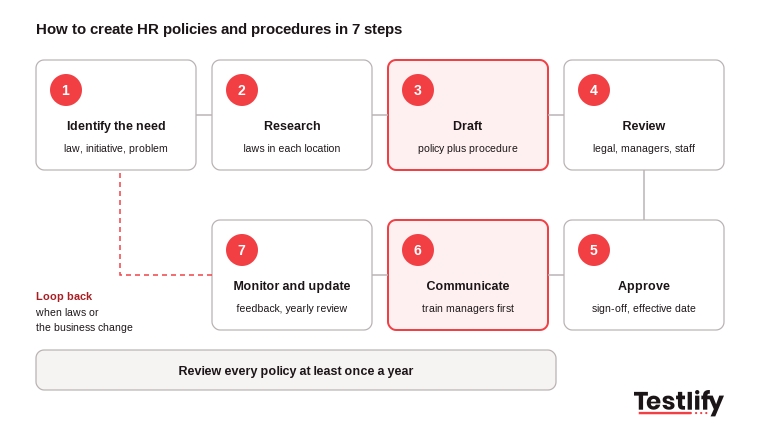
- Identify the need: A new law, a new business initiative, a new location or a problem such as repeated complaints shows that a policy is missing or out of date. Start with an assessment of organizational needs, industry standards, legal requirements and employee feedback.
- Research and analyze: Gather legal requirements for every location, good practice from bodies such as SHRM and CIPD, and the likely impact on employees and managers.
- Draft the policy and procedure: Define the purpose and scope, write in plain language, and set out the steps, owners and records. The next section lists what every policy document should include.
- Review with stakeholders: Ask legal counsel, HR business partners, managers and a group of employees (or employee representatives) to test the draft against real situations.
- Approve: Get sign-off from the decision makers named in your governance, and set a clear effective date.
- Communicate and train: Publish the policy, explain what changed, train managers first, and collect acknowledgements.
- Monitor and update: Track whether the policy is followed and achieves its goal, gather feedback, and review it on a fixed schedule.
Key takeaway: Involving employees in step 4 is not a courtesy. People follow rules they helped shape, and they spot situations HR did not think of.
What should an HR policy document include?
An HR policy document should include its purpose, scope, key definitions, the policy statement, the procedure, roles and responsibilities, links to related laws and policies, and version control. With all eight parts, an employee or manager can act on the policy without asking HR.
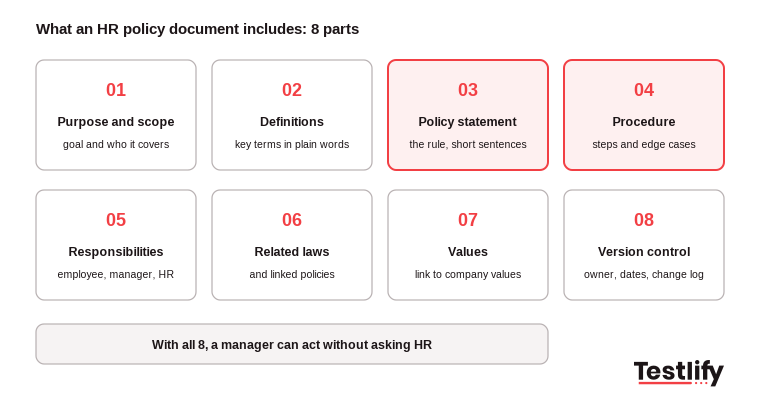
- Purpose and scope: The goal of the policy and who and what it applies to: which employees, contractors, locations and situations.
- Definitions: Key terms explained in plain words, with examples, so readers do not have to guess.
- Policy statement: The rule itself, in short, simple sentences. Avoid jargon, acronyms and legal language where you can.
- Procedure: The steps to follow, in order, using numbered lists and headings. Cover everyday situations and edge cases employees are likely to meet.
- Roles and responsibilities: What employees, managers and HR each must do, and what must be written down, reported and kept as records.
- Legal and related references: The laws and regulations the policy follows, and links to related policies. Ask legal counsel or HR experts to check them.
- Values: One or two lines linking the rule to the company's mission and values, such as respect, inclusion and fairness.
- Version control: Owner, approval date, effective date, next review date and a short change log.
Tie compliance-heavy policies to your wider HR compliance program so legal changes reach every affected document.
How do you implement and communicate HR policies?
HR policies are implemented by publishing them in one place, briefing managers before employees, training people on what changed, and recording that each employee has read and accepted them. A policy nobody knows about protects nobody.
- Written notice with an effective date: Announce new and changed policies in writing, and highlight the key changes rather than resending the whole handbook.
- One source of truth: Keep the current version in the employee handbook or HRIS, and remove old copies from shared drives.
- Manager briefings first: Managers answer most policy questions, so brief them before the announcement and give them a short FAQ.
- Training and support: Run short sessions or e-learning for policies with real risk, such as harassment, data protection and safety, and build them into the employee onboarding process.
- Acknowledgements: Ask employees to confirm receipt and keep the records. Most HRIS platforms can track this by policy and version.
- Many channels: Use the handbook, intranet, email, team meetings and translated versions for multilingual teams.
- Lead by example: Ask managers to model the rules, coach their teams, give feedback and thank people who follow them.
- Consistent enforcement: Apply the progressive discipline steps the same way for everyone. Selective enforcement creates legal risk and undermines the policy.
How often should HR policies and procedures be reviewed?
HR policies and procedures should be reviewed at least once a year, and again whenever a trigger event happens: a new law, a new location, a merger, a new tool, an incident or feedback that shows people are confused. A yearly review keeps every policy current; trigger reviews catch the changes that cannot wait.
Laws change faster than most handbooks. In the UK, for example, GOV.UK confirms that employees can now request flexible working from their first day in a job, so remote and hybrid work policies written before that change need an update.
Review trigger | What to check | Who leads |
|---|---|---|
Annual review | Every policy, effective dates, links and named owners | HR policy owner |
New law or regulation | Affected policies, such as pay transparency or sick leave | HR with legal counsel |
New state or country | Local leave, pay, working time and data rules | HR with local counsel |
Merger, acquisition or restructure | Conflicting handbooks, benefits and approval chains | HR leadership |
Incident or complaint | The policy involved and whether it was followed | HR, legal and the line manager |
New technology or AI tool | Data, monitoring and AI use rules | HR, IT and legal |
Employee feedback | Policies people find unclear or unfair | HR business partners |
An annual HR audit is a good moment to run the full review, using a list of common HR compliance landmines as the checklist. For flexible work rules in particular, see how to create a successful hybrid work policy.
Put fair hiring into your HR policies with Testlify
A hiring policy is only as fair as the screening behind it. Testlify gives hiring teams the tools to apply the same criteria to every candidate: 3,500+ skills tests, structured AI interviews that score every answer against the same rubric, 20+ proctoring checks, and reports that show the evidence behind each score. In June 2023, the Testlify matching model completed a third-party NYC Local Law 144 bias audit.
Browse the Testlify test library to find a test for your next role, or start a 7-day free trial with no credit card.
Frequently asked questions (FAQs)

Wordpress Developer
Yash Patel is a Wordpress and SEO Specialist at Testlify with 3+ years of experience in technical SEO, on-page optimization, and content strategy. He works on improving Testlify's organic presence and produces content focused on hiring, talent assessment, and HR technology.
LinkedInRelated resources
View all
HR & recruitment
Employee benefits package example: what to include in 2026

HR & recruitment
Why test English proficiency in hiring? 7 reasons for 2027

HR & recruitment
How to simplify candidate screening with English proficiency test

HR & recruitment
How English proficiency test help you screen candidates

HR & recruitment
How to hire top talent using English proficiency test

HR & recruitment
Leadership assessment: types, methods and how to use it in hiring
Get started.
Hire on proof, not resumes.
Run your first skills-based assessment free — no credit card required.