
Account executive hiring trends: 8 shifts for 2026
AE pay is splitting, AI fluency earns a premium and resumes no longer predict quota. Eight hiring shifts sales and TA teams should plan for.

Account executive hiring trends in 2026 point one way: companies want fewer, stronger sellers and they are checking skills before they pay for them. Pay for senior and AI-fluent account executives (AEs) is rising while entry-level pay softens, resumes matter less than proof of selling ability, and sales leaders now ask about ramp time and quota fit before they make an offer.
TL;DR:
- The biggest account executive hiring trends in 2026 are a pay split by seniority, a premium for AI fluency, skills-based screening, AI in recruiting, and closer checks on ramp time and quota.
- Betts Recruiting's 2026 guide puts target base pay at $90,000 for an AE with 0 to 3 years and $175,000 for an enterprise AE, with on-target earnings (OTE) about double the base.
- AEs with vertical AI experience now earn about 20% more than the standard rate, on top of a 10% premium for a technical background.
- Overall demand is flat, not booming: the BLS projects little or no change in wholesale and manufacturing sales jobs from 2025 to 2035, but still about 123,400 openings a year.
- A skills-based approach widens the US talent pool by about 15.9 times, according to LinkedIn's 2025 research.
- Test discovery, objection handling, written follow-up and CRM discipline before the final interview, and share quota and ramp facts with candidates up front.
 ChatGPT
 Gemini
 Claude
 Grok
 Perplexity
What are the biggest account executive hiring trends in 2026?
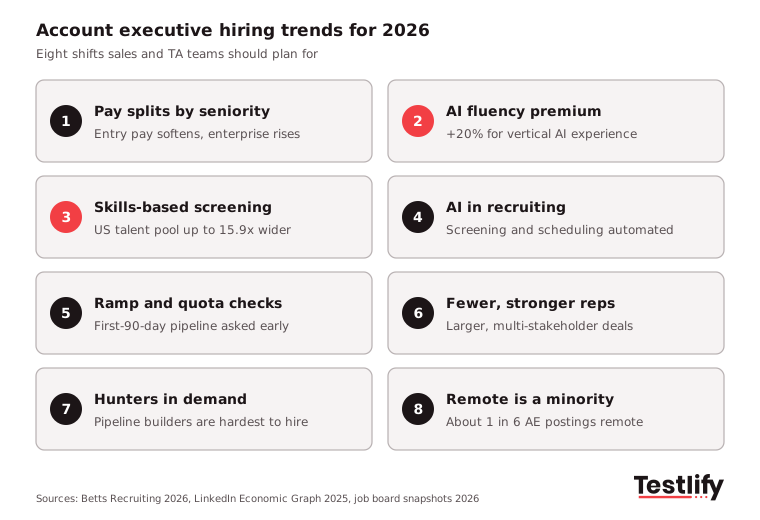
The biggest account executive hiring trends in 2026 are a pay gap between junior and senior AEs, extra pay for AI fluency, skills-based screening, AI-assisted recruiting, ramp and quota checks during hiring, fewer but stronger reps per team, steady demand for pipeline hunters, and remote roles concentrated at the senior and enterprise level.
Here is each trend in one line, with the section that covers it below:
- Pay splits by seniority: Entry-level AE pay is softening while mid-market and enterprise pay keeps rising.
- AI fluency earns a premium: Sellers who sell or use AI tools well cost more and are easier to justify.
- Skills-based screening replaces resume filters: Sales leaders test selling ability instead of trusting past titles and logos.
- AI runs more of the recruiting work: Resume screening, scheduling and first-round interviews are increasingly automated.
- Ramp and quota fit move into the interview: Teams ask how fast a hire reaches full quota before they extend an offer.
- Fewer, stronger reps: Teams are hiring fewer AEs who can run larger, multi-stakeholder deals.
- Hunters are in demand: New-business AEs who can build their own pipeline are the hardest seats to fill.
- Remote work settles into a minority model: Remote AE roles still exist, mostly for experienced sellers with a track record.

Is demand for account executives still growing?
Demand for account executives is steady rather than growing fast. Total sales jobs are flat, but turnover and expansion keep openings high, and companies compete hardest for experienced new-business sellers. The pressure is on quality: teams hire fewer AEs and expect each one to carry more pipeline.
The BLS Occupational Outlook for wholesale and manufacturing sales representatives projects little or no change in employment from 2025 to 2035 (about 1.57 million jobs), yet expects about 123,400 openings every year as people retire or change roles. Median pay was $76,460 in May 2025.
Recruiters see the same pattern from the inside. Talentfoot's 2026 hiring trends report says sales leadership was the largest category in its client searches (15.6% of searches from November 2025 to June 2026), and that hunter AEs are in demand because pipeline generation is the main limit on revenue. Flexa's 2026 sales jobs roundup links AE demand to companies moving toward fewer, higher-quality reps who handle larger deals.
The candidate side is moving too. Talentfoot cites Robert Half data from June 2026 showing 46% of US professionals plan to look for a new job in the second half of the year, up from 27% a year earlier. More AEs on the market means more applications per role, which makes fast, fair screening more important than sourcing volume.
How is account executive pay changing in 2026?
Account executive pay in 2026 is splitting by seniority. Entry-level base pay has softened, while mid-market and enterprise AE pay keeps rising, and premiums for technical and AI experience now stack on top. OTE is usually about twice the base salary, so offers are judged on both numbers.
Betts Recruiting's 2026 AE compensation guide, based on its own placement data, gives these targets:
AE level | Target base | Target OTE | What changed in 2026 |
|---|---|---|---|
AE, 0 to 3 years | $90,000 | $180,000 | Entry pay softened; remote roles start about $10,000 lower |
AE, 3 to 5 years | $115,000 | $230,000 | Location matters less; pay is flat across most regions |
Mid-market AE, 3 to 5 years | $125,000 | $250,000 | Base range of $110,000 to $150,000 in every region |
Enterprise AE, 5 to 10 years | $175,000 | $350,000 | Coastal markets still pay a floor up to $20,000 higher |
Three pay trends matter for hiring plans:
- Premiums stack: Betts adds about 10% for an established technical background and a new 20% for vertical AI experience. An enterprise AE with both can approach $230,000 base.
- Underpaying shrinks the pool: Betts reports that a $115,000 base for a 3 to 5 year AE reaches about 70% of the candidate pool with a 35-day time-to-hire. Offer less and the reachable pool drops to about 40%.
- Variable pay is changing shape: Some companies are testing team-based variable pay and pay tied to tracked sales activity alongside the classic OTE model.
Pro tip: Publish base and OTE as two separate numbers in the job post. Candidates compare both, and a vague "competitive OTE" line costs you the strongest applicants.
Why does AI fluency matter when hiring account executives?
AI fluency matters when hiring account executives because AI now handles much of the research, note-taking, forecasting and CRM updates that used to fill an AE's week. Sellers who use these tools well spend more time with buyers, so teams pay more for them and test for it during hiring.
Salesforce's State of Sales research says nine in 10 sales teams use AI agents or expect to within two years. That shifts what a good AE looks like: less manual prospecting, more judgment about which accounts to work, how to read a buying group and how to use AI output without sending generic messages.
AI fluency for an AE usually means four things:
- Research: Using AI to build account and stakeholder briefs before a first call, then checking them.
- Messaging: Drafting personalized outreach and follow-ups that still sound like the seller.
- Pipeline hygiene: Keeping CRM records and forecasts current with help from automation.
- Selling AI: For companies with AI products, explaining value, risk and data handling to buyers.
Hiring teams are adopting AI as well. SHRM's 2025 Talent Trends report found AI use in HR tasks rose to 43% in 2025 from 26% in 2024, and 69% of organizations still struggle to fill full-time roles.
Why are teams moving to skills-based AE hiring?
Teams are moving to skills-based AE hiring because past titles and company logos are weak signals of who will hit quota. Skills-based hiring screens candidates on discovery, objection handling, written communication and pipeline discipline, which widens the pool and gives sales leaders evidence instead of a gut feel from a resume.
The talent pool gain is large. LinkedIn's Economic Graph Skills-Based Hiring 2025 report found that hiring on skills rather than prior job titles expands talent pools by a median of 6.1 times globally and by 15.9 times in the United States. For AE roles, that pool includes customer success managers, sales engineers, account managers, recruiters and consultants who already sell every day.
A skills-based AE process changes three steps:
- The job post: Lists the selling skills and deal type (SMB, mid-market, enterprise) instead of "5+ years closing SaaS deals".
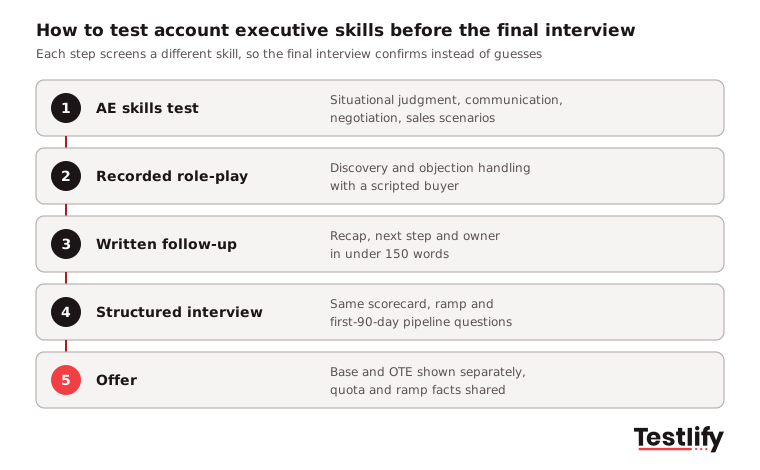
- The first screen: Uses a short, role-specific test instead of a resume filter, so career switchers and new-business sellers from other industries get a fair look.
- The interview: Uses a structured role-play and the same scorecard for every candidate.
Testlify's account executive test is built for that first screen.
What skills should you test in an account executive?
The skills to test in an account executive are discovery, objection handling, negotiation, written follow-up, pipeline and CRM discipline, commercial acumen and coachability. Each one shows up in real deals, and each can be measured before the final interview with a test, a role-play or a short work task.
The O*NET profile for sales representatives lists active listening, negotiation, persuasion and social perceptiveness among the core skills, and Salesforce CRM, Excel and PowerPoint as in-demand tools. Here is how to check each skill:
Skill | What good looks like | How to test it |
|---|---|---|
Discovery | Asks about the problem, impact and decision process before pitching | Role-play with a scripted buyer, scored on questions asked |
Objection handling | Acknowledges, asks why, answers with evidence | Situational questions or a short video response |
Negotiation | Trades value instead of dropping price | Scenario on a discount request with a fixed budget |
Written follow-up | Clear recap, next step and owner in under 150 words | Written task after the role-play |
Pipeline and CRM discipline | Accurate stages, close dates and next steps | Spreadsheet or CRM data task |
Commercial acumen | Understands margin, deal size and buyer ROI | Business case question |
Coachability | Changes approach after feedback | Second role-play after brief feedback |
For interview prompts, Testlify's list of account executive interview questions covers discovery, closing and pipeline questions with what to listen for.
How are ramp time and quota changing the hiring process?
Ramp time and quota are changing the hiring process because a slow-ramping AE costs months of salary before producing revenue. Sales leaders now ask during interviews how a candidate built pipeline in the first 90 days of past roles, and strong candidates ask about quota attainment and ramp plans before accepting.
Two practical changes follow from this:
- Ramp questions move earlier: Hiring managers ask for specifics on first-quarter pipeline, average deal cycle and the size of deals closed, not only for percent of quota.
- Quota transparency becomes a selling point: Experienced AEs want to know what share of the team hit quota last year, how long ramp is and whether there is a draw in the first months. Teams that share this up front lose fewer finalists late.
The work does not stop at the offer. Testlify's guide on how to reduce sales rep ramp time covers onboarding plans that use the same skills data from hiring to target coaching.
Pro tip: Ask every finalist for a written 30-60-90 day plan for your territory. It shows how they think about pipeline and gives your sales manager a ready-made onboarding baseline.
Are remote account executive roles still common?
Remote account executive roles are still common, but they are a minority and mostly go to experienced sellers. Many companies now prefer hybrid AEs near a hub for team selling and coaching, while fully remote seats are kept for enterprise or territory roles where travel matters more than an office.
Job aggregator snapshots from mid-2026 show roughly one in six AE postings listed as remote, and Betts reports remote AEs with 0 to 3 years start about $10,000 lower in base than office-based peers. Flexibility still helps recruiting: SHRM's 2025 Talent Trends report found organizations offering flexible work reported less trouble recruiting than those that did not (22% versus 29%).
For hiring teams, remote AE hiring raises the bar on screening. You cannot watch a remote candidate work a whiteboard, so recorded role-plays, written tasks and proctored tests carry more of the decision. Testlify's one-way and AI video interviews let every remote candidate answer the same sales questions in a consistent first round.
What should hiring teams do about account executive hiring trends?
Hiring teams should respond to these account executive hiring trends by setting pay to reach most of the pool, testing selling skills before interviews, checking AI fluency, sharing quota and ramp facts with candidates and keeping one scorecard across every interviewer. Each step shortens time-to-hire and lowers the risk of a costly mis-hire.
Trend | What to do this quarter |
|---|---|
Pay splits by seniority | Benchmark base and OTE by level and region; budget for the level you actually need |
AI fluency premium | Add one AI research or messaging task to the process and pay for it when it shows |
Skills-based screening | Replace resume filters with a short AE skills test as the first step |
AI in recruiting | Automate scheduling and first-round screening; keep a person on every rejection |
Ramp and quota checks | Ask for first-90-day pipeline examples; share your attainment and ramp facts |
Fewer, stronger reps | Score multi-stakeholder deal skills, not only call volume |
Hunter demand | Test prospecting and written outreach for new-business seats |
Remote as a minority | Use recorded role-plays and proctored tests for remote finalists |
For the full step-by-step process, from job description to offer, use the account executive hiring guide and the ready-to-edit account executive job description template.
How does Testlify help you hire account executives?
Testlify helps hiring teams screen account executives on skills before the first interview. Teams pick a role-based test from 3,500+ tests in the test library, or turn the job description into a custom assessment with the AI test builder, then invite candidates from their ATS.
- AE and sales tests: Role-specific tests such as the enterprise account executive test and the account executive B2B sales test, plus communication, situational judgment and personality tests.
- Interviews that sound like selling: One-way video and audio questions, and two-way Video AI, Voice AI and Chat AI interviews, so you can hear how a candidate handles an objection before booking a sales manager's time.
- Fair, comparable scores: Automated scoring, AI candidate insights with a per-skill breakdown and a ranked shortlist, all against the same criteria.
- Integrity checks: 20+ proctoring checks, including AI assistance detection and copy and paste tracking, which matters when candidates can paste AI-written answers.
- Fits your stack: Two-way sync with 100+ ATS and HRIS tools, and tests in 15+ languages for global sales teams.
Ready to hire account executives on proof?
Browse the account executive tests in the Testlify test library, or start a 7-day free trial with no credit card and send your first assessment today. Want to see it on your own sales roles first? Book a demo and we will walk through an AE hiring workflow with you.
Frequently asked questions (FAQs)
Related resources
View all
HR & recruitment
Top 7 recruitment trends in IT support specialist hiring

HR & recruitment
How to assess entry-level candidates with skills assessment

HR & recruitment
Top 7 recruitment trends in supply chain analyst hiring

HR & recruitment
Amazon hiring process: stages, timeline and lessons for HR teams

HR & recruitment
Case studies of companies that have successfully used coding assessments to hire top talent

HR & recruitment
Top 7 recruitment trends in customer service manager hiring
Get started.
Hire on proof, not resumes.
Run your first skills-based assessment free — no credit card required.