
Technical recruitment: a 2026 guide for hiring teams
How technical recruitment works in 2026: the process, the skills recruiters need, how to test candidates and 10 ways to hire engineers fast.

Your best engineering candidate has three offers and no reason to wait for yours. Most technical hiring loops still run as if the candidate has all the time in the world.
Technical recruitment is the process of finding, assessing and hiring people for specialist roles, from software engineers to security analysts. The work is harder than general recruiting because skills are hard to verify and the strongest candidates are rarely looking.
Get the process right and you fill roles faster with people who can do the work. This guide walks through each step, from intake to offer, plus 10 ways to hire engineers faster and more fairly.
TL;DR:
- Technical recruitment is sourcing, testing and hiring people for specialist tech roles, and the hard part is proving skills, not finding resumes.
- Demand keeps growing: US software developer, QA and tester jobs are projected to grow 10% from 2025 to 2035, with about 106,100 openings a year.
- Run a short loop: recruiter screen, a role-based skills test, one structured technical interview and a team conversation. Five or more rounds lose the best candidates.
- Test skills before any interview, so engineers only spend time on candidates who already cleared the bar.
- Publish the pay range, offer flexible work and source from referrals and technical communities, not only job boards.
- 84% of developers use or plan to use AI tools, so test how candidates use AI with judgment instead of pretending they do not.
- If you use AI to screen or score candidates, plan for a bias audit, candidate notice and human review.
 ChatGPT
 Gemini
 Claude
 Grok
 Perplexity
What is technical recruitment?
Technical recruitment, also called technical recruiting, tech recruitment or IT recruitment, is the work of locating, screening and evaluating candidates for roles where specific technical skills decide success. The goal is a qualified shortlist that matches the hiring manager's requirements, built on proof of skill rather than job titles.
Technical jobs are most common in IT, software and engineering, but they are not limited to those sectors. Banks hire data engineers, hospitals hire systems administrators and retailers hire cloud architects.
Typical roles include:
- Software engineering: front-end, back-end, full-stack and mobile developers.
- Data and AI: data engineers, data scientists, machine learning engineers.
- Infrastructure: cloud, DevOps, site reliability and systems engineers.
- Security and quality: cybersecurity analysts, QA engineers and testers.
- IT and technical support: support engineers, network and systems administrators.

How is technical recruitment different from general recruiting?
Technical recruitment differs from general recruiting in four ways: skills are harder to judge from a resume, the recruiter needs working knowledge of the tech stack, interviews involve engineers and take more hours, and strong candidates are usually employed and choosy. Volume of applicants matters less than the share who can actually do the work.
Area | General recruiting | Technical recruitment |
|---|---|---|
What decides a hire | Experience, motivation, fit | Proven skill in a specific stack, plus fit |
How skills are checked | Interview and references | Skills tests, coding tasks, technical interviews |
Who is involved | Recruiter and hiring manager | Recruiter, hiring manager and engineers |
Where candidates are | Job boards, active seekers | Referrals, GitHub, Stack Overflow, communities, passive candidates |
Main risk | Slow process | Mis-hire on skills, losing candidates to faster offers |
Job titles | Fairly consistent | Inconsistent across companies, so titles mislead |
What does a technical recruiter do?
A technical recruiter is a member of the talent acquisition team who specializes in technology hiring. Technical recruiters plan the search, write the job requirements with the hiring manager, source and engage candidates, run screens and assessments, coordinate technical interviews and close offers.
A technical background helps, but a strong working knowledge of the technology is enough.
In general, technical recruiters are in charge of:
- Creating a plan for each technical role and the team's hiring pipeline.
- Finding new ways to reach and engage technical talent, including passive candidates.
- Writing job descriptions and requirements for specialist roles.
- Running skills assessments and recruiter screens.
- Working with hiring managers and engineers so screening is thorough and fair.
- Negotiating offers and keeping candidates warm until day one.
Two skills set the best technical recruiters apart:
- Technical literacy: Recruiters do not need to write code, but they need to know the tools of the trade, the difference between a front-end and a back-end role, and which skills are must-haves. Without it, they cannot judge a resume or talk credibly to an engineer.
- People skills: Listening, building rapport, solving problems and reading what candidates expect from the company. Good recruiters also feed what they hear back into the employer brand and retention plans.
Recruiters and engineers should not judge the same things. Splitting the decisions protects engineering time and keeps every stage useful:
Recruiter screens for | Engineers judge |
|---|---|
Motivation, pay and location fit | Depth in the core stack |
Communication and clarity | System design and trade-offs |
Basic skill threshold from a skills test | Code quality and problem-solving approach |
Notice period and competing offers | Seniority, through the decisions they explain |
If you recruit for technical roles without a technical background, our guide on how to interview a software developer as a non-tech recruiter covers the questions to ask, and the recruiter cheat sheet for assessing technical roles lists what to check for each role.
How does the technical recruitment process work?
The technical recruitment process is a repeatable sequence that takes a role from agreed need to accepted offer. Each stage has one job, and the order matters: testing skills before interviews means engineers only meet candidates who already cleared the bar.
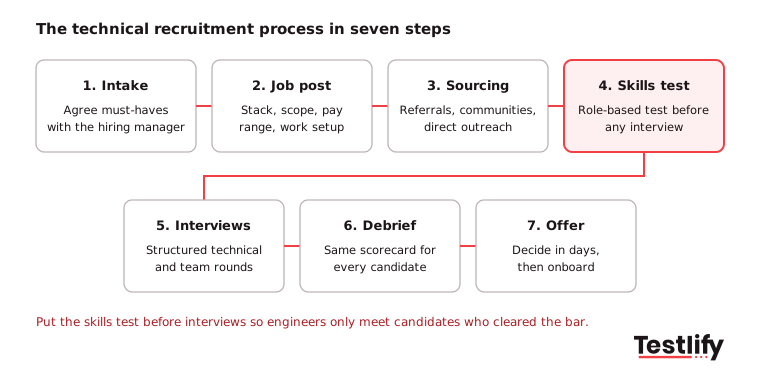
Work through the each of the seven steps in this order:
- Intake: Sit down with the hiring manager before you search. Agree on must-haves, nice-to-haves and deal-breakers, the business outcome behind the role, and the terms they use for the job.
- Job post: Write what candidates want to know: the stack and tools, the problems they will own, how much control they have over projects, the team, the pay range and the work setup.
- Sourcing: Combine referrals, technical communities, direct outreach and job boards. The strongest candidates are usually employed, so most of them will not apply on their own.
- Skills test: Send a role-based assessment before any interview. It verifies what the resume claims and cuts mis-hires.
- Interviews: Run a structured technical interview with a rubric, then a team conversation. Use the same questions for every candidate in the role.
- Debrief: Compare candidates against one scorecard, not against each other's personalities.
- Offer: Decide in days, not weeks. Close on pay, scope and growth, then hand over to onboarding.
Pro tip: Build requirements from the work the role must do in the next 12 months, not from the profile of the person who last held it. A backward-looking profile can include skills the role no longer needs and miss ones it now does.
Why is technical recruitment so hard right now?
Technical recruitment is hard because demand for specialist skills keeps rising while most teams still struggle to fill roles, and the skills themselves change fast. The US Bureau of Labor Statistics projects employment of software developers, QA analysts and testers to grow 10% from 2025 to 2035, with about 106,100 openings each year and a median pay of $134,040 in 2025.
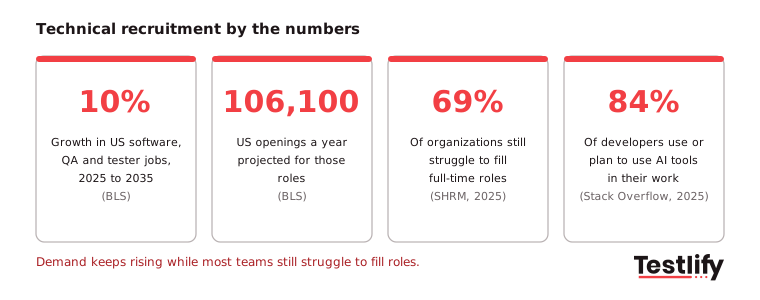
The difficulty shows up in surveys too. Robert Half's 2026 research on technology teams found that 69% of large enterprise and 60% of smaller company tech leaders say hiring is more challenging than a year ago, and 79% of large enterprise leaders report a skills gap in their department.
The main challenges are:
- Specialist supply: AI engineering, cloud architecture, data infrastructure and security are under-supplied. Requirements written too broadly attract the wrong people; written too narrowly, they rule out capable candidates.
- Screening difficulty: A resume cannot prove someone can design a system or debug production code. Without a skills check, interviews carry all the weight.
- Fast-changing skills: Tools and frameworks change every few years, so hiring only on today's exact keyword match leaves teams with gaps soon after.
- Speed: Strong candidates field competing outreach constantly. A slow loop selects for the people with the fewest options.
- Competition on pay: In-demand roles command high salaries, and elite candidates use competing offers as negotiating chips.
Key takeaway: Most of the difficulty sits in the process, not the market: credential filters that drop capable people, slow reviews, and unstructured interviews that produce inconsistent signals. Each one can be fixed.
What strategies improve technical recruitment?
The strategies that improve technical recruitment most are skills-based screening, a short and structured interview loop, transparent pay, flexible work, strong referrals and sourcing from technical channels. None works alone.
Teams that combine skills testing with clear pay and a fast loop fill roles faster and lose fewer candidates late.
1. Align with the hiring manager before you search
The hiring manager is your best source for the skills and terms that should guide the search. Agree on the profile before you write a word of the job post, and use their language when you describe the role.
Close alignment speeds the process and improves quality of hire.
2. Hire for skills, not credentials
Drop degree and years-of-experience requirements that do not connect to a measurable outcome in the role. Replace them with a skills threshold candidates can demonstrate in a test.
This widens the qualified pool and brings in people from bootcamps, self-taught paths and adjacent roles.
3. Assess soft skills as well as technical skills
Technical ability is not the only thing that counts. Engineers also need to document their work, collaborate toward a shared goal and explain technical limits in business terms.
Test communication and teamwork alongside the stack, especially for senior individual contributors and technical leads.
4. Treat flexible work as the default offer
Offer remote or hybrid work unless the job truly needs someone on site. SHRM's 2025 Talent Trends research found organizations with flexible work arrangements report less trouble recruiting than those without (22% versus 29%), while 69% of organizations still struggle to fill full-time roles.
5. Build an employer brand engineers can verify
Technical candidates check before they apply: review sites, public engineering work, the team they would join and the scope of the problems. Make that work visible through engineering blogs, open-source contributions and talks.
Your hiring process is also a brand signal, because technical communities are small and candidates share bad experiences. See our employer branding glossary entry for the basics.
6. Shorten the interview loop
A five-stage process over six weeks is a filter for candidates with few options. A competitive loop has four steps: a recruiter screen (30 minutes), a role-based skills assessment (30 to 45 minutes, taken on the candidate's schedule), a structured technical interview (60 to 90 minutes) and a team conversation (45 minutes).
Remove any stage that repeats what an earlier one already established. Our guide to structured vs unstructured interviews shows how to score each round.
7. Publish pay ranges and career paths
Pay transparency filters out candidates who are not aligned before the process starts, and those who are aligned convert at higher rates because there is no late surprise. Show career progression next to pay: strong engineers weigh access to harder problems and a clear path to seniority as carefully as base salary.
Be ready to negotiate with the candidate, the hiring manager and leadership on a package that works for everyone.
8. Run a structured employee referral program
Engineers refer people they have worked with, which carries a quality signal no job board can match. A good employee referral program says which roles are open for referrals, gives referrers feedback within 5 business days and pays a real incentive.
Reach beyond your current team's networks through community groups and professional associations, or referrals will copy your team's existing makeup.
9. Source from technical channels and hire proactively
The best technical people are usually employed. Build a list of strong prospects and contact them directly with specifics about the role, the team and the pay.
GitHub and open-source records show real work, Stack Overflow shows people solving problems in public, and meetups, conference speaker lists and technical Slack groups surface people who share knowledge. For more channels, see our talent sourcing strategies guide.
Sourcing channel | Signal quality | Speed to a qualified candidate | Cost |
|---|---|---|---|
Generic job boards | Low | Slow | Low per post, high per qualified hire |
Technical communities (GitHub, Stack Overflow) | High | Medium | Low |
Direct outreach to passive candidates | High | Medium | Medium |
Employee referrals | Very high | Fast | Low (referral bonus) |
Internal mobility | High | Fast | Lowest |
Do not skip internal mobility. Where the underlying aptitude is there, an employee can often learn the domain in 6 to 12 months and tends to settle in faster than an external hire.
10. Make the funnel fair by design
Remove names, schools and past employers from early screening where you can, and let skills test results do the first cut. Audit each requirement in the job description for a real link to performance.
Put interviewers from adjacent teams, such as product, data or design, on panels alongside engineers, and score every round against a written rubric.
How should you assess technical skills?
Technical skills are best assessed with a short, role-based test before interviews, followed by a structured technical interview that probes how the candidate thinks. Match the format to the job: coding tasks for developers, scenario questions for support and security, and work samples for senior roles.
Keep it proportional, as a 30 to 45 minute test is enough to screen.
Role | Useful assessment | What it shows |
|---|---|---|
Software developer | Coding test in a live IDE, then a code review conversation | Code quality, problem-solving, debugging |
Data engineer or scientist | SQL and Python tasks on a realistic dataset | Data handling, logic, communication of results |
DevOps or cloud engineer | Scenario questions on deployment and incidents | Systems thinking, trade-offs |
QA engineer | Test-case design for a given feature | Coverage thinking, attention to detail |
IT support | Troubleshooting scenarios and a typing test | Diagnosis, customer communication |
Any technical role | Communication or situational judgment test | Teamwork, clarity, judgment |
AI tools are now part of how engineers work. The Stack Overflow Developer Survey 2025 found 84% of developers use or plan to use AI tools, 51% of professional developers use them daily, and more developers distrust the accuracy of AI output (46%) than trust it (33%).
So test judgment: ask candidates how they use AI, which tasks it is weak at and how they check its output before it ships.
Good technical interview questions test approach as well as knowledge:
- How do you approach a task you are not sure how to solve?
- What was the hardest project you have worked on, and how did you get past the blockers?
- Which languages and tools have you used in production, and what would you pick for this problem?
- Walk me through a bug you could not reproduce at first. What did you try?
Testlify gives technical recruitment teams 3,500+ tests, including coding tests in a live IDE that supports 45+ coding languages, plus 20+ proctoring checks such as AI assistance detection and copy-paste tracking. Results sync to your ATS through 100+ integrations.
For a deeper look at screening, read our guide to technical screening.
Which technical recruitment metrics should you track?
Technical recruitment metrics should show speed, quality and candidate experience together, because any single number can mislead. Track time to hire, stage conversion, offer acceptance and early retention, and review them per role and per hiring manager.
Use speed as a warning signal, not a target to hit at the cost of quality.
Metric | What it measures | What a weak reading usually means |
|---|---|---|
Days from first contact to accepted offer | Slow reviews, too many rounds, scheduling gaps | |
Time to shortlist | Days from opening to a ranked shortlist | Weak sourcing or no early skills test |
Stage conversion rate | Share of candidates moving from each stage to the next | Poor targeting, a test that is too hard, or drop-off from slow follow-up |
Offer acceptance rate | Accepted offers divided by offers made | Pay misalignment, delays or a weak employer brand |
Quality of hire | Performance and manager rating after 6 to 12 months | Wrong requirements or unstructured interviews |
90-day retention | New hires still in role after 90 days | Role or expectation mismatch |
Candidate satisfaction | Survey score after the process | Poor communication, long silences |
Should you use a technical recruitment agency or hire in-house?
A technical recruitment agency makes sense for rare skills, one-off senior searches or a sudden spike in roles, while an in-house team is better for steady, repeat hiring where process knowledge builds up. Many teams use both: in-house for core roles, an agency or interview partner for the hardest searches.
- In-house works best when: you hire for the same roles every quarter, want to own the employer brand and candidate data, and can invest in recruiter training and tools.
- An agency works best when: the skill is scarce, you need reach in a new market, or the role is too senior or too urgent for your current team.
- A hybrid works when: your recruiters run sourcing and screening, and outside experts run technical interviews. Testlify's Interview-as-a-Service, for example, gives access to 1,500+ vetted domain-expert interviewers.
Compare the total effort, not only the fee: internal recruiter time, engineer interview hours and the cost of a role sitting open.
What rules apply to AI tools in technical recruitment?
AI tools in technical recruitment fall under hiring and anti-discrimination rules like any other selection method. In New York City, Local Law 144 bars employers from using an automated employment decision tool unless it had a bias audit within the past year and candidates get notice, and it has been enforced since July 5, 2023.
Practical steps for any team using AI to screen, score or rank technical candidates:
- Ask vendors for audits: Request the latest bias audit and how the tool was tested. Testlify publishes a third-party NYC Local Law 144 bias audit of its Matching Model, completed June 16, 2023.
- Tell candidates: Explain where AI is used, what it scores and how to request an alternative where the law requires one.
- Keep a human in the loop: Let AI rank and summarize, but have a person review scores and make the hiring decision.
- Log decisions: Keep scores, rubrics and reviewer notes so each shortlisting decision can be explained later.
Ready to make technical recruitment faster and fairer?
Technical recruitment gets easier when every candidate proves their skills before the first interview. Browse the Testlify test library to find role-based tests for your open technical roles, or start a 7-day free trial with no credit card and build your first assessment from a job description.
Prefer a guided walkthrough? Book a demo to see how Testlify fits your technical hiring process.
Frequently asked questions (FAQs)

Director of Marketing
Akash Patange is the Director of Marketing at Testlify, where he works closely with HR leaders and recruiters to help organizations improve hiring outcomes. He writes about talent assessment, recruitment technology, and data-driven hiring practices.
LinkedInRelated resources
View all
HR & recruitment
A complete guide to remote hiring

HR & recruitment
8 Effective strategies for managing a global team

HR & recruitment
Addressing unconscious bias in hiring: strategies for overcoming

HR & recruitment
8 ways to improve quality of hire to build a high-performing team

HR & recruitment
How to recruit for small businesses: 9 steps

HR & recruitment
6 workplace inclusion strategies to build a better work environment
Get started.
Hire on proof, not resumes.
Run your first skills-based assessment free — no credit card required.