
What’s hot in HR lingo: 2026’s HR buzzwords explained
Discover the HR lingo of 2026, what they mean, and how to apply them to drive strategy, retention, and innovation in your organization.

HR buzzwords are the short labels HR teams use for real shifts in how people get hired, managed, and kept. Quiet cracking, agentic AI, conscious unbossing, skills-based everything. Some name a change worth budgeting for. Others repackage a problem HR has been fighting for decades.
Telling those two apart is the actual skill, and most HR teams already know it. When McLean and Company asked HR professionals how they feel about hearing a new buzzword, most said they felt cautious or uninterested rather than excited. Caution is the majority position, and it is the right one.
So this is not a list of terms to sprinkle into a board deck. It is a translation guide: what each term means in plain English, whether it describes anything new, and what a People team should do about it before the quarter ends.
 ChatGPT
 Gemini
 Claude
 Grok
Grok Perplexity
TL;DR
- Buzzwords are shorthand for workforce shifts. Roughly half of them describe something genuinely new, and the rest rename an old problem.
- The 2026 vocabulary clusters into three groups: AI at work, quiet disengagement, and skills replacing credentials.
- Complaint language is a separate category with legal weight. Words like harassment, discrimination, and retaliation oblige an employer to act, whatever the buzzword of the month is.
- Test a term with one question: does adopting it change a decision we make? If not, it is vocabulary, not strategy.
- The durable answer to every skills buzzword is the same. Measure what candidates can do, keep the evidence, and let people make the call.

What are HR buzzwords?
HR buzzwords are trending terms that describe workplace behavior, hiring practice, or people strategy in a compact phrase. They spread through social platforms, vendor content, and analyst reports, usually faster than the evidence behind them. A buzzword is useful when it gives a team shared language for something real, and harmful when it becomes a project on its own.
The word itself carries a sneer, and that is a bit unfair. Every profession compresses complex ideas into shorthand. The problem is not the shorthand. It is adopting the shorthand and skipping the diagnosis underneath it.
Why do HR buzzwords matter?
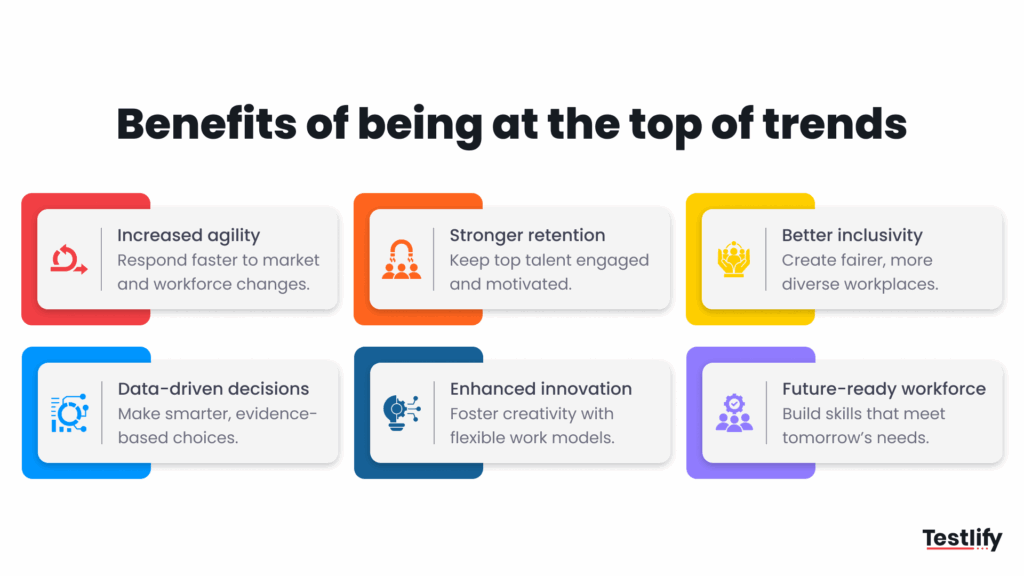
HR buzzwords matter because language shapes how organizations understand and respond to workplace changes. Terms like quiet cracking, copilot culture, and skills-based hiring give HR leaders a way to name emerging patterns that may otherwise be difficult to see or discuss. But the value of a buzzword depends on whether it helps explain a real shift or simply gives an old idea a new label.
A useful HR buzzword should sharpen the conversation, not replace it. Quiet cracking, for example, draws attention to employees who are struggling to stay engaged or productive without necessarily leaving the organization. Copilot culture reflects a broader shift in how employees work alongside AI, raising questions about productivity, skills, accountability, and job design. Skills-based hiring challenges organizations to look beyond traditional credentials and evaluate what candidates can actually do.
The real test for HR leaders is what happens after the buzzword. Skills-based hiring means little if companies continue screening candidates primarily by degrees and years of experience. Copilot culture is not simply giving employees access to AI tools; it requires organizations to rethink workflows, expectations, and the skills people need to succeed. And quiet cracking should prompt leaders to examine what is causing employees to disengage rather than treating the label as the problem itself.
That distinction matters because workplace language moves faster than workplace reality. The best HR leaders don't adopt every new term they encounter. They ask a more important question: What is changing beneath the buzzword, and what should we do differently because of it?
What do HR buzzwords really mean?
Here is the translation table. The third column is the one that matters: plenty of 2026's vocabulary is a rename, and a rename does not need a budget line.
Buzzword | Plain English | New or repackaged? | What to do about it |
|---|---|---|---|
Quiet cracking | Staff who stay but slowly stop caring | Repackaged burnout and disengagement | Look at your existing engagement and exit data before buying anything |
Agentic AI | AI that completes multi-step tasks, not just answers questions | New | Decide which workflows an agent may touch, and who signs off |
Copilot culture | Staff using personal AI tools alongside approved ones | New in scale, old in shape (shadow IT) | Write an AI use policy people can actually follow |
AI-washing | Calling ordinary automation "AI" to sell it | New | Ask any vendor what the model does that a rule could not |
Skills-based everything | Hiring, paying, and promoting on demonstrated skill | Real shift, slow adoption | Start with two high-volume roles, not a company-wide rollout |
Conscious unbossing | Capable people declining the management track | New name, growing behavior | Build a senior individual-contributor ladder with real pay |
Career catfishing | A candidate accepts an offer, then never appears | New name, old ghosting problem | Shorten offer-to-start and keep contact warm in between |
Anti-perks | Benefits that quietly make work worse | Repackaged | Ask what people actually use, then cut the rest |
What HR lingo is hot right now?
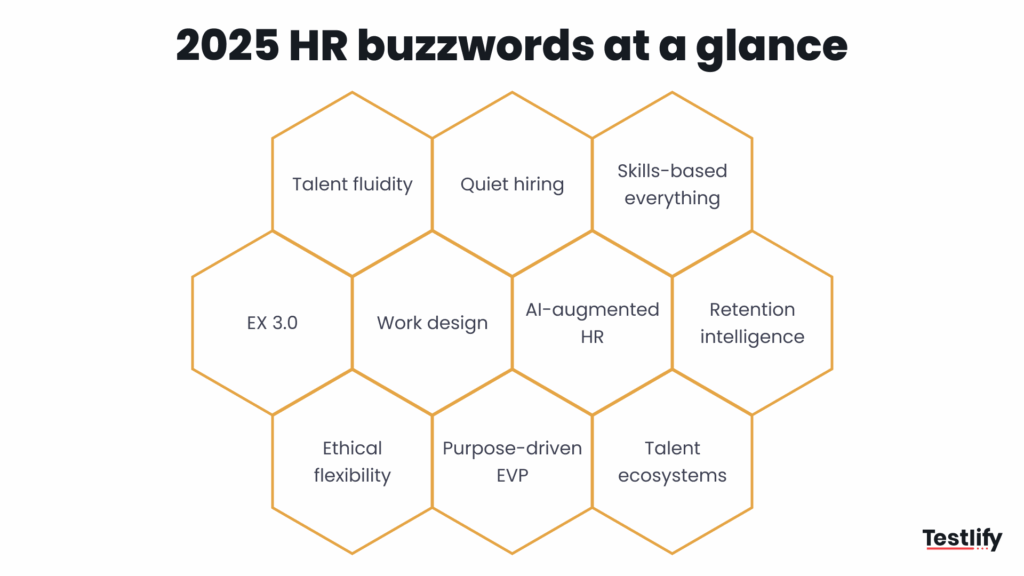
These are the terms showing up in 2026 planning documents, roughly in order of how much they change what a People team does. Each one gets a definition and the move it implies.
1. Quiet cracking
Quiet cracking is an employee who is still present, still delivering, and steadily losing motivation. It is slower than quiet quitting and harder to see, because output holds up for months before it drops. The tell is usually withdrawal from anything optional: the volunteering stops before the work does.
What to do: check whether your engagement survey asks anything a quietly cracking employee would answer honestly. Most do not.
2. Agentic AI
Agentic AI carries out a sequence of steps toward a goal rather than answering one question at a time. In HR that looks like a system that screens applications, schedules interviews, and updates the ATS without a human between each step. The capability is real. The governance usually is not.
What to do: name the decisions an agent may never make on its own. Rejection is the obvious one.
3. Human-agent teams
Human-agent teams are a working model where people and AI agents share a workflow closely enough that the output is joint. It is the honest description of how a lot of recruiting already runs. The interesting question is not whether the AI helped, but whether anyone can explain the decision afterwards.
What to do: keep a record of which signals a human actually reviewed. You will need it when a candidate asks.
4. Copilot culture
Copilot culture is employees using their own AI tools next to whatever the company approved. It spreads because the personal tool is often better than the approved one. Banning it does not work; people just stop telling you.
What to do: publish a short list of what may and may not go into an external tool. Confidential candidate data belongs on the "may not" side.
5. AI-washing
AI-washing is marketing ordinary automation as artificial intelligence. It has become common enough in HR tech that a healthy default is skepticism. If a vendor cannot describe what their model learns from, assume it is a rules engine with a new sticker.
What to do: ask for the validation evidence, not the demo.
6. Skills-based everything
Skills-based everything puts demonstrated skill, rather than a degree or a job title, at the center of hiring, pay, and promotion. This one is not a fad. The World Economic Forum's Future of Jobs research found employers expect nearly 40% of the skills required on the job to change by 2030, with a net increase of 78 million jobs. When the skill mix moves that fast, credentials age badly.
What to do: pick two roles you hire often and replace the resume screen with a skills-based hiring step. Measure the difference in shortlist quality before extending it.
7. Quiet hiring
Quiet hiring means meeting a talent need without adding headcount: redeploying people internally, upskilling, or bringing in contractors for a defined stretch. It is a sensible response to a hiring freeze and a terrible response to a chronic gap.
What to do: run a skill gap analysis first, so redeployment is aimed rather than improvised.
8. Talent fluidity
Talent fluidity is people moving between projects and teams based on skill rather than sitting in one fixed role. It works when internal moves are genuinely easy and fails when a manager can block them. Fluidity is a permissions question dressed as a culture question.
What to do: audit how many internal moves happened last year and how many needed a manager's blessing.
9. Conscious unbossing
Conscious unbossing is capable people turning down promotions into management. They watched what the job did to the last person who took it. The usual response is to make management sound more appealing, which misses the point.
What to do: build a senior individual-contributor track that pays comparably, then say so out loud.
10. Career catfishing
Career catfishing is when a candidate signs the offer and never turns up on day one. Recruiters have called this ghosting for years; the new name has not made it less annoying. It concentrates in long gaps between offer and start date.
What to do: measure your offer-to-start window. Anything past four weeks needs a contact plan.
11. Anti-perks
Anti-perks are benefits that sound generous and make work worse. Unlimited leave nobody takes. A free dinner that exists so people stay late. The category is useful because it gives managers language for something they already suspected.
What to do: pull usage data on every perk. The unused ones are telling you something.
12. Reverse mentoring
Reverse mentoring is junior staff coaching senior leaders, usually on technology, tools, or how the work actually feels lower down the org chart. It is one of the cheapest interventions available and one of the easiest to let quietly lapse after the launch email.
What to do: pair it with a specific topic. "Mentor me on AI tools" beats "mentor me".
13. Salary transparency
Salary transparency means publishing pay ranges, in job ads and internally. In much of the US and Europe this has moved from a choice to a legal requirement. The hard part is rarely publishing the range; it is explaining why two people in the same band sit at different points in it.
What to do: fix the pay-band logic before you publish it, because publishing exposes it.
14. Retention intelligence
Retention intelligence uses data to work out who is likely to leave and why, early enough to do something. Done well it points at a broken team or a manager who needs support. Done badly it becomes surveillance with a dashboard, and people can tell the difference.
What to do: connect it to turnover costs so the intervention gets funded, and be transparent about what is being measured.
Which HR buzzwords will matter in 2026?
Three, in this order. Skills-based hiring, because the skill mix is genuinely moving and credentials cannot keep up. Agentic AI, because it changes who is accountable for a hiring decision. And salary transparency, because in several jurisdictions it is law rather than opinion.
Everything else is worth understanding and not worth a program. A term earns a budget line when adopting it changes a decision you make. Quiet cracking does not change a decision. It renames a symptom you should already be tracking.
Pro tip: before adding a buzzword to your people strategy, write one sentence describing what you will stop doing because of it. If nothing stops, nothing changed.
Which 2025 buzzwords are fading in 2026?
Quiet quitting has been absorbed into ordinary engagement reporting, which is where it belonged. Bare minimum Mondays turned out to be a content format rather than a workforce trend. The great resignation is now a period people refer to in the past tense.
Two others are worth watching as they shift shape. Hybrid work stopped being a buzzword and became a policy argument about trust. And DEI did not fade so much as fracture: the acronym is politically loaded in some markets while the underlying work continues under quieter names, often folded into employee experience or fairness in hiring.
Which HR buzzwords for complaints must you act on?
This is a different category, and it gets conflated with trend vocabulary constantly. When certain words appear in an employee complaint, the employer's obligation changes regardless of how the complaint was phrased. Four carry the most weight: harassment, discrimination, hostile work environment, and retaliation.
Each maps to a protected legal concept. Discrimination points at treatment based on a protected characteristic. Retaliation covers punishing someone for raising a concern or taking part in an investigation. Once one of those appears, "let's keep an eye on it" is no longer a defensible response.
The volume is not trivial. The US Equal Employment Opportunity Commission received 88,531 new charges of discrimination in fiscal year 2024, more than 9% up on the year before. Most started as a conversation someone in HR could have handled differently.
What to do: train managers to recognize the four words and escalate rather than reassure. A manager promising to "sort it informally" is how a documented complaint becomes an undocumented one.
What are HR trigger words?
HR trigger words are phrases that oblige an employer to open a formal process because they signal a potential legal or safety issue. Harassment, discrimination, hostile work environment, retaliation, bullying, and unsafe are the common ones. They are triggers because of what the law requires next, not because HR finds them alarming.
Two honest caveats. There is no universal list, and the exact obligations vary by jurisdiction and by your own policy. And employees increasingly know these words work, which means some complaints arrive pre-translated into legal language. That does not make them less real. It means the intake conversation matters more, because the job is to find out what actually happened underneath the vocabulary.
What to do: give managers a one-page script for the first five minutes after one of these words is said. Listen, do not promise confidentiality you cannot deliver, write it down, escalate the same day.
How do you turn buzzwords into hiring evidence?
Every skills-flavored term on this list points at the same underlying request: stop guessing from resumes. The Testlify Human+AI Evidence-Based Hiring Framework is the version of that worth adopting. It combines AI-assisted evaluation with human judgment, using structured evidence instead of resumes, intuition, or inconsistent interviews. AI helps sort and summarize. People make the call, and the evidence behind the call is written down.
Consider a hypothetical 4,000-person retailer filling 60 store-manager roles a quarter. Screening on resumes, the shortlist reflects who writes the best resume. Screening on a role-based assessment first, the shortlist reflects who can actually run a shift, and the hiring manager sees scored evidence before the first interview rather than after the third. Nothing about that requires a new buzzword. It requires deciding what "good" looks like and measuring it consistently.
That is also the honest answer to conscious unbossing, talent fluidity, and internal mobility. All three need the same thing: a current, trustworthy picture of what people can do. Ready to see what that looks like for your roles? Book a demo and walk through an assessment built for a role you are hiring right now.
Key takeaways
- A buzzword earns attention only when it changes a decision. If adopting the term does not change who you hire, what you measure, or what you stop doing, it is vocabulary. Run that test before a term reaches a planning document, and most of the list falls away on its own.
- Half of 2026's vocabulary is a rename. Quiet cracking is disengagement, career catfishing is ghosting, anti-perks are badly designed benefits. Recognizing the rename saves you from buying new software for a problem your existing data already describes.
- Three terms are genuinely worth planning around: skills-based hiring, agentic AI, and salary transparency. Each changes an obligation or a decision path, which is exactly why they are worth budget while the rest are worth a glossary entry.
- Complaint language sits in a separate category with legal consequences. Harassment, discrimination, hostile work environment, and retaliation trigger an employer duty to act, so managers need a script for the first five minutes, not a definition.
- Governance lags AI adoption, and that gap is where the risk lives. Decide now which decisions an agent may never make alone, and keep a record of what a human actually reviewed, because you will be asked to explain a rejection eventually.
- The durable answer under most of these terms is evidence. Measure what candidates can do, keep the results comparable across candidates, and let people make the final call with that evidence in front of them.
FAQs

Content Writer
Yashika Khandelwal is a Content Writer with 3+ years of experience creating research-backed content on hiring, talent assessment, and HR technology. She is a registered Organizational Psychologist and subject matter expert who combines behavioral science with practical recruitment insights to produce accurate, evidence-based content.
LinkedInRelated resources
View all
HR & recruitment
Enterprise guide: Centralized vs decentralized recruitment

HR & recruitment
How to stand out in a competitive talent market

HR & recruitment
How image-to-video AI is transforming HR communication
HR & recruitment
Speed vs accuracy in enterprise hiring funnel

HR & recruitment
How to build a recruitment tech stack that works at enterprise scale

HR & recruitment
How to hire startup web app development company
Get started.
Hire on proof, not resumes.
Run your first skills-based assessment free — no credit card required.