
Quiet hiring: A bold solution or a hidden workplace problem?
Discover how quiet hiring reshapes workplaces, its benefits, challenges, real-world examples, and tips for employers to implement it effectively.

After quiet quitting, there’s a new workplace buzzword that’s making waves, i.e., “quiet hiring”. This new approach of quiet hiring skips the job postings and instead focuses on utilizing existing employees to fill crucial skill gaps.
Sounds like a win-win for both parties, right? On the one hand, companies can save loads of money and time, and on the other hand, employees can get a chance to expand their roles and learn new skills.
In today’s world of AI advancements and widespread layoffs, quiet hiring might seem like a perfect solution for employers who want to retain their teams. After all, no founder wants to make overnight cuts.
However, while it safeguards existing employees, it raises two crucial questions. They are
1. What happens to new aspirants entering the job market?
2. How do you ensure your current employees don’t feel overburdened by these shifts?
It might come out that for some employees, quiet hiring might feel less like an opportunity and more like added pressure.
So, is quiet hiring the bold solution organizations need, or is it quietly creating problems beneath the surface? Let’s find it out!
 ChatGPT
 Gemini
 Claude
 Grok
Grok Perplexity
What is quiet hiring?
Quiet hiring refers to a workforce strategy where the organizations fill specific skill gaps at the workplace by assigning more responsibility to the existing workforce.
Unlike traditional hiring, in quiet hiring, internal mobility and short-term solutions will be more prominent. For instance, an HR team member might temporarily take on a project management role.
This practice was propelled during economic slowdowns and has been further fueled by the rise of AI, increasing skill demands, and tighter budgets.
However, one should not ignore the fact that while it can be a cost-effective solution, it also comes with challenges, such as the risk of employee burnout and the question of fairness to new job seekers.
Let’s see if this practice is a bold innovation or a problem in disguise.

The bold solution: How quiet hiring benefits employers
In challenging times marked by AI advancements and economic uncertainties, quiet hiring has emerged as a lifeline for organizations. For employers, it’s a delicate balancing act: shielding existing employees from layoffs while keeping the organization productive.
This approach supports stability for the current workforce but leaves questions about its broader implications. Quiet hiring can provide solutions, but its success depends on thoughtful implementation.
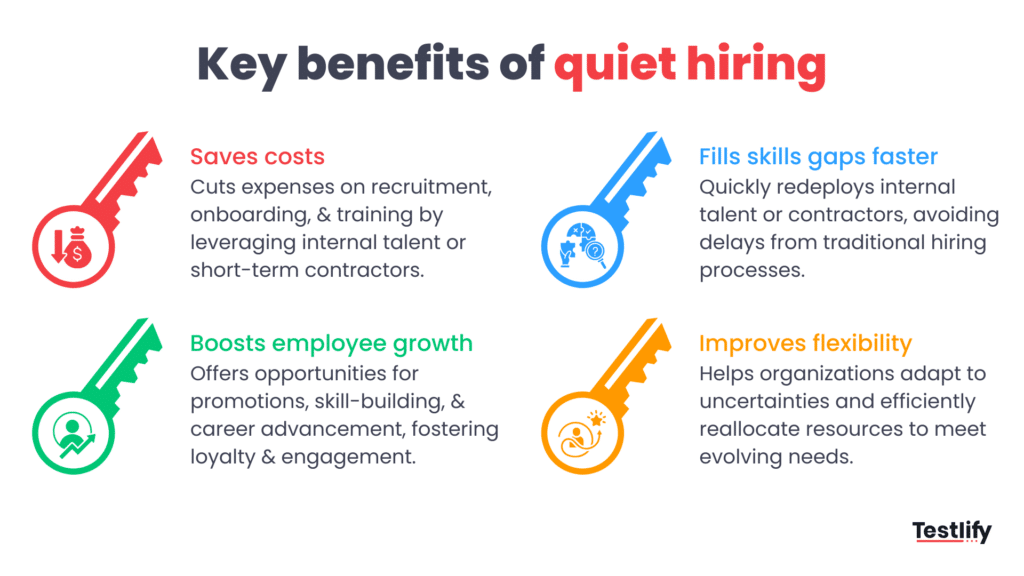
Despite these concerns, quiet hiring offers several compelling benefits. Let’s understand how this practice is reshaping the workplace and benefiting employers,
Cost savings without compromise
Companies can eliminate the high costs associated with traditional hiring, such as onboarding, training, and recruitment. If you promote your internal talents or hire short-term contractors, you might be able to save money and address the skills gaps.
Faster access to critical skills
In organizations where agility is the driving force, the use of traditional hiring could come out as a bottleneck. Quiet hiring allows redeployment from internal talent pools or hiring contractors for immediate requirements in order to stay on schedule with projects.
Suppose in a hiring freeze, a tech company could not find a data scientist. In this case, the company can temporarily reassign an experienced marketing analyst with strong data visualization skills to handle reporting and insights tasks. By breaking the role into manageable components, the company can address its immediate needs without waiting months for a full-time hire.
Employee development and retention
Quiet hiring opens doors to new opportunities for employees. You can use this strategy if you can identify top-performing employees who seek opportunities for promotion and an increase in pay. This helps to build loyalty and makes the internal talent pool much stronger.
Encourages organizational flexibility
Quiet hiring allows companies to be agile in times of uncertainty. This approach promotes resilience and adaptability in case of resource reallocation or filling skill gaps.
Creates a skilled and engaged workforce
The ability to take on new challenges gives employees a culture of growth and engagement. Teams develop a diverse set of skills over time. This makes them more versatile and prepared for future challenges. This ultimately makes the organization more innovative and robust.
Encourages a proactive approach to talent management.
Quiet hiring pushes companies to identify and nurture high-potential employees. Organizations can maximize productivity by aligning roles with individual strengths. That too, while creating an environment where employees feel valued.
Quiet hiring is cost-effective for hiring managers. But, long-term success is reflected in careful execution. Companies must balance immediate needs with employee well-being. Employers must also ensure the practice doesn’t unintentionally overlook external talent.
In the next section, we’ll dive into the hidden challenges of quiet hiring and explore its potential impact on the workforce.
The hidden problem: Challenges of quiet hiring
While quiet hiring is undeniably beneficial to employers, it comes with some challenges as well. This approach, if poorly implemented, can disrupt workplace dynamics and even backfire on the organization’s long-term goals. Below are some of the key challenges associated with quiet hiring:
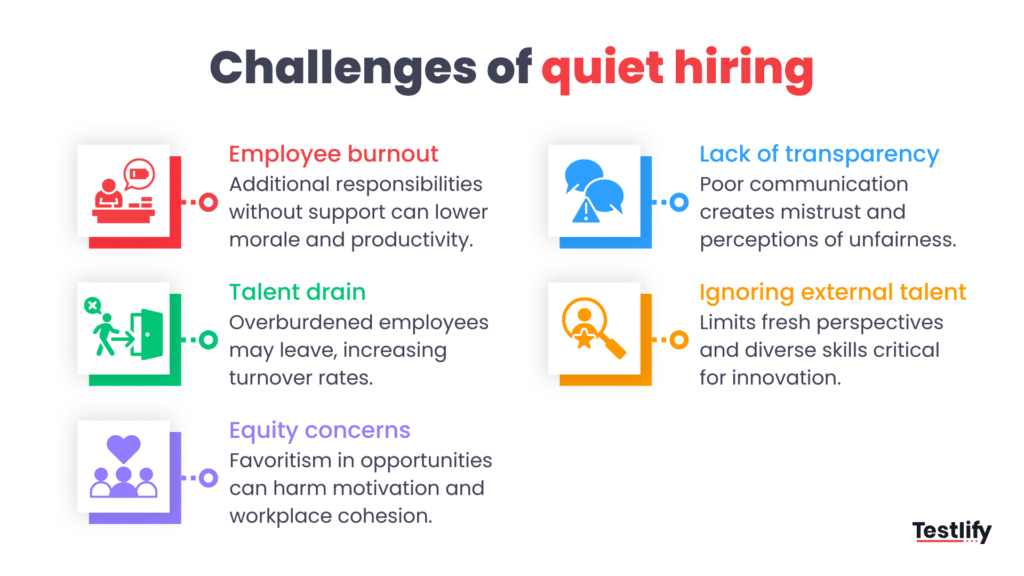
- Employee burnout and overload – Without adequate support, reassigning employees to new roles or additional responsibilities can lead to burnout. Over time, this lowers morale and reduces overall productivity. For example: An HR manager who suddenly finds himself in charge of an IT project due to a skills gap would likely feel frustrated and inefficient if he were not adequately prepared for this role.
- Lack of transparency – Sometimes, it involves role assignment without open communication. Employees are, therefore, left feeling blindsided. They may take this process as unfair, which might result in mistrust towards management.
- Risk of talent drain – If the staff feels overburdened or overworked during the process, they might try to find opportunities elsewhere. The best talent could leave where they feel undervalued. This can lead an organization towards high turnover rates.
- Ignoring external talent – Cost-saving efforts might lead organizations to ignore the value that new hires can bring. Fresh perspectives and diverse skill sets are often critical. This approach may unintentionally limit the influx of fresh perspectives and new skills.
- Equity and fairness concerns – If only certain employees are given new opportunities or added responsibilities, quiet hiring can give a perception of favouritism. The employee who might feel so may lose their motivation. This feeling of inequality may also harm the cohesion in the workplace.
How to address these challenges?
To ensure quiet hiring works well, organizations must overcome the following challenges proactively:
- Clear communication: Keep employees informed about changes in their roles and the reasons behind them.
- Provide training and resources: Equip staff with the skills and tools necessary to succeed in their new roles.
- Recognize and reward efforts: Provide fair compensation, promotions, or incentives to recognize and reward the efforts made by employees.
- Strike a balance: Avoid burdening employees with overwork and take in external hires when necessary.
The idea of quiet hiring is valuable only if it can be implemented smartly. For companies to truly take advantage of quiet hiring, they need to overcome these limitations without harming their employees or making the workplace too tense.
Real-world examples and case studies
Quiet hiring is not a theoretical concept. It has been actively used by organizations worldwide to address workforce challenges. Let’s dive into some real-world case studies that demonstrate its practical applications.
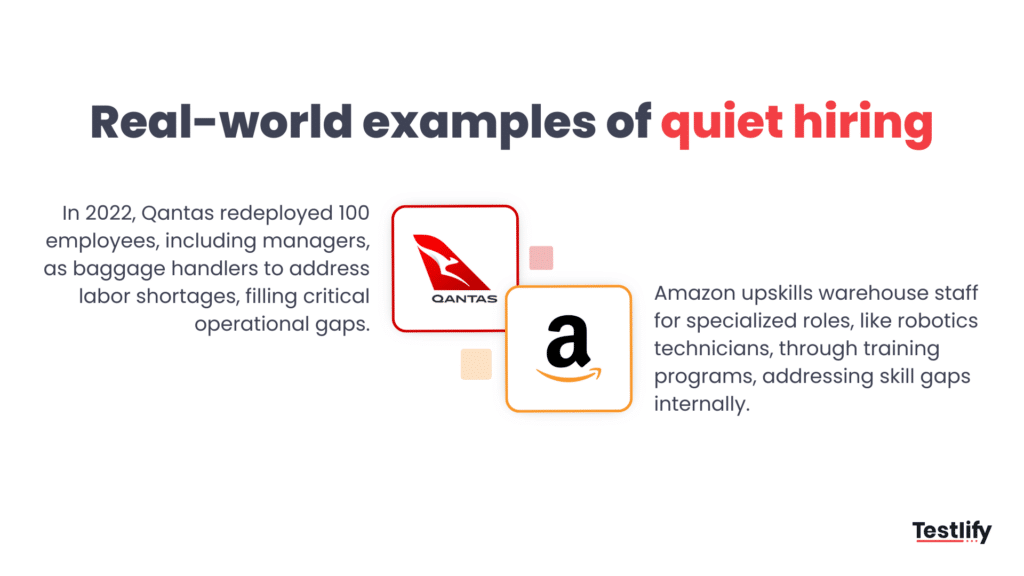
Qantas Airlines: Redeploying executives as baggage handlers
In 2022, an Australian airliner faced a labour shortage, which was affecting its operations. To address this, the airline redeployed 100 employees, including managers and senior executives, to work as baggage handlers for three months. This was an unconventional form of quiet hiring, but it literally helped the company to fill operational gaps.
Amazon: Upskilling warehouse staff
Amazon has implemented quiet hiring by upgrading its existing warehouse staff to undertake specialized roles, such as robotics technicians and process improvement coordinators. The firm addresses skill gaps through targeted training programs rather than hiring from external sources. Such an approach enables Amazon to make quick adjustments towards technological advancements.
Key takeaways from real-world applications
- Proactive planning: Quiet hiring is most effective when organizations anticipate skill gaps and invest in upskilling employees.
- Cost efficiency: Real-world examples show that reallocating internal talent saves both time and money.
- Employee engagement: Companies like Qantas and Amazon demonstrate how recognizing and rewarding internal talent strengthens workforce loyalty and morale.
Tips for employers to implement quiet hiring effectively
Quiet hiring can be quite transformative. However, it will require careful planning. Start clear communication; tell the employees why changes are happening and what they get through this. That transparency builds up trust.
Prepare employees with proper training and mentoring for new roles. Upskilling is a long-term investment in your workforce. Acknowledge their efforts with rewards, promotions, or public appreciation.
Quiet hiring should never drown out employees. Regular check-ins help prevent burnout and keep workloads realistic. And though internal mobility is incredibly valuable, do not overlook the fresh perspectives external talent brings. If implemented thoughtfully, quiet hiring empowers employees and strengthens organizations.
Final thoughts
Quiet hiring can be a smart strategy for filling skill gaps and reducing costs. If your organization needs agility and cost-efficiency in 2025, consider quiet hiring. However, avoid it if it risks overburdening employees or stifling innovation by ignoring external talent.
For employees, this can offer opportunities for growth, skill-building, and recognition. However, its success as a long-term strategy depends on balance.
If done thoughtfully, quiet hiring can strengthen organizations and empower employees. This may help you build a resilient and adaptable workforce.
Frequently asked questions (FAQs)

B2B SaaS Content Writer
Rishav Kumar is a B2B SaaS content writer with 4 years of experience. He loves crafting engaging content. Always exploring fresh ideas, he's passionate about helping businesses grow through impactful writing.
LinkedInRelated resources
View all
HR & recruitment
Different recruitment types: Pros, cons, & what works best

HR & recruitment
HR workplace failures: What’s breaking your culture?

HR & recruitment
Leveraging paraphrasing tools to enhance recruitment strategies

HR & recruitment
7 steps to master candidate profiling for top talent
![How to perform a talent review in 2026 [in 5 simple steps]](/wp-content/uploads/2025/01/How-to-perform-a-talent-review.png?dpl=dpl_6Z8Gzi5dgny5ePrnCfPbRPCRYCA7)
HR & recruitment
How to perform a talent review in 2026 [in 5 simple steps]

HR & recruitment
Boolean search in recruitment: How to use it with examples?
Get started.
Hire on proof, not resumes.
Run your first skills-based assessment free — no credit card required.