
What is DEI: Definition, why it matters & tips
Discover what DEI (Diversity, Equity, and Inclusion) means, why it matters in the workplace, and how HR can implement effective DEI strategies.

DEI stands for diversity, equity, and inclusion. It is the umbrella term for the policies and everyday habits an organization uses to build a workforce made up of people with different backgrounds, to remove the barriers that hold particular groups back, and to make sure every employee can contribute and be heard.
The three words get run together as one idea, and that's where most of the confusion starts. They describe three different things. They're measured differently. An organization can do well at one and fail badly at another without anyone noticing. Public opinion has shifted too: 52% of US workers said focusing on DEI at work is mainly a good thing in a 2024 Pew Research Center survey, down from 56% in early 2023. Support fell while the term itself got louder, which tells you something about how loosely it gets used.
 ChatGPT
 Gemini
 Claude
 Grok
Grok Perplexity
TL;DR
- DEI stands for diversity, equity, and inclusion, three separate ideas that are usually treated as one.
- Diversity is about who is present, equity is about what each person needs to compete fairly, and inclusion is about whether people can actually contribute once they arrive.
- Equity is not the same as equality. Equality gives everyone the same thing; equity accounts for different starting points.
- The business case is real but correlational, and it has been publicly contested, so treat it as supporting evidence rather than proof.
- DEI is not a quota, not a lowered hiring bar, and not a single training session.
- US anti-discrimination law gives DEI no special status, which makes how a programme is designed more important than what it is called.

What is DEI?
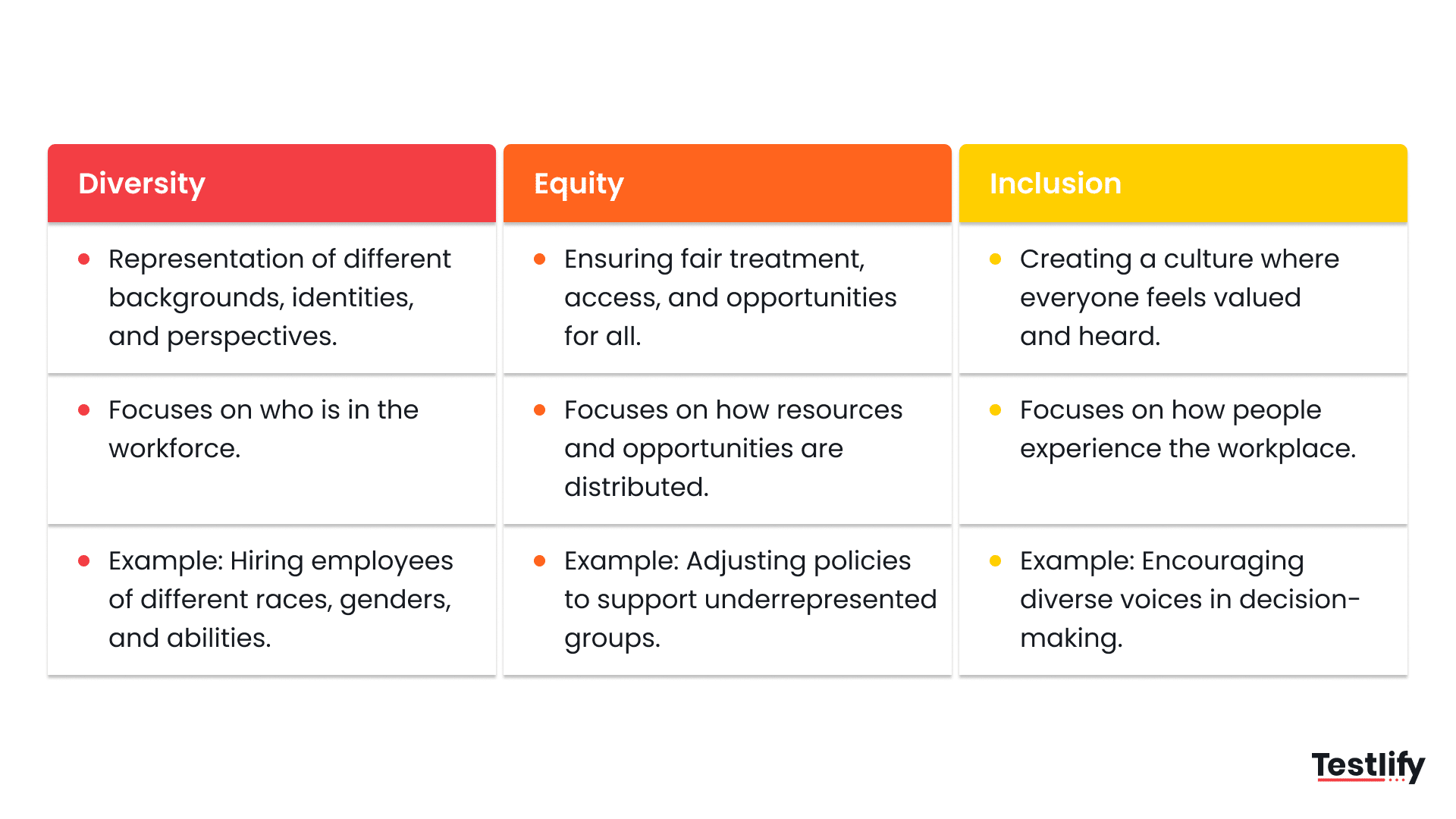
DEI is an acronym built from three words that each answer a different question. Diversity asks who is in the room. Equity asks whether the route into that room was fair. Inclusion asks whether the people who made it can speak, be heard, and shape decisions once they are there.
Term | What it describes | A question that tests it |
|---|---|---|
Diversity | The mix of backgrounds, identities and experiences present in a team | Who is actually here, at every level? |
Equity | Whether processes account for different starting points and barriers | Does everyone have what they need to compete on merit? |
Inclusion | Whether people can contribute, disagree and be heard day to day | Who gets listened to when it matters? |
Diversity: who is in the room
Diversity is the presence of difference. It covers visible characteristics such as age, race and gender, and less visible ones such as socioeconomic background, disability, neurodivergence, caring responsibilities, and the kind of career path someone took to get here. A team can look diverse in a group photo and still be uniform in the ways that shape decisions, which is why representation is usually measured level by level rather than as one company-wide figure.
Equity: what each person needs to compete fairly
Equity is the one most often misread. Equality means giving every person the same thing. Equity means recognizing that people do not start from the same place, and adjusting the process so the comparison between them is a fair one. Offering every candidate the same interview slot is equality. Making sure the interview does not quietly reward people who already knew someone inside the company is equity.
Inclusion: whether people can actually contribute
Inclusion is what happens after someone is hired. It is the difference between being invited to the meeting and being able to change its outcome. Inclusion is the hardest of the three to see from the outside, because it shows up in small, repeated moments: who gets interrupted, whose idea gets attributed to somebody else, who is asked to take the notes.
What does DEI mean in the workplace?
In the workplace, DEI means the concrete mechanisms that decide who gets hired, paid, promoted and heard. It is a set of processes rather than a statement of values. That usually includes structured hiring, pay review, promotion criteria, accessibility, and a way for employees to raise problems without the person they are raising them about deciding the outcome.
The mechanisms are more common than the job titles. In Pew Research Center's 2023 survey of DEI in the workplace, 61% of US workers said their employer had policies meant to ensure fairness in hiring, pay or promotions, while only 33% said someone at work was specifically responsible for promoting DEI, 30% reported salary transparency, and 26% had employee resource groups. Most DEI activity, in other words, is carried out by managers as part of ordinary process design rather than by a dedicated function.
For a company under a few hundred people, this is the practical reading: the work is not appointing someone to own DEI, it is making sure the hiring and promotion processes that already exist are written down, applied the same way each time, and reviewed by more than one person.
Why is the importance of DEI in workplace?
DEI matters because hiring and managing people through the same narrow profile can exclude capable candidates before their skills are properly evaluated.
For recruiters, the practical value is better access to talent and more consistent hiring decisions. That means looking beyond familiar schools, employers, career paths, accents, locations, or demographic proxies and using structured criteria tied to the job.
Three areas matter most:
- Wider talent pools: broader sourcing reduces dependence on the same networks and candidate profiles.
- More consistent evaluation: structured interviews, skills assessments, and defined scoring criteria reduce the room for irrelevant factors to influence decisions.
- Better accessibility: flexible assessment formats, reasonable accommodations, and accessible job descriptions can remove barriers unrelated to job performance.
DEI also needs to extend beyond hiring. If promotion, performance reviews, pay, and access to development opportunities are inconsistent, a diverse hiring pipeline alone will not change the employee experience.
The recruiter takeaway is simple: DEI is not just about who enters the pipeline. It is about whether every candidate gets a fair opportunity to demonstrate the skills the role actually requires.
3 misconceptions about DEI
Much of the disagreement about DEI is really disagreement about three things it is frequently confused with.
- It is not a quota. A quota sets a required number by group. Setting hiring targets by protected characteristic is legally risky in the US, and it is not what most DEI programmes do.
- It is not a lower bar. Equity is about removing distortions in how ability is measured, not about lowering what counts as ability. A process that reduces the weight of a candidate's alma mater is measuring skill more directly, not less.
- It is not a training day. One session changes what people can recite, not how decisions get made. The parts of DEI that change outcomes are the boring structural ones: written criteria, multiple reviewers, documented decisions.
Is DEI legal under US law?
DEI programmes are lawful in the US, but DEI itself carries no special legal status. The US Equal Employment Opportunity Commission's technical assistance on DEI-related discrimination at work states that the term has no legal definition or exemption under Title VII of the Civil Rights Act of 1964, and that an employment action motivated even in part by race, sex or another protected characteristic can be unlawful regardless of the intention behind it.
Two points follow, and they are the ones worth carrying into any programme design. First, Title VII protects all workers, not only members of a minority group. Second, the EEOC's examples of what can cross the line are about exclusion: restricting mentoring or sponsorship by protected characteristic, limiting who may join a workplace group, or separating employees by race or sex during training. Programmes that widen access to opportunity sit on much safer ground than ones that ration it.
This is a live area of regulatory attention, and none of the above is legal advice. Employers should run programme design past their own counsel.
DEI vs DEIB vs D&I: what is the difference?
The acronyms mark what an organization chose to make explicit, not different fields of practice.
- D&I is the older term, covering diversity and inclusion without naming equity separately.
- DEI adds equity, making the fairness of the process an explicit commitment rather than something assumed.
- DEIB adds belonging, the subjective experience of being accepted, which some organizations separate from inclusion to measure it directly in surveys.
The additions are real but incremental. An organization that renames its program without changing how it hires and promotes has changed a label.
How to build DEI into your workplace
DEI works better when it is built into everyday people's decisions rather than treated as a separate HR initiative. Start with the points where employees enter, progress through, and experience the organization.
1. Audit where candidates drop out
Look at conversion rates between application, screening, assessment, interview, offer, and joining. Break the data down by relevant demographic groups where legally permitted and where sample sizes are large enough to protect privacy.
A large difference at one stage tells you where to investigate, not automatically why the difference exists.
2. Separate essential requirements from preferences
For every job description, ask: would someone genuinely fail in this role without this requirement?
Remove unnecessary degree requirements, years-of-experience cutoffs, location restrictions, or “culture fit” language when they are not directly related to performance. Keep requirements that have a clear connection to the work.
3. Make assessments accessible
Give candidates a reasonable way to demonstrate the required skill. Check whether your assessments depend unnecessarily on speed, vision, hearing, internet quality, specific software, or a particular communication style.
Where appropriate, provide reasonable accommodations without changing the competency being assessed.
4. Standardise promotion criteria
DEI cannot stop at hiring. Define what employees need to demonstrate to move to the next level.
Use observable evidence such as scope, outcomes, skills, leadership responsibilities, or business impact instead of vague criteria such as “shows potential” or “is a strong culture fit.”
5. Track who gets high-visibility opportunities
Promotion is not the only route to career growth. Track access to important projects, leadership exposure, client work, mentoring, conferences, and stretch assignments.
If the same people repeatedly receive opportunities that build promotable experience, your promotion process can become unequal even when the formal criteria look neutral.
6. Give employees a safe way to flag barriers
Create a clear channel for employees to report accessibility problems, exclusionary practices, or inconsistent treatment. More importantly, define who reviews those reports, how they are documented, and what happens afterward.
A reporting mechanism without follow-through quickly becomes performative.
7. Review outcomes, not just participation
Do not measure DEI only by the number of people hired from different groups. Look at retention, promotion, pay, performance ratings, engagement, and access to development.
A diverse hiring pipeline with unequal retention or progression is a signal that the problem has moved further down the employee lifecycle.
8. Assign ownership
Give specific leaders responsibility for reviewing the data and acting on identified gaps. Set a review cadence and document what changed.
If DEI belongs to “everyone,” it can easily become nobody's measurable responsibility.
The practical test: if a DEI initiative changes a hiring form, assessment, promotion criterion, accessibility process, or decision-making practice, it has a chance of changing outcomes. If it only produces another presentation, survey, or annual training session, its impact is much harder to establish.
Pro tip: check where candidates leave your funnel before changing how you source. Teams usually assume the problem is at the top and spend on diversity recruitment, when the drop-off is at a specific interview stage that one panel runs differently from everyone else.
How do you measure DEI progress?
Measurement is what separates a programme from a statement. Four families of metric cover most of what matters, and the useful ones are the middle two, because they point at a process you can change.
- Representation: workforce composition by level and function, not one company-wide number. A balanced headcount with a uniform leadership team is a known failure pattern, which is why diversity in leadership roles is tracked separately.
- Process: pass-through rates at each hiring stage, and promotion rates by group. This is where a fair-looking process usually turns out to leak.
- Outcome: pay gaps for comparable roles, and attrition by group. Attrition is the number that tends to expose an inclusion problem first.
- Experience: survey measures of inclusion and psychological safety, which is the only one of the four that asks employees directly.
Two cautions apply to all of them. Small samples move wildly, so a team of twelve will produce percentages that look like findings and are noise. And measuring by group requires care about privacy and consent, and about what the law in your jurisdiction permits you to collect.
Hire on evidence, not assumptions
Most of the equity gap in hiring is created by processes that were never written down. Structured, role-relevant assessments are the practical way to close it: they give every candidate the same opportunity to show what they can do, and they give reviewers something comparable to judge. Testlify supports this with role-based skills assessments, structured interview questions, and multi-reviewer scoring, so a shortlist is built from evidence rather than impressions. Book a Testlify demo to see how a structured assessment fits your hiring process, or explore how to build inclusive workplace practices alongside it.
Key takeaways
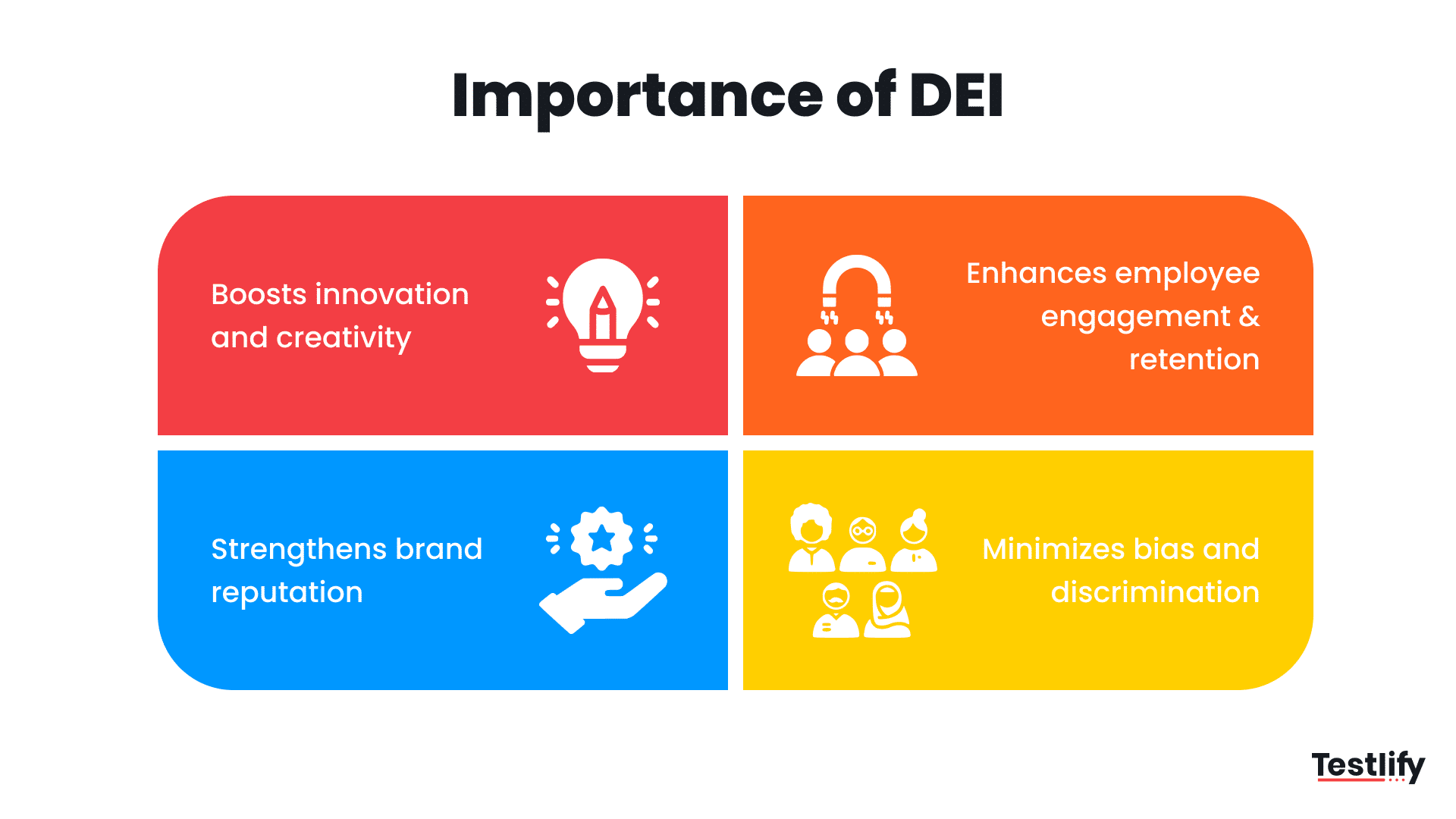
- DEI is three ideas, not one. Diversity, equity and inclusion are measured differently and fail differently, so an organization that reports only headcount representation has no idea whether the other two are working. Track each one separately or you will not see the problem until people start leaving.
- Equity is about the process, not the outcome. The distinction from equality is what makes DEI defensible: adjusting a process so it measures ability accurately is different from adjusting a result. Teams that blur the two invite the criticism that the bar has been lowered.
- The business case is supporting evidence, not proof. The 39% outperformance finding is a correlation that has been publicly contested, so a programme justified on that number alone is fragile. Build the case on process consistency and a wider candidate pool, which are directly observable.
- The law cares about design, not vocabulary. Because Title VII gives DEI no special status, what protects a programme is whether it widens access rather than rations it by protected characteristic. Renaming a programme changes nothing about its legal exposure.
- Most DEI work is ordinary process design. Only about a third of US workers report anyone at work being responsible for DEI, so in practice the work sits with managers writing down criteria and applying them consistently. That is good news for small teams, who can act without hiring a specialist.
- Hiring is where the biggest gains are. Unstructured interviews and resume screening are where inequity enters, and structured assessment is the one change that both improves fairness and produces evidence you can audit afterwards.
- Measure the middle of the funnel. Stage-by-stage pass-through and promotion rates show where a process leaks, which representation totals and engagement scores never will.
Frequently asked questions (FAQs)

Content Writer
Yashika Khandelwal is a Content Writer with 3+ years of experience creating research-backed content on hiring, talent assessment, and HR technology. She is a registered Organizational Psychologist and subject matter expert who combines behavioral science with practical recruitment insights to produce accurate, evidence-based content.
LinkedInRelated resources
View all
HR & recruitment
Top 6 hard-core tips to hire top IT specialists
HR & recruitment
4 simple ways to measure training effectiveness
HR & recruitment
Employee Pulse Surveys: What They Are, How They Work, and Why They Matter in 2026

HR & recruitment
The science behind picOCEAN: How image personality test work
HR & recruitment
Why visual personality tests are the future of hiring

HR & recruitment
What Is Quiet Quitting? Causes, Signs, and How to Prevent It in 2026
Get started.
Hire on proof, not resumes.
Run your first skills-based assessment free — no credit card required.