
Best Pre-Hire Assessment Platforms for Enterprises: An Honest Buyer’s Guide (2026)
Explore the best enterprise pre-hire assessment platforms that help recruiters make confident hiring decisions at scale

A global logistics company spent eight months and $340,000 implementing an enterprise assessment platform, only to discover six months post-launch that their time-to-hire hadn’t budged and their candidate satisfaction scores had dropped 22 points. The platform was technically impressive. It just wasn’t built for the way their talent team actually hired. They ripped it out and started over.
This happens more than anyone in HR tech will tell you. Enterprise assessment platforms are a high-stakes decision, and most comparison guides treat them like a shopping list rather than a strategic choice. They rank tools by feature count or G2 stars without asking the questions that actually matter: How does this platform hold up at 50,000 concurrent assessments? What happens when your ATS vendor resists the integration? Can your legal team defend the scoring methodology if a candidate files a complaint?
This guide answers those questions. It covers the 10 platforms that consistently show up in enterprise RFPs, what they are genuinely good at, where they fall short, and how to run a structured evaluation so you don’t end up eight months and $340,000 into the wrong choice.
 ChatGPT
 Gemini
 Claude
 Grok
Grok Perplexity
What “enterprise-ready” actually means
Most platforms that market to enterprises are not truly enterprise-ready. They have enterprise pricing. That is different.
A genuinely enterprise-ready pre-hire assessment platform handles five things that SMB tools cannot: volume without degradation, legal defensibility at scale, deep ATS integration without custom engineering, candidate experience that holds across dozens of countries and languages, and reporting granular enough for a CHRO to present to the board.
Most platforms handle three of the five. A few handle four. The ones that handle all five cost more, take longer to implement, and are absolutely worth it if you’re hiring at enterprise scale.
Before you evaluate any platform, you need a framework for what you’re actually scoring. That’s what the Enterprise Assessment Fit Matrix is for.

The Enterprise Assessment Fit Matrix
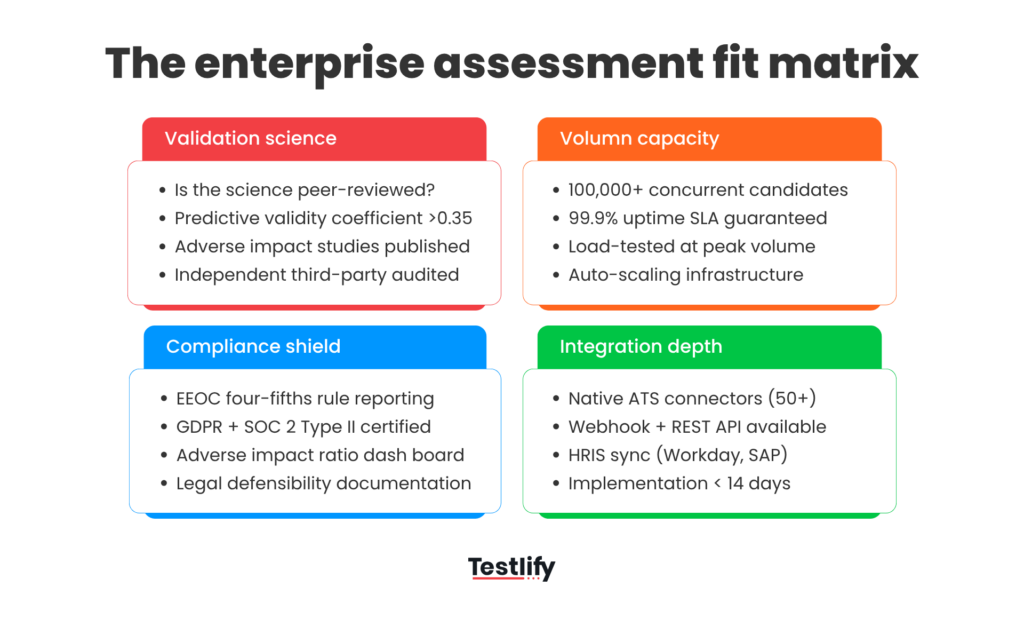
The Enterprise Assessment Fit Matrix evaluates platforms across four dimensions that consistently separate platforms that perform from platforms that sound good in demos. Score each vendor from 1 to 5 on each dimension during your evaluation.
Dimension 1: Validation Science
This is the dimension most buyers underweigh. Validation science asks: is there peer-reviewed research proving that this assessment predicts job performance? Not internal vendor studies. Not G2 reviews. Published research with measurable predictive validity coefficients.
A predictive validity coefficient above 0.35 is considered strong. Most cognitive ability tests from established vendors hit 0.50 or above. Personality inventories, without role-specific calibration, typically land between 0.20 and 0.30 — useful, but not sufficient on their own. Platforms that mix validated instruments with unvalidated “culture fit” questionnaires dilute the science without telling you they’re doing it.
Dimension 2: Volume Capacity
Volume capacity is not about the number of assessments in the library. It’s about infrastructure. Can the platform serve 100,000 simultaneous test sessions without latency? Does it have a published uptime SLA above 99.9%? Has it been independently load-tested? If the vendor can’t produce a load test report, treat that as a yellow flag.
For context: a Fortune 500 with 40,000 annual hires and a 4:1 shortlisting ratio runs roughly 160,000 assessments per year. During a spring recruiting push, that can mean 8,000 assessments being completed in a single week. Platforms that weren’t built for this traffic pattern slow down at exactly the wrong moment.
Dimension 3: Compliance Shield
EEOC compliance for pre-hire assessments is not optional. Under the Uniform Guidelines on Employee Selection Procedures, any selection procedure that produces adverse impact — measured by the four-fifths rule — must be validated as job-related. Platforms that don’t provide Adverse Impact Ratio dashboards are leaving you exposed.
The four-fifths rule: if your assessment passes a minority group at less than 80% the rate of the majority group, you have documented adverse impact. Enterprise platforms should calculate this automatically, flag breaches, and provide enough audit trail to defend any challenged hiring decision.
Dimension 4: Integration Depth
Integration depth determines how much custom engineering your IT team will spend after contract signature. Native connectors to your ATS — Workday, Greenhouse, SAP SuccessFactors, Lever — matter more than a generic API. A native connector means the assessment triggers automatically when a candidate reaches a specific stage, results flow back into the ATS record, and nothing requires manual downloading or re-uploading.
Platforms with fewer than 30 native ATS integrations will require custom work. Budget $15,000 to $40,000 for that work if your ATS isn’t on their native list.
Platform comparison: how the top 10 score
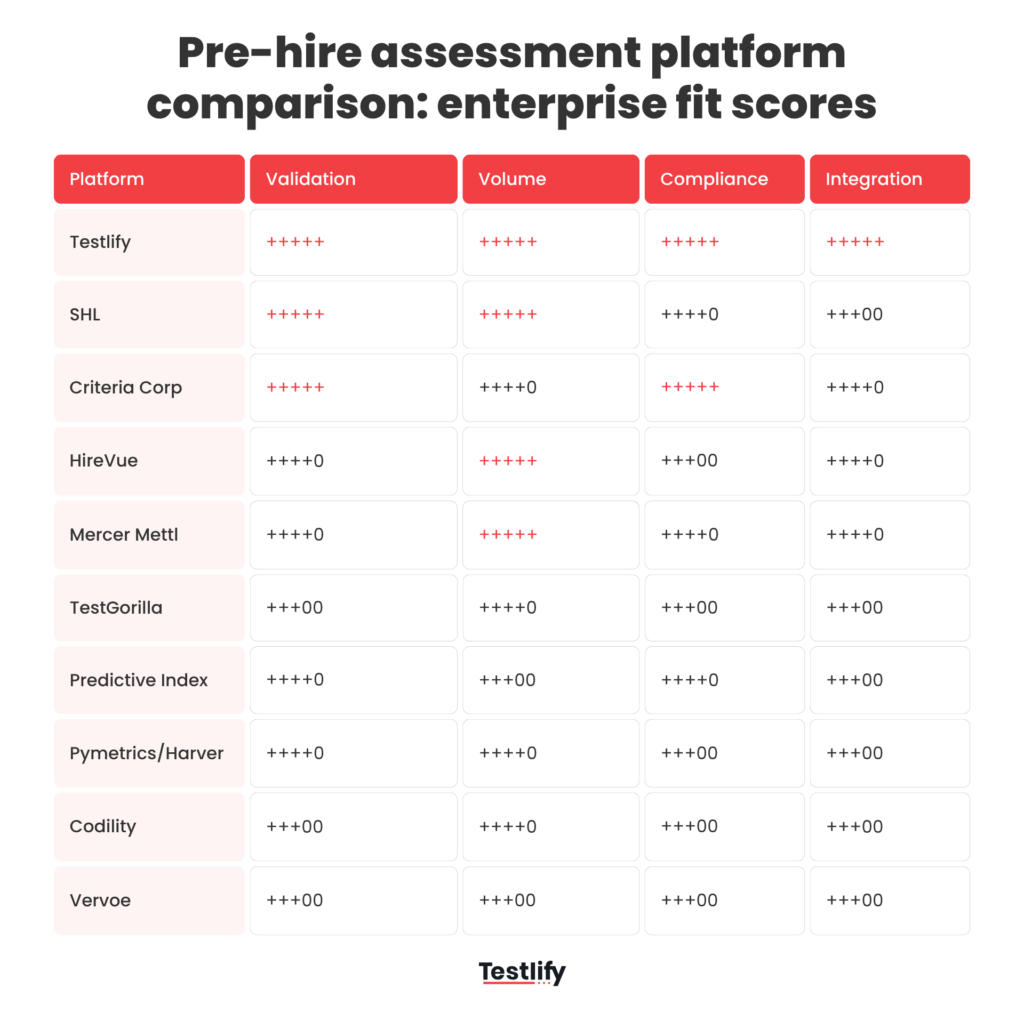
**Scores are editorial assessments based on publicly available platform documentation, third-party reviews, and enterprise implementation case data. They reflect enterprise use cases specifically, not SMB deployments.**
The 10 platforms: what they’re genuinely good at
1. Testlify

What differentiates Testlify at the enterprise tier is the combination of speed and compliance depth. Implementation takes under 14 days for most ATS configurations. The platform ships with native connectors to over 50 ATS systems, including Workday, Greenhouse, Lever, SAP SuccessFactors, iCIMS, and Taleo. Adverse Impact Ratio dashboards are built in, not bolted on, and they refresh in real time as your candidate pool grows.
Based on Testlify implementation data across enterprise clients, teams that deploy a validated multi-measure battery see recruiter screening time drop 68% within 90 days, and bad-hire rates fall 41% by the second quarter. The platform handles online proctoring natively, with AI-powered monitoring that doesn’t require a third-party proctoring service or an additional contract.
Where Testlify is strongest: enterprises that want fast deployment, transparent compliance reporting, and a single vendor for the complete assessment workflow from invite to result. If you need deep behavioral science for executive selection or bespoke norm development for niche industries, you’ll want to discuss that specifically before signing.
2. SHL

SHL has been running pre-hire assessments since 1977. That tenure is both their greatest strength and occasionally their limitation. The science is genuinely deep: SHL’s Occupational Personality Questionnaire (OPQ) is one of the most-studied behavioral instruments in the world, with peer-reviewed validation research spanning four decades and multiple continents.
Enterprises that prioritize validation rigour above all else, and particularly those in regulated industries like financial services, healthcare, and defence, will find SHL’s benchmark library and norm databases compelling. The platform can produce validation studies for specific roles, industries, and geographies that most competitors simply cannot match.
The trade-off is implementation pace and integration flexibility. SHL implementations at the enterprise level typically take 60 to 90 days, and ATS integration often requires professional services engagement. For teams that need to be live in two weeks, SHL is the wrong choice. For teams building a five-year talent strategy and willing to invest in the setup, it’s a serious contender.
3. Criteria Corp
Criteria Corp has built a reputation for legal defensibility that few competitors can match. Their flagship instruments, including the CCAT (cognitive ability), the OCEAN personality inventory, and the Emotify emotional intelligence measure, all ship with published validation studies, adverse impact documentation, and clear guidance on appropriate use by role type.
For HR teams in the US dealing with OFCCP audits or Title VII litigation risk, Criteria Corp’s documentation depth provides a meaningful layer of protection. They can produce validity evidence that withstands legal scrutiny faster than most competitors, because they’ve designed for that outcome from day one.
The platform is less strong on the candidate experience side. The assessment interface is functional but dated compared to Testlify or HireVue, and completion rates in mobile-heavy candidate pools tend to run 10 to 15 percentage points lower than platforms designed for mobile-first experiences. That’s a real consideration if you’re hiring at high volume in markets where mobile is the primary channel.
4. HireVue

HireVue’s positioning has shifted over the past three years. Originally known for AI-scored video interviews, they’ve broadened the platform to include structured assessments and game-based evaluations, but video AI selection remains their core differentiator.
For enterprises that run structured interview processes at scale — thousands of first-round video interviews per month — HireVue’s infrastructure is genuinely strong. The platform can handle high concurrent video sessions, and the structured interview framework gives hiring managers consistent data across candidates even when those managers are distributed across time zones.
The compliance watch is worth noting. HireVue’s AI facial analysis features drew EEOC scrutiny in 2021, and while the company has adjusted their model, enterprises in Illinois (which passed a specific AI Video Interview Act) and other regulated states should review their compliance documentation carefully before deployment. The science on video AI predictive validity is still developing, and it’s not peer-reviewed to the same standard as cognitive or structured personality tools.
5. Mercer Mettl
Mercer Mettl excels at two things: global volume and technical role assessment. The platform is particularly strong in Asia-Pacific and EMEA markets, where many Western competitors have thinner norm databases and weaker localisation. If you’re building a global assessment program and a significant share of your hiring happens in India, Southeast Asia, or the Middle East, Mettl’s regional calibration and multilingual support stand out.
For technical roles — software engineering, data science, cloud infrastructure — Mettl’s coding assessment library is deep and regularly updated. They support 20+ programming languages with IDE-like test environments that accurately simulate real development conditions rather than simplified sandbox tests.
Where Mettl is less competitive: US market ATS integrations and behavioral science depth. Their personality and leadership instruments are solid, but don’t carry the same peer-review depth as SHL or Criteria Corp. For pure technical screening at global volume, they’re a strong choice. For a comprehensive enterprise assessment stack, most buyers end up combining Mettl with another platform.
6. TestGorilla

TestGorilla has grown rapidly by making assessment setup faster and cheaper than the legacy vendors. The platform is straightforward to configure, has a broad but shallow test library, and integrates with common SMB-to-midmarket ATS systems without much friction.
The honest limitation for enterprise buyers: TestGorilla is built for speed and accessibility, not validation depth. Most of their tests are not backed by peer-reviewed validity studies, adverse impact documentation is limited, and the platform hasn’t been stress-tested at the volumes that large enterprises require. Teams hiring 500+ per year are fine. Teams hiring 5,000+ per year will start to feel the seams.
If you’re a midsize company or a startup in a growth phase, TestGorilla is one of the better options at the price point. If you’re in the Fortune 1000 and need your assessment methodology to hold up in a discrimination lawsuit, look elsewhere.
7. Predictive Index

Predictive Index (PI) has a genuinely strong behavioural science foundation. The PI Behavioral Assessment has been validated continuously since 1955 and has an extensive body of peer-reviewed research supporting its construct validity. If behavioral fit — how someone naturally works, communicates, and makes decisions — is central to your assessment strategy, PI’s science is worth taking seriously.
The limitation is that PI is primarily a behavioural tool that has expanded into cognitive (PI Cognitive Assessment) and engagement, but it’s not a full-stack enterprise assessment platform. Enterprises that need to run technical skills tests, candidate screening at high volume, and situational judgement alongside behavioural profiles will find PI’s ecosystem incomplete without integrating additional tools.
Best for: organisations building management selection and talent management programs where understanding behavioural drives is the primary goal. Weaker for: high-volume funnel screening, technical role assessment, or markets outside North America.
8. Pymetrics / Harver
Pymetrics (now part of Harver) pioneered the use of neuroscience-based games for candidate assessment. The approach is genuinely novel: candidates play 12 short games that measure cognitive and emotional traits, and the resulting profile is matched against profiles of successful existing employees in the same role.
The science is peer-reviewed and the adverse impact performance is one of the stronger results in the industry for a personality-adjacent tool. For high-volume consumer-facing roles where candidate experience matters and explicit testing feels off-brand, Pymetrics’ game format has demonstrated real engagement lift.
The practical challenge for enterprises is that the matching model requires a meaningful sample of successful employees to calibrate against. For common high-volume roles (call centre agent, retail associate, logistics operative), this is fine. For niche or newly created roles where you don’t have a large incumbent sample, the model lacks a foundation to calibrate from. Implementation timelines also tend to run longer than the industry average as a result.
9. Codility

Codility is the specialist choice for engineering and technical hiring. If your enterprise hires hundreds of software engineers, data scientists, or DevOps engineers per year, Codility’s depth in technical challenge design, plagiarism detection, and live coding interview tools is hard to beat at the pure-technical tier.
The platform supports 50+ programming languages, offers pair programming sessions for senior candidates, and maintains a library of challenges reviewed for bias and difficulty calibration. Many large tech companies use Codility specifically for their engineering pipeline while running a separate platform for non-technical roles.
That specialisation is also the limitation: Codility does technical hiring and does it well, but it doesn’t handle behavioural, cognitive general ability, or situational judgement. Enterprises looking for a single-platform approach will need to pair it with something else.
10. Vervoe

Vervoe takes a different philosophical position from most assessment vendors: rather than standardised tests, they build job simulations where candidates complete actual work samples relevant to the role. A marketing candidate might write a campaign brief. A customer support candidate might respond to a realistic complaint email. An analyst candidate might build a simple financial model.
The candidate experience is typically rated higher than standardised testing by candidates who understand what they’re being evaluated on. The signal can also be highly relevant when the simulation is well-designed. The challenge for enterprises is consistency: the predictive validity of work samples depends entirely on how carefully the simulation is constructed and how objectively it’s scored. AI grading helps, but it’s not as statistically robust as norm-referenced cognitive testing across a broad population.
Vervoe is a good fit for roles where job-specific capability is the most important predictor and where the candidate experience needs to reflect actual work conditions. It’s a harder fit for high-volume screening where speed and standardisation matter more than role-specific depth.
The real cost of getting this wrong: total cost of ownership
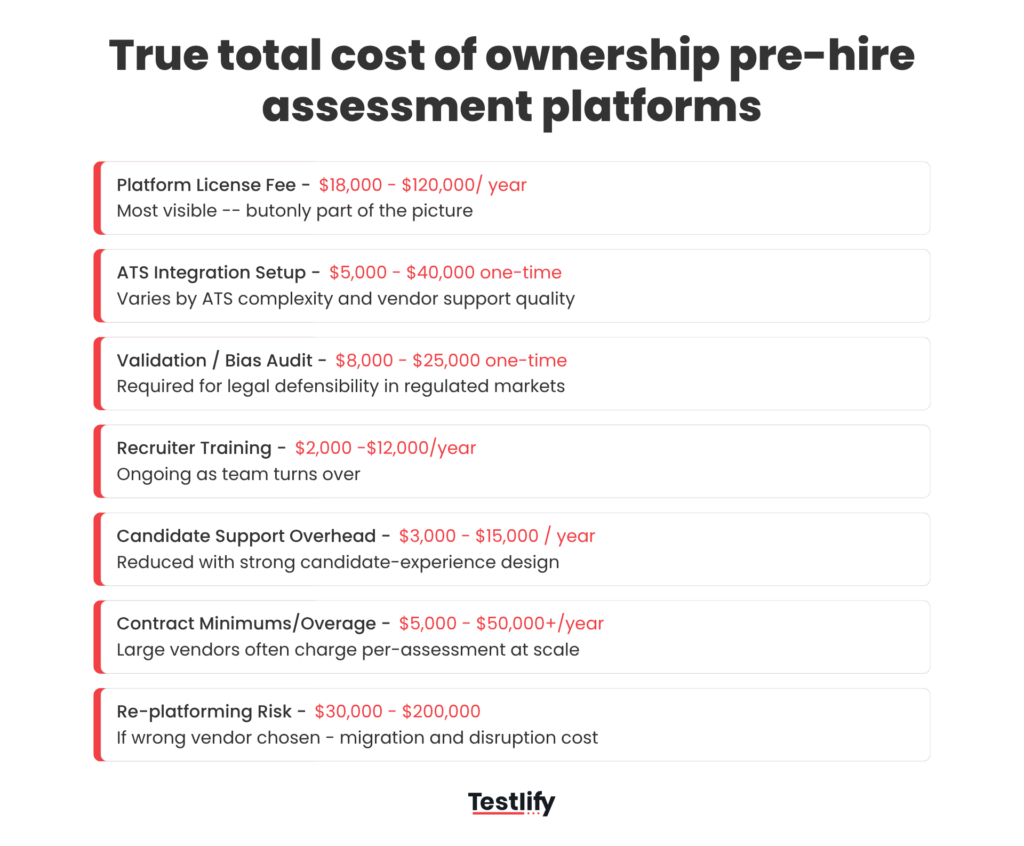
Most enterprise assessment RFPs compare license fees. That’s the visible part of the cost. The total cost of ownership is rarely less than 2x the license fee in the first year, and for platforms with complex integrations or mandatory professional services, it can reach 4x.
The re-platforming risk is the one that stings. When an enterprise assessment platform fails to deliver and the organization has to migrate — move historical data, rebuild integrations, retrain teams, and restart the change management process — the cost rarely comes in under $50,000 and can easily hit $200,000 when you count disruption to live hiring pipelines.
The way to protect against this is to run a structured 30-day pilot before you sign a multi-year contract.
How to run a 30-day enterprise platform pilot
A well-run pilot surfaces the problems that demos hide. Most enterprise assessment vendors will agree to a 30-day pilot with real candidates for a specific role family before full contract execution. Here’s how to structure it.
- Week 1 — Integration and setup: Connect the platform to your ATS. Measure the actual integration time, not the promised time. Watch for anything that required custom engineering that wasn’t in the standard contract scope.
- Week 2 — First live cohort: Run a real candidate cohort through the assessment. Measure: candidate completion rate, time-to-complete, and the number of support tickets generated. A good platform produces a completion rate above 85% and fewer than 2% support contacts.
- Week 3 — Data quality review: Pull the results. Do they differentiate candidates clearly? Is the score distribution bell-curved, or are 80% of candidates clustered in a narrow band? Flat distributions mean the assessment isn’t creating usable signal.
- Week 4 — Compliance check: Calculate the Adverse Impact Ratio for each protected group in your pilot cohort. If AIR falls below 0.80 for any group, flag it before you scale. Also request a sample legal defensibility report and verify it meets your legal team’s requirements.
At the end of 30 days, you should have enough data to make a confident decision. If the vendor won’t agree to a live pilot with real candidates, that itself is a red flag.
EEOC compliance: what the four-fifths rule means for platform selection
Under 29 CFR Part 1607 (Uniform Guidelines on Employee Selection Procedures), any selection procedure that produces adverse impact must be validated as job-related. This applies directly to pre-hire assessments.
The four-fifths rule works like this: if 60% of majority group candidates pass your assessment and only 40% of minority group candidates pass, your Adverse Impact Ratio is 0.67, which is below the 0.80 threshold. You have documented adverse impact and are required to either validate the assessment as job-related or discontinue use.
Enterprise assessment platforms vary significantly in how much help they give you here. The strongest platforms ship with built-in AIR dashboards that calculate in real time as candidates complete assessments. The weakest require you to export data and run the calculation yourself in a spreadsheet. For enterprises with thousands of assessments running simultaneously, that difference is the difference between proactive compliance and an audit surprise.
When evaluating platforms, ask directly: Does your platform calculate Adverse Impact Ratios automatically? Does it flag breaches? Can you produce a defensibility report for a specific assessment and role within 24 hours? If any of those answers is “no” or “it depends on your contract tier,” factor that into your risk assessment.
For a deeper look at how this connects to language fairness specifically, see our guide on ensuring language fairness in pre-employment assessments.
Choosing the right platform: the honest bottom line
If you’re an enterprise running 1,000 or more hires per year and you want a platform that deploys fast, handles compliance natively, integrates with your ATS without custom engineering, and gives your legal team the documentation they need — Testlify is worth a serious look. The 30-day pilot is live: you can run real candidates through real assessments before signing anything.
If your primary need is deep behavioural science for executive selection, SHL or Predictive Index deserves evaluation. If you’re hiring mostly software engineers at scale, Codility earns a dedicated look. If you’re building a global program and a significant share of hiring is in Asia-Pacific, Mercer Mettl’s regional calibration is worth the tradeoff in integration depth.
What matters most is that you evaluate these platforms on the four dimensions that predict enterprise success — validation, volume, compliance, and integration — rather than on demo polish or feature count. A beautiful interface built on unvalidated science is a legal liability. A clunky interface with 40 years of peer-reviewed research behind it is a defensible business decision.
The 30-day pilot framework is your protection. Use it. And if a vendor won’t agree to one, that tells you everything you need to know.
Not sure which platform fits your stack?
Use the Vendor Evaluation Matrix to score each of the 10 platforms above across validation science, volume capacity, compliance, and integration depth. Includes 25 RFP questions to ask in your next vendor demo.
Frequently asked questions

Founder and CEO, Testlify
Abhishek Shah is the Founder and CEO of Testlify, a pre-employment assessment platform used by 1,500+ companies globally to hire fairly and at scale. He focuses on skills-based, bias-free hiring technology. Testlify is part of the SHRM Labs 2026 WorkplaceTech Accelerator.
LinkedInRelated resources
View all
Candidate Screening
Effective methods for screening candidates in 2026

Candidate Screening
What to look for in candidate screening software

Candidate Screening
Candidate screening: Methods, process, and best practices

Candidate Screening
Screening interview explained: Purpose, stages, and tips

Candidate Screening
Candidate Screening Dos and Don’ts: Best Practices for 2026

Candidate Screening
How to automate your candidate screening process (2026)
Get started.
Hire on proof, not resumes.
Run your first skills-based assessment free — no credit card required.