
Best pre-hire assessments when hiring for top roles in the financial industry
Hire smarter in financial industry with role-specific pre-hire assessments. Reduce risk, improve quality, and speed up hiring.

The pre-hire assessments that work best for financial industry roles are the ones tied to a named competency: a numerical reasoning or financial modeling test for analysts, an accounting and attention-to-detail test for auditors, a situational judgment and ethics test for client-facing advisors, and a cognitive ability test for graduate intakes.
The harder question is not which test to buy. It is how to prove, months later, that the test measured something the job actually needs. That is where most finance hiring programs come apart, and it is what this page is about.
 ChatGPT
 Gemini
 Claude
 Grok
 Perplexity
TL;DR
- Start from the role, not the test. Map each finance role to two or three competencies, then pick the assessment that produces evidence for each one.
- Hiring volume in finance is steady, not shrinking: the U.S. Bureau of Labor Statistics projects about 29,500 openings for financial analysts a year through 2035, so screening load is a permanent cost, not a seasonal one.
- Structured, scored methods beat resume review and unstructured interviews on predictive accuracy, and the research is clear that recombining scores by gut feel gives that advantage back.
- In a regulated industry, defensibility is part of the product. Keep the job-relatedness argument, the scoring rules, and the adverse-impact math written down before you screen anyone.
- Proctoring belongs on the high-stakes stages only, and it should produce evidence a human reviews, not an automatic rejection.

Why is hiring in finance getting harder?
Finance hiring has three pressures at once: regulation that keeps widening, a skills mix that now spans spreadsheets and systems, and applicant volumes that make manual screening impractical.
Volume is the one teams underestimate. The U.S. Bureau of Labor Statistics projects employment of financial analysts to grow 7% between 2025 and 2035, with about 29,500 openings a year and a median wage of $102,740 as of May 2025. For one job family, that is a continuous screening load at a salary level where a mis-hire is expensive to unwind.
- Compliance knowledge is now a screening criterion, not an onboarding topic.
- Analyst work sits in spreadsheets, reporting tools, and internal systems, so tool fluency has to be observed rather than claimed.
- Hybrid teams put more weight on written communication and self-management.
- Entry-level and graduate pipelines arrive with near-identical resumes, which leaves nothing to rank on.
Which assessment fits which finance role?
Do not start with a test. Start with the role. The Testlify Competency-to-Evidence Matrix maps every role to the competencies that matter, then connects each competency to measurable evidence through assessments, simulations, interviews, references, and structured feedback. The point of the matrix is that every competency you claim to care about has to produce evidence someone can review.
Applied to the five finance role families that hire in volume:
Role family | Competency that decides the hire | Evidence to collect | Where it fits |
|---|---|---|---|
Financial analysts and associates | Quantitative reasoning, model building | Numerical reasoning and data interpretation, plus a financial modeling task | Before the first call |
Accountants and auditors | Accuracy under procedure | Accounting principles, attention to detail, and a documentation check | Before the first call |
Investment and wealth advisors | Judgment and integrity with clients | Situational judgment and ethics and compliance, plus risk management | After a screen, before panel |
Finance operations and admin | Throughput without error | Office tools and Excel functions, plus a process-adherence task | Before the first call |
Graduate and entry-level | Learning speed | Cognitive ability and logical reasoning, plus a culture-fit check | Whole-cohort screen |
Two columns in that table do more work than the test names. "Competency that decides the hire" forces you to pick one or two things per role instead of testing everything, and "where it fits" stops a 60-minute battery landing on a candidate who has not spoken to a recruiter yet.
Also read: 60 Financial Controller interview questions to ask job applicants
How accurate are pre-hire assessments really?
Accurate enough to beat what most finance teams do now, and less accurate than vendors imply. Both halves matter.
The modern reference point is Sackett and colleagues' 2022 reanalysis of selection-method validity, which revised many long-quoted validity estimates downward after questioning how earlier work corrected for range restriction. Its durable finding is a ranking, not a coefficient: structured interviews sit among the strongest predictors, while years of education and general years of experience sit among the weaker ones. The exact numbers are still argued over in print, so treat any single figure with suspicion, including a flattering one.
The practical point for finance hiring is what you do with the scores. A meta-analysis of mechanical versus clinical data combination found that mechanically combining assessment information predicts outcomes as well as or better than experts recombining the same information holistically. In other words, the gain comes from scoring consistently and then not overriding the total on instinct. A panel that collects four scores and then decides on "fit" has spent the budget and kept the bias.
That is an argument for fewer, better-chosen assessments with a written scoring rule, not for a longer battery.
Are pre-employment tests legal in financial services?
Yes, when the assessment is job-related and you can show the work. In the United States the governing text is the Uniform Guidelines on Employee Selection Procedures, codified at 29 C.F.R. Part 1607, which supplies the four-fifths rule: if a group's selection rate falls below 80% of the highest-scoring group's rate, that is a flag worth investigating.
Two cautions, because this is where confident writing does damage. The four-fifths rule is a practical enforcement rule of thumb, not a definition of lawful or unlawful discrimination, and none of this is legal advice. Treat it as the trigger for a conversation with counsel, not a pass mark.
What a finance team can do without a lawyer in the room:
- Write the job-relatedness argument for each test before you use it, in one paragraph per competency.
- Fix the scoring rule and the cutoff in advance, then leave them alone for the whole requisition.
- Track selection rates by group from the first cohort, not after someone asks.
- Keep the assessment the same length and format for every candidate in a role.
- Record who reviewed a flagged session and what they decided.
Pro Tip: run the four-fifths check on your existing resume-screening step before you add any assessment. Teams who do this often find the unstructured stage they were defending is the one with the widest gap, which reframes the assessment from a new risk into a measurable replacement for an unmeasured one.
Real hiring problems assessments solve in finance
Four problems come up on nearly every finance requisition, and each maps to a different kind of evidence.
Self-reported tool skills that do not survive contact with the job
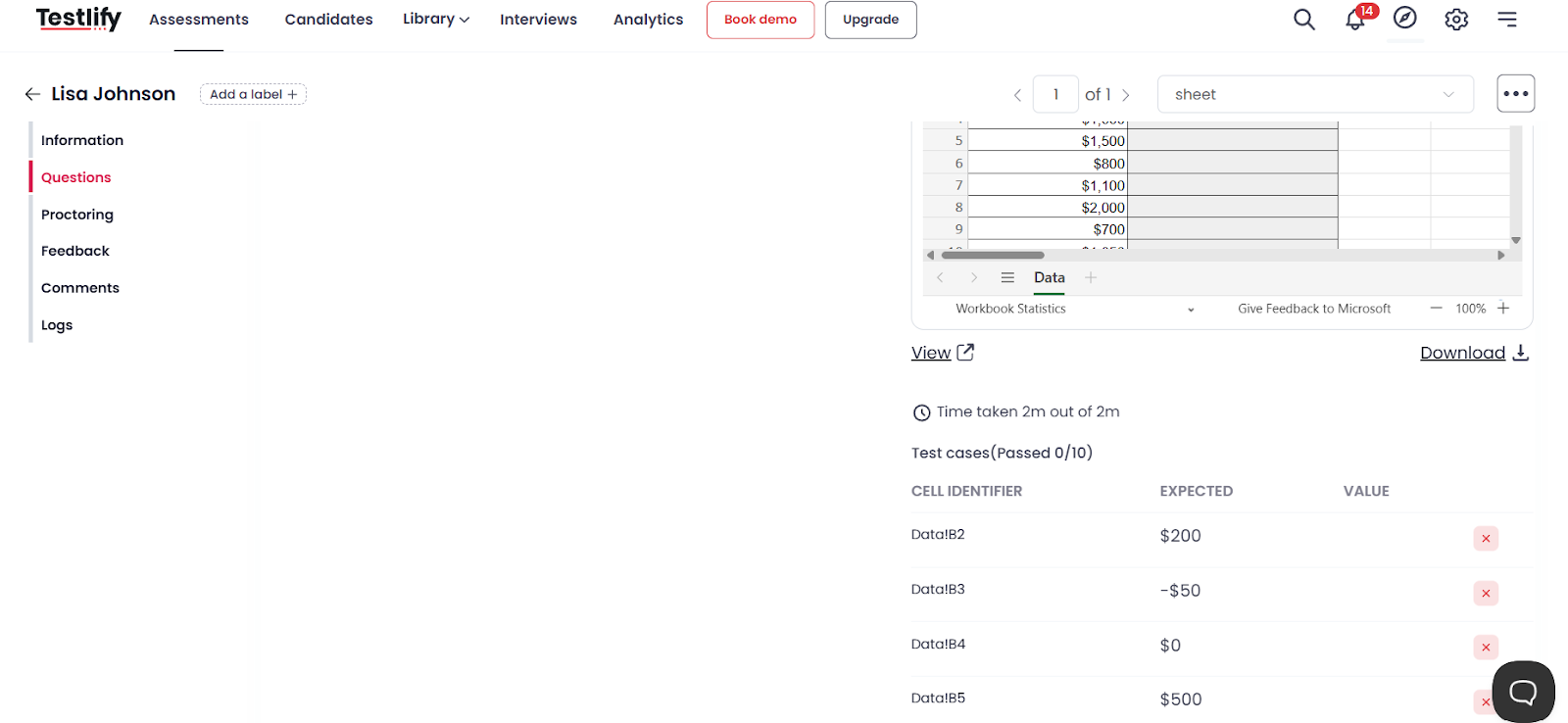
Finance roles lean on spreadsheet work, and proficiency is the claim candidates overstate most. A task-based test removes the guess: candidates work in a real spreadsheet, and the submission is scored on accuracy, logic, and completion rather than on a self-rating.
In Testlify, you pick a question type and either use a pre-built template or write your own, including questions that run inside Google Workspace and Microsoft Office tools.
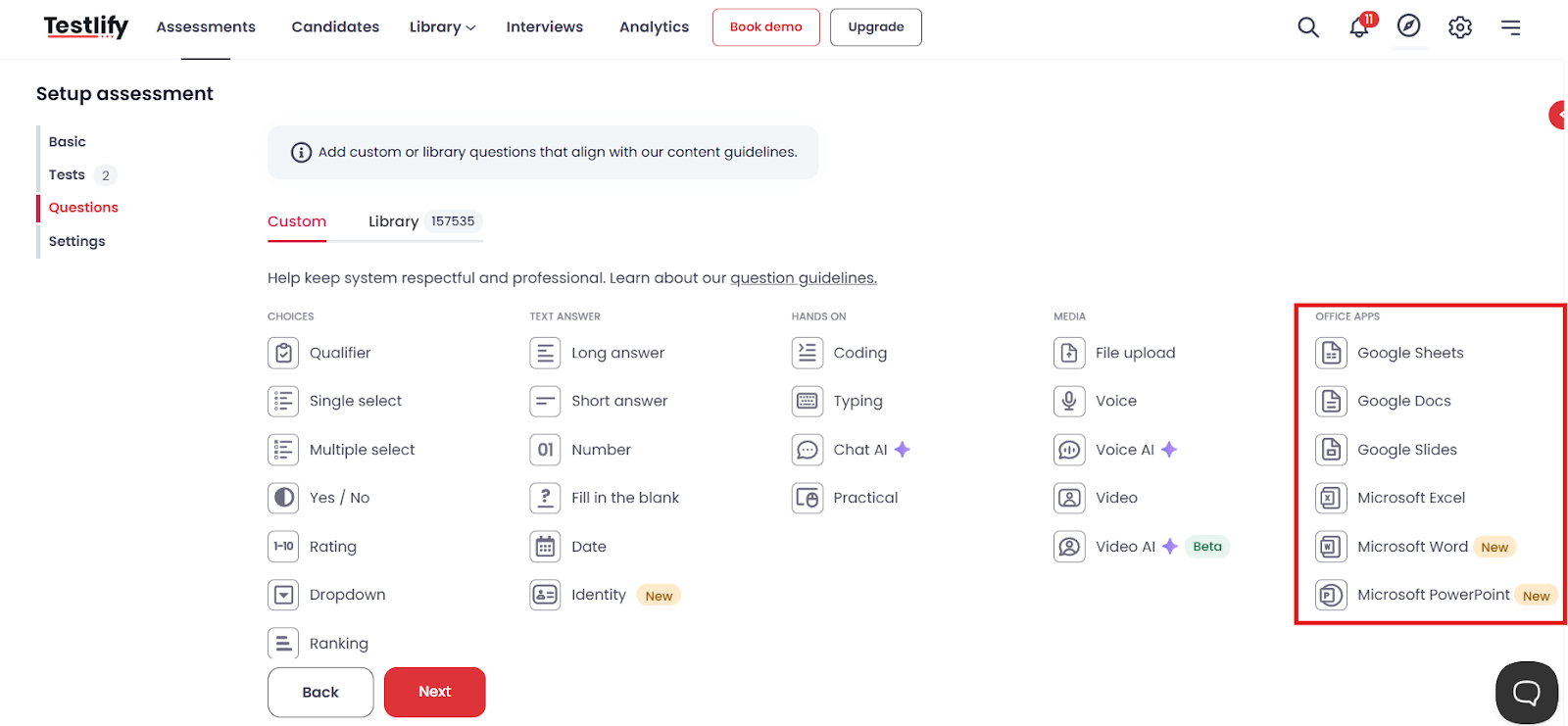
To assess spreadsheet skill, choose the question type, then take a template or build the question directly.
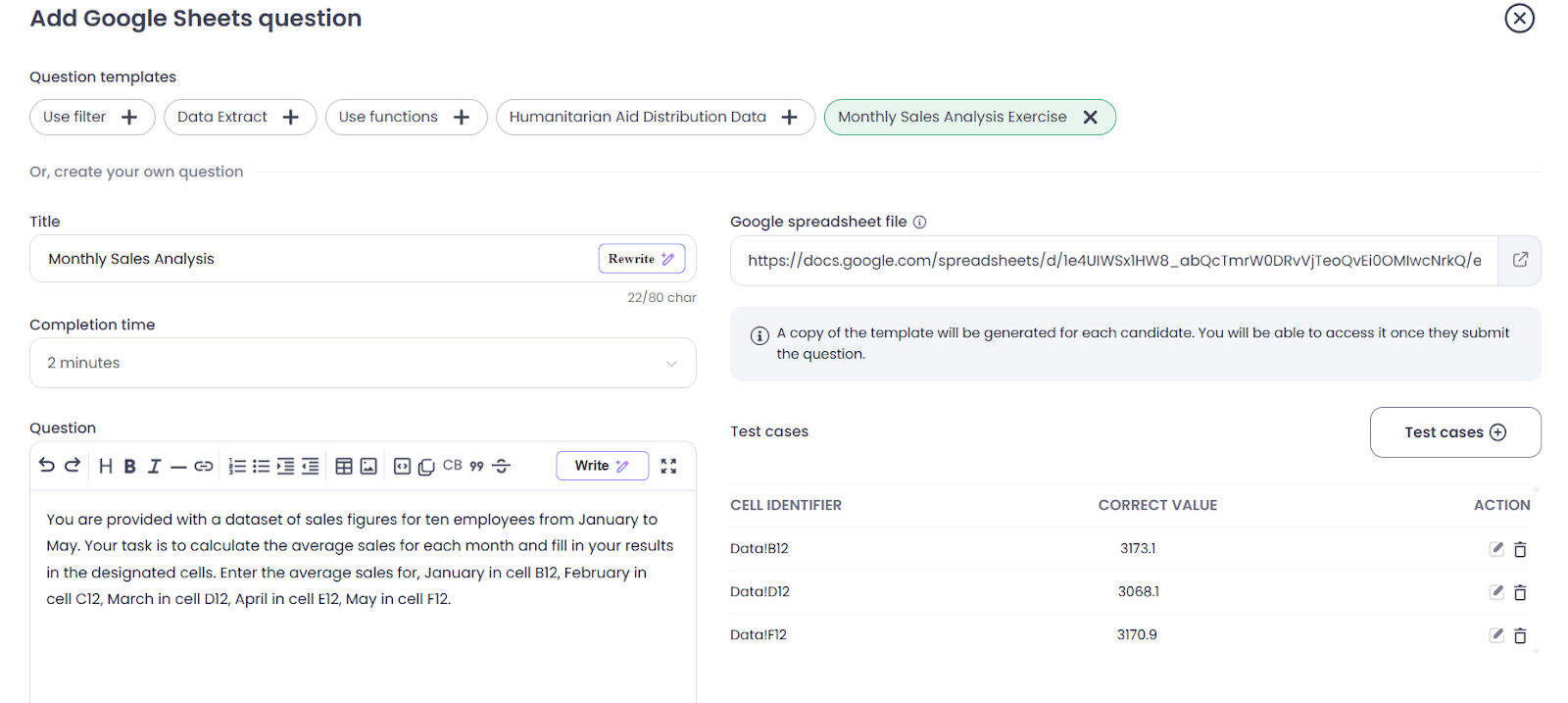
Candidates get a distraction-free interface. For Google Sheets questions they work in an actual spreadsheet, the way they would on the job.
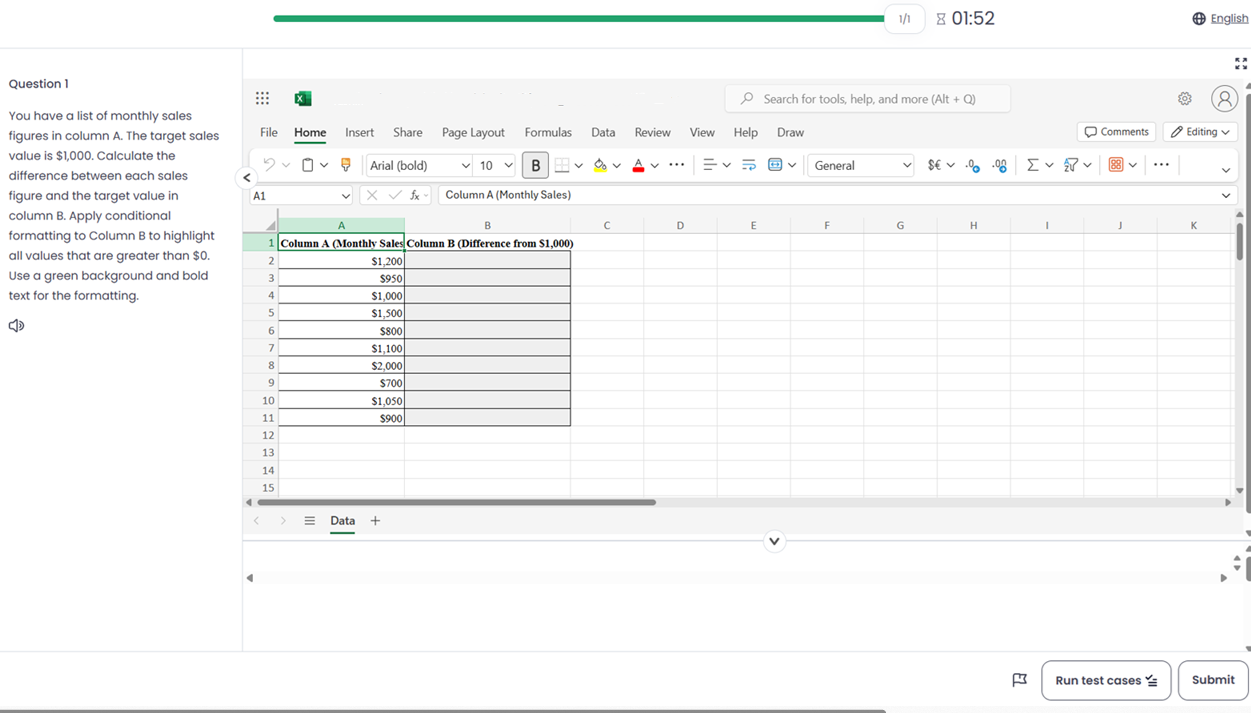
On submission, the sheet is scored automatically on accuracy, logic, and completion.
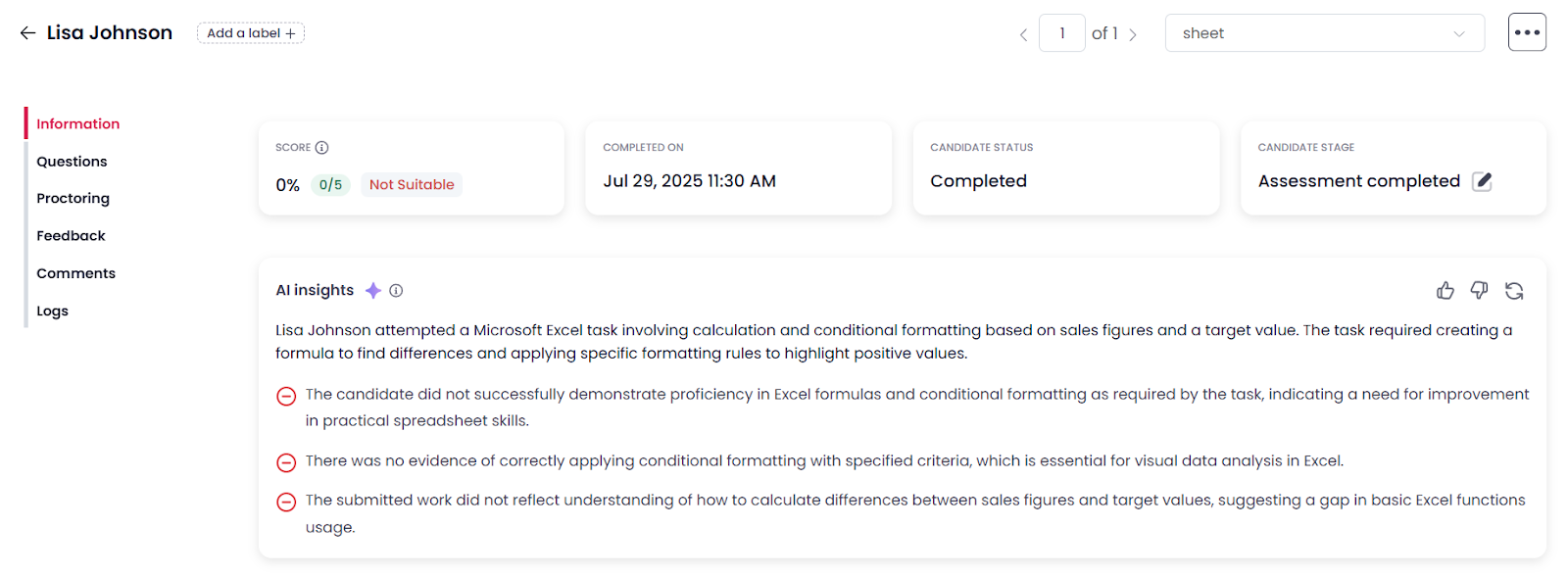
The report shows the candidate's actions, a comparison against other submissions, and a breakdown by skill, which is what makes a shortlist defensible to a hiring manager.
Judgment and ethics in client-facing roles
Integrity and composure under pressure decide outcomes for advisors and compliance officers, and a resume says nothing about either. Situational judgment tests and personality assessments put a scored, comparable signal in front of the panel before the interview, so the interview can probe the result instead of starting from zero. For advisory roles specifically, a communication and persuasion test shows how clearly a candidate explains a recommendation, and a behavioral management test covers initiative and ethical grounding.
Assessment integrity at the stages that matter
In a regulated industry, a score is only useful if you can say who produced it. Testlify ships three proctoring presets, Standard, Strict, and Custom, with measures including photo ID verification with a face match against the ID, tab-switch and multi-monitor detection, AI-tool and browser-extension detection, and dual-device proctoring, where the candidate's phone acts as a second camera and the assessment cannot start until mobile monitoring is active.
The design decision worth copying is what happens with a flag. Sessions come back green, yellow, or red, and a yellow reads "a quick manual review is recommended" rather than a verdict. Auto-termination is a separate, opt-in setting with a threshold a recruiter chooses. Face verification data is deleted after 30 days and candidates can withdraw consent at any time, which is the kind of detail a compliance review will ask about. Keep heavy proctoring for the high-stakes stage and leave the first screen light, or completion rates pay for it.
Volume screening that stalls on manual review
Graduate and operations pipelines arrive in bulk, and resume review does not scale to them. A role-specific assessment ranks the cohort on the competency you named, which cuts the queue to a reviewable shortlist and shortens both time-to-hire and time-to-fill. This is the stage where campus hiring programs gain the most, because a graduate cohort has no work history to rank on. Results sync into the applicant tracking system a team already runs, so the shortlist lands where recruiters work rather than in a separate tool.
How do you roll this out without losing candidates?
Four habits separate an assessment program that lasts from one quietly abandoned after two quarters.
- Keep it role-specific and short. One or two competencies per role, and a first-stage assessment a candidate can finish in a single sitting. A long generic battery is the most common cause of drop-off.
- Tell candidates why. State what the assessment measures and how it is used. Completion rates move with this, and it is the fairness story the candidate repeats to other candidates, which is employer branding you do not have to buy.
- Give hiring managers the breakdown, not the total. A skill-level report supports a recommendation; a single number invites an argument.
- Check the scores against outcomes. After two or three cohorts, compare assessment results with manager-rated performance and retention, then adjust the weights. An assessment nobody validates is just a different kind of guess.
The tradeoff to name out loud: assessments add a step. On a senior, low-volume search where the shortlist is five known names, that step rarely earns its place, and a structured interview with a written scorecard does the same job. Volume and repeatability are what make testing worth it.
To see how the role-specific tests, proctoring presets, and skill-level reporting fit your requisitions, book a demo with the Testlify team.
FAQs
Key takeaways
- Pick the competency first and the test second; the role decides the assessment, not the catalog.
- Consistent scoring is where the accuracy comes from, so do not override a total on instinct.
- Write the job-relatedness argument and track selection rates from the first cohort, in finance especially.
- Proctor the high-stakes stage, keep the first screen light, and have a human review every flag.
- Validate against performance and retention after two or three cohorts, or the program is guesswork with a score attached.

Content Writer
Yashika Khandelwal is a Content Writer with 3+ years of experience creating research-backed content on hiring, talent assessment, and HR technology. She is a registered Organizational Psychologist and subject matter expert who combines behavioral science with practical recruitment insights to produce accurate, evidence-based content.
LinkedInRelated resources
View all
Skill assessment
Top 10 job roles that need pre-hiring assessments

Skill assessment
Skills and abilities: What’s the difference?

Skill assessment
What is skills management? Definition, process, and benefits

Skill assessment
How to efficiently evaluate hard and soft skills in 2026?
Skill assessment
What is an interview scorecard and how to create one?
Skill assessment
Learning Agility: What It Is and How to Assess It (2026)
Get started.
Hire on proof, not resumes.
Run your first skills-based assessment free — no credit card required.