
Screening interview explained: Purpose, stages, and tips
A screening interview helps recruiters check early fit, save time, and move the right candidates forward in the hiring process.

A screening interview is a short first conversation, usually by phone or video, that helps a recruiter decide whether a candidate should move forward in the hiring process. It is not the final judgment. It is an early filter to check basic fit and interest.
That may sound simple, but this step carries more weight than most teams admit. In one quick call, recruiters are often checking whether a candidate’s experience matches the job description, whether the role makes sense for them, and whether basics like notice period or salary expectations line up.
In many cases, this first discussion decides whether the rest of the interview process is worth everyone’s time. In this guide, we will break down why screening interviews matter, where they fit in candidate screening, what happens at each stage, and how to handle them well without overcomplicating the process.
 ChatGPT
 Gemini
 Claude
 Grok
Grok Perplexity
TL;DR – Key takeaways
- A screening interview is a short first conversation used to check whether a candidate should move forward in the hiring process.
- Its main purpose is to confirm early fit, interest, and practical alignment before longer interviews begin.
- A screening interview is different from a first interview because it focuses on basics, not deep skill evaluation.
- The best screening interviews follow a clear structure, from preparation and fit checks to candidate questions and next steps.
- Strong screening interviews save time, reduce weak-fit interviews, and make candidate screening more consistent and fair.

What is a screening interview?
A screening interview is the first real conversation between an employer and a shortlisted candidate. It usually happens early in the hiring process, often as a phone screen or video call. It is not a final interview, and it is not meant to judge every skill in depth. It is an early filter for fit, interest, and basic alignment.
In practical terms, this is where a recruiter checks the things that can save everyone time later. Does the candidate’s background match the job description at a basic level? Do they understand the role? Are they still interested? Do details like work location, shift, telework eligibility, notice period, or salary expectations line up well enough to continue?
That is why this stage matters in candidate screening. It helps narrow the pool before the heavier interview rounds begin.
What makes a screening interview useful is the structure. The University of Washington advises using the same rubric for all candidates at this stage, and the The Office of Personnel Management (U.S.) notes that interviews with higher structure show better validity, interviewer reliability, and agreement.
In simple words, a good screening interview is not a casual chat. It is a short, focused checkpoint that helps teams make early decisions.
Screening interview vs phone screen vs first interview
These terms often get mixed up, but they do not always mean the same thing. A screening interview is the early filter. A phone screen is usually one way to run that filter. A first interview is often the next, deeper conversation after the screening stage.
A screening interview is meant to check basic alignment before the company spends more time on a candidate.
At this stage, recruiters usually review whether the person meets the core requirements, understands the role, is still interested, and aligns on practical points like location, availability, and salary expectations.
A phone screen is usually just the format of that early conversation. It is short, practical, and often handled by a recruiter.
Northwestern University’s guidance shows exactly how these calls are used: review the role, walk through the resume at a high level, confirm minimum qualifications, discuss compensation, timing, and fit, then decide whether the person should continue. So, in many hiring teams, a phone screen is simply the most common version of a screening interview.
A first interview usually goes further. Once a candidate clears the early screen, the next round tends to focus more on job-specific ability, examples from past work, problem-solving, and team fit.
That distinction matters because many hiring mistakes start when teams treat all three as the same thing. If the early screen is too shallow, weak-fit candidates move ahead. If it becomes too deep too soon, the process slows down and good candidates lose interest.
Enterprise teams also run live video screens, one-way (asynchronous) video screens, and automated chatbot/text screens. Live video interviews are roughly six times faster to review at scale than phone screens, and one-way video lets a recruiter review about 10 candidates in the time a single phone screen takes, though one-way formats require a validated scoring rubric to hold up to legal scrutiny.
Where the screening interview fits in the candidate screening process
A screening interview sits near the start of the candidate screening process, after the application and resume review but before the deeper interview rounds. In most hiring flows, the order looks something like this:
- Application
- Resume shortlisting
- Screening interview
- Skills assessment
- First formal interview
- Hiring manager or panel rounds
Workable describes the screening call as one of the initial hiring stages used to check whether a candidate is genuinely interested and at least minimally qualified.
That position in the process matters because the screening interview is where teams make an early go or no-go decision. It helps recruiters confirm the basics before the company invests more time.
it recommends the screen trigger a skills assessment before the panel interview, not after, noting this sequencing can reduce panel interview volume by 30 to 40%.
The 6 stages of a screening interview
A good screening interview should feel simple. The best ones follow a clear flow. That helps recruiters stay consistent and helps candidates understand what the conversation is really about.
1. Preparation before the call
The work starts before the call begins. A recruiter should know what the role actually needs, what the candidate’s profile says, and what must be confirmed in the conversation. This is the stage where the recruiter reviews the job description, checks for key qualifications, and decides what needs a closer look. It could be a career gap, a change in industry, missing context on a recent role, or a possible mismatch between the candidate’s experience and the position.
This step matters because a screening interview is short. If the interviewer comes in unprepared, the call often turns into a generic chat with no real value.
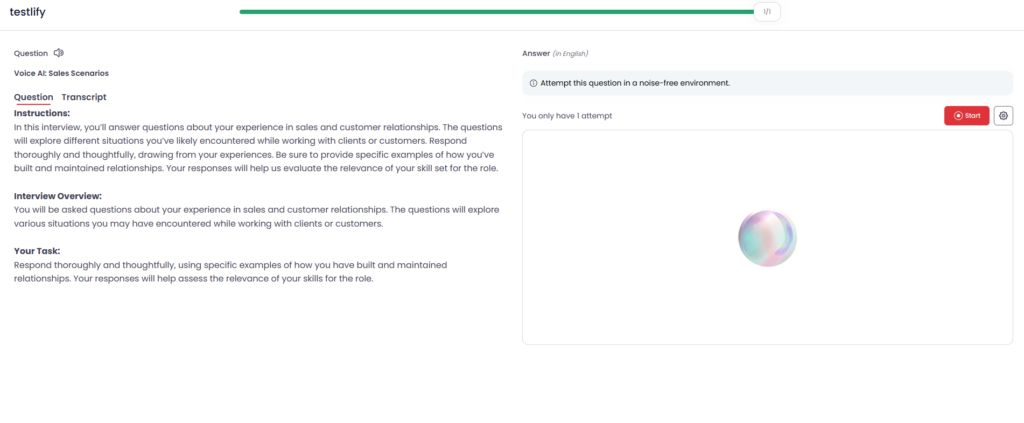
For some teams, this stage can also be supported with structured tools like AI audio interviews, especially when the goal is to handle high-volume applicants.
Every screening question should map to a documented, job-related competency or requirement pulled from the job analysis. Questions about age, marital status, national origin, or disabilities are prohibited under Title VII and the ADA, regardless of how casually they are asked (EEOC).
2. Opening the conversation
The opening sets the tone. A strong start is short, clear, and calm. The recruiter introduces themselves, explains the role in a few lines, and tells the candidate what the conversation will cover. This may sound basic, but it makes the call feel more respectful and organized.
Disclose the process at the start of the call — what the screen covers, how long it will take, and what comes next. This reduces no-shows at later stages and improves candidate experience scores, which feed directly into employer brand metrics.
3. Baseline fit check
This is the core of the screening interview. Here, the recruiter checks whether the candidate meets the role at a basic level. That does not mean going deep into every skill. It means answering a few simple questions. Does the person have relevant experience? Have they handled similar work before? Do they understand what the role demands?
This is also where resume claims start getting tested in a light but useful way. A candidate may look good on paper, but the call helps reveal whether their experience is truly relevant or just loosely related. In many hiring teams, this stage decides whether the person moves forward or not.
4. Motivation and intent
A candidate may be qualified and still not be the right fit for the role. That is why motivation matters. At this stage, the recruiter usually tries to understand why the candidate applied, what they want next, and whether the role actually matches that direction. This part is often underrated.
5. Practical alignment
This is where recruiters check the details that can block progress later. That includes location, work setup, notice period, schedule fit, and salary expectations. These are not side issues. They are part of early fit.
A candidate may be capable and interested, but if the role is office-based and they only want remote work, the process may not make sense to continue.
Apply ban-the-box rules at the screen stage (criminal history cannot be asked about during pre-offer screening in ban-the-box jurisdictions, confirm the ATS workflow reflects the most restrictive jurisdiction in the hiring footprint), and log salary range compliance, since more than 30 US states prohibit asking about salary history, ask only about salary expectations and confirm they align with the posted range, documenting the confirmation in the ATS record.
6. Candidate questions and next steps
The final stage is often short, but it matters. A good screening interview should leave space for the candidate to ask questions. This tells the recruiter something useful as well. Thoughtful questions usually show preparation, interest, and seriousness. No questions at all do not always mean a bad fit, but they can sometimes show low engagement.
Before ending the call, the recruiter should explain what happens next. That might be a test, a hiring manager interview, or a follow-up discussion.
Running screening interviews at enterprise scale
HR teams running screening interviews at volume, with compliance stakes that are worth calling out on their own. The points below are genuinely new relative to the guidance above.
Why it matters at scale: every bad hire costs an organization an average of $5,475 in direct costs, before factoring in the hidden cost of interviewer time, which runs $4,000 to $8,000 for a mid-level professional hiring loop (SHRM, 2026). Average time-to-hire has stretched to 68.5 days (The Interview Guys, 2025), meaning every inefficient early-stage screen adds real cost. EEOC enforcement of AI-assisted hiring tools has also intensified, putting the compliance burden squarely on the employer rather than the vendor (EEOC, 2026). Talent acquisition teams at large organizations are managing 5 to 8 interview rounds per role, a volume that only works if the first filter is airtight. Done well, screening interviews reduce time-to-fill, protect interviewers' time, and produce an auditable record of consistent, job-related evaluation.
ATS integration timing: for roles integrated with Workday, Greenhouse, or Lever, the screening step is where candidate data first enters the ATS pipeline. Greenhouse and Lever connect via REST API in 1 to 2 days, while Workday typically requires middleware (MuleSoft, Boomi) and 4 to 8 weeks of integration work. Scheduling the screening trigger correctly inside the ATS avoids duplicate records and keeps the audit trail clean. Greenhouse and Lever both support structured feedback forms natively for scoring; Workday shops generally need a custom scorecard template built in the Recruiting module.
Audit pass rates quarterly: if screening pass rates differ significantly by race, gender, or age group, the question set or scoring rubric may have a disparate impact problem. The Merge-Draft page recommends catching this internally before it becomes an EEOC charge, with a people operations team owning the audit on a quarterly cadence. It also recommends pairing screens with objective assessments, such as a cognitive ability test or role-specific skills assessment, to reduce interviewer conformity bias and contrast effect at the panel stage.
Red flags and false red flags in screening interviews
Not every weak moment in a screening interview is a warning sign. Some candidates are nervous, some need a minute to settle, and some are just not naturally polished on a short call. The real job here is to separate lack of fit from normal human variation.
A good recruiter should look for patterns that affect the role, not just small things that sound awkward at the moment.
What you notice | Real red flag | False red flag | What to do |
|---|---|---|---|
The candidate gives vague answers about past work | They cannot clearly explain what they actually did, what they owned, or what results they contributed to | They take a few seconds to think before answering | Ask one follow-up question and check whether the answer becomes clearer |
Their background sounds relevant on paper but weak in conversation | Their experience does not match the role once you go beyond the resume lines | They are not great at speaking in a polished way | Focus on relevance, not presentation style |
They show little understanding of the role | They have not read the job description properly or clearly do not understand what the job involves | They ask a basic clarifying question early in the call | Check whether they understand the role after you explain it once |
Their interest feels low | They sound disengaged, give flat answers, and show no clear reason for applying | They are slightly reserved or formal at first | Look at the full conversation, not just the first two minutes |
They avoid practical details | They are unclear or inconsistent about notice period, location, work setup, or salary expectations | They need a moment to check dates or numbers | Confirm the details directly before assuming misalignment |
Their answers do not add up | There are repeated contradictions around dates, responsibilities, or reasons for moving jobs | They simplify an answer because the call is short | Go deeper only where the inconsistency matters to the role |
They speak negatively about past employers | They are openly bitter, blame everyone else, or sound unprofessional | They describe a difficult situation in a calm and fair way | Listen for tone, accountability, and balance |
They have no questions at the end | They show no curiosity about the role, team, or next steps | They say their main questions were already answered during the call | Treat this as one signal, not a final decision on its own |
They seem nervous | Not a red flag by itself unless it blocks basic communication for the role | Very common in early-stage interviews | Give the candidate space and judge the content of the answer |
They have a career gap or unusual career move | Not a red flag by itself unless the explanation raises real concerns | Many strong candidates have non-linear careers | Ask for context instead of making an assumption |
Final takeaway
A screening interview is a small step with a big impact. When done well, it helps teams spot early fit, avoid wasted interviews, and move the right candidates forward faster. The goal is simple: keep it structured, relevant, and easy to judge fairly.
If you want to make early candidate screening more consistent with assessments and AI-powered interview workflows, book a demo with Testlify today!
Frequently asked questions (FAQs)

B2B SaaS Content Writer
Rishav Kumar is a B2B SaaS content writer with 4 years of experience. He loves crafting engaging content. Always exploring fresh ideas, he's passionate about helping businesses grow through impactful writing.
LinkedInRelated resources
View all
Candidate Screening
Candidate Screening Dos and Don’ts: Best Practices for 2026

Candidate Screening
How to automate your candidate screening process (2026)

Candidate Screening
Preliminary Screening: How to Run the First Filter in Hiring
Candidate Screening
Which technical assessment platforms support in-browser coding with live proctoring?

Candidate Screening
Language fairness in assessments: The complete guide for global hiring teams

Candidate Screening
Best Pre-Hire Assessment Platforms for Enterprises: An Honest Buyer’s Guide (2026)
Get started.
Hire on proof, not resumes.
Run your first skills-based assessment free — no credit card required.