
What’s the best way to combine psychometric tests with skills tests?
Discover how to combine psychometric tests with skills tests to evaluate personality, cognitive ability, and job readiness of candidates.

Resumes tell you where someone has worked, and interviews tell you how well they speak under pressure. Neither tells you with confidence whether the person can actually succeed in the role.
Yet most companies still rely heavily on both, only to face costly mis-hires, poor performance, and high turnover months later. The smarter approach is to assess candidates before the interview stage using a combination of skills tests and psychometric assessments.
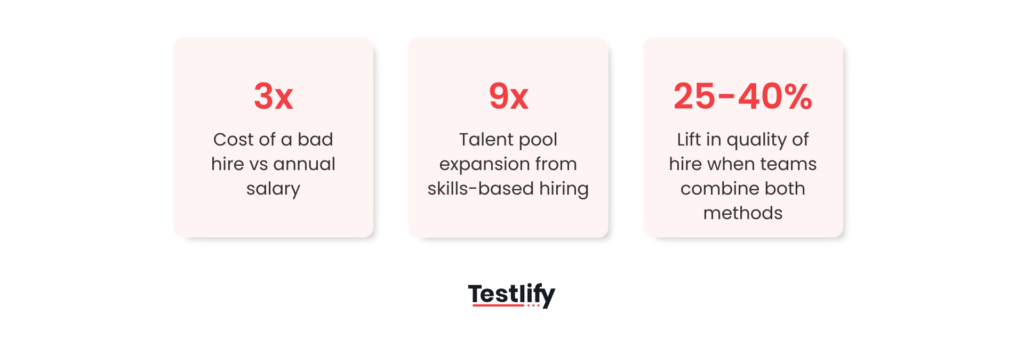
Recruiters must run skills tests first as the capability filter, then layer psychometric data on the shortlist as the fit validator. This sequence sharpens decisions, reduces bias, and lifts the quality of hire by 25 to 40 percent in most rollouts.
 ChatGPT
 Gemini
 Claude
 Grok
Grok Perplexity
What are psychometric tests in hiring?
Psychometric tests are scientifically validated assessments that help employers measure how candidates think, solve problems, and behave at work. Unlike resumes or unstructured interviews, these tests provide objective insights into a candidate’s potential fit for a role.

Different types of psychometric tests
Employers today use a combination of these psychometric tests to gain a more complete understanding of candidates during the hiring process.
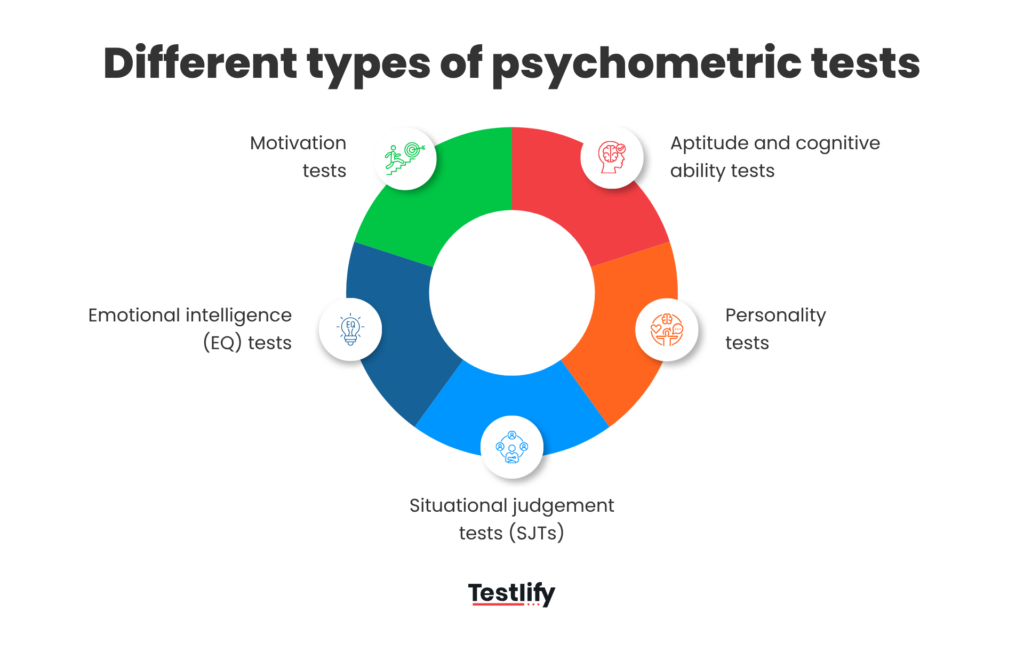
Aptitude and cognitive ability tests
Aptitude and cognitive ability tests measure a candidate’s logical reasoning, analytical thinking, problem-solving ability, and information-processing speed. These tests are usually timed and contain questions with correct and incorrect answers.
- Numerical reasoning test helps evaluate how well candidates interpret graphs, analyze data, and solve mathematical problems.
- Verbal reasoning test enables recruiters to assess a candidate’s ability to understand, interpret, and evaluate written information.
- Abstract reasoning test helps evaluate logical thinking and pattern recognition using shapes, sequences, and visual relationships.
- Error-checking test measures attention to detail, accuracy, and speed when identifying errors and inconsistencies in data.
Personality tests
Personality tests evaluate behavioral styles, communication preferences, and how candidates interact with others in workplace environments. These assessments are usually untimed and do not have right or wrong answers.
- The Big Five personality test measures openness, conscientiousness, extraversion, agreeableness, and emotional stability.
- The Occupational Personality Questionnaire focuses on workplace behavior and professional strengths.
- The Myers-Briggs Type Indicator (MBTI) evaluates personality preferences and decision-making styles.
Situational judgement tests (SJTs)
Situational judgement tests present realistic workplace scenarios and ask candidates how they would respond in different situations. These tests help employers evaluate decision-making ability, interpersonal skills, communication style, and professional judgment.
Emotional intelligence (EI) tests
The Emotional intelligence test measures a candidate’s ability to recognize, understand, manage, and respond to emotions effectively. Employers often use these assessments for leadership, customer-facing, and team-oriented roles. Tools such as the Trait Emotional Intelligence Questionnaire (TEIQue) are commonly used for EQ testing.
Motivation tests
A Motivation test is useful for identifying what drives a candidate to succeed, including career goals, workplace preferences, personal interests, and sources of motivation at work.
What are skill tests in hiring?
Skill tests are job-specific assessments that measure a candidate’s ability to perform real work tasks required for a role. Unlike resumes, which rely on self-reported experience, skills assessments evaluate proven capability through measurable performance.
Companies use skills tests to assess both hard skills and soft skills before interviews begin. These assessments help recruiters identify candidates who can actually perform the job rather than candidates who only present well on paper.
Key types of skills tests
Companies use different types of skills tests to evaluate whether candidates can perform the practical, technical, and interpersonal tasks required for a role.
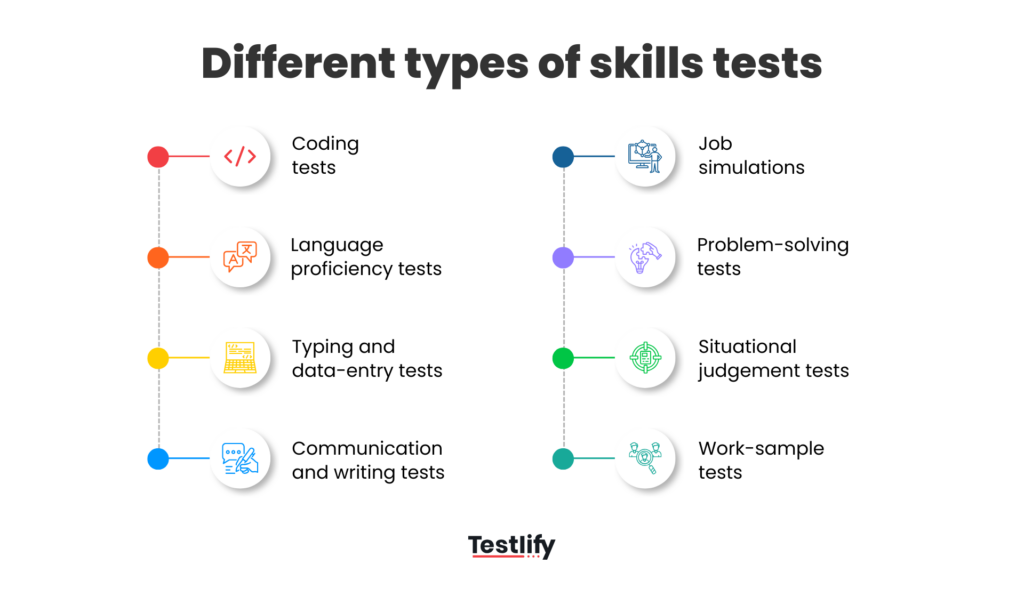
Coding tests
Coding tests evaluate programming knowledge, debugging ability, algorithmic thinking, and real-world software development skills. Companies often use live coding challenges, take-home assignments, and coding simulations during technical hiring.
Language proficiency tests
Language proficiency tests measure reading, writing, speaking, listening, and grammar skills in one or multiple languages. These assessments are frequently used for customer support, content, sales, and communication-focused roles.
Typing and data-entry tests
Typing and data-entry tests evaluate typing speed, accuracy, concentration, and attention to detail. Employers commonly use these assessments for administrative, support, and operations positions.
Job simulations
Job simulation, especially for assessing sales and customer service roles, presents realistic customer interactions to evaluate persuasion, negotiation, empathy, objection handling, and communication skills in workplace scenarios.
Problem-solving tests
The problem-solving test measures logical reasoning, analytical thinking, decision-making, and the ability to solve unfamiliar workplace challenges effectively.
Situational judgement tests
Situational and role-play assessments place candidates in realistic job scenarios to evaluate how they respond to deadlines, customer interactions, workplace conflicts, or business challenges.
Soft skills tests
Soft skills tests evaluate communication, teamwork, adaptability, leadership, emotional intelligence, and conflict resolution. Many modern platforms use scenario-based simulations to assess these workplace behaviors.
Work-sample tests
Work-sample tests replicate real job tasks to measure practical performance. Candidates may be asked to write content, analyze data, create presentations, review reports, or complete role-specific assignments.
How do psychometrics and skills tests differ?
Dimension | Psychometric tests | Skills tests |
|---|---|---|
Primary purpose | Measure how a candidate thinks, behaves, communicates, and adapts in workplace environments. | Measure whether a candidate can perform the actual tasks required for the role. |
What they evaluate | Cognitive ability, personality traits, emotional intelligence, judgment, motivation, and behavioral patterns. | Technical proficiency, practical execution, domain expertise, and job-specific skills. |
Core hiring question answered | “How is this person likely to work and grow over time?” | “Can this person successfully do the job today?” |
Predicts best | Long-term performance, leadership potential, culture fit, and adaptability. | Immediate productivity, role readiness, and operational performance. |
Assessment format | Personality questionnaires, reasoning tests, situational judgment tests, and behavioral assessments. | Coding challenges, simulations, case studies, work samples, and technical tests. |
Nature of results | Produces behavioral profiles, cognitive benchmarks, and trait-based insights. | Produces measurable performance scores against predefined job criteria. |
Best stage in hiring | Most effective during mid-to-late stage evaluation and final hiring decisions. | Most effective during early-to-mid stage candidate screening and shortlisting. |
Strength when used well | Identifies candidates with high long-term potential, resilience, and leadership capability. | Identifies candidates who can immediately contribute and perform role-specific tasks effectively. |
Limitations when used alone | Misses the existing skill gaps of candidates | May fail to identify behavioral risks, adaptability issues, and long-term growth potential. |
Best use case | Evaluating leadership, communication, decision-making, and team fit. | Validating technical competence and job readiness with objective evidence. |
Strategic value in hiring | Helps companies build stronger teams, reduce culture mismatch, and improve retention. | Helps companies reduce mis-hires and accelerate productivity. |
Most effective approach | Works best when combined with structured skills assessments for a complete view of candidate potential. | Works best when paired with psychometric testing to balance capability with long-term fit. |
Why should HR leaders combine the tests?
Each method on its own creates blind spots. A skills test confirms someone codes well, but cannot predict how they handle pressure or feedback. A personality test flags a strong communicator who lacks the technical chops. The combination closes both gaps and gives hiring managers a complete decision picture.
According to SHRM, the cost of recruiting, hiring, and onboarding a new employee can be as much as $240,000. The math on bad hires favors any method that catches mistakes earlier in the funnel.
Best framework for combining both assessments
A reliable framework rests on five steps. Each step removes guesswork from the hiring decision.
Step 1: Define the role with measurable outcomes
Start with the actual work the new hire must deliver. Translate every responsibility into a testable behavior or skill.
A sales role demands measurable outreach skills and a persistent personality profile. An engineering role requires a coding test and a problem-solving cognitive measure.
Step 2: Run skills tests early in the funnel
Place skills tests right after the application stage. This step proves capability before any human bias enters the loop.
Use timed, role-specific assessments that mirror real tasks. Avoid generic IQ-style tests at this point because they distract from the job-relevant signal.
Step 3: Layer psychometric assessments on the shortlist
Invite candidates who clear the skills bar into the psychometric layer. This sequence respects candidate time and protects your employer brand.
A short Big Five scan plus a brief cognitive test gives enough signal for most roles. Reserve longer batteries for senior or safety-critical positions.
Step 4: Score every candidate against role-specific benchmarks
Raw scores mean little without context. A senior engineer should score differently from a junior support agent on the same trait.
Build benchmarks from your top performers in each role. Compare new candidates to that profile rather than to a one-size-fits-all baseline.
Step 5: Feed assessment data into structured interviews
The data should sharpen the interview, not replace it. Hand interviewers a one-page brief with score interpretations and probing questions.
Structured interviews connect assessment evidence with face-to-face validation. Interviewers ask better questions and stop duplicating what the tests already revealed.
Which roles benefit most from a combined assessment approach?
Some roles gain more from the combination than others. The pattern follows risk and complexity.
Role type | Primary skills test | Psychometric add-on | How does the combination of tests help recruiters |
|---|---|---|---|
Sales | Outbound simulation | Drive and resilience scan | Predicts pipeline stamina |
Engineering | Coding test | Cognitive reasoning | Surfaces problem-solving depth |
Customer support | Ticket simulation | Agreeableness and stability | Predicts CSAT scores |
Management | Case study | SJT and Big Five | Reduces costly leader misfires |
Operations | Process simulation | Conscientiousness measure | Predicts adherence to SOPs |
How does combining tests reduce hiring bias?
Single-method hiring leaves room for pattern matching and pedigree bias. Combined assessment data creates a structured, evidence-based record.
Skills tests reduce credential bias because outcomes outweigh school names and job titles. Psychometric tests reduce gut-feel bias because scores compare against role benchmarks rather than the interviewer’s preferences.
Reputable assessment vendors validate every test for adverse impact. HR leaders should request validation reports and confirm fairness across demographic groups before any rollout. Hiring bias shrinks fastest when data replaces opinion at every funnel stage.
What KPIs prove the combined approach works?
Track outcomes over six to twelve months. The numbers tell the story.
Quality of hire is the headline metric. First-year retention, time to productivity, and hiring manager satisfaction round out the dashboard.
- Quality of hire score measured by manager rating at 90 and 180 days
- First-year retention rate compared to the pre-program baseline
- Time to productivity from start date to full performance
- Cost per hire, including assessment licensing fees
- Candidate experience score from post-process surveys
- Diversity of finalist pool versus prior funnel benchmarks
Most teams see a 25 to 40 percent lift in quality of hire within two quarters. Retention gains follow within the first year of full rollout.
What mistakes should HR leaders avoid?
Smart frameworks fail when teams skip basics. Five mistakes drive most failed rollouts.
- Treating personality scores as pass-fail gates instead of discussion inputs
- Using one personality profile across every role in the company
- Ignoring local employment law on assessment use and data privacy
- Skipping benchmark calibration with internal top performers
- Failing to train hiring managers on score interpretation
The first mistake creates legal and ethical risk. The other four quietly erode trust in the system over time.
How can HR teams implement this framework in 30 days?
A focused rollout beats a six-month committee process. The plan below moves teams from idea to live in one month.
- Week 1: Pick one critical role family and define five measurable outcomes
- Week 2: Select a skills test and a short psychometric assessment for that role
- Week 3: Calibrate benchmarks using current top performers in the role
- Week 4: Launch the combined funnel for new applicants and brief hiring managers
- Day 30 onward: Track quality of hire weekly and refine benchmarks every quarter
Start small, measure ruthlessly, and expand to other roles only after the first cohort proves the model. Modern pre-employment assessment platforms shorten this rollout further by bundling skills and psychometric libraries in one workflow.
Pair the rollout with a focus on candidate experience and a clear plan to lower time to hire. Both metrics protect the employer brand while the new framework matures.
Final thoughts
The future of hiring belongs to teams that combine signal sources. Skills tests alone leave cultural fit on the table, and psychometrics alone leave capability unproven. The combination closes every gap and gives HR leaders the cleanest decision data the function has ever had.
Build this framework now, and you will out-hire your competition for the next decade. Explore Testlify’s full test library to find the tests that fit your roles, and pair them with a clear skill-based hiring strategy to identify top talent best suited for your organization.
Book a demo with Testlify to see how your team can streamline candidate screening, reduce mis-hires, and make more confident hiring decisions at scale.
Frequently asked questions (FAQs)

Head of Assessments
Usha brings a rare depth of expertise to Testlify’s assessment function, over 40 years of multidisciplinary experience spanning banking, insurance, healthcare, automotive, IT services, manufacturing, pharmaceuticals, and enterprise software. At Testlify, she ensures that every assessment, scoring methodology, and competency structure meets the highest standards of enterprise-grade transparency, fairness, and consistency, the kind that holds up under audit and earns the trust of the world’s most rigorous hiring teams.
LinkedInRelated resources
View all
Candidate assessment
How to use AI to tailor assessments to job descriptions

Candidate assessment
Aptitude Tests in Hiring: The Complete 2026 Guide for Recruiters

Candidate assessment
AI features transforming HR support and leadership

Candidate assessment
Conversational Video AI interviews for sales hiring

Candidate assessment
Chat AI interviews for customer support hiring

Candidate assessment
How to use the picOCEAN personality test in hiring?
Get started.
Hire on proof, not resumes.
Run your first skills-based assessment free — no credit card required.