
Language fairness in assessments: The complete guide for global hiring teams
A complete guide for global hiring teams to ensure language fairness in assessments, improving candidate experience and diversity.

Language fairness in an assessment means a candidate's score reflects how well they can do the job, not how fluently they read English. When a test loads more language on a candidate than the role does, it stops measuring skill and starts measuring vocabulary, and the hiring team never sees the swap happen.
That swap has a name in psychometrics: construct-irrelevant variance. It is the part of a score that comes from something the test was never meant to measure. Language is one of the most common sources of it in pre-employment testing, and one of the easiest to fix once you know where to look.
Here is a case that plays out constantly. A candidate with five years of Python behind them, solid SQL, and production code shipped every quarter applies for a senior engineering role. English is their third language. They understand every technical requirement cold. But the cognitive test is dense with idioms and runs on a tight clock, so they finish well below someone who has never deployed anything. The process felt rigorous. That is exactly why nobody catches it.
TL;DR
- Language bias is a measurement error, not a diversity checkbox. The score stops predicting job performance, so the hiring decision gets worse.
- A meta-analysis of 22 studies with 3,615 raters found applicants who speak with an accent or dialect are judged less competent and less employable at identical competence.
- Six mechanisms cause most of it: processing speed, idiom, cultural reference, vocabulary load, reading density, and AI scoring trained on one speech pattern.
- You can audit what you already own in about a week: readability check, idiom count, timing review, and completion rates split by language background.
- Item-level statistics, not opinion, tell you which specific question is biased. Ask your vendor for difficulty and discrimination data per item.
- The four-fifths rule is a regulator's rule of thumb for where to look, not a legal definition of discrimination. Treat it as a smoke alarm.
 ChatGPT
 Gemini
 Claude
 Grok
Grok Perplexity
What is language fairness in assessments?
Language fairness in assessments means a candidate's result depends on job-relevant skill rather than English fluency. A language-fair test gives you the same predictive accuracy whether the candidate's first language is Mandarin, Portuguese, or English. It does not lower the bar. It removes a variable that was never part of the bar.
Worth being precise about what this is not. It is not a ban on testing language. If a role genuinely runs on written English, measure that on purpose, with a language test, and score it separately. The problem is measuring it by accident inside a test that claims to be about reasoning, coding, or judgment.

Why does language bias slip past hiring teams?
Because it produces clean-looking numbers. A biased test still returns scores, ranks, and a shortlist. Nothing errors out. The gap shows up only when you split results by language background, which most teams never do, so the process looks objective right up to the point someone audits it.
The effect itself is measured. Researchers at Neu-Ulm University of Applied Sciences, Ulm University, and the Free University of Berlin ran a meta-analysis of 22 studies covering 3,615 HR managers. Applicants were presented saying the same thing, once in standard language and once with an accent or dialect. The accented versions were rated less competent and less warm, and at identical competence they were judged less worthy of employment. The researchers' own recommendation was structured interviews, which they note are both one of the most valid selection tools and a way to cut bias out of the decision.
There's a legal edge to this too, and it catches employers who assume a vendor's tool is neutral ground. In SHRM's reporting on assessment risk, labor and employment attorney Peter Cassat put it plainly: the fact that an assessment runs through a technology that is supposed to be neutral "is not a defense as to whether a hiring practice has a discriminatory impact." The same piece flags candidates with English as a second language as a group particularly exposed. The employer owns the outcome, not the vendor.
What are the 6 types of language bias in tests?
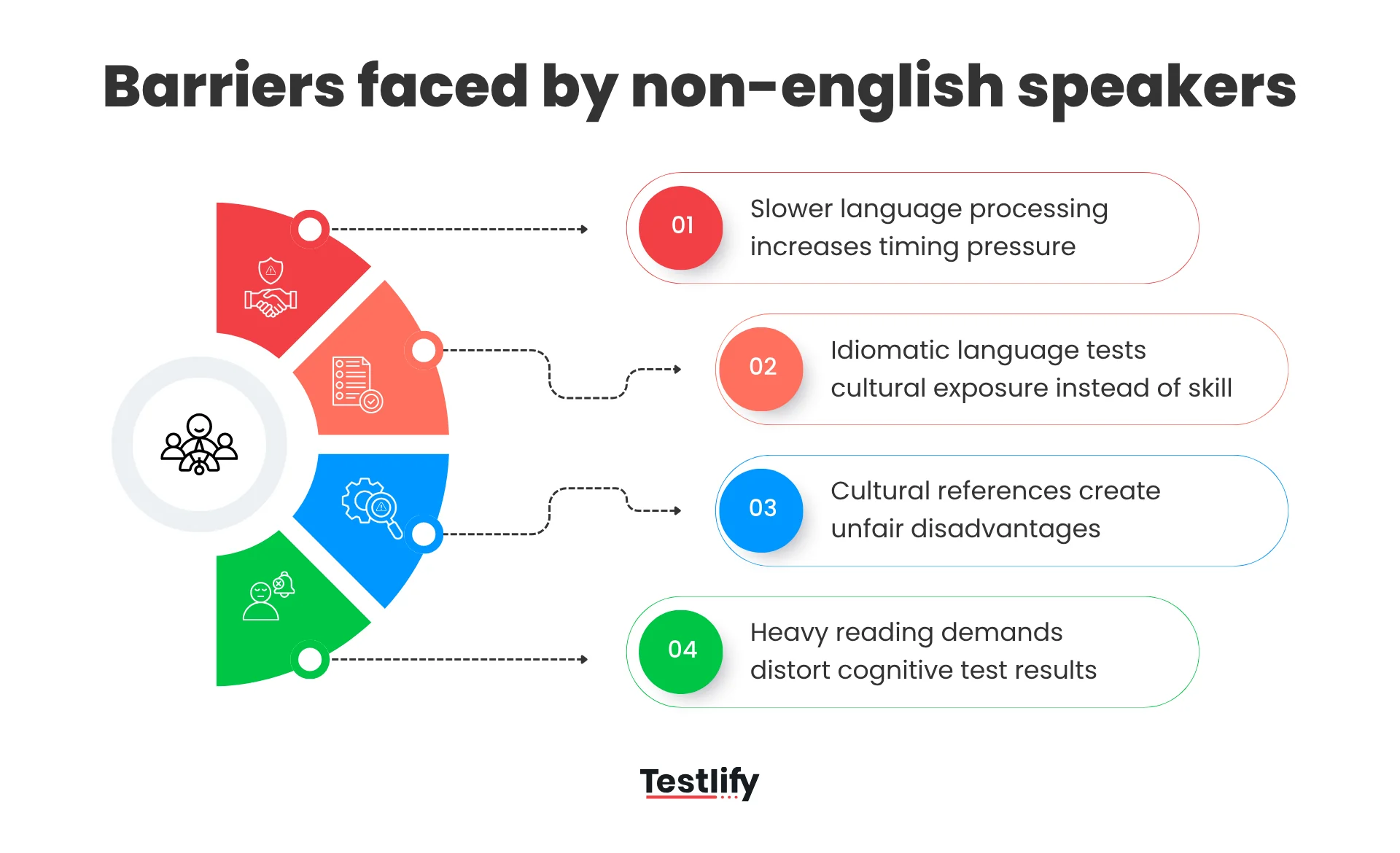
Language bias shows up in six recognizable ways. Each has a different fix, and you can usually spot all six in an afternoon with the tests you already run.
1. Processing speed bias
Reading in a second language takes more working memory, so a timed test converts that overhead into a score gap that has nothing to do with the skill being measured.
Fix: extend time limits for roles where speed isn't part of the job. For analytical, technical, and strategic roles, untimed is usually the better call.
2. Idiomatic language bias
Phrases like "ballpark figure", "low-hanging fruit", and "hit the ground running" reward people who grew up inside one set of cultural references. If a data engineer in Hanoi doesn't know what "low-hanging fruit" means, you have learned nothing about their SQL.
Fix: read every question for idioms and cut them unless the role genuinely requires that register.
3. Cultural reference bias
Scenario questions built around American football, US office norms, or one country's business etiquette penalize candidates from elsewhere even when the underlying skill is universal.
Fix: swap region-specific settings for neutral professional ones that read the same in Manila and Manchester.
4. Vocabulary load bias
Cognitive and situational judgment tests often reach for elevated vocabulary that has nothing to do with the reasoning being tested. Answering a logic question shouldn't require an advanced English word list.
Fix: write questions at the reading level the job actually needs. Grade 8 to 10 covers most professional roles.
5. Reading density bias
Long, multi-clause sentences eat the working memory a candidate should be spending on the problem. This is the core mechanism, and it is baked into a lot of off-the-shelf cognitive tests.
Fix: keep average sentence length under 20 words and run a readability score across the whole item bank.
6. AI scoring bias
Scoring models trained mostly on one group's speech patterns will mark other patterns down, with no intent required. In a 2025 study of cultural bias in large language model hiring evaluations, researchers scored 100 UK and 100 Indian interview transcripts. The Indian transcripts came out consistently lower even after anonymization, and the disparity tracked linguistic features such as sentence complexity and lexical diversity. Swapping names by gender, caste, and region produced no statistically significant effect, which is the useful part: the model wasn't reacting to who the candidate was, it was reacting to how they wrote.
Fix: don't ban AI scoring, govern it. Keep AI output advisory, require a human to set the final score, and ask your vendor for score distributions split by language background.
How do you audit assessments for language load?
Run this on the tests you already own before redesigning anything. Most teams get through the first three steps in a week, and those three alone surface the bulk of the problem.
Step 1: Measure the language load you already ship
Pull completion rates split by candidate language background. Run your top 10 assessments through a readability score, count the idioms, flag the cultural references, and note which tests run on a clock. You are looking for anywhere the language is harder than the job.
Step 2: Classify each test by language dependency
Assessment type | Language dependency | Action required |
|---|---|---|
Coding and technical | Low | Minimal changes |
Visual and spatial reasoning | Very low | No changes needed |
Cognitive ability (verbal) | High | Full redesign |
Situational judgment | Medium | Plain language review |
Personality inventory | Medium | Idiom audit |
Work sample simulations | Varies | Role-specific review |
AI-scored interviews | High | Add human override |
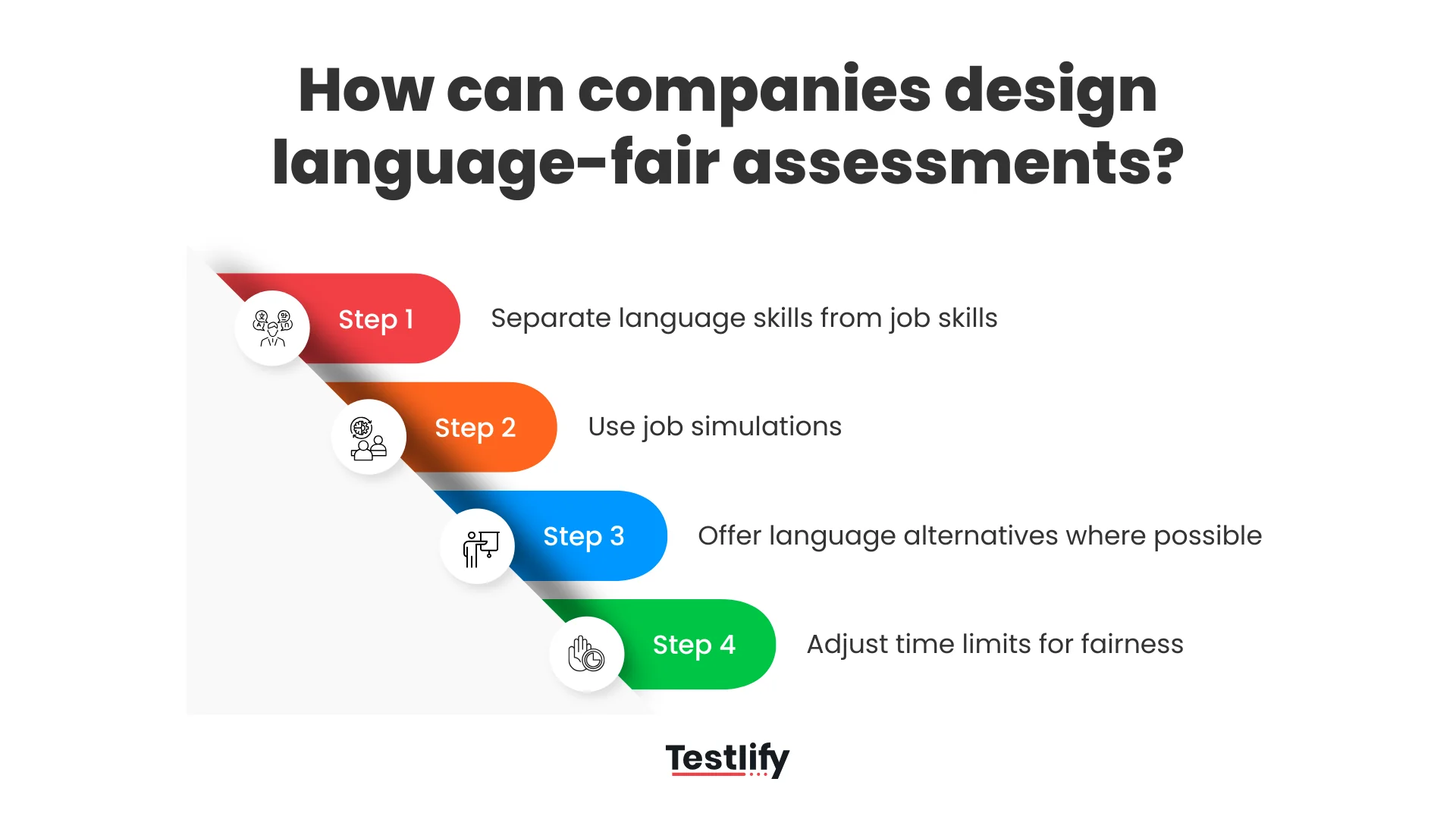
Step 3: Separate language skill from job skill
For each role, answer three questions. What is the minimum English this job actually requires? What job-performance skills are you trying to measure? Is your current test measuring the first, the second, or quietly both? If a backend engineer communicates through code and short written updates, a verbal-heavy cognitive test is working as an English screen nobody signed off on.
Step 4: Redesign the high-dependency tests
- Replace verbal reasoning with visual reasoning or pattern recognition where the role allows, and anchor the whole process in skills-based hiring rather than proxies
- Convert wordy scenario questions into role simulations the candidate performs instead of reads
- Use objectively scored formats such as coding challenges, structured case templates, or portfolio review
- Offer the test in the candidate's language where the role and the law allow it
Step 5: Set time limits by role, not by habit
Speed-critical roles such as live support or a trading desk should keep tight limits, because processing speed genuinely is the job. Most professional roles don't need a clock at all. Technical and analytical roles do best untimed or with a generous window.
Step 6: Train the people reading the results
Fluency and competence get confused at the review stage, not just the test stage. Structured rubrics, written follow-ups instead of verbal delivery, and a shared definition of what a strong answer contains all pull the decision back toward evidence. This is the intervention the meta-analysis above actually recommends.
Step 7: Measure adverse impact, then do it again next quarter
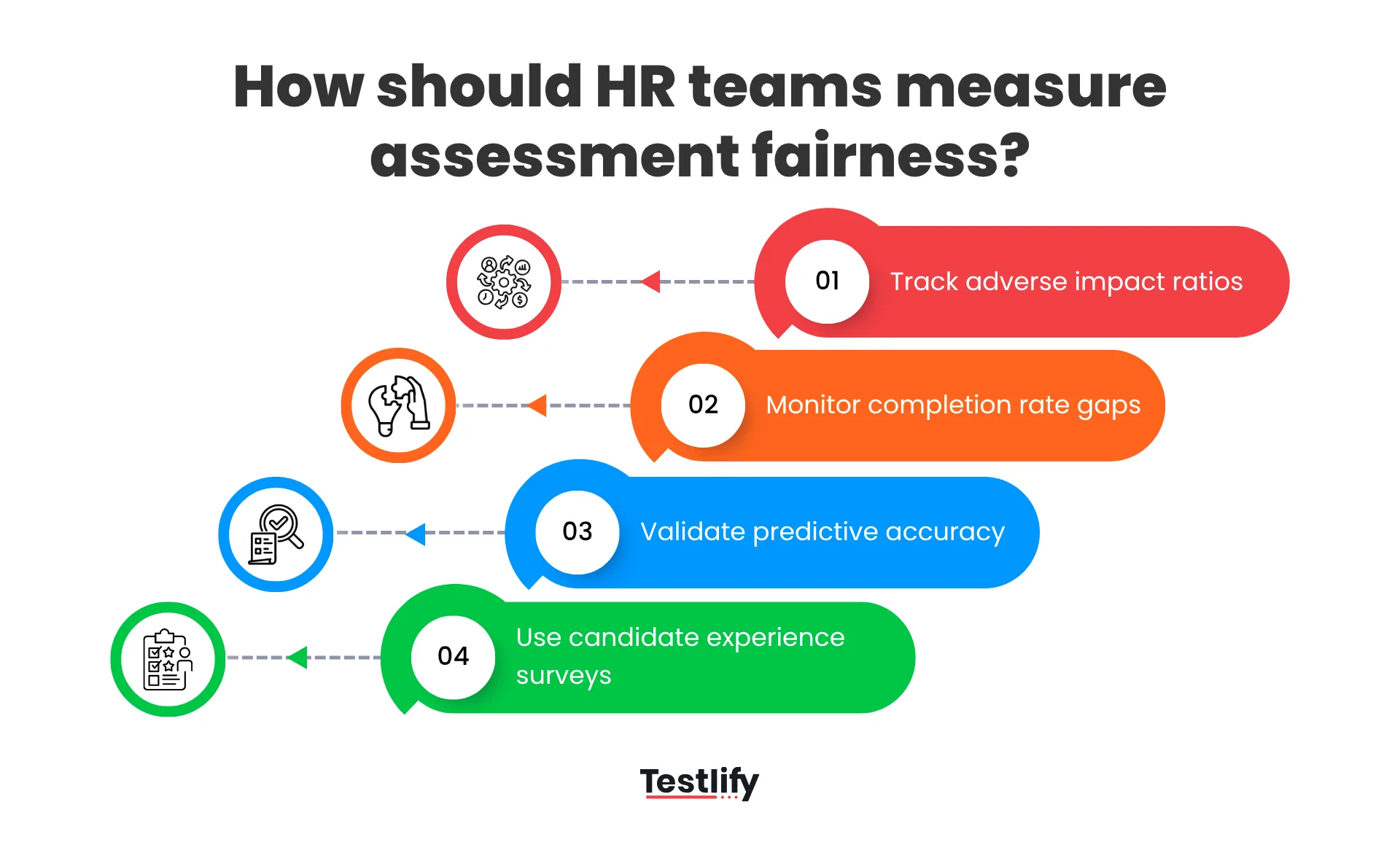
- Adverse impact ratio: the selection rate of one group divided by the selection rate of the highest group. The four-fifths rule puts 0.80 as the watch line.
- Completion rate parity: a gap of 15 points or more between native and non-native speakers is a language barrier, not a talent signal.
- Predictive validity by language group: compare scores against 90-day performance ratings. The test should predict equally well across groups, or it isn't measuring what you think.
- Candidate feedback: a short anonymous survey on question clarity, split by language background.
Pro tip: run the completion-rate split first. It takes one query, it needs no psychometrician, and a 15-point gap is usually enough evidence to get budget for the rest of the audit.
Assessment formats ranked by language load
Assessment type | Language dependency | Fairness rating | Best for |
|---|---|---|---|
Visual and spatial reasoning | Very low | Highest | Analytical, engineering, design |
Coding challenges | Very low | Highest | Software engineering, data |
Work sample simulations | Low | High | Operations, finance, sales |
Situational judgment (plain language) | Low to medium | Medium | Management, leadership |
Personality inventories | Medium | Medium | Team fit and working style |
Verbal reasoning | High | Low | Language-critical roles only |
AI-scored interviews | High | Depends on controls | Any role, with human override on |
Lead with coding tests, simulations, and visual reasoning for global roles. Keep verbal reasoning for positions where written English is the deliverable rather than the packaging. The full breakdown of pre-employment test types covers where each one fits in a hiring process.
How do you detect a biased test item?
You don't detect it by reading the question. You detect it by comparing how candidates of equal ability perform on that one item. If two groups match on total score but diverge on item 14, item 14 is measuring something extra. Psychometricians call this differential item functioning, or DIF.
This is standard practice in high-stakes testing and almost unknown in hiring. The National Conference of Bar Examiners lays out the strategies a testing body uses to detect and prevent bias, organized around four kinds of validity evidence. Three of them transfer directly to hiring:
- Content review. Train whoever writes items to avoid construct-irrelevant variance, obscure terminology being the example they name, and run a sensitivity review on every new question.
- Internal structure. Pretest items, run item analysis, and study DIF across groups. Language is explicitly one of the grouping variables they list, alongside race, ethnicity, gender, age, culture, and disability.
- External relationship. Check that scores predict the outcome with equal accuracy for each subgroup, which is the same predictive-validity test the audit above asks for.
Two honest caveats come with DIF, and the bar examiners name both. You need samples big enough to trust, which is why teams sometimes pool candidates from different regions into one group, and that pooling can hide differences inside the pool. And DIF usually places candidates into ability bands using the total score of the very test you're investigating, so it is evidence, not proof.
For most hiring teams the practical version is shorter: ask your assessment vendor for item-level difficulty and discrimination statistics, and for score distributions split by language background. If they can't produce either, you have no way to find a biased question except waiting for a complaint.
How do you offer assessments in other languages?
Offering a test in the candidate's language is the single biggest win available to a team hiring across borders, and the fastest one to get wrong. Running English questions through a translation tool moves the bias into a new language rather than removing it, because the idioms and the sentence structure travel with the words.
A translation workflow that holds up
- Translate with domain knowledge. A general translator working on a technical assessment introduces errors that look like candidate mistakes.
- Back-translate and reconcile. Have a second translator convert it back to English and compare. Where the meaning drifted, you'll see it.
- Replace, don't translate, the culture. "Ballpark figure" has no equivalent idiom in most languages. Use direct language instead of hunting for a local metaphor.
- Pilot with native speakers. Run the translated version past a small panel before it reaches candidates, and look at completion rates and score spread.
- Version-control it. When an English question changes, every translation is stale until it changes too.
Watch for calibration drift
A translated test can end up easier or harder than the original, which means candidates taking the Spanish version are held to a different standard than those taking the English one. False friends, words that look the same across two languages but mean different things, are a common cause in European language pairs. Pilot data and score equating are what close the gap.
Measure language on purpose when the role needs it
When a role genuinely requires English, test it deliberately and separately using CEFR levels, the A1 to C2 scale. A support role serving English-speaking customers might justify B2 or C1. A data engineering role working in code and documentation might need B1 and nothing more. Setting the level explicitly gives you a defensible requirement instead of an accidental one, and CEFR-aligned testing keeps that measurement out of your skills scores.
How Testlify supports language-fair hiring
The Testlify Human-Led Decision Scorecard is the framework underneath this. It turns candidate evidence into a structured hiring decision by combining assessment results, AI insights, reviewer feedback, references, and interview data while final judgment stays with the hiring team. For language fairness that division matters, because most of the damage happens when a single score, produced by something nobody can inspect, becomes the decision.
The controls that do the work:
- AI scoring stays advisory by default. The product ships the disclaimer in the interface: AI scores and insights are for guidance only, use human judgment for final decisions. Whether AI scores are shown to a reviewer, and whether they count toward the final average, are both toggles. A question can be routed for mandatory manual review.
- Real-time translation of questions into the candidate's preferred language, with the honest caveat the product itself states: quality varies by language pair. Pair it with the pilot step above rather than trusting it blind.
- Item-level statistics in the analytics: difficulty index, discrimination index, answer distribution, and a quality-risk flag for questions with very low accuracy or high skip rates. This is the data the DIF section says to ask for.
- Multilingual interview transcripts generated automatically, with the spoken language detected for recordings of at least 30 seconds, so a reviewer reads the substance instead of grading an accent in real time.
- A candidate accommodation request flow that names limited language proficiency explicitly. It is a structured request routed to an administrator who adjusts the session, a human-reviewed step rather than automatic extra time.
- Anonymous DEI data collection that is optional, skippable, and not shared with employers, so fairness reporting doesn't come at the candidate's expense.
- Per-question and per-assessment time controls, plus preparation time before a recorded answer, so step 5 of the audit is a setting rather than a project.
On AI interviewing specifically, Testlify runs one-way, two-way conversational, voice, and phone formats. The fairness question isn't whether to use them, it's whether the scores they produce can be inspected and overridden. Those controls exist and are worth turning on before the first invite goes out.
Legal exposure by jurisdiction
Language bias is a legal risk with a different shape in each market.
United States
The Uniform Guidelines on Employee Selection Procedures require that any selection procedure producing adverse impact be validated as job-related and consistent with business necessity. A language requirement that disadvantages a national-origin group needs that justification like any other screen.
The four-fifths rule sits inside the codified guidelines at 29 CFR Part 1607, and it is worth being accurate about what it is. The EEOC's own interpretive questions describe it as a practical enforcement rule of thumb, not a definition of what is or isn't lawful discrimination. A ratio above 0.80 is not a clean bill of health, and one below it is not a finding of liability. It tells you where to look.
European Union and United Kingdom
EU employment equality law prohibits indirect discrimination on national origin, which is what a language requirement becomes when it isn't tied to the job. Automated decision-making carries its own obligations, and teams running assessments at scale should read how recruitment platforms handle GDPR before switching on automated scoring. UK equality law follows the same indirect-discrimination logic.
Australia
The Racial Discrimination Act 1975 covers discrimination based on national or ethnic origin. A language requirement has to be demonstrably necessary for the role rather than a preference.
Canada, India, and Brazil
Canadian human rights law protects against discrimination on national or ethnic origin, and federally regulated employers carry employment equity monitoring duties on top. India and Brazil both run employment equity frameworks with local language access expectations for consumer-facing and government-adjacent roles. Get local review before scaling assessments into either market.
The rule that travels across all of them: if you can't show your assessment predicts job performance equally across language groups, you have a legal exposure and a hiring quality problem at once. One fix addresses both.
A 90-day rollout plan
Phase | Days | Actions | Owner |
|---|---|---|---|
Audit | 1 to 14 | Split completion rates by language background; readability-score the top 10 assessments; list every AI-scored step | TA lead |
Redesign | 15 to 45 | Swap verbal-heavy tests for skill equivalents; plain language review; reset time limits; turn on human override | TA lead |
Train | 46 to 60 | Calibrate hiring managers; update rubrics; separate fluency from competence in review criteria | HRBP |
Measure | 61 to 90 | Adverse impact ratios; candidate survey; predictive validity by language group | People analytics |
Iterate | 90 and on | Quarterly review; request item-level statistics; revalidate annually | TA lead |
Key takeaway: treat language fairness as a measurement problem and the rest follows. A test that loads more English on a candidate than the role does is returning a number that partly measures fluency, which means it predicts job performance worse than the team believes it does. The evidence that this is real is already published, the detection method already exists in high-stakes testing, and the audit fits in a quarter. Start with the completion-rate split by language background, because it is one query and it either clears your process or hands you the business case. Then work down the list: readability, idioms, timing, and the controls on any AI-generated score. What you're protecting is not just the candidate experience. It's whether your shortlist is actually your best five people.
The bottom line
Language bias is one of the most common sources of hiring error in global teams, and one of the few that is genuinely straightforward to fix. It isn't about lowering standards. It's about checking that the standard you're applying is the one you meant to apply.
If you want to see what language-fair testing looks like in a real hiring flow, including the item-level reporting and the human-override controls, book a demo and bring one of your current assessments to pull apart.
FAQs

Founder and CEO, Testlify
Abhishek Shah is the Founder and CEO of Testlify, a pre-employment assessment platform used by 1,500+ companies globally to hire fairly and at scale. He focuses on skills-based, bias-free hiring technology. Testlify is part of the SHRM Labs 2026 WorkplaceTech Accelerator.
LinkedInRelated resources
View all
Candidate Screening
Best Pre-Hire Assessment Platforms for Enterprises: An Honest Buyer’s Guide (2026)

Candidate Screening
Effective methods for screening candidates in 2026

Candidate Screening
What to look for in candidate screening software

Candidate Screening
Candidate screening: Methods, process, and best practices

Candidate Screening
Screening interview explained: Purpose, stages, and tips

Candidate Screening
Candidate Screening Dos and Don’ts: Best Practices for 2026
Get started.
Hire on proof, not resumes.
Run your first skills-based assessment free — no credit card required.