
Effective methods for screening candidates in 2026
Discover the most best methods for screening candidates. Learn how AI resume screening, skills assessments, and AI interviews help recruiters find top talent

Candidate screening has never been harder to get right, and the stakes have never been higher. In 2026, HR teams face a market that is simultaneously flooded with AI-polished applications and starved of the right skills.
According to SHRM’s Talent Trends report, nearly 7 in 10 organizations (69%) still report difficulties recruiting for full-time roles. The average cost-per-hire in the US now sits between $4,700 and $4,800, climbing sharply for specialized positions.
So what 2026 demands is a smarter screening process: one that blends technology with human judgment and gives every qualified candidate a fair shot at being seen. This guide covers the most effective candidate screening methods that exist today for recruitment teams.
 ChatGPT
 Gemini
 Claude
 Grok
Grok Perplexity
What is candidate screening?
Candidate screening is the process of evaluating applicants to determine who is qualified and worth advancing in the hiring process. It sits between the moment someone applies and the moment they walk into an interview.
Done well, candidate screening:
- Saves recruiters from wasting time on mismatched interviews
- Gives candidates from non-traditional backgrounds a fair chance to prove their ability
- Creates a structured, documented process that is legally defensible
- Reduces costly mis-hires by surfacing genuine fit early
Keep in mind that candidate screening is not a single step. It is a layered set of methods that, when combined thoughtfully, gives HR teams a complete picture of each candidate before committing significant time and resources to later hiring stages.

Popular methods for screening candidates in 2026
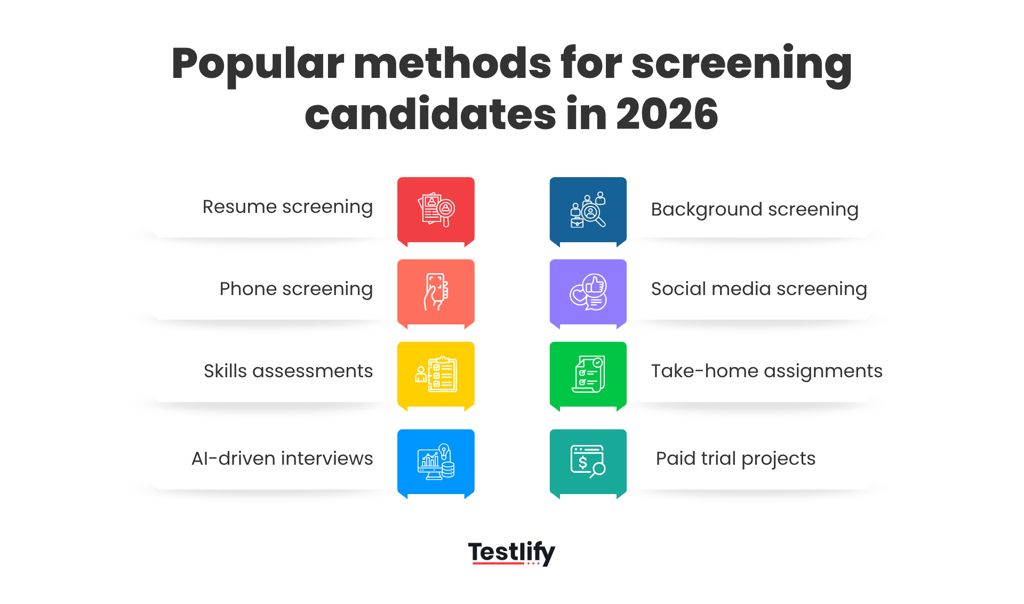
1. Resume screening
Resume screening is the first step in discovering candidates who meet the fundamental job requirements. It is also the stage most prone to unconscious bias. When a single job posting attracts hundreds of applications, no recruiter can give every resume the attention it deserves.
AI-powered resume screening solves this. Instead of manually filtering CVs, AI native resume screening tools parse resumes, match them against role requirements, and surface the best candidates based on actual job-fit scoring. The result is a faster shortlist that is easier to explain and defend.
Common pitfalls to avoid
- Relying on generic keyword matching, which disqualifies candidates who describe the same skills differently
- Using AI tools without configuring them for the specific competencies the role demands
- Failing to audit results for bias before passing the shortlist to hiring managers
→ Testlify’s AI resume screening tool automates shortlisting with intelligent job-fit scoring, freeing your recruiters to focus entirely on top candidates. See how it works here.
2. Phone screening
Phone screening is typically a short 15 to 30-minute call designed to quickly verify the candidate’s communication skills, interest in the role, and overall job fit.
A good phone screening interview covers:
- Whether the candidate’s experience actually aligns with the role
- Salary expectations and notice period
- Genuine interest in the position versus mass applying
- Any immediate deal-breakers on either side
Phone screening enables you to catch mismatches that a resume simply cannot reveal. A candidate who looks excellent on paper might immediately signal that the role is not what they expected, or that their timeline does not fit yours.
3. Skills assessments
If the resume tells you what a candidate claims to know, a skills assessment tells you what they can actually do. For HR teams focused on hiring for demonstrated ability rather than credentials, skills assessments are the most effective screening tool available.
Skills assessments work across virtually every role type. For example:
- A content writer tested on their ability to draft compelling content
- A financial analyst assessed on data interpretation and modeling
- A customer success manager is evaluated on problem-solving and product knowledge
They create an objective benchmark that every candidate is measured against, making it far easier to compare applicants and justify shortlisting decisions. They also expand your talent pool. When you stop filtering primarily on degrees and job titles and start filtering on what candidates can actually do, you open the door to high-potential people from non-traditional backgrounds.
→ Testlify offers 3,500+ role-specific tests across 16+s, covering technical skills and soft skills. Explore the test library here.
4. Conversational AI interviews
Conversational AI interviews are one of the biggest shifts in candidate screening in recent years. These are structured interview experiences powered by AI that engage candidates in a natural conversation without requiring a recruiter to be present.
They can be delivered in chat, voice, or video formats, and they are designed to:
- Ask role-relevant questions and follow up dynamically on responses
- Evaluate answers against a consistent, predefined rubric
- Give every applicant the same quality of interview experience, regardless of when they apply
For high-volume hiring, this is transformative. Instead of scheduling 200 first-round interviews, a recruiter can deploy a conversational AI interview across the entire applicant pool and review AI-analyzed results in a fraction of the time.
And because the evaluation is consistent across all candidates, the results are far less susceptible to interviewer bias.
→ Testlify’s conversational AI interviews are available in chat, voice, and video formats, giving candidates a flexible experience while giving HR teams structured, consistent data at scale.
5. Background checks and references
Background checks and references typically come later in the process, once a candidate is being seriously considered for an offer. Their purpose is different from every other screening method: rather than evaluating future potential, they verify past facts.
What each check covers:
- Background checks: Employment history, educational credentials, criminal records where applicable, and professional licensing
- Reference checks: Structured conversations with past managers or colleagues about how the candidate actually operates in practice
The most common mistake is treating reference checks as a formality. A well-crafted set of behavioral questions focused on specific situations can reveal how a candidate handles pressure, receives feedback, collaborates with others, and grows in a role. Apply consistent questions across all final-stage candidates to ensure the data is comparable.
6. Social media screening
Social media screening involves reviewing a candidate’s publicly available online presence as part of the evaluation process. It remains widely used in 2026, but it comes with real risks that HR teams must manage carefully.
When it adds value:
- A LinkedIn profile may reveal thought leadership, industry engagement, or professional depth not captured in a resume
- A design or writing portfolio might showcase work that never made it into a CV
- For roles where personal brand matters, such as marketing or executive leadership, it can be a meaningful data point
When it creates risk:
- Viewing profiles exposes HR teams to information about protected characteristics such as religion, ethnicity, family status, and political views
- Unconscious bias can easily influence decisions based on what is seen
- Inconsistent application across candidates creates legal exposure
If you use social media screening, keep it separate from the primary decision-maker, apply it consistently across all candidates, and document clearly what was reviewed and why.
7. Take-home assignments
Take-home assignments ask candidates to complete a relevant task independently before or after a formal interview. They work particularly well in creative, strategic, and technical roles where quality of thinking and execution are central to the job.
Examples by role:
- A copywriter drafts a short piece for a fictional brief
- A product manager makes a strategic recommendation from a dataset
- An analyst outlines their approach to a business scenario
The output gives hiring managers a tangible sample of the candidate’s work: their thinking structure, communication style, and attention to detail. The critical consideration is respecting the candidate’s time. A two to three-hour task is reasonable at a late screening stage. Asking for 10 to 15 hours of unpaid work is not. Top candidates will simply disengage, and your employer brand takes the hit.
8. Paid trial projects
Paid trial projects take the take-home assignment concept further. Instead of hypothetical work, you engage candidates on a short-term project and compensate them for their time. This typically spans two to five days.
The advantages are significant:
- Both sides get a far more accurate preview of what working together would actually be like
- The candidate demonstrates real capability in a real context
- The hiring team can observe how they handle feedback, ask for clarification, and deliver under actual conditions
Paid trial projects are most common in freelance, contractor, and senior hiring, but they are increasingly being adopted for full-time roles where demonstrated output matters more than interview performance.
They are also one of the most equitable screening methods available: candidates who may not interview well get a genuine opportunity to show their value through the work itself.
Key factors to consider when screening candidates
Choosing the right screening methods is only half the challenge. How you implement them matters just as much. Here are the most important factors to keep in mind.
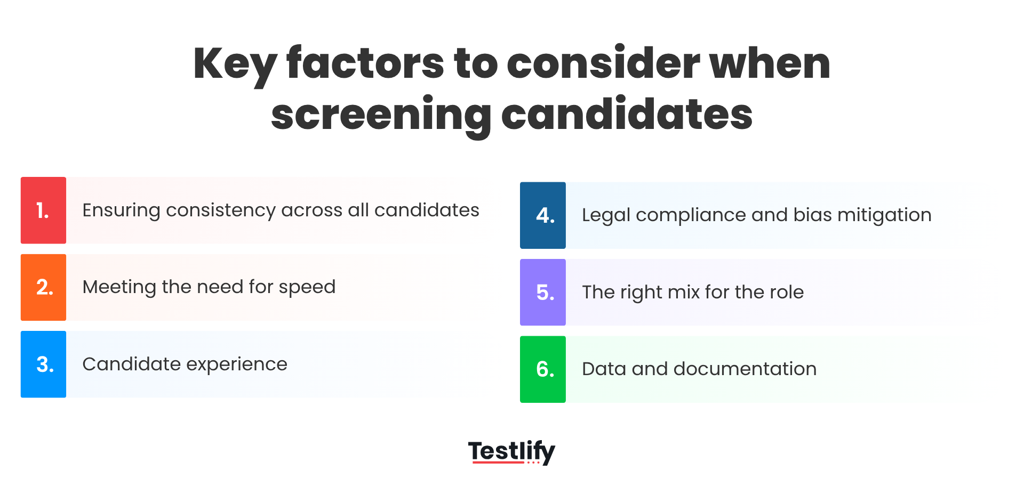
Ensuring consistency across all candidates
Every candidate for the same role should go through the same stages, in the same order, with the same criteria applied. Inconsistency undermines hiring quality and creates legal and reputational risk.
Meeting the need for speed
Bottlenecks in screening cost you top candidates who are advancing through other companies’ processes simultaneously. The right combination of automation and human judgment can compress this timeline significantly.
Candidate experience
How a candidate feels during screening is a direct reflection of your employer brand. Lengthy, poorly communicated processes push strong candidates toward competitors. Keep your process clear, communicate status updates, and make every touchpoint reflect the organization you want to be known as.
Legal compliance and bias mitigation
Screening decisions must be based on job-relevant criteria only. Audit your tools and questions regularly for potential bias. Avoid collecting information about protected characteristics. If you use AI-powered screening tools, ongoing compliance review of those tools is no longer optional.
The right mix for the role
A junior administrative hire and a senior engineering leader require fundamentally different screening approaches. Think carefully about which methods give you the most relevant signal for each specific role rather than applying a one-size-fits-all process.
Data and documentation
Every screening decision should be documented with a clear, objective rationale. This protects your organization legally, creates accountability within your hiring team, and enables continuous improvement over time.
Final thoughts
Candidate screening in 2026 is no longer just about filtering out the wrong people. It is about building a process that consistently identifies the right ones.
The methods covered in this article each serve a distinct purpose. For example:
- Resume screening helps manage volume.
- Skills assessments verify real ability.
- Conversational AI interviews bring structure and speed to early evaluation.
- Reference checks confirm what matters most before an offer goes out.
None of them work in isolation, but together they form a screening process that is both rigorous and respectful of everyone’s time.
The organizations that will hire best going forward are not necessarily the ones with the biggest recruiting teams. They are the ones that invest in the right tools, apply them consistently, and never lose sight of the candidate experience along the way.
Start with the methods that address your biggest current bottleneck, measure the outcomes, and build from there.
Ready to take your candidate screening to the next level? Book a free demo today and see how Testlify brings together AI resume screening, role-specific tests, and conversational AI interviews to help you create the best candidate screening process.
Frequently asked questions (FAQs)

Related resources
View all
Candidate Screening
What to look for in candidate screening software

Candidate Screening
Candidate screening: Methods, process, and best practices

Candidate Screening
Screening interview explained: Purpose, stages, and tips

Candidate Screening
Candidate Screening Dos and Don’ts: Best Practices for 2026

Candidate Screening
How to automate your candidate screening process (2026)
Candidate Screening
Which technical assessment platforms support in-browser coding with live proctoring?
Get started.
Hire on proof, not resumes.
Run your first skills-based assessment free — no credit card required.