
Structured vs. Unstructured Interviews: Key Differences, Pros and Cons
Structured vs. unstructured interviews: uncover the key differences, pros, and cons to choose the best approach for effective, unbiased hiring.
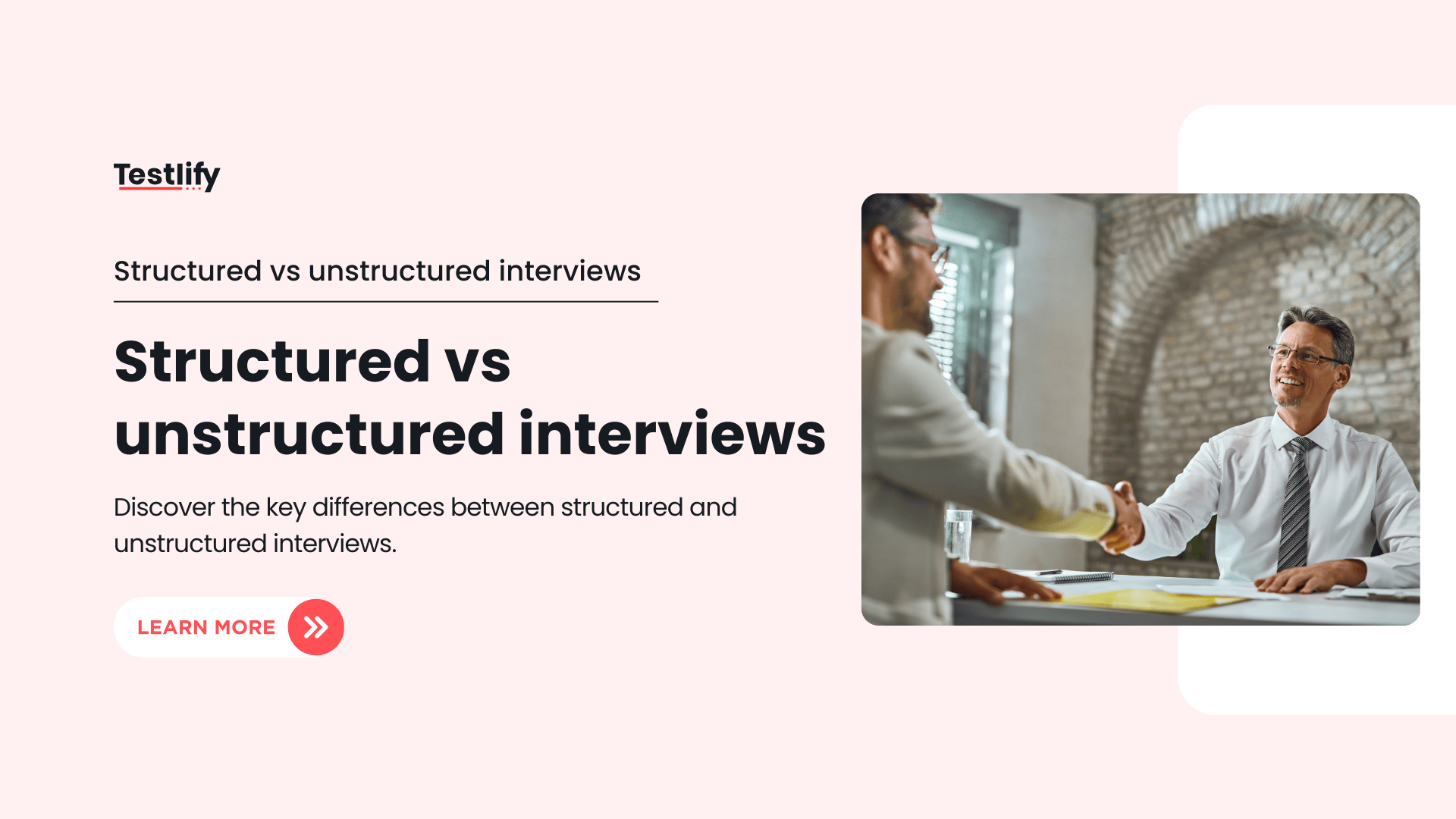
Structured interviews use a fixed set of questions, delivered in the same order to every candidate and scored against a shared rubric. Unstructured interviews let the conversation flow naturally, with no preset questions and no scoring guide.
Most organizations use something closer to the second format, often without realizing the predictability they are giving up.
TL;DR
- Structured interviews use standardized questions and scoring rubrics; unstructured interviews are conversational and vary by candidate.
- Decades of research in industrial-organizational psychology show structured formats predict job performance more reliably and reduce interviewer bias.
- Unstructured interviews can surface personality and cultural alignment, especially in senior or creative roles where judgment and chemistry matter.
- A semi-structured hybrid (structured core questions, then open conversation) is the most practical approach for most hiring scenarios.
- Pairing structured interviews with pre-employment assessments gives you the most complete, data-backed picture of a candidate before you extend an offer.
 ChatGPT
 Gemini
 Claude
 Grok
Grok Perplexity
What is a structured interview?
A structured interview uses a fixed set of predetermined questions, delivered in the same order to every candidate, and scored against a consistent rubric. Every interviewer applies the same criteria. The result is a hiring process where candidate comparisons are based on the same evidence, not on different conversations that happened to go in different directions.
Key characteristics of structured interviews
- Standardized questions: Every candidate gets the same questions in the same sequence.
- Scoring rubric: Responses are rated against pre-defined criteria, typically a behavioral anchor scale.
- Job-relevant design: Questions trace back to a job analysis or competency framework, not interviewer instinct.
- Consistency across interviewers: Multiple hiring managers can compare notes because they all evaluated the same competencies.
How structured interviews work
The process starts with a job analysis: identify the core competencies the role requires, then build behavioral or situational questions that reveal how candidates have handled those competencies. During the interview, each response gets scored against the rubric before moving to the next question. This keeps the interview focused and gives you data you can actually compare across candidates.
Structured interviews are standard in volume hiring, regulated industries, and technical roles with objectively measurable skill requirements. If you want a full implementation framework, our guide on how to conduct a structured job interview walks through question design, rubric calibration, and panel alignment step by step.

What is an unstructured interview?
An unstructured interview has no fixed question list. The interviewer follows the conversation wherever it leads, probing based on what the candidate says rather than a prepared script. This format can surface things a rigid process would miss, but it introduces a serious problem: different candidates answer different questions, making a genuine comparison almost impossible.
Key characteristics of unstructured interviews
- No fixed format: Questions emerge from the conversation rather than from a prepared list.
- Subjective evaluation: Assessments are based on the interviewer’s overall impression, not a scoring guide.
- Conversational tone: The format tends to feel more natural, which can help candidates open up.
- High interviewer dependency: The quality of the interview depends almost entirely on the skill and self-awareness of the person conducting it.
How unstructured interviews work
An unstructured interview typically starts with a general opener (“tell me about yourself”) and branches based on what the candidate shares. If they mention an interesting project, the interviewer digs in. If the conversation drifts toward values or work style, that gets explored. For the right interviewer, this can be genuinely revealing. The catch is that two candidates for the same role may have been assessed on entirely different things.
Structured vs unstructured interviews
Here is a direct comparison across the dimensions that matter most for hiring decisions:

Factor | Structured Interview | Unstructured Interview |
|---|---|---|
Questions | Pre-defined, same for all candidates | Vary by candidate and conversation |
Evaluation | Rubric-based, consistent criteria | Subjective, based on overall impression |
Consistency | High (candidates can be compared fairly) | Low (apples-to-oranges comparison) |
Bias risk | Lower (same criteria applied to everyone) | Higher (gut-feel and affinity bias play large roles) |
Predictive validity | Stronger predictor of job performance | Weaker predictor, less reliable |
Candidate experience | Can feel formal or exam-like | More conversational, often less stressful |
Setup time | Requires upfront question and rubric design | Quick to run, little preparation needed |
Legal defensibility | Strong (documented criteria for every decision) | Weak (no audit trail, inconsistent criteria) |
Best for | Volume hiring, technical roles, regulated industries | Senior hires, exploratory conversations, culture-fit discussions |
Why does interview structure matter for hiring quality?
Structured interviews have a predictive validity of 0.42, the highest of any common hiring method. The U.S. Office of Personnel Management recognizes structured interviews as a best practice in federal hiring.
This is because standardized questions and scoring rubrics remove the variance that makes unstructured conversations unreliable predictors of job performance.
The validity gap between formats
The numbers reflect two structural problems that compound in unstructured settings. Structured evaluation removes the variance that comes from different candidates being asked different questions. Unstructured evaluation leaves that variance in place, which means the outcome partly depends on what came up in the room that day.
- Inconsistent questions: When two candidates answer different questions, you are not comparing equivalent data. One gets an easy opener; another gets a harder scenario. The scores reflect different conversations, not different candidates.
- Affinity bias: Without a rubric, interviewers gravitate toward candidates who communicate like they do or share similar backgrounds. The rubric interrupts that pattern.
- No audit trail: Unstructured evaluations produce impressions, not data. If a hiring decision is challenged, documented rubric scores give you defensible criteria. Gut feelings do not.
What this means for hiring teams
Enterprise teams that struggle with quality-of-hire most often share the same root issue: their process relies on interviewer intuition without a consistent evaluation framework. Structure does not guarantee great hires. It eliminates a lot of the variance that bad hires come from.
- Predictable outcomes: Structured formats produce consistent signals, so your final ranking reflects real competency differences rather than who had the better conversation.
- Faster debrief calls: When every interviewer uses the same rubric, post-interview alignment moves faster. You are comparing scores, not reconciling five different subjective impressions.
- Scalable quality: A calibrated rubric replicates across every hire you make with it. Unstructured formats do not replicate: what you get depends on which interviewer ran the session.
Advantages of structured interviews
Structured interviews deliver consistent, measurable results across every candidate who walks through your process. Four advantages stand out for enterprise hiring teams.
Fairer evaluation for every candidate
When every candidate answers the same questions and is scored on the same rubric, the comparison is meaningful. A candidate from a non-traditional background gets the same shot as someone with a polished resume and a smooth presentation style. That is not just an equity argument. It is a practical one: if your process systematically filters out candidates based on how comfortable they are in conversation rather than how well they can do the job, you are losing talent to a flaw in your method.
Stronger prediction of job performance
Behavioral and situational questions built from a job analysis measure real competencies. “Describe a time you had to manage a project with shifting requirements and a tight deadline” reveals problem-solving, communication, and resilience in a way that “tell me about yourself” simply does not. The connection between the question and the job skill is direct, which is why structured formats consistently outperform unstructured ones as predictors of performance.
Legal defensibility
If a hiring decision is ever challenged, structured interviews give you documentation. You can show that every candidate was evaluated on the same criteria, through the same questions, scored by the same rubric. That paper trail matters in regulated industries, government contracting, and any environment where EEOC compliance is scrutinized. Unstructured interviews offer no such defense.
Scalability across large candidate pools
When you are hiring 20 engineers in a quarter or screening hundreds of candidates for a seasonal push, structured interviews let multiple interviewers participate without producing incomparable results. Calibrate the rubric upfront, train the panel on what “strong” looks like for each question, and the process scales. Unstructured formats do not replicate this way. Every interviewer doing their own thing produces noise, not data you can act on.
Disadvantages of structured interviews
Structured interviews are more predictive than free-form conversations, but they carry real trade-offs. Three limitations show up consistently in practice.
Less flexibility to follow interesting threads
A rigid script can block you from digging into something genuinely relevant. If a candidate mentions an unusual career pivot or a project that seems directly applicable, the structured format pushes you to stay on track rather than explore it. For roles where the unexpected is the point (founding hires, research positions, early-stage creative leadership), that constraint can cost you context you would actually want.
Can feel mechanical to candidates
Candidates often describe highly structured interviews as feeling more like an exam than a conversation. That is a real concern if you are competing for senior or in-demand talent who have other options. Rapport matters, and a format that prioritizes consistency can sacrifice warmth if the interviewer is not careful about how they deliver it. The fix is in the delivery, not in abandoning the structure.
Requires upfront investment
Good structured interviews do not happen by accident. You need a job analysis, a question bank, a rubric, and interviewer calibration before the first candidate walks in. For a small team hiring one person every six months, that investment can feel disproportionate. But once the process is built, it replicates. The upfront cost pays back across every hire you make with it.
Advantages of unstructured interviews
Unstructured interviews are not inherently flawed. In the right context, a free-form conversation surfaces information that a scripted format cannot capture.
Surfaces personality and cultural alignment
A skilled, self-aware interviewer can learn things in a free-form conversation that a script would not find: how a candidate thinks when surprised, how they handle a shift in direction, whether their working style fits the team’s rhythm. For roles where interpersonal chemistry and judgment are central to performance (senior leadership, executive positions, roles with heavy stakeholder management), organic conversation can reveal more than a rubric alone captures.
Builds genuine rapport
Candidates relax in conversations that feel human. A two-way exchange can make a nervous candidate open up in ways a formal Q&A never would. That is not just about making people feel welcome. It can surface more authentic answers, which is what you are actually after. The challenge is that “feeling comfortable in the room” does not always correlate with “being the right fit for the role.”
Useful for exploratory discussions
For roles that do not yet have a fully defined scope (a new function, a founding hire, a position that will evolve quickly), an open conversation helps both parties figure out whether there is a genuine match. The structured framework you would build for a well-defined role does not exist yet, so conversation is the better starting point.
What are the disadvantages of unstructured interviews?
The problems with unstructured interviews compound when hiring volume rises or the role is high-stakes. Three disadvantages appear across nearly every research study on the format.
Inconsistent evaluations across candidates
The core problem: if two candidates answered completely different questions, you do not have a fair basis for comparison. You might feel more confident in one candidate because the conversation flowed well, but that is measuring conversational chemistry, not job readiness. Inconsistency at the evaluation stage produces inconsistent hiring outcomes, and those bad hires cost more than most companies realize when they look at full replacement costs.
High bias risk
Affinity bias, halo effect, anchoring on first impressions: all of these run harder in unstructured settings. Without a rubric, the interviewer’s gut feeling drives the evaluation. And gut feelings, even well-intentioned ones, tend to favor candidates who look, sound, and communicate like the people already in the room.
That is not a minor distortion. It compounds across hundreds of hires and shows up in the demographics of who gets promoted and who gets passed over. The path to reducing bias in hiring runs through structured evaluation, not around it.
Difficult to defend legally
If a rejected candidate challenges a hiring decision, “we had a great conversation, and I just did not feel it” is not a defensible position. Unstructured interviews leave no audit trail and no consistent criteria. In roles covered by EEOC guidelines or similar frameworks, that exposure is real and the liability is yours.
When should you use structured interviews?
Structured interviews are the right default for most hiring scenarios. Use them when:
- You are evaluating multiple candidates for the same role and need a fair basis for comparison.
- The role has well-defined competencies you can build behavioral or situational questions around.
- You are hiring at volume (more than five to ten people for similar roles).
- Your industry has legal or regulatory requirements around equal treatment in hiring.
- Multiple interviewers will evaluate the same candidates and need to compare notes meaningfully.
- You are trying to reduce the influence of interviewer bias or affinity effects on your decisions.
Structured interviews work for almost every role from individual contributor to director level. They require more upfront design but produce more defensible, more consistent results. Learning how to manage the hiring process from sourcing to final offer is the right context for building structured evaluation into your broader workflow.
When should you use unstructured interviews?
Unstructured (or lightly structured) interviews have a real place in hiring. They work best when:
- You are making a senior or executive hire where interpersonal alignment and judgment matter more than checkbox competencies.
- The role is new or evolving quickly, and you do not yet have a competency framework to build questions around.
- You are in an early exploratory conversation to assess whether there is even a mutual fit worth pursuing further.
- You want to give a candidate room to show their thinking without a rigid script constraining the interaction.
- You have skilled, experienced interviewers who know how to extract useful signal from open conversations and can stay aware of their own biases.
Even in these cases, keeping three or four anchor questions that you ask everyone goes a long way toward making your evaluation comparable. A little structure costs nothing and reduces a lot of variance.
How to combine structured and unstructured approaches?
For most roles, the best answer is not a binary choice between two formats. A semi-structured interview gives you the reliability of a structured core with room for the kind of organic exploration that produces genuine insight.
Here is how to run one.
A 45 to 60 minute semi-structured interview works well: spend the first 20 to 25 minutes on four or five standardized, competency-based questions scored against a shared rubric.
Then open the floor for 10 to 15 minutes of genuine conversation: “What did I not ask that you would want me to know?” or “What kind of work environment brings out your best?”
Score the structured portion consistently across all candidates. Use the open section to fill in gaps, not to override the data you already collected.

This hybrid approach is particularly useful when you are competing for senior talent who may push back on rigid formats, but still need evaluation consistency to compare three or four strong finalists fairly.
Pro Tip: Calibrate before the first interview, not after. Gather your interviewing panel, walk through the rubric together, and agree on what “strong,” “adequate,” and “weak” looks like for each question. Calibration sessions take 30 minutes and cut inter-rater variance significantly. Without them, two interviewers using the same rubric can still produce wildly different scores because they have different mental benchmarks for what a good answer looks like.
How do assessments complement structured interviews?
Structured interviews improve on free-form conversations, but they still cannot measure whether a candidate can actually do the job. Assessments close that gap.
What interviews cannot tell you?
Interviews have an inherent ceiling. They reveal how a candidate communicates, how they frame experience, and how they perform under social pressure, but they cannot reliably measure actual skill.
A candidate who articulates a sharp answer about problem-solving may or may not be a strong problem-solver. The articulation and the skill are related, but they are not the same thing.
How assessments close the gap
According to an SHRM survey of 1,688 HR professionals, 79% say the quality of their organization’s hires improved after introducing pre-employment assessments. A skills test, cognitive ability assessment, or role-specific evaluation measures what a candidate can actually do, not what they can say about doing it.
This matters most for technical roles where coding skill or analytical ability can be objectively tested, but the principle applies across functions. You can explore the main types of pre-employment tests to see which fit your hiring goals.
The assess-first approach
Testlify’s assess-first method runs candidates through a pre-employment assessment before the structured interview, so you enter every conversation knowing which competencies each candidate scored strongly on. Use interview time to probe gaps and explore what assessments cannot measure: motivation, communication style, and judgment under ambiguity.
For a 20-person engineering team hiring 5 roles at once, this approach can cut initial screening time from 21 to 28 days down to about 10 days. The shortlist arrives scored and ranked before anyone schedules a call.
This is also one of the most effective ways to implement skills-based hiring in practice. The assessment creates a skills-verified shortlist; the structured interview then deepens your understanding of candidates who already passed an objective screen.
You are not relying on resume signals or gut feel at either stage. The candidates who reach the offer stage are there because of what they can do, not how they interviewed on a particular day.
Key Takeaway: Interviews measure communication and self-presentation. Assessments measure skills and cognitive ability. Use them together, and you are evaluating the full picture. Use them in isolation, and you are making big decisions on partial information.
Final thoughts
Most hiring teams already know that unstructured interviews introduce bias. The harder part is building the structured alternative before the next role opens. That means a job analysis, a question bank mapped to actual competencies, and a scoring rubric calibrated before the first candidate walks in.
Pairing structured interviews with pre-employment assessments gives you the most complete picture. The assessment verifies what a candidate can do. The structured interview explores how they think, communicate, and handle pressure. Used together, they get you closer to hiring decisions you can defend with data rather than instinct.
To see how a skills-first approach fits into your interview process, book a demo with Testlify.
FAQ

Content Writer
Yashika Khandelwal is a Content Writer with 3+ years of experience creating research-backed content on hiring, talent assessment, and HR technology. She is a registered Organizational Psychologist and subject matter expert who combines behavioral science with practical recruitment insights to produce accurate, evidence-based content.
LinkedInRelated resources
View all
HR & recruitment
Proactive Recruitment: Definition, Strategies & Examples
HR & recruitment
Blind hiring: What is it, process, and benefits

HR & recruitment
HR trends in higher education in 2026
HR & recruitment
Raven’s Progressive Matrices Test: A Recruiter’s Guide 2026
HR & recruitment
Headhunting in recruitment: Your ultimate 2026 guide

HR & recruitment
Best Recruitment Methods in 2026: 12 Strategies That Fill Roles Faster
Get started.
Hire on proof, not resumes.
Run your first skills-based assessment free — no credit card required.