
Are background checks enough to stop employment fraud?
Are background checks enough to stop employment fraud? Learn their limits, red flags, and how to build a fraud-resistant hiring process with extra screening steps.

Every company wants to believe a background check tells the full story. It doesn’t. A resume can look polished, references can be rehearsed, and a clean record doesn’t always mean a candidate is honest.
Employment fraud costs organizations billions each year and often slips past routine checks. Companies lose 5% of revenue to fraud.
From fake degrees to stolen identities, fraudsters have learned how to game the system. A quick criminal search or a checkbox screening isn’t enough anymore to stop employment fraud.
In this guide, we’ll break down what background checks can and can’t do, how fraud affects your workplace, and the extra steps you need to take to prevent bad hires.
 ChatGPT
 Gemini
 Claude
 Grok
Grok Perplexity
What is employment fraud, and why does it matter?
Employment fraud happens when a candidate lies or misrepresents themselves to get hired. Sometimes it’s small, like exaggerating skills or stretching job titles.
Other times, it’s more serious, fake degrees, invented references, stolen identities, or even having someone else sit in for an online interview.
Common types of candidate fraud include:
- Identity fraud
- Credential misrepresentation
- Resume fraud
- Reputational misrepresentation
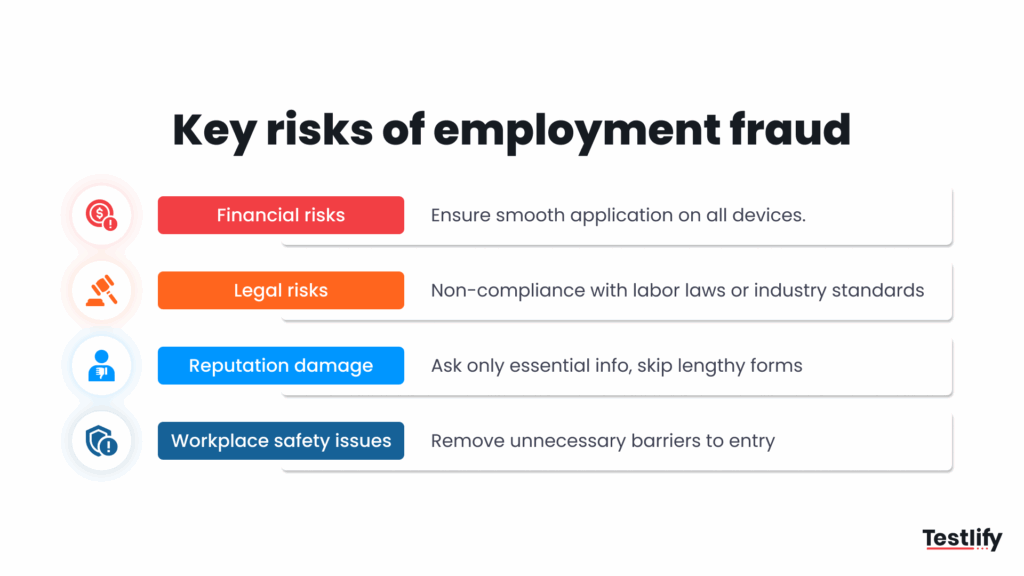
Why is this important? Because the cost of a dishonest hire can be much higher than their salary. The Association of Certified Fraud Examiners estimates that fraud costs businesses about 5% of their yearly revenue, with a median loss of $150,000 per case.
Beyond money, fraud affects trust, compliance, and safety. Hiring someone under false pretenses can expose your organization to:
“It takes 20 years to build a reputation and five minutes to ruin it.” – Warren Buffett
It’s no surprise that 90% of employers conduct criminal background checks as a risk management measure, aiming to prevent theft, fraud, or workplace violence before it happens.
To put it briefly, a poor resume is not the only aspect of employment fraud. It’s about letting someone in who can damage your brand, your people, and your finances. That’s why identifying it early in the hiring process is critical.

What do background checks actually cover?
When most people think of a background check, they picture a quick search for a criminal record. In reality, a pre-employment background check usually covers several areas designed to verify whether the details a candidate provides are accurate and genuine.
Here are the main things a pre-employment background check usually looks at:
- Identity confirmation: Checking if the candidate’s name, date of birth, and Social Security number match government records.
- Criminal history: Searching police or court databases for past convictions that could affect the role.
- Employment history: Confirming job titles, dates of employment, and past employers to catch gaps or inflated claims.
- Education records: Ensuring that degrees and certifications are from accredited schools.
- References: Speaking with previous managers or references to understand integrity and performance.
- Credit history (for financial roles): Reviewing credit reports where relevant, in accordance with the Fair Credit Reporting Act (FCRA).
- Drug tests (in some industries): Ensuring workplace safety and compliance with regulations.
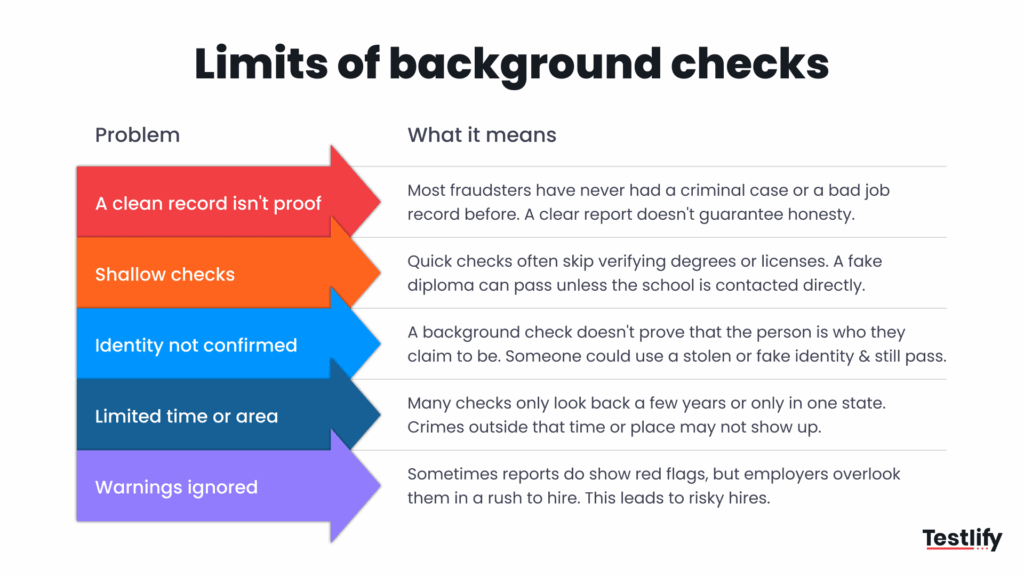
These checks are useful because they validate what’s written in a résumé or said in an interview. But they have limits.
A candidate who has never been caught lying or breaking the law might still look clean on paper. That’s why background checks alone can’t always guarantee a fraud-free hire.
Basic vs. comprehensive background checks [Comparison]
A basic background check is quick and covers only a few details. A comprehensive background check goes deeper, verifies more information, and makes it harder for fraud to slip through. Here’s the difference:
Area | Basic check | Comprehensive check |
|---|---|---|
Identity | Confirms name and Social Security number match records. | Uses ID document scans, biometrics, or liveness checks to verify the person’s identity. |
Criminal history | Searches standard state or national databases for recent convictions. | Expands to county, federal, and even global watchlists with longer look-back periods. |
Employment history | Verifies job titles and dates from listed references. | Contacts past employers directly, checks for gaps, and confirms responsibilities. |
Education | May confirm the highest degree if requested. | Validates all claimed degrees and certifications, detects fake schools or diploma mills. |
References | Relies on candidate-provided references (which may be biased). | Independent reference checks, often with verified supervisors or professional contacts. |
Other checks | Usually none. | May include drug tests, credit checks (for finance roles), social media screening, or ongoing monitoring after hire. |
Skills & fit | Not included. | Combines background data with skill assessments and integrity tests to verify ability and honesty. |
As the table suggests, comprehensive screening goes beyond the basics. For example, a basic check might verify that a Social Security number is valid and belongs to someone with the candidate’s name.
Still, a comprehensive process would also require the candidate to prove they are that person (through identity verification steps).
Why aren’t background checks enough on their own?
Given the gaps in basic checks, stopping employment fraud requires a multi-layered screening strategy.
Many people who commit fraud have clean records. Others know how to work around shallow checks. That’s why relying only on a background check can leave big gaps.
Here are a few reasons why:
- Fraudsters often have no record: According to the Association of Certified Fraud Examiners, 84% of fraudsters had no criminal or job history problems on file. A “clean” report doesn’t always mean safe.
- Fake documents slip through: A quick check may not catch fake degrees or licenses unless schools or licensing bodies are contacted directly.
- Identity can be faked: A background check doesn’t always confirm if the person is truly who they say they are. Stolen or synthetic identities can still pass.
- Checks are limited in scope: Many reports only cover certain years or regions. Crimes outside those limits may never show up.
- Warnings get ignored: Sometimes red flags do appear in reports, but hiring teams under pressure overlook them.
What else should employers do beyond background checks?
Preventing employment fraud can sound like a daunting, multi-step effort. Still, modern platforms like Testlify are making it easier to execute a thorough screening strategy without overburdening your HR team.
Robust identity verification
Ensure the person behind the application is real and truly who they claim to be. This can involve using digital identity verification services (for example, having candidates upload a government ID and a selfie, which a system checks for a biometric match and liveness).
Thorough credential and reference checks
Recommended: Which HR training strategies stop recruitment fraud?
Go beyond automated checks by directly validating a candidate’s claims. Contact universities to confirm degrees (with the candidate’s permission, as academic records may be protected by FERPA privacy rules).
Reach out to previous employers, not just the ones a candidate lists as references. According to one report, 20-30% of resumes include false information, so this human due diligence is vital.
Skills and integrity assessments
Integrating pre-employment assessments can reveal whether candidates truly have the skills and qualities they claim. For instance, a technical skills test can expose a candidate who padded their résumé with coding skills they don’t actually possess.
Integrity tests or scenario-based questions can gauge honesty and ethics. Work sample projects or trial assignments could be used to confirm that a portfolio is authentic and not plagiarized. This layer helps identify individuals with clean histories but a lack of genuine ability.
AI-powered interviews and proctoring
In the era of remote hiring, it’s easier for candidates to attempt impersonation or cheating (such as having someone else complete an online test or even a recorded video interview). AI and proctoring features can deter and detect such fraud.
For example, AI-driven video interview platforms can verify the candidate’s image against their ID, analyze for signs of deepfakes, and ensure the person who showed up for the interview is consistent across all stages.
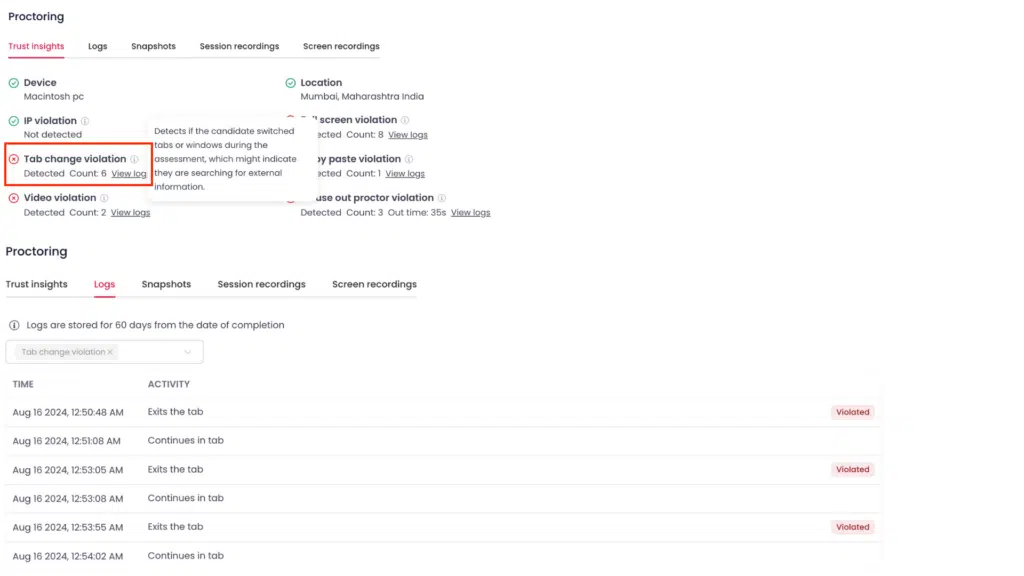
Proctoring features such as dual-camera setups, environment checks, and browser lockdowns help keep tests secure. They ensure the applicant isn’t receiving outside help or using fraudulent methods.
Know more: Types of online exam proctoring: Which one’s right for you?
Continuous monitoring after hire
Re-check sensitive roles over time. Alerts about new criminal records or financial issues can protect your company from insider threats.
Fraud awareness training for HR
Ensure your talent acquisition team is aware of the latest fraud schemes. Modern fraudsters may use tactics like proxy interviewees (someone else logging in to do an interview or test), stolen resumes, or AI-generated credentials.
Train recruiters to verify identities during live video calls (ask spontaneous questions, compare to ID), to notice inconsistencies (e.g., a candidate who can’t discuss details written on their resume), and to use verification tools at their disposal.
How can Testlify strengthen fraud prevention in hiring?
Background checks are good for confirming history, but they don’t always prove who the person is or what they can actually do. That’s where Testlify fits in. It helps recruiters go beyond paperwork by testing real skills with 3,500+ ready-made assessments or custom ones built for the role.
With AI-powered video and audio interviews, you can also see and hear candidates directly, making it harder for someone else to stand in their place.
To keep online tests fair, Testlify has proctoring tools like dual-camera monitoring, full-screen enforcement, and copy-paste blocking. It connects with over 100 ATS platforms, so teams don’t add extra work.
And because it’s compliant with GDPR and FERPA, you can trust that the process is safe and privacy-first. Together, these features add the layers that background checks miss, giving you more confidence that the person you hire is genuine.
Final takeaway: How to build a fraud-resistant hiring process
A background check is an important step, but it shouldn’t be the only step. Many fraudsters pass basic checks because they know how to hide gaps or use fake information. The safer approach is to build layers into your hiring process.
The goal should be to protect your team, your finances, and your company’s reputation. By combining traditional background checks with modern tools like Testlify, you create a balanced process that is both thorough and fair.
Key takeaways:
- Background checks are valuable, but can’t catch every fraud risk.
- Many fraudsters have clean records and can slip through basic checks.
- Comprehensive screening verifies identity, education, and work history more deeply.
- Extra steps like skill tests, proctoring, and monitoring close the gaps.
- A fraud-resistant hiring process protects finances, safety, and reputation.
Frequently asked questions (FAQs)

B2B SaaS Content Writer
Rishav Kumar is a B2B SaaS content writer with 4 years of experience. He loves crafting engaging content. Always exploring fresh ideas, he's passionate about helping businesses grow through impactful writing.
LinkedInRelated resources
View all
Hiring Risks & Safeguards
How to prevent impostors in video interviews?
Hiring Risks & Safeguards
Resume Fraud Verification: How to Detect Fake Resumes Before the First Interview (2026)

Hiring Risks & Safeguards
How to stop cheating in online tests?
Hiring Risks & Safeguards
How do platforms handle GDPR compliance for candidate data?

Hiring Risks & Safeguards
The real cost of a slow hiring process
Hiring Risks & Safeguards
Are traditional background checks enough for HR compliance?
Get started.
Hire on proof, not resumes.
Run your first skills-based assessment free — no credit card required.