
How to handle fake certificates in recruitment?
Fake certificates in recruitment can harm trust and compliance. Learn how to detect fraud, verify credentials, and use AI and blockchain to secure hiring.

Have you ever considered that a candidate’s certificate might look genuine, but actually isn’t? More companies are finding out the hard way.
A recent survey by HEDD (2025) found that nearly half (45%) of large organizations have come across applicants misrepresenting their academic qualifications. Misleading credentials do more damage than one bad hire.
In this article, you’ll learn how to spot fake certificates in recruitment, what the risks are (legal, compliance, reputational), and how tools like blockchain, AI, and skills assessments can protect your hiring process.
 ChatGPT
 Gemini
 Claude
 Grok
Grok Perplexity
How can recruiters spot fake certificates in candidate applications?
While it’s not always easy to spot fake certificates, there are clear signs that can help you do so. It is much less likely for recruiters to be fooled when they check documents, talk to candidates directly, and carefully watch them during the hiring process.
Scrutinize document details
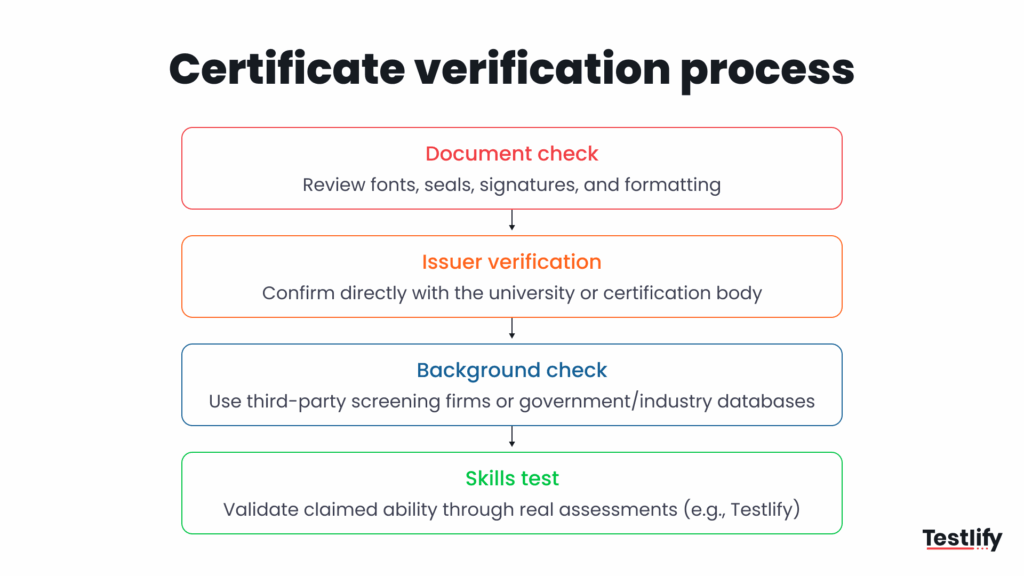
The first step is to look closely at the certificate itself. Genuine documents usually have consistent fonts, proper seals, and official signatures.
Fakes often show spelling mistakes, mismatched logos, or poor-quality printing. If a certificate feels “off” in design or wording, treat it as a red flag and investigate further.
Cross-verify credentials with issuers
Do not rely on a document alone. The safest thing to do is to check directly with the institution that issued the document. There are numerous online portals and hotlines that universities and training bodies have developed for verification.
In the UK, for example, the Higher Education Degree Datacheck (HEDD) allows employers to validate degrees. In India, services like NSDC or third-party verifiers can confirm whether a certificate is genuine.
Many companies now verify directly with the educational institutions. In fact, a recent study by S2Verify found that about 50% of organizations include education verification in their background checks.
This number indicates that direct verification is growing, although it’s not yet universal. Adding this step gives you an edge.
Watch for resume and interview red flags
Sometimes the resume looks fine, but the candidate’s story does not add up. Look for gaps in employment timelines, qualifications that don’t match their job history, or vague answers about their education.
Related: How to detect fake resumes in hiring?
During interviews, ask specific questions about what they learned in the program. If a candidate struggles to explain, it may mean the certificate is not real.
Be aware of common fraud types
Candidates can use fake certificates that were made from scratch, real documents that have been altered to make the roles or dates seem more impressive, or even credentials from counterfeit “universities” that only exist to sell degrees.
Knowing these patterns helps recruiters stay alert. If the institution itself is not recognized or accredited, that’s often a sign of fraud.
Use background checks and reference calls
The most reliable protection is a structured verification process. Third-party background screening firms can confirm academic records internationally.
Employers should also speak directly with references or past HR managers instead of relying on contact details provided by the candidate. Cross-checking certificates with payslips or bank statements can also reveal if the claimed employment was genuine.

What are the legal and compliance risks of fake certificates for employers?
If a company hires someone with fake credentials, the organization could be in danger. If an unqualified worker, such as an engineer or nurse, hired without a license or with counterfeit credentials, causes harm, the employer could be sued for negligent hiring or face government fines.
There’s also reputational damage and internal morale issues if it comes to light that the company didn’t vet credentials properly.
Can employers be liable for hiring someone with fake qualifications?
Yes, employers can be held liable if they fail to verify a candidate’s credentials properly. Here are the key risks:
- Negligent hiring claims: If an unqualified employee causes financial loss or safety issues, the company may be sued for negligence. For example, hiring a fake-certified engineer or nurse could result in serious harm and legal consequences.
- Regulatory non-compliance: Many industries, such as healthcare, finance, and education, require verified licenses or degrees. Hiring someone without genuine qualifications may lead to fines, penalties, or loss of accreditation.
- Data protection violations: Under GDPR (Europe) and FERPA (US), employers must handle verification legally, with candidate consent and secure data storage. Skipping proper procedures risks both non-compliance and penalties.
- Reputational damage: If the media or clients discover a company hired someone with falsified credentials, trust erodes. This can affect brand value and future recruitment.
- Financial cost: Beyond legal issues, rehiring and retraining costs pile up when a fake-qualified employee is removed.
How can skills assessments (like Testlify) help address fake certificates in hiring?
When you only use certificates, it can be risky. A document may look official, but it doesn’t always reflect a person’s true level of skill. This problem can be solved by skills assessments, which focus on actual performance instead of claims made on paper.
What you need | How Testlify helps |
|---|---|
Validate real skills | If someone claims a coding certificate, you can give them a short coding test. The results instantly show if the skill is genuine or exaggerated. |
Reduce reliance on degrees. | Instead of filtering only by academic papers, recruiters can test for problem-solving, communication, or job-specific skills. This makes hiring fairer and more accurate. |
Ensure identity and fairness. | Proctoring features (live environment scans, full-screen monitoring, copy-paste blocking) confirm the test is taken by the actual candidate, not a proxy. |
Integrate with hiring flows. | Testlify connects with 100+ ATS platforms, so skill results fit into your recruitment process without delays. |
How can technology like blockchain and AI help prevent fake credentials in hiring?
The way employers check qualifications is changing because of technology. The recruiters no longer have to rely only on paper documents. They can now use digital tools that make fraud harder to pull off.
In particular, blockchain and AI are becoming very useful technologies for finding fake certificates.
A 2025 study in the Journal of Network and Computer Applications explained that blockchain-based systems (built on platforms like Ethereum) make certificate issuance and verification much more secure.
Because every record is cryptographically protected, the chance of a certificate being altered or faked is extremely low. These decentralized systems also improve reliability and user experience by giving candidates and employers instant, trustworthy verification.
How can AI tools help spot fake documents or profiles?
AI can catch details that human eyes often miss. Document-checking algorithms can scan certificates and flag signs of tampering, such as inconsistent fonts, edited seals, or copied signatures.
These tools are trained on thousands of genuine and fake documents, so they learn to recognize subtle differences.
AI also helps with cross-checking data. For instance, if a candidate claims a degree from 2018, AI can match that against university records, online data, or even the candidate’s own digital footprint.
In remote hiring, AI-powered ID checks and facial recognition make sure the person presenting the certificate is the same one interviewing or taking the test.
AI powered platforms like (Testlify) combines AI with skills testing. If a candidate submits a questionable IT certificate but fails a basic coding assessment, that’s a strong sign their document is fraudulent. Know about Testlify from the video below,
Conclusion: Safeguarding Your Recruitment Process from Credential Fraud
A certificate can open doors, but only if it’s real. The cost of overlooking a fake one far exceeds the time it takes to verify. Develop a habit of reviewing documents, asking questions, and verifying information with trusted sources.
Use technology where it makes sense, but don’t forget the basics: trust, fairness, and clear hiring policies. When you test for real skills and verify every credential, you protect not just your company, but also the people who work there.
Hiring with integrity means every person on your team has truly earned their place. Want to be sure every hire has the skills they claim? Testlify makes it easy! Try it out and see how simple, fair, and reliable hiring can be.
Frequently asked questions (FAQs)

B2B SaaS Content Writer
Rishav Kumar is a B2B SaaS content writer with 4 years of experience. He loves crafting engaging content. Always exploring fresh ideas, he's passionate about helping businesses grow through impactful writing.
LinkedInRelated resources
View all
Hiring Risks & Safeguards
Are background checks enough to stop employment fraud?

Hiring Risks & Safeguards
How to prevent impostors in video interviews?
Hiring Risks & Safeguards
Resume Fraud Verification: How to Detect Fake Resumes Before the First Interview (2026)

Hiring Risks & Safeguards
How to stop cheating in online tests?
Hiring Risks & Safeguards
How do platforms handle GDPR compliance for candidate data?

Hiring Risks & Safeguards
The real cost of a slow hiring process
Get started.
Hire on proof, not resumes.
Run your first skills-based assessment free — no credit card required.