
The real cost of a slow hiring process
Slow hiring costs more than time. It reduces output, raises expenses, and risks losing great candidates to faster companies.

A slow hiring process costs more than time. Research shows the average time to fill a job in the U.S. is about 42 days. That means over a month of lost productivity, extra stress for staff covering gaps, and delayed projects.
Even worse, 60% of candidates quit a hiring process that drags on (Glassdoor, 2023). The longer the search drags, the higher the financial, cultural, and reputational costs.
For HR leaders and recruiters, the challenge is clear: move fast enough to secure great talent without compromising fairness or compliance.
 ChatGPT
 Gemini
 Claude
 Grok
Grok Perplexity
What does a slow hiring process really cost?
A slow hiring process costs far more than just time. Each day a role remains open, the company is losing value.
Think of it this way: if an employee brings in $80,000 a year, that’s about $365 a day. Leaving that role vacant for 40 days could mean more than $14,000 in lost productivity.
The financial costs show up in other ways, too. Job ads run longer, recruiters spend more hours screening resumes, and managers sit in repeated interviews. SHRM reports the average cost-per-hire in the U.S. is $4,700 (SHRM, 2024).
Want to know your CPH? Try our new: Cost per hire (CPH) calculator
But when a process drags on, this number climbs because you’re paying for more job postings, overtime for staff, or even temporary replacements.
There’s also the risk of losing great candidates. Research shows that top talent is off the market in about 10 days.
If your hiring takes weeks, strong applicants will likely accept offers elsewhere. Restarting the process means paying for another round of ads and interviews that doubles your costs.
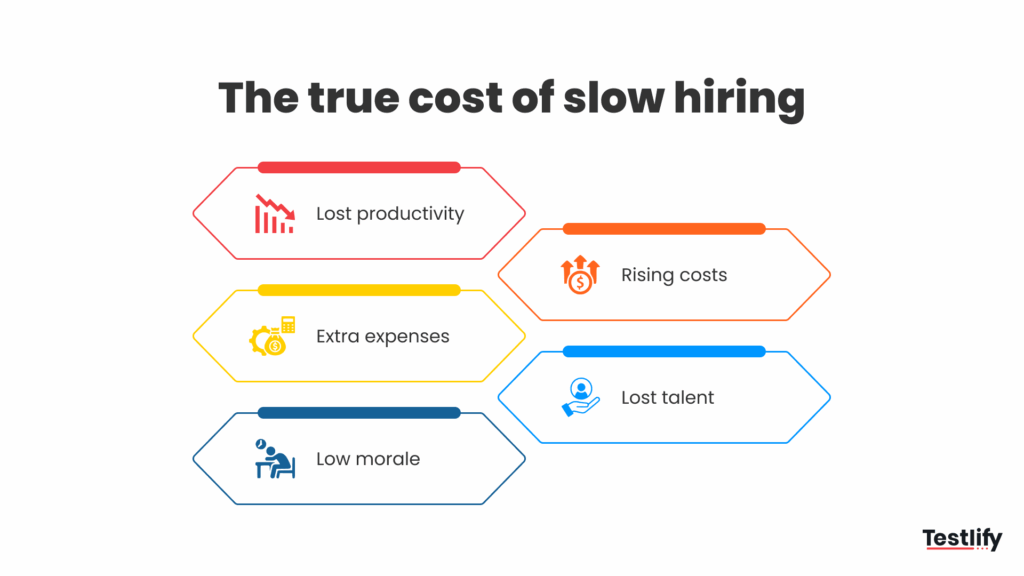
The hidden cost is morale. When one seat is empty, others on the team have to cover the extra work. Over time, this creates stress, errors, and burnout. Some employees may even quit, leaving you with more vacancies and even higher costs.

Why do hiring delays happen?
One big reason is the number of steps. Some companies add round after round of interviews. Indeed states that extra interviews rarely change the final decision. More steps add weeks to the process.
Another common delay is slow feedback. Candidates finish an interview, but managers don’t respond for days. If feedback takes longer than a week, drop-off rates spike. Waiting for approvals from multiple leaders can stretch timelines even further.
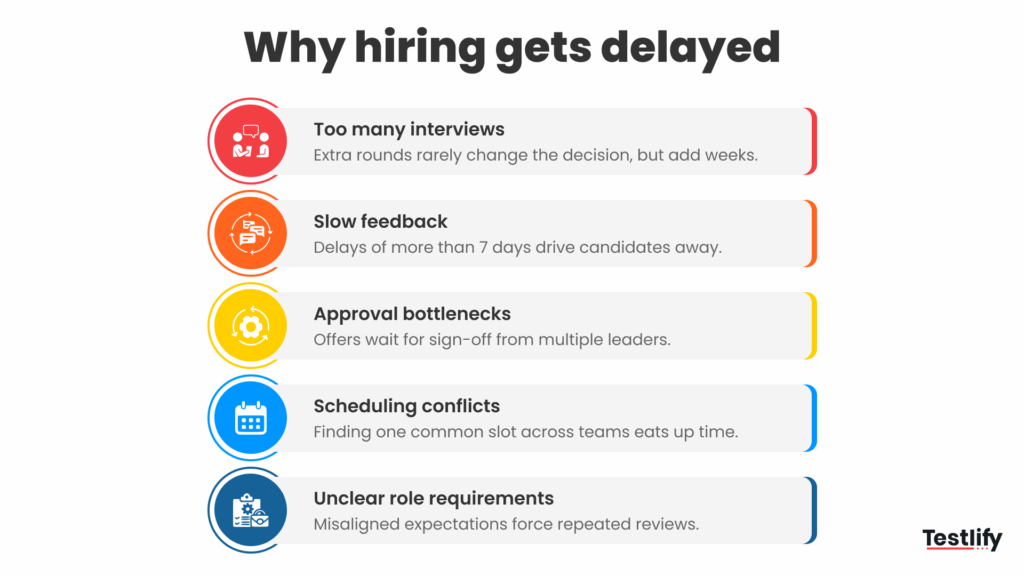
Scheduling is another bottleneck. Coordinating calendars across departments or time zones can take days. Without a scheduling tool, even finding one common slot for three people can drag things out.
Finally, unclear job requirements cause stalls. If recruiters and hiring managers aren’t aligned on what the role needs, they spend weeks revisiting applications and debating candidates. The longer the role stays open, the more costly it becomes.
Also try: Free job description generator | No sign-up required
What are the business risks of hiring too slowly?
A slow hiring process doesn’t just cost money. It exposes a business to risks that can harm growth, culture, and reputation.
1. Losing top talent to competitors
Skilled candidates often juggle multiple offers. Glassdoor reports that while the average U.S. hiring process takes 24 days, top talent is gone in about 10 days.
CypressHCM adds that nearly 25% of candidates accept another offer because the first company took too long. Slow hiring lets competitors win the best people.
2. Compromised hire quality
When strong candidates drop out, the hiring pool shrinks. Managers may feel forced to settle for a weaker match.
Long delays also frustrate candidates still in the funnel, so by the time an offer arrives, enthusiasm has faded. That weak start can affect performance and retention.
3. Strain on current employees
Vacant roles don’t remove the workload; they spread it. Staff covering gaps face heavier duties, longer hours, and more stress. CypressHCM notes this often causes declining morale and higher turnover.
Jobandtalent adds that critical projects stall and service quality dips when teams are stretched thin.
4. Operational and financial risks
Some positions are business-critical. A missing compliance officer can mean missed audits or fines. An empty sales role can mean lost revenue each week. These opportunity costs add up quickly and directly affect quarterly results.
5. Damage to employer brand
Candidates notice when a process drags. Long waits and poor communication create a poor impression.
Jobandtalent found that 72% of job seekers share negative hiring experiences, often on platforms like Glassdoor. That negative word of mouth discourages future applicants and poisons your talent pipeline.
6. Missed innovation and agility
In fast-moving industries, speed matters. Competitors who fill roles quickly can pivot, launch, or expand faster. If your team is understaffed, you risk falling behind on market opportunities.
What trends and compliance issues make speed critical?
The hiring market has changed. Skilled people have more options than ever, and they don’t wait long. But top candidates are often off the market in just a week or two. If your process is slow, faster companies will hire them first.
Candidates also expect the process to feel simple. They want to apply on their phone, pick interview slots quickly, and get updates without chasing recruiters. If your hiring process feels slow or outdated, they may lose interest and even leave negative reviews online.
Compliance adds another layer. In Europe, the GDPR requires employers to handle candidate data carefully. In U.S. education, FERPA protects student and applicant records.
And new rules like the EU AI Act will soon make many recruitment tools “high risk,” which means stricter checks for fairness and bias. Delays in handling data or paperwork can create legal risks.
Hiring across countries makes things more complicated. Different time zones, local laws, and onboarding steps can further stretch timelines. Without a clear and fast process, global hiring can stall before it even starts.
How Testlify helps hiring teams stay fast and fair
Vacant roles slow teams down. Interviews drag, candidates walk away, and compliance tasks pile up. Testlify helps recruiters cut those delays. It enables faster skill testing, simpler interviews, and built-in safeguards, so hiring stays quick and fair.
Feature | What it does | How it solves the slow hiring problem |
|---|---|---|
Covers technical, cognitive, and role-specific skills. | Helps recruiters spot job-fit candidates quickly without weeks of resume screening. | |
Adjusts difficulty, topics, and length to match each role. | Keeps candidates engaged and reduces drop-offs by making tests relevant and concise. | |
Candidates record answers to set questions on their own time. | Removes scheduling delays and gives recruiters structured insights into tone, clarity, and confidence. | |
Captures spoken answers for quick review. | Speeds up early-stage screening where communication matters without waiting for live calls. | |
Uses a webcam and a secondary camera to monitor test takers. | Ensures fairness and trust in results without slowing down reviews. | |
Keeps candidates from switching windows during a test. | Prevents cheating so recruiters can trust the scores at a glance. | |
Tracks if a candidate leaves the test screen. | Adds another layer of security, reducing time wasted on invalid results. | |
Stops candidates from pasting in outside answers. | Keeps tests reliable and saves recruiters from rechecking suspicious results. | |
Connects smoothly with common Applicant Tracking Systems. | Eliminates manual data entry, keeping hiring records and results synced in one place. | |
Uses consistent scoring models and automatic results. | Speeds up decisions and removes bias from manual reviews. | |
Candidate data is handled in accordance with strict privacy laws. | Let’s companies move fast without creating legal or compliance risks. | |
Works for small teams or large hiring pipelines. | Keeps processes quick and consistent, even as hiring needs grow. |
See it in action:
Final thoughts: faster hiring, better outcomes
When roles are filled quickly and fairly, teams stay focused, projects move on time, and candidates leave with a good impression of your brand. Hiring then becomes a driver of growth.
With Testlify, recruiters get speed without losing accuracy. From skill tests to proctoring and compliance, it keeps the process clear and efficient.
Book a demo to see how faster, fair hiring can support your team’s success.
For further reading, explore Cost Accountant, Real Estate Appraiser & Real Estate Broker.
Key takeaways
- A slow hiring process costs more than time. Every empty role means lost productivity and added strain on your team.
- The cost of slow hiring shows up in many ways: longer job ads, higher recruiter hours, and even overtime for current staff.
- Hiring delays make you lose good candidates. Many accept faster offers, leaving you with fewer and weaker options.
- Stretched teams burn out. Covering vacant roles leads to stress, mistakes, and even resignations.
- Platforms like Testlify cut wasted time with skill tests, video and audio interviews, proctoring, ATS integrations, and GDPR/FERPA compliance.
Frequently asked questions (FAQs)

B2B SaaS Content Writer
Rishav Kumar is a B2B SaaS content writer with 4 years of experience. He loves crafting engaging content. Always exploring fresh ideas, he's passionate about helping businesses grow through impactful writing.
LinkedInRelated resources
View all
Hiring Risks & Safeguards
Are traditional background checks enough for HR compliance?

Hiring Risks & Safeguards
Post-hire employee monitoring and behavioral analysis

Hiring Risks & Safeguards
How to prevent qualification fraud in hiring?

Hiring Risks & Safeguards
Candidate ghosting in recruitment: Solutions
Hiring Risks & Safeguards
Candidate dishonesty: Key red flags

Hiring Risks & Safeguards
Which HR training strategies stop recruitment fraud?
Get started.
Hire on proof, not resumes.
Run your first skills-based assessment free — no credit card required.