
Recruitment fraud: Everything you need to know
That dream job may be a scam. Learn how recruitment fraud works, the warning signs to spot, and how to protect your money and data.

Recruitment fraud happens when scammers pose as legitimate employers or recruiters to trick job seekers into sharing personal information, paying fake fees, or accepting fraudulent job offers. These scams often use stolen company names, fake job listings, convincing email addresses, and realistic interview processes to appear legitimate.
Knowing how recruitment fraud works can help you spot fake job offers before you lose money or expose sensitive information. This guide explains the most common recruitment scams, warning signs to watch for, and how to verify whether a recruiter, employer, or job offer is genuine.
 ChatGPT
 Gemini
 Claude
 Grok
Grok Perplexity
TL;DR
- Recruitment fraud is any use of false information, stolen identity, or fake credentials to secure a job, and it is rising with remote work and AI-assisted deception.
- The damage lands twice: direct financial loss (wasted spend, replacement costs, legal exposure) and brand damage (lost trust from customers, investors, and future candidates).
- High-trust sectors like healthcare, finance, IT, and education carry the steepest downside because a bad hire there risks safety, compliance, and data security, not just payroll.
- Background checks alone miss impostors. Layered identity verification plus a role-specific skills assessment before the offer catches most fraud early.
- Prevention is far cheaper than repair: confirming identity and ability up front costs a fraction of unwinding a completed hire, a lawsuit, or a public scandal.

What is recruitment fraud and why does it happen?
Recruitment fraud is when a candidate, or someone posing as one, uses false information, a stolen identity, or fake credentials to secure a job. It ranges from small resume exaggerations to organized identity schemes, and it is one of the most common hidden risks in hiring.
The scale is easy to underestimate. A SHRM analysis of hiring dishonesty found that 78% of candidates admit to misrepresenting themselves to employers, and 60% overstate skills they have only basic knowledge of. When most applicants shade the truth at least a little, telling ordinary embellishment apart from deliberate fraud becomes a core recruiting skill.
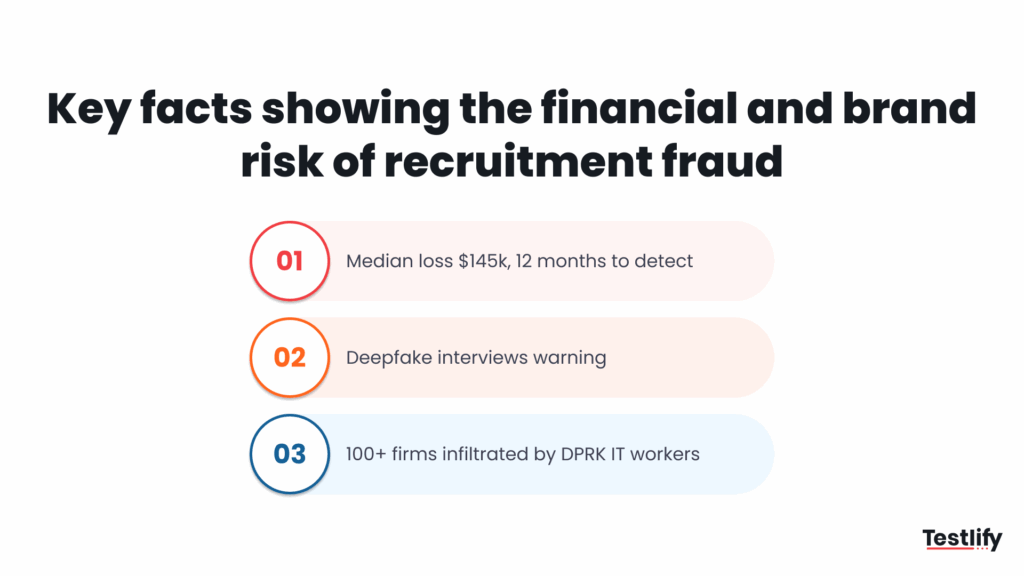
Why it is rising:
- Remote work: Employers rarely meet candidates in person, so fraudsters use the distance to hide who they really are.
- Skill shortages: In-demand roles across IT, healthcare, and finance push companies to move fast, and speed often means skipping thorough checks.
- Weak verification: Many teams rely only on background checks or paperwork, which confirm documents but not the living person behind an AI-generated resume or a borrowed ID.
How does recruitment fraud affect companies and their reputation?
Recruitment fraud primarily targets job seekers, but companies whose names are misused can also face financial, reputational, and security consequences. When scammers impersonate a legitimate employer or recruiter, victims often associate the fraudulent experience with the real company.
Reputational damage
A recruitment scam can damage trust long after the fraudulent job posting or message disappears. Job seekers who believe they were scammed by a company may share their experience online, leave negative reviews, or warn others, making it harder for the real employer to attract candidates and protect its brand.
Financial and operational costs
Companies may need to investigate fraudulent job postings, respond to affected job seekers, remove fake listings, and involve legal or cybersecurity teams. In large-scale cases, the time and resources required to manage the incident can create significant operational costs.
Data and cybersecurity risks
Scammers may misuse a company's name, employee identities, logos, or email domains to make fake job offers appear legitimate. They may also create spoofed websites or impersonate recruiters, creating phishing and cybersecurity risks for both job seekers and the company.
Loss of candidate trust
Recruitment fraud can make genuine candidates suspicious of legitimate job opportunities. When fake offers circulate using a company's name, candidates may hesitate to apply, share personal information, or respond to real recruiters. Clear application channels and an official careers page can help candidates verify genuine opportunities.
Risk category | Examples | Estimated impact |
|---|---|---|
Direct costs | Recruitment ads, recruiter fees, onboarding, training | Thousands of dollars per hire |
Replacement costs | Restarting the search after fraud is exposed | Double spend for one role |
Fraud schemes | Payroll theft, asset misuse, corruption | $3.1B across 1,921 cases; ~12 months to detect (ACFE 2024) |
Legal and compliance | Hiring without right-to-work, regulatory fines, lawsuits | Unlimited fines; up to 5 years prison in the UK |
Operational disruption | Lost productivity, project delays, reputational fallout | Hard to measure, often larger than direct costs |
Which industries face the highest fraud risk?
Recruitment fraud is not spread evenly. Sectors that hold public trust, sensitive data, or large sums of money carry the steepest downside when an impostor gets through.
Industry | Fraud risk example | Impact | Lesson learned |
|---|---|---|---|
Healthcare | Fake doctors or nurses with forged licenses | Patient safety, lawsuits, permanent brand loss | Verify medical licenses with official registries |
Finance | Unqualified hires handling funds or data | Compliance failures, regulatory fines | Pair background checks with real skill assessments |
IT and tech | Fraudulent engineers with system access | Data theft, IP leaks, cyber breaches | Use identity checks and limit access during probation |
Education | Fake teaching credentials | Loss of trust, accreditation risk | Confirm academic certificates with issuing institutions |
Financial services deserve a closer look, because the fraud risk compounds. A single bad hire there can expose an institution to regulatory penalties, reputational damage, and direct financial loss at the same time, which is why the sector layers identity verification on top of skill checks rather than choosing one.
What are the red flags recruiters should watch for?
Fraud usually slips in through small details that do not add up. Recruiters who know the warning signs can stop a problem before it grows into a hire.
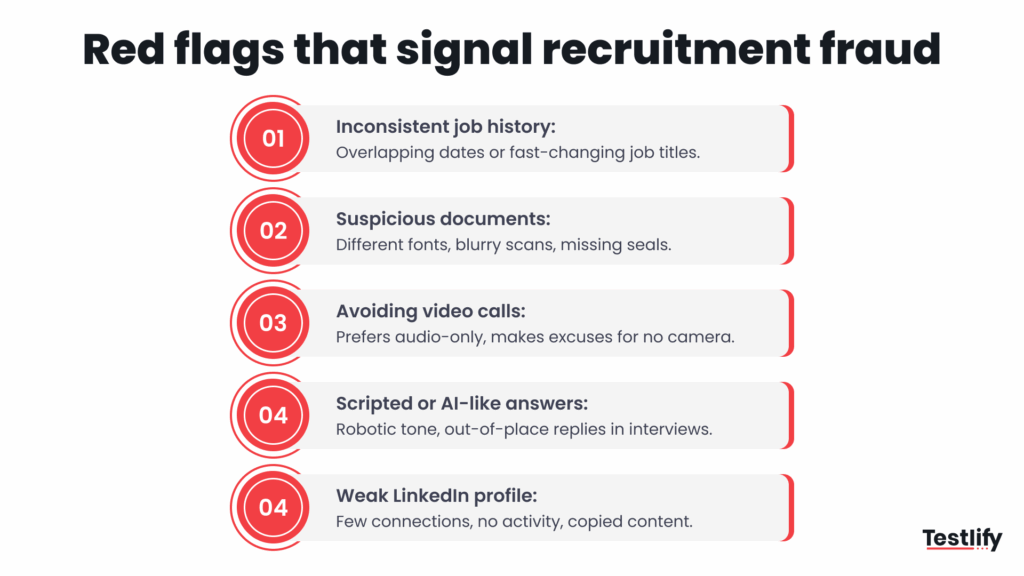
- Inconsistent job history: Overlapping dates or titles that change too often can hide gaps or inflated experience. A quick call to a past employer clears it up.
- Suspicious documents:Resumes or certificates with mismatched fonts, blurry logos, or missing seals deserve a second look against official samples.
- Avoiding video calls: Candidates who insist on audio only may be hiding their identity. An AI video interview with an ID check is the fastest way to confirm who is on the other end.
- Scripted or AI-like answers: Responses that sound over-polished or fall apart under follow-up can signal AI-generated text or a coached stand-in. Situational questions expose it.
- Weak online presence: A profile with no activity, few connections, or copied details is worth a closer check. Real professionals usually leave some trace of past work.
One red flag rarely proves fraud. Several together are a strong signal that deeper checks, such as identity verification and a skills assessment, are needed before moving forward.
How can you prevent recruitment fraud?
Recruitment fraud drops sharply when companies combine strong checks with evidence-based assessment. The goal is not to add friction. It is to make sure the person in the interview is the same one who shows up for work, and that they can actually do the job.
This is where the Testlify Assessment Integrity Framework fits. It protects the validity of an evaluation through identity checks, proctoring controls, AI-assistance detection, and reviewable evidence, while keeping the final decision human-led. Applied to fraud prevention, it means every candidate proves both who they are and what they can do before they reach an offer, so an impostor has to defeat several independent signals rather than one weak paperwork check.
Layer your checks
Background checks confirm documents, not the real person. Adding ID validation, biometric checks, and device or IP signals makes fraud much harder to pull off. For higher-risk roles, run these checks before the final interview, not after the offer.
Train recruiters to spot the signals
Recruiters who know the red flags catch more fraud. Mismatched dates, poor-quality certificates, or a candidate dodging video are often enough to trigger a deeper review. Small details, caught early, save large costs later.
Verify continuously, not just once
Fraud does not end at the offer. Checks during probation and before granting access to sensitive systems protect against impostors who slip past the first round. Access should expand as trust is earned, not on day one.
Prove skills with assessments
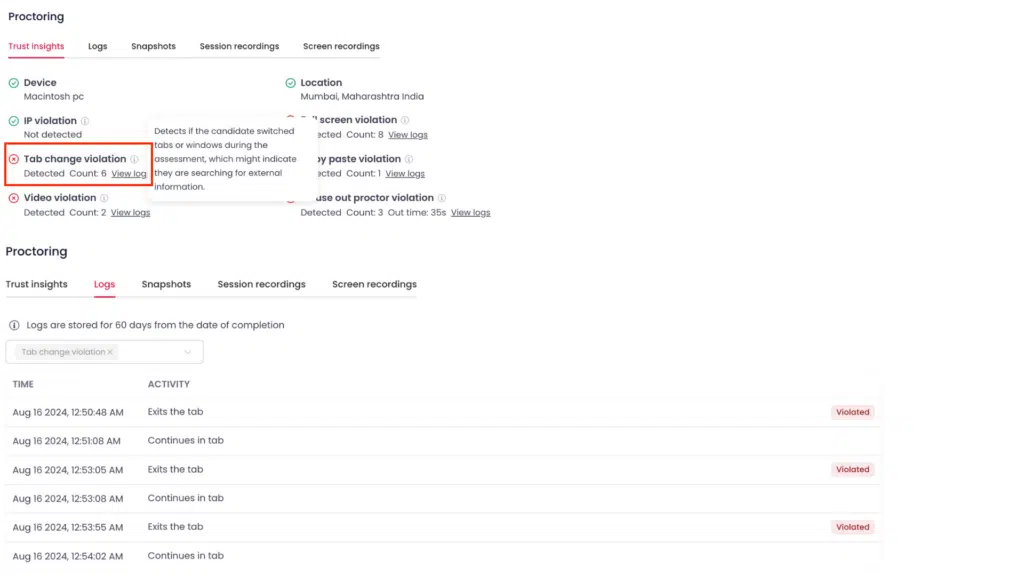
The surest way to confirm ability is to test it directly. Teams use platforms like Testlify to run role-based skills tests early, so a candidate proves capability before the first interview rather than claiming it on paper. AI-powered video and audio interviews add signal on tone and clarity, and built-in proctoring, including live environment scans, tab monitoring, and copy-paste blocking, makes cheating harder, all handled with GDPR and FERPA compliance.
Explore more:how proctored exams work and the proctoring features that matter.
A worked example
Picture a 400-person fintech scaling its engineering team by roughly 25 hires a quarter. Under deadline pressure, it fast-tracks a remote contractor who interviews well on audio only. If that contractor is working under a borrowed identity and gains access to production systems, the company is not just out one salary. It faces a possible data-breach disclosure, a regulatory review, and the customer churn that follows a headline. Now run the same hire through an identity check and a role-specific coding assessment before any system access is granted. The impostor either fails the skills evidence or refuses the verified video step, and the risk is contained at the assessment stage, where it costs the least. This scenario is illustrative, but the sequence, verify identity, prove skills, then grant access, is exactly how high-risk teams close the gap.
Pro Tip: Run identity verification and a role-specific skills assessment before the final interview, not after the offer. Catching an impostor at the assessment stage costs a fraction of unwinding a completed hire, and it keeps the fraud out of your systems entirely.
Building fraud-resistant hiring practices with Testlify
Recruitment fraud creates two kinds of damage. The first is financial: wasted recruitment spend, replacement costs, and schemes that run for months. The second is reputational: lost trust from customers, investors, and future candidates. Both can weaken a business for years when left unchecked.
The good news is that prevention beats repair by a wide margin. Companies that layer their checks, train recruiters to read the signals, and verify skills directly catch fraud early, usually at the assessment stage, before it reaches payroll or production. Confirming identity and ability before someone joins is far cheaper and safer than untangling a lawsuit or a brand crisis afterward.
The best way to understand fraud-resistant hiring is to see it work on your own roles. See how evidence-based screening closes fraud gaps and book a demo with Testlify.
Key Takeaways
- Fraud hits twice, so plan for both. Recruitment fraud drains money and reputation at the same time. Budgeting only for the wasted salary understates the risk, because the reputational and regulatory fallout often costs more and lasts longer. Treat it as a business-continuity issue, not just a hiring hiccup.
- Documents are not identity. Background checks confirm paperwork, not the living person behind an AI-generated resume. Because impostors now use deepfakes and stolen data, identity verification has to be a distinct, deliberate step, or the whole funnel inherits that blind spot.
- High-trust sectors need the most layers. In healthcare, finance, IT, and education, a fraudulent hire threatens safety, compliance, and data, not just cost. These teams should combine identity checks, skills proof, and staged system access rather than relying on any single control.
- Catch it at the assessment stage. The cheapest place to stop fraud is before the final interview. A role-specific skills assessment plus a verified video step forces an impostor to defeat several signals at once, which most cannot, so the risk never reaches your systems.
- Verification is continuous, not a one-time gate. Fraud does not end at the offer. Re-checks during probation and least-privilege access before someone touches sensitive systems protect against anyone who slips past the first round.
- Prevention is the cheaper investment. Confirming who a candidate is and what they can do up front costs a fraction of a lawsuit, a breach disclosure, or a public scandal. The return on a stronger front door shows up as risk that never materializes.
Frequently asked questions (FAQs)

B2B SaaS Content Writer
Rishav Kumar is a B2B SaaS content writer with 4 years of experience. He loves crafting engaging content. Always exploring fresh ideas, he's passionate about helping businesses grow through impactful writing.
LinkedInRelated resources
View all
Hiring Risks & Safeguards
How to handle fake certificates in recruitment?

Hiring Risks & Safeguards
Are background checks enough to stop employment fraud?

Hiring Risks & Safeguards
How to prevent impostors in video interviews?

Hiring Risks & Safeguards
Resume Fraud Verification: How to Detect Fake Resumes Before the First Interview (2026)

Hiring Risks & Safeguards
How to stop cheating in online tests?
Hiring Risks & Safeguards
How do platforms handle GDPR compliance for candidate data?
Get started.
Hire on proof, not resumes.
Run your first skills-based assessment free — no credit card required.